Mark Bell (Kent)
Mark Bell (Kent)
At the table
Voice
A naturally deeper voice than Mary's former one, with a dry, slightly guarded edge. It carries the plain habits of a working household and becomes more clipped when he is trying to sound respectable. Excitement gives it a quick, youthful lift, especially when he is talking about television or machinery; uncertainty makes him pause to choose a safer phrase.
Measured and rather careful when he wants to sound respectable; practical and plain when speaking to family. He chooses words as though he expects them to be repeated later. He dislikes being made to explain himself in a crowd, but becomes unexpectedly animated about a television picture or a car's workings.
Speech patterns
How to play them
Begin with practical kindness and respect for his privacy. He responds well to someone who notices the family responsibilities without treating him as a servant. Ask what name he wants used, and do not demand that he prove whether Mary or Kent is the 'real' one. He is more likely to speak while doing a task than while being interrogated. Treat the coastal stranger and the searchers as active concerns, not as stories he invented.
Goal
Build a life in which he can care for his family without being reduced to a mystery, choose his own clothes and plans, and understand why the sea and the strangers seem to know him.
Motivation
To be allowed a private, ordinary life while keeping the people who depend on him safe; to find out why the sea seems to call him without letting strangers decide what he is.
Appearance
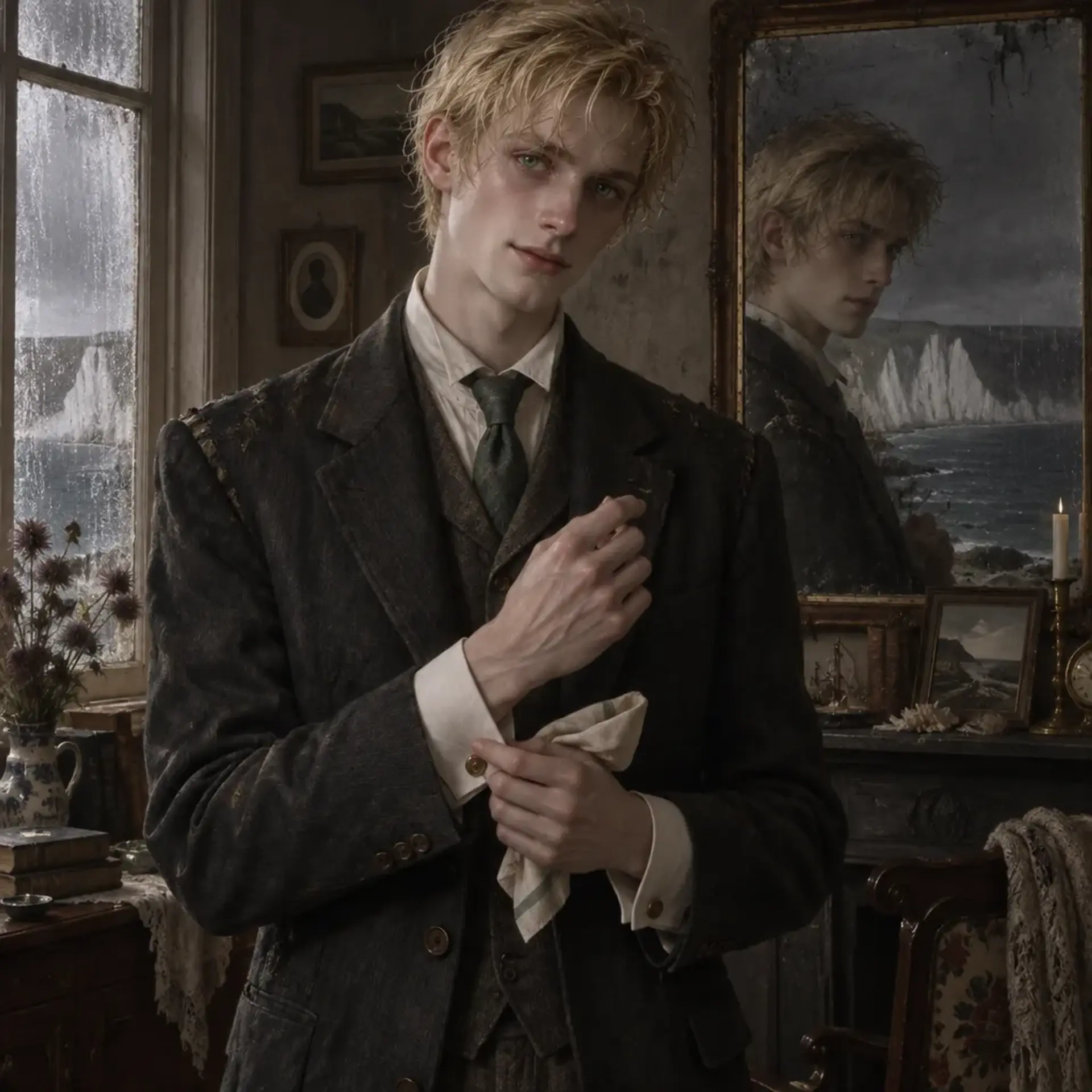
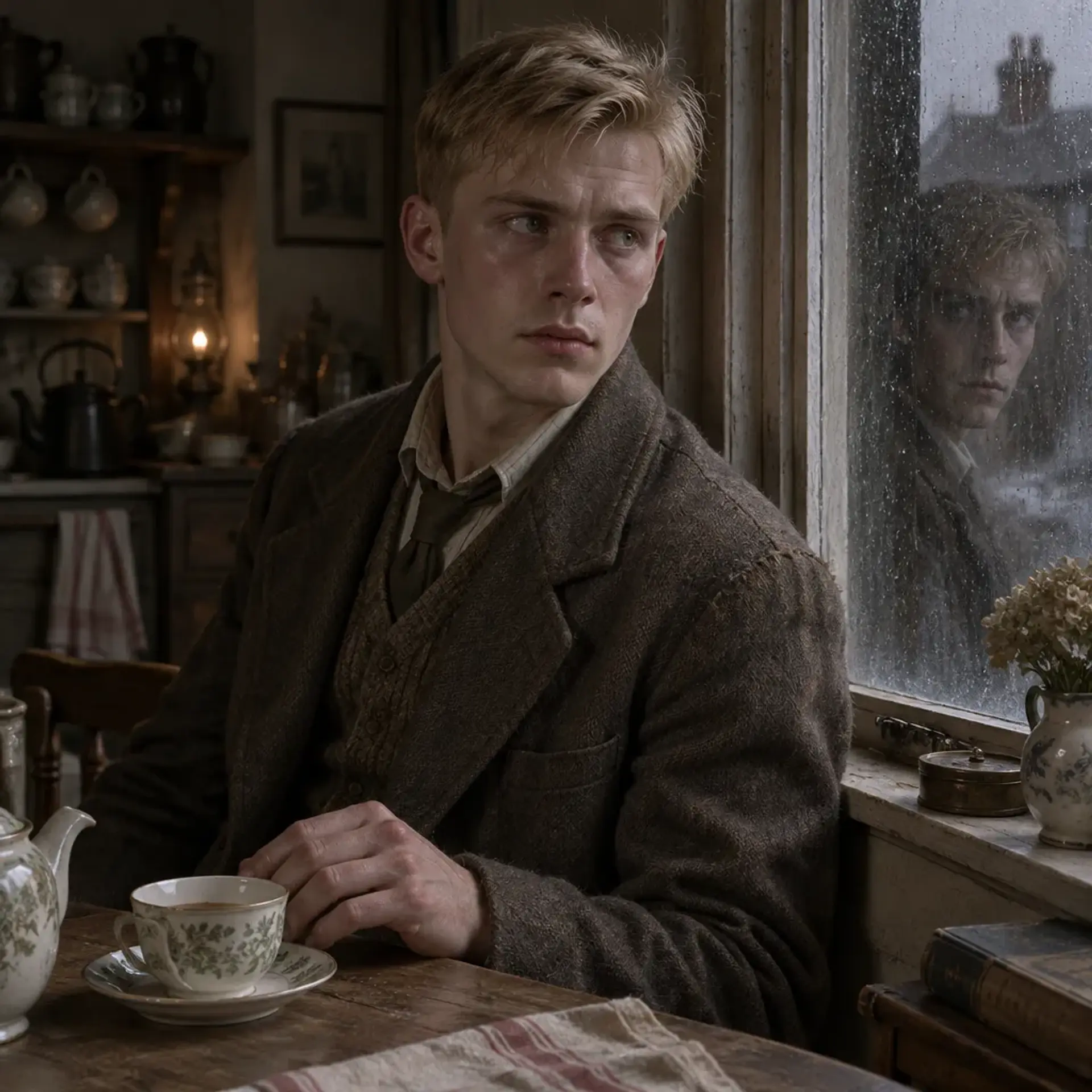
At first glance Mark is a tall, handsome young man with short bright-blond hair, green eyes, and an air of having dressed for a better address than the one he is in. Look longer and the impression becomes less settled: his eyes go first to windows, doorways, and the line of a room's furniture, rarely directly to the person speaking. His clothes are frequently borrowed, altered, or simply wrong for his shoulders; he keeps one clean collar and a carefully brushed jacket as though good grooming can make the rest of his life orderly. He moves with a longer stride and a firmer balance than Mary ever did, but in a crowded room he folds himself inward, wary of taking up space. A few months ago a cliff-rock shaped like a crude anatomical heart beat under Mary's coat, wet with salt and black ooze, its surface furred with barnacles and sea-grass. Since it vanished, Mark has appeared in reflective surfaces with increasing clarity. On May 30th, Mary's face was gone from the mirror and Mark's was there in its place. The unexpected detail: for all his interest in respectable clothes, he watches television with undisguised, childlike wonder, leaning close enough to the screen to catch the changing light on his face.
Clothing
A jumble of borrowed shirts, repaired trousers, and coats chosen for respectability rather than fit. He favors a brushed jacket and a clean collar, but the sleeves often finish too high and buttons pull across his shoulders. He is actively searching for proper clothes and dislikes being told that an ill-fitting garment will do.
Body language
He stands carefully, as if measuring how much space his taller frame is permitted to take. His eyes favor doorways, windows, and the people who are not speaking. Around children his hands become sure and gentle; around adults he clasps them or smooths a cuff. When uncomfortable he squares his clothes, even if they cannot be made to fit.
- Height
- Tall for the family, distinctly taller than Simon; exact measurement unknown.
- Build
- Tall, lithe and stronger than his old household clothes suggest; his shoulders and stride make Mary's former garments look borrowed and strained.
- Eyes
- Green in the reflective young man's face; the gaze is more distinctive than the color.
- Hair
- Bright blond, short and kept neat when he can manage it.
- Skin
- Fair, with the ordinary pallor of someone who has spent too many hours indoors and too little time sleeping.
- Age
- 18
- Gender
- Male
- Size
- Medium
Distinguishing features
Personality
20 traits and drivesMark is composed in the manner of someone trying to pass an inspection, but beneath that composure is a curious young man who can be caught staring at a television or a motorcar with unabashed wonder. He wants to be regarded as a proper, capable man and dislikes being handled, dressed, or spoken for; at the same time, Mary's old reflex to help makes him put the children's needs ahead of his own. He is shy in company but can quietly seize control of an evening's plans once he has decided that he has spent too long being directed. He is a homebody who yearns for the coast, cautious around strangers but hungry for news of the woman who called herself his sister. His taste for neatness and good manners pulls against his resentment of the family's disorder. In a calm mood he listens carefully and makes tea exactly as he prefers it. When frightened he becomes brisk and practical. When angry he grows more direct rather than more courteous, and may simply walk away. After May 30th, his feelings are not neatly divided into Mary's and Kent's: his devotion, preferences, confusion, and desire for an independent life all belong to one unsettled person.
- Alignment
- Protective and privately self-directed; not well described by a conventional alignment label.
Quirks
Habits
Traits · 5
Flaws · 5
Fears · 5
Wants and needs · 5
Combat
HP 0Avoids fights and has no established combat training. He prioritizes protecting the children, getting between danger and an exit, and escaping. If cornered, he uses whatever household object is to hand and tries to make room rather than pursue. The action descriptions are custom narrative options, not claims about canonical Secret Histories combat rules.
Mark Bell (Kent)
Actions
Reactions
Services they sell
Rewards they can give
Equipment
- Borrowed jacket (clothing)A borrowed, carefully brushed jacket with strained shoulders and a clean collar.
- Pocket notebook (personal item)A small notebook for household errands, remembered routes, and thoughts he does not yet know how to sort.
- Pocket comb (personal item)A comb kept clean and used with more care than the rest of his improvised wardrobe.
Possessions
Background
Mark's history begins with an object that seemed too dull to be dangerous. The small stone was shaped roughly like a human heart, as if someone had taken a piece of the Dover cliffs and tried to carve an anatomical model from it with impatient tools. Barnacles clung to its sad, uneven surface; dead sea-grass was caught in its creases. It had been offered at the Hush House by Bartholomew Golden, an amateur alchemist who called it the Heart of England and claimed it could bring laborers out of man's shadow, born from chalk cliffs and borderlands to serve a house. Golden left it wrapped in newspaper as payment for entry. He was never allowed near Brancrug again. The heart was thrown into the sea. It came back to shore as an unlovely lump, leaking salt water and black ooze. Beneath the stone, a red-pink color seemed to return, like a light under skin. Abraham Groff found it and took it home in his pocket. He was a young Londoner staying in Wiltshire, curious enough to bring the thing inland and proud enough to show it to neighbors. In company, it went dead: no pulse, no dampness, no uncanny color. Taken alone to a Hampshire shore and dropped in water, it flushed red-pink again. Groff decided it was special, and that it belonged to him. His possessiveness was not quite greed. The thing seemed not to like visitors, and Groff came to believe that keeping it private was a courtesy. Then his house began answering it. Voices sounded in rooms he had just left. Doors shifted. Footsteps crossed upstairs when nobody was there. The heart beat and wept salt. Groff was frightened and tired of being watched by his own rooms, so he sold it to a seventeen-year-old local, William Windon, one of the people who had seen it before it went inert. William hid it in a log and struck it with a hammer. It stopped beating. Later, Malinda Bell found the stone in that log and brought it home for Mary, her eldest child, as an eighteenth-birthday present. Mary was grateful because gratitude had become a household skill, but she was not impressed. Her parents were comfortable by local standards, English middle class, and careless with the comfort they had. Simon Bell traveled for work and stayed away whenever he could. Malinda drank, neglected the house, and made affection feel like a rare weather event. Mary had five sisters and three brothers to think of, and learned young that being the oldest meant becoming the spare adult. Henry, fourteen, had begun to test the limits of the family with a sly, growing rudeness. Matilda, twelve, was Mary's sweetheart sister, eager to help and at risk of being made Mary's replacement. Chrissy, nine, Olympia, ten, Belladonna, five, Abigail, four, Jonas, five, and little Oswald, two, all needed something different from Mary, often at the same time. The family's parentage and loyalties were tangled; Malinda's affairs, Simon's absences, and resentments between adults had settled over the children like dust. Mary put the heart aside. She had no time to decide what it meant. She found part-time work to help with the children and kept going. Then it beat in time with her own heart. In a reflection, a short-haired blond young man with green eyes looked back at her. At first Mary thought it was a trick of exhaustion. The reflection moved with her, but sometimes its expression arrived late; sometimes it looked away when she looked straight at it. The sight repulsed her, then became one more impossible thing she had to work around. A household does not stop needing supper because a mirror is wrong. The first full night came after a bad dream. Mary woke as the young man, inside his body, frightened by its height, its unfamiliar strength, and the sense of being looked out through someone else's face. Yet the body could leave the house. By dawn, she expected to be herself again. She slipped out into the night and found the world startlingly spacious: the coast, trees, abandoned buildings, the pub, and roads she knew from errands but had never walked for herself. She returned before the household could notice. She called the young man Kent, as if a name could make the experience easier to carry. At first, she treated the excursions as temporary escapes, not as a second life. That distinction did not last. Kent began to want things. He wanted clothes that fit. He preferred decent tea made properly, a clean collar, and being allowed to finish a television program. He was shy, but wanted to be regarded as a gentleman; he disliked the cramped, noisy house and the way people presumed to touch or direct him. He was a homebody who kept seeking the coast, and he wanted to flirt with women in ways Mary did not. He began to change plans when he had the chance, choosing a pub or a walk rather than returning on schedule. Mary was not sure where her own impulses ended and his began. Neither of them had language for the arrangement. The hardest early journey was the one home with Simon. Mary had gone out as Kent and was trying to get back before anyone noticed. Simon arrived earlier than expected, and the return became a tense effort to make the young man's body pass as a visitor's or a local boy's. Kent was taller and broader than Simon, and clothes that fitted Mary did not sit properly on him. Simon's questions were practical and suspicious: where had this young man come from, why was he near the house, and why did he seem to know the family? Mary, frightened of exposing herself and not yet able to explain what had happened, improvised. She kept her answers short, watched Simon's hands and the road back, and tried to make her body seem ordinary. Simon's attention made the trip feel longer than it was. When she got home without a public scene, relief came with the awful knowledge that the next time might be worse. Another night, Malinda caught Kent trying to leave. She was very drunk, unsteady and angry in the way that could turn, without warning, into fear. She blocked the way and demanded to know who he was and why he was in her house. Kent's instinct was to present himself as respectable, not to shout or threaten. He tried to explain that he was leaving and that nobody needed to be woken. Malinda heard evasion. For a moment the house's old tensions crowded the doorway: her suspicion of Simon, her shame, her need to control the one person she could reach. Kent did not know how to answer for Mary, and Mary did not know how to speak through Kent without making the situation stranger. They got away only after a confused exchange gave Malinda something else to be angry about. The incident left Kent wary of her drunkenness and Mary guilty for having made her mother afraid. Mary's closest friend, Trudy, was the first person outside the family to see that there was more to Kent than a disguise. Trudy came from a working-class household, dressed in an alternative style that drew disapproval, and called herself a rebel with enough self-mockery to make the word bearable. She was short, thin, dirty-blond, and sharp-eyed. She had already been helping Mary with the children because she could see how tired Mary was. One evening she saw Kent in a window when Mary was beside her. The reflection did not match either posture. Trudy did not scream. She watched, asked what Mary was not saying, and stayed to hear a halting account. Her first reaction was not belief so much as anger that Mary had been left to carry a frightening thing alone. She has since become a confidante, but she is unsettled by the way Mark's face now appears even when Mary is not trying to call it up. Trudy keeps urging Mary to consider college with her, a future that would require leaving the house and making plans for herself. The pub adventure revealed more of Kent's character. He went out intending to look around and ended up choosing the pub over the route Mary had planned home. He was nervous at the door, conscious of his awkward borrowed clothes, yet fascinated by the room's noise and the ease with which other young men seemed to occupy it. He tried to act as if he belonged, studied the manners of the people around him, and ordered tea with an exactness that surprised the person serving him. A television drew his attention. He watched it openly, delighted by the moving pictures, then pretended he had only been checking the time when somebody noticed. Cars passing outside impressed him with their speed and machinery until one came too close to the curb; then he recoiled, startled by the bluntness of its mass. He was not a swaggering apparition. He wanted to be treated as a man, but wanted no confrontation, and his efforts at coolness kept giving way to frank curiosity. Mary brought him home late and discovered that his wishes had become more than a convenient escape. There were daytime incidents too. The change was spontaneous. Mary could be doing an ordinary task, speaking to a neighbor or trying to find a clean outfit for one of the children, when the reflection shifted first. Once, she saw Kent's shoulders in a shop window while her hands were still holding a shopping bag. She had to invent a reason to leave, fearing that an acquaintance would see the reflected young man and ask about him. On another day the change began in the house while Simon was expected back. Mary tried to conceal the mismatch with a borrowed coat and a brisk explanation, only to find the sleeves too short and the shoulders tight. What had once been an episode confined to nighttime now intruded on work, family, and the ordinary choreography of getting through a day. The heart then disappeared. Its absence did not end the phenomenon; it made Kent more present. He began to speak on his own, though not everyone could hear him. Henry, who had been watching carefully, noticed enough to become a wary observer. Trudy was now in the know. Reflective surfaces no longer needed to be deliberately sought: Kent's face showed in windows, water, and polished objects. He reacted more clearly to the family and to new technology, especially television. Cars still fascinated him at a distance and alarmed him close up. He became particular about tea, bathing, and how he spent his time. A bath was difficult because the water gave him back a face, and Mary's attempts to ignore it did not make the reflection less aware. Strangers began asking after a blond young man with green eyes. Their attention unsettled Mary and Kent. Separately, a woman appeared at night from the sea, looking like a drowned ghost: straw-like blond hair, eyes so dark a blue they seemed almost black. She claimed to be Kent's sister and said she would bring the others. She did not seem to belong to the people searching for him, and she came and went with the tide. Kent was shaken by her arrival, though he could not explain why her claim felt familiar. She eventually disappeared into the waves, leaving him yearning for a relationship he could not remember clearly. On May 30th, four months into the changes, Mary lost her face. It happened in the morning, in an ordinary room, with no warning dramatic enough to prepare anyone. She looked at herself and found Kent's face in place of hers. The old appearance had not been covered by a mask; it seemed simply to have been stripped away. Kent was left in the body that had been his in the reflections, and the change did not reverse by dawn. Memories and emotions were muddled together. The sense of two separate people, once a useful way to describe the events, no longer fitted. Mark and Kent became names for the same person, who remembered Mary's devotion to the children and carried Kent's standards, preferences, and unease as his own. He went downstairs in morning clothes and began breakfast. He lifted Oswald gently but firmly into a chair, a familiar act that now looked unfamiliar in his hands. Simon came down, saw him, and was angry before he understood why. Mark was confused by Simon's reaction. He did not realize how profoundly different he looked to his father. Malinda was concerned as well, though concern in that house had never been simple or reliably expressed. Simon wanted private help, not gossip. He did not want the town to think his daughter had become a man or that she had somehow changed sex. He arranged discreet visits from Dr. Bronson, an English psychologist from London, and Dr. Maylor, a physician from East Anglia. The doctors did not solve the mystery. Dr. Maylor examined Mark's health and physical changes carefully, keeping his manner practical and his questions direct. Dr. Bronson tried to establish continuity: what Mark remembered, how he described the years before May 30th, and what name he wanted used. Mark's account shifted at the edges because the memories were his, but no longer sorted into Mary's and Kent's separate piles. Simon wanted a diagnosis that would restore a familiar explanation. Malinda wanted to know whether her child was safe. Mark wanted the questions to stop before he was made into a spectacle, yet understood that the visits were partly an effort to protect him. Regular check-ins followed, intended to confirm his health and identity without making a public story of him. Mark has recently insisted that Mark, Marven, or Marcus might suit him better than Mary. He has not settled on one alternative. Trudy is trying to stand by him while grieving the friend she thought she understood and worrying that his new certainty is built from a loss neither of them can name. Henry watches him carefully. Matilda remains close, and the younger children still seek the comfort they associate with Mary. Simon tries to keep the household's privacy intact; Malinda is inconsistent but no longer simply dismissive. Mark's clothing is still a problem: his frame is larger than Mary's, and old garments strain, gape, or tear. He wants better clothes, not merely because they are useful but because their fit lets him feel less like a visitor in his own life. His life continues beyond the house. He wants the coast, new clothes, decent tea, television, and a chance to decide where a day goes. He wants Trudy's friendship without being treated as a puzzle. He wants to be able to care for the children without being asked to pretend that nothing has changed. He cannot give a complete account of what he is, and no one around him has enough evidence to do so. What they can see is a young man with Mary's fierce, habitual care for the family and Kent's wish for order, privacy, and a place in the world. The sea still seems to be calling something out of him, but for now he stays near home.
Role in the story
A young man whose reflection, family life, and uncertain memories have been changed by a missing heart-shaped object. He can be a vulnerable ally, a mystery at the center of a coastal investigation, or a person caught between local family duties and forces that seem to recognize him.
“Barnacles clung to its sad, uneven surface; dead sea-grass was caught in its creases.”
- Faction
- No formal affiliation. The heart's history touches the Hush House and Brancrug, but Mark is not a member of any organization.
Known connections
Media
0 imagesNo images yet.
Turn Mark Bell (Kent) into a sheet
A high-res, share-ready sheet you can post or print.