Kent
Kent
At the table
Voice
Kent's voice comes from a larger chest and throat than Mary's, with a dry, slightly rough edge that suggests salt air and tiredness. His work around the house has given him a habit of speaking over clatter without raising his voice much. The sound is not naturally commanding; it becomes firm when he is protecting a child or insisting that he be addressed as himself.
Kent's speech is shaped by a borrowed English middle-class sensibility: careful diction, measured sentences, and a tendency to sound more formal when uncertain. He does not sing or perform a regional accent. His vocabulary is sometimes older or oddly local, especially when he talks about roads, boundaries, or the coast. He can be blunt when frustrated, and his voice carries a bodily depth Mary does not recognize as hers.
Speech patterns
How to play them
Offer practical help and speak to Kent directly rather than treating him as a trick or a diagnosis. Respect his wish to choose a name, but do not assume that Mary has vanished. Trudy can help establish trust. Mentioning the missing heart or the sea may provoke interest and fear in equal measure.
Goal
Secure a private, respectable life and clothing that fits, discover what the missing heart made possible, and find out whether the woman from the sea is truly his sister without putting Mary's family in danger.
Motivation
To be recognized as a person with preferences and a future, while protecting the family whose memories and obligations he has inherited.
Appearance
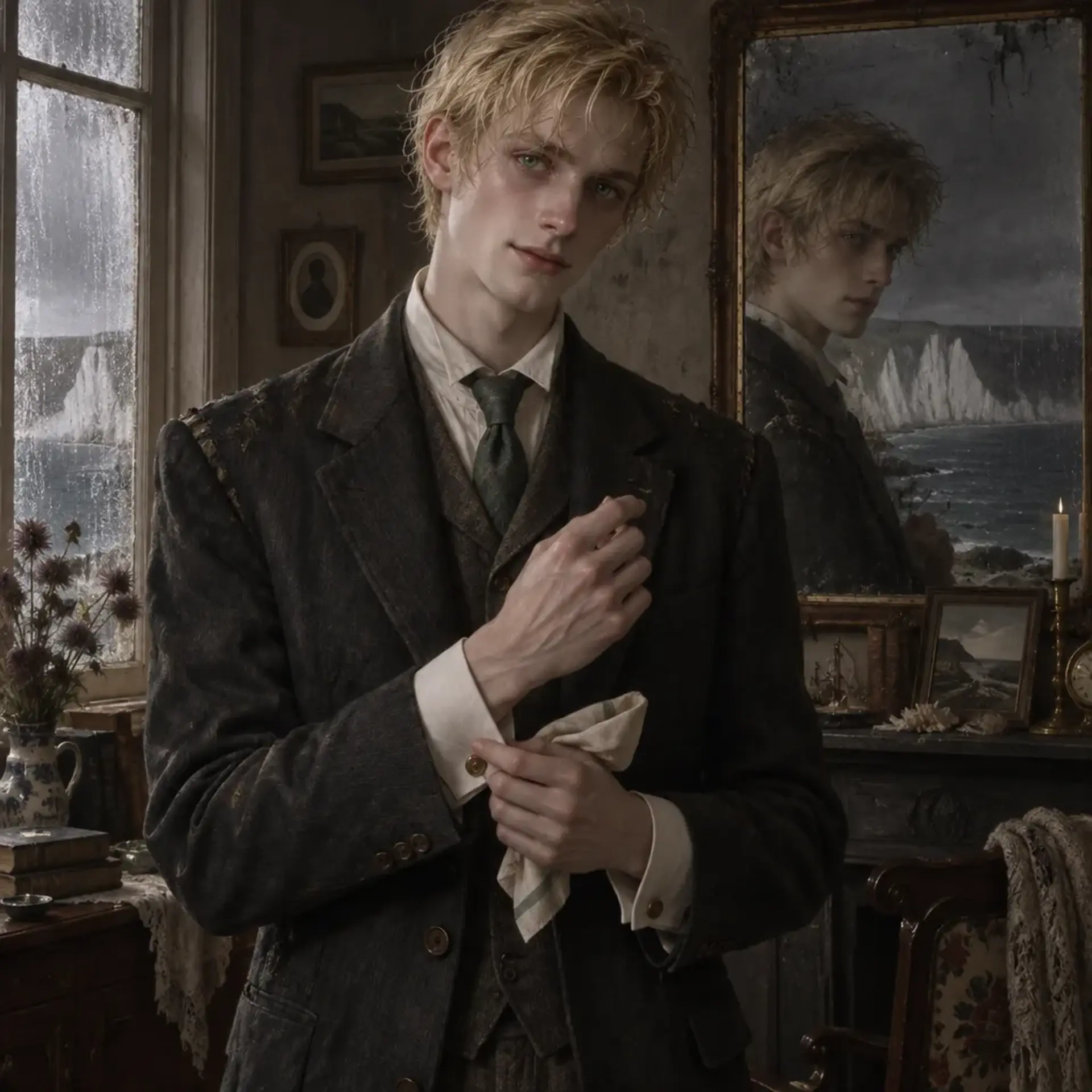
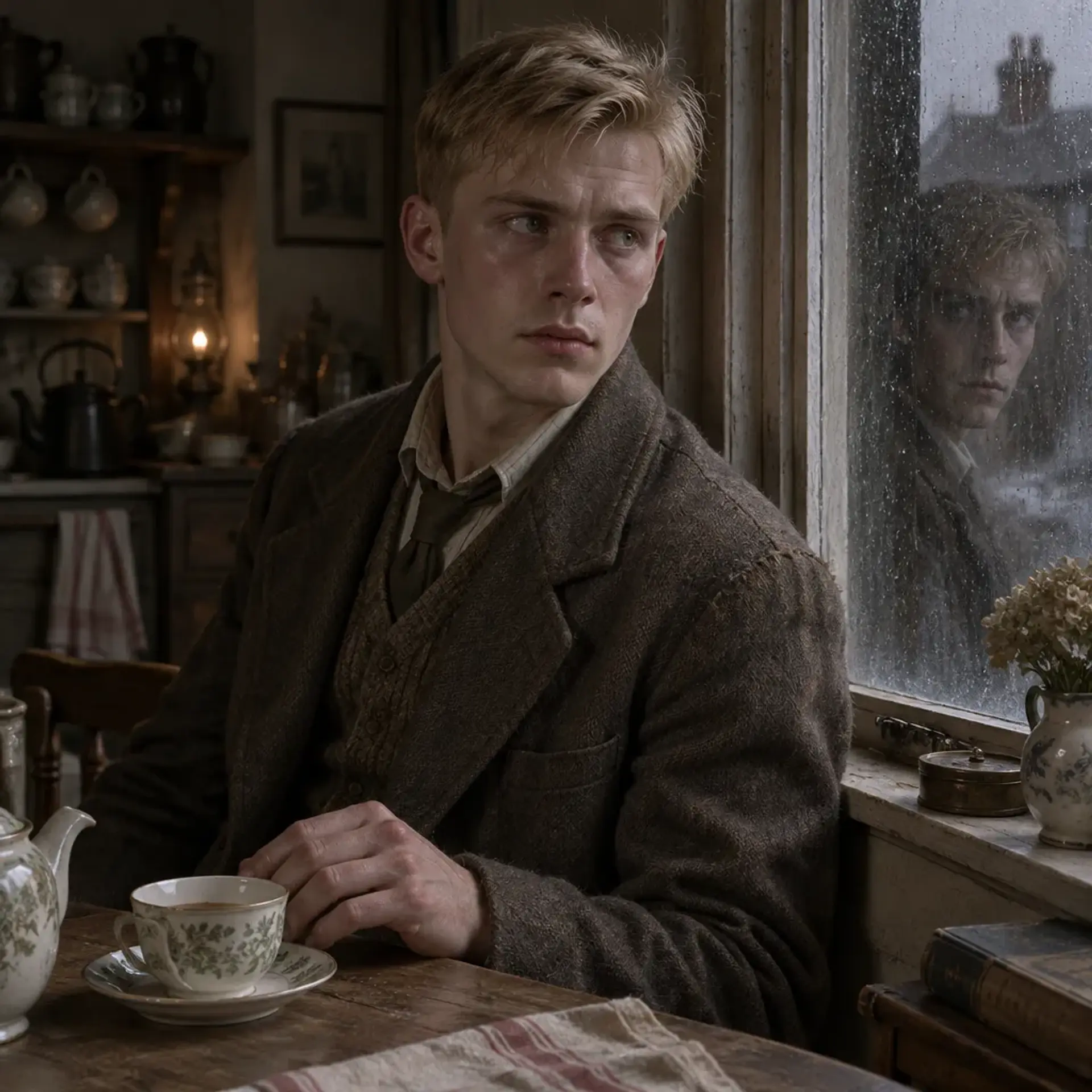
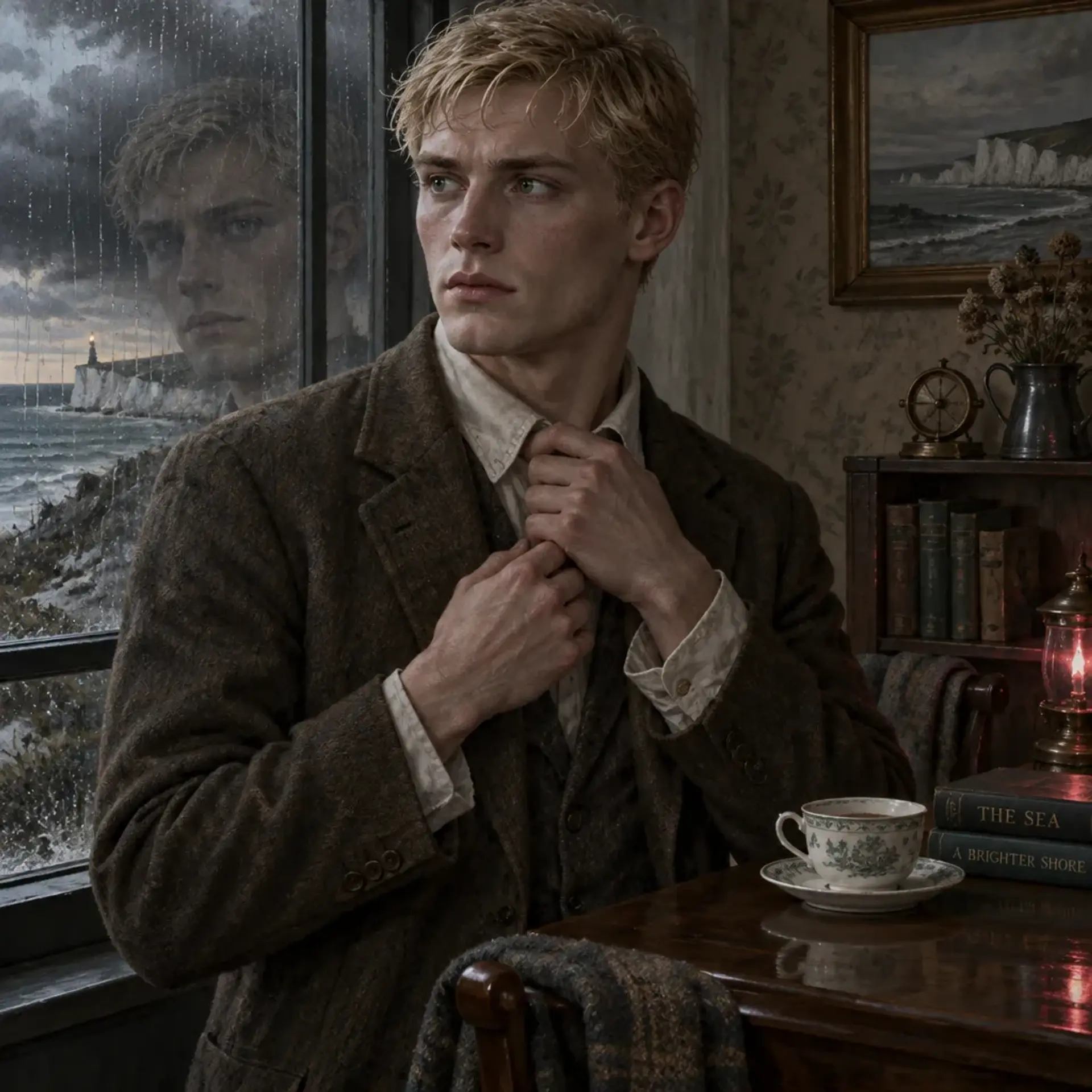
Kent appears as a handsome young man with short, bright blond hair, malachite-green eyes, and a face that seems almost too composed when seen in a reflection. He is taller than Simon and has a lithe but solid frame, broad enough through the shoulders that Mary's clothes pull tight or split at the seams when he takes her body. His skin has the underfed pallor of a person who has spent too many days indoors, but at the hairline and knuckles it carries a faint weather-roughened texture, like skin repeatedly dried by salt wind. He moves with an alert, careful economy, as if used to narrow lanes and sudden traffic; when startled, he looks first for an exit. The surprising detail is that, despite his county-bound strangeness, he is captivated by modern cars and television pictures, watching them with a child's frank wonder until a car comes too close. Since the heart vanished, Kent's face can appear in windows, water, polished cutlery, and dark glass even when no one stands before them.
Clothing
Practical, borrowed clothes that often do not fit. Kent is searching for respectable young men's clothing and prefers clean collars, sturdy shoes, and muted colors. Mary has to improvise when a change occurs in clothes cut for her smaller body.
Body language
Kent holds himself upright and watches people as if trying to determine the correct social distance. His shoulders tighten when someone calls him Mary, and his hands go to his cuffs or collar when his clothes fit badly. In mirrors he sometimes turns his head toward the reflected figure before he realizes he has done so.
- Height
- Taller than Simon Bell; approximately 5 feet 10 inches when fully manifested
- Build
- Lithe but strong, taller and broader than Mary's undernourished frame.
- Eyes
- Malachite green
- Hair
- Bright blond
- Skin
- Pale, with a faint salt-weathered roughness at the hairline and knuckles
- Age
- 18
- Gender
- Male
- Size
- Medium
Distinguishing features
Personality
20 traits and drivesKent is shy but proud, domestic but restless when confined, and desirous of respect while uncertain what respect should look like. He wants to appear high-class and composed, yet his curiosity about television and cars is immediate and unguarded. He can be gentle with the children, especially when carrying Oswald or helping Matilda, and coldly formal with adults who treat him as an embarrassment. When alone, he prefers tea, orderly surroundings, and a quiet evening indoors. When he feels trapped in Mary's body, he grows irritable and may seize control of an outing or choose a destination Mary would never have chosen. His interest in women is real to him and unwanted by Mary, a source of shame, anger, and conflict rather than a simple joke. He is protective of the family but has begun forming judgments about them: he recognizes Simon's fear as love mixed with cowardice, sees Malinda's care as inconsistent, admires Matilda's efforts, and distrusts Henry's watchfulness. The memories and emotions are becoming entangled. Kent can no longer reliably tell whether a feeling belongs to him, to Mary, or to both.
Quirks
Habits
Traits · 5
Flaws · 5
Fears · 5
Wants and needs · 5
Combat
HP 0Avoids violence. If trapped, Kent uses his greater reach to shove past an opponent, grab a door or railing, and escape. He has no formal combat training or canonical combat statistics.
Kent
Actions
Reactions
Services they sell
Equipment
- The missing heart (occult object)The small heart-shaped stone is missing. It was rough like Dover chalk, crusted with barnacles and sea grass, and sometimes showed a red-pink light beneath its surface.
- Borrowed clothes (clothing)A small collection of ill-fitting clothes accumulated during the transformations; Kent is trying to replace them with proper men's clothing.
- Household purse (personal effects)Kept by the family for the children's needs and occasionally carried by Mary or Kent on errands.
Possessions
Background
Kent's story begins with a stone that looked too ordinary to deserve a story. The small, crudely carved object had the shape of an anatomical heart, its surface like a piece of Dover cliff. Barnacles and sea grass clung to it. Under the rock, after it returned from the water, a red-pink glow seemed to pulse. Bartholomew Golden, an amateur alchemist, had once presented it at Hush House as a supposedly fossilized living heart, payment for entry. He claimed it could bring servants from man's shadow, from the hearts of chalk cliffs and borderlands, born to labor for a house. He was never allowed near Brancrug again. The heart was thrown into the sea; later it washed ashore, wet with salt water and black ooze. Abraham Groff, a young Londoner, picked it up and carried it home to Wiltshire. It beat beneath his coat during the train journey. At first the thing repulsed him. Then it fascinated him. He showed it to neighbors, and in their presence the heart appeared dead. Alone with it, he found it responsive, especially near water. When he carried it to a Hampshire shore and dipped it in the sea, the red-pink color returned. He concluded that the heart was special and, because it seemed to dislike visitors as much as he did, kept it from other people. The house filled with footsteps, voices, doors moving on their own, and sounds in the stairs. Abraham could not live with it. He sold it to a seventeen-year-old local, William Windon, one of the people who had seen the object before it went still. William hid it in a log and struck it with a hammer. The heart stopped beating. The object passed through hands and time before Malinda Bell found it in a log and brought it home to Rochester, Kent, as a present for Mary on her eighteenth birthday. Mary was the oldest of eight children, but the household treated childhood as a luxury none of them could afford. Simon Bell was often away taking work wherever he could find it. Malinda drank too much and fought with him. The family had enough money to be called middle class, yet neglect made the house feel pinched and chaotic. Mary tried to keep the younger children fed, clean, and out of trouble while taking whatever schooling and part-time work she could manage. She loved Matilda, twelve, and kept her from being turned into a replacement servant. She tried to make time for little Oswald, who followed her with his blanket, and for Abigail, two years older and proud of her red hair. Henry, fourteen, had begun to grow cunning and resentful. Chrissy, Olympia, Belladonna, and Jonas each carried their own parentage and place in the household's unresolved arguments. Mary did not have time to untangle any of it. She was not impressed by the gift, but she knew her mother had made an effort. She hid the heart rather than call it jewelry. It began to beat in time with her own. At first she thought this was an odd trick of pulse and attention. Then her reflection stopped being hers. A young man looked back: short bright blond hair, green eyes, a handsome face, a taller body. Mary thought it was a horrible joke and tried to ignore it. She was tired, busy, and practical enough to put fear behind chores. The first night she became Kent began with a bad dream and ended with Mary waking in a stranger's body. The house had gone still except for the pipes and the wind worrying at the window. Her hands were larger; her nightclothes hung wrong; her voice, when she tested it, came from deeper in her chest. The mirror showed the same green-eyed young man who had been watching her for weeks. Terror made her sit on the floor until the shock passed. Then she realized the body could leave the house. She dressed in clothes that could pass in the dark, slipped down the stairs, and went out before dawn. Her first adventure was not heroic. She walked the streets, climbed a tree behind an empty building, and explored a boarded-up place that smelled of wet plaster and old coal. The world looked newly available, though she could not have explained why. She found the shore and touched the heart to seawater; the stone warmed and showed its red-pink color. By morning she was Mary again, with salt on her cuffs and no convincing explanation. She treated the change as an escape hatch, not a second life. Kent's preferences were not Mary's. He liked orderly rooms, well-made clothes, tea prepared just so, and the restrained manners he associated with respectable middle-class life. He was shy, wanted to be regarded as high-class, and was more of a homebody than Mary. He disliked being made to wear feminine clothes and resented the constraints of Mary's body. He was interested in women in a way Mary was not. At first these were urges and tastes that Mary could treat as a disturbing mood. Over time Kent grew more definite. When he got out, he sometimes changed Mary's plans without asking: a walk became a visit to a pub, an errand became a search for decent men's clothes, a quiet outing became an attempt to meet women. Mary found this increasingly frightening and irritating. One early attempt to return home nearly exposed everything. Simon came back unexpectedly while Mary was out as Kent. She recognized his car and ducked down a side street, but he saw her and called after her. She had to answer as Kent, using the young man's voice and a hurried explanation about being lost. Simon was polite but suspicious. He offered to walk her toward the main road. Every step home felt like a trap: Mary knew the house, but Kent's appearance made her a stranger in her own neighborhood. She gave Simon a false name, then froze when he asked where she was staying. At last she claimed she had relatives nearby and fled through an alley. She spent the remaining dark hours under a railway arch, ashamed that she had been afraid of her own father and furious that she had no safe way to explain herself. Another time, Malinda caught her trying to leave as Kent. Malinda was drunk, and the hour was late. She had heard a door and followed Mary downstairs, then found a tall young man in the hall. For a long moment neither spoke. Malinda's confusion hardened into anger; she demanded to know who he was and what he was doing in her house. Mary tried to answer without revealing herself, but Kent's voice came out too naturally. Malinda grabbed for his sleeve. Mary pulled away, knocking a chair into the wall. The crash woke the children. Matilda appeared on the stairs, frightened and ready to defend Mary from a stranger. Mary could not say, 'It's me.' She managed to convince Malinda that she had let a local boy in through the back door, an explanation that made Malinda angrier but gave Mary time to get out. The next day Malinda remembered pieces of the confrontation and asked Mary whether she had been hiding a boyfriend. Mary lied. The lie lodged between them. Mary's friend Trudy noticed what the family did not. Trudy was short, skinny, dirty blond, hazel-eyed, and proudly called herself a rebel. Her clothes were alternative by the standards of the period, and her working-class family had taught her to recognize exhaustion in people who tried to hide it. She helped Mary with the children and pushed her to consider college. One evening she saw Kent watching Mary through a shop window when Mary stood several paces away. Trudy turned to look at the young man, then back at Mary. Kent's expression was not Mary's. Trudy followed them to a quiet street and asked directly who he was. Mary tried to evade the question, but Kent's reflection continued to move when Mary held still. Trudy did not run. She offered to help find clothes that fit and asked Mary to tell her when it happened again. This was the first time Mary had an ally who knew enough to be useful. The pub adventure confirmed that Kent had his own ideas. Mary had meant to walk along the river and go home. Kent steered her instead to a pub, drawn by warm light, conversation, and the promise of being treated as a young man. He chose a table near the wall, ordered tea first, then a drink after deciding that refusing would seem childish. He watched people more than he spoke, correcting Mary's posture in his head and bristling whenever someone looked at him too long. A woman at the bar smiled at him. Kent wanted to approach her. Mary did not. He did so anyway, awkwardly, with a stiffness that made him seem proud rather than confident. When a man made a crude joke, Kent answered with a sharp, carefully phrased insult that sounded borrowed from an older and better-dressed world. The room went quiet. He left before the situation turned into a fight, but the choice had been his. Mary remembered the evening as a betrayal; Kent remembered it as the first time he had been allowed to make a decision. A daytime change made their private arrangement harder to deny. Mary was at work when a reflective window showed Kent's face over her shoulder. She felt the shift in her balance before she understood it. Her work clothes pulled tight, her voice changed, and a customer stared. She escaped to a back room and waited, but Kent's body did not immediately give way to hers. Later, Henry saw the change and watched carefully. He had been suspicious for some time. He did not immediately tell the adults, perhaps because he wanted to understand the advantage before deciding what to do with it. From then on, Mary knew the change could happen without night, privacy, or warning. Everything worsened after the heart disappeared. Its absence did not end Kent; it made him more alive. He began speaking without Mary's permission, though other people often heard only Mary talking to herself. He formed opinions about the family and reacted to new technologies with open curiosity. Cars amazed him until they came too near, when his fear was sudden and physical. Television pictures held him still. He became particular about tea and how it was made. Bathing became difficult because water showed him clearly, and Mary tried to ignore the discomfort of being watched from her own reflection. Windows and polished objects began reflecting Kent even when Mary was alone. His clothes became a practical problem: his frame was larger, and a rushed change could tear her blouse or split a skirt. Strangers began asking after a blond young man with green eyes. Their interest unsettled both Mary and Kent. A separate figure began appearing at night by the water: a woman with straw-like hair and eyes near black, as if she had drowned and brought the sea's darkness with her. She claimed to be Kent's sister, called for him, and said she would bring the others. She did not seem to belong to the searchers. Kent wanted to answer her, but Mary feared what answering might invite. The woman eventually vanished into the waves, leaving Kent yearning for her and unable to say whether she was kin, memory, or something else. Four months after the changes began, on May 30, Mary's face was gone. It was not a wound. The old appearance simply seemed to have been shed, as though it had been a skin that no longer fit. She woke as Kent and remained Kent. His memories and Mary's were tangled together; their feelings had become difficult to separate. He could say 'I' and mean either of them. He sometimes spoke of himself as Mary, then corrected himself, then stopped correcting himself at all. He began asking to be called Mark, Marven, or Marcus, but had not chosen one name firmly enough to make it stick. That morning he came downstairs in clothes that fit and started breakfast. He carried little Oswald to a chair, gentle but firm, and set out food without thinking to ask whether the family would accept it. Simon came down ready for work and stopped. His concern was real, but so was his fear of what the neighbors would say. He saw a young man where his daughter should be and could not make the facts sit together. Malinda was sober enough to be frightened. The younger children gathered in the doorway. Matilda tried to reach for him; Henry watched his face; Abigail hid behind a chair. Kent was confused by their reactions. He had not understood how profoundly different he looked. Simon arranged private visits to keep the matter from becoming public. Dr Bronson, an English psychologist from London, came first. He asked questions about names, memory, time, and the sensation of the transformations. He did not accept a simple supernatural account, but neither did he treat Kent's distress as a performance. He asked Simon and Malinda to describe Mary before the changes and asked Kent to describe himself without prompting. Kent answered plainly that he was not sure where Mary ended. Dr Bronson recommended regular check-ins and separate conversations with the family, especially the children. His careful manner helped, though his questions left Kent feeling examined as if he were an unreliable witness in his own house. Dr Maylor, a physician from East Anglia, examined Kent next. Simon wanted a physical explanation and wanted privacy more than anything. Dr Maylor checked Kent's general health, listened to his lungs and heart, asked about food and sleep, and documented the change in build and appearance without pretending to have a ready explanation. He was cautious about conclusions. Kent disliked being handled and disliked even more being referred to as a young woman in old notes. The doctors arranged recurring private appointments to confirm his health and identity, while Simon tried to prevent gossip. Kent came to tolerate the visits but insisted on answering for himself. Now, Kent lives in Mary's home as both its helper and its disturbance. He is protective of the younger children, especially Matilda and Oswald, but his patience is not inexhaustible. He is increasingly frustrated when confined to Mary's body and increasingly independent when he can act. Trudy understands that something has changed but is lost about what Kent has become. Henry watches. Simon fears scandal and fears for his daughter. Malinda's concern competes with shame and denial. Kent wants proper clothes, privacy, respect, and a life with choices. Mary, whose memories and habits remain in him, wants her siblings safe and misses a self she can no longer locate. The heart's disappearance has not freed either of them. It has made their shared life more vivid, more public, and less possible to control.
Role in the story
A central mystery and uneasy ally whose growing independence forces the family and the player characters to confront identity, consent, class, and the hidden history of places.
“The small, crudely carved object had the shape of an anatomical heart, its surface like a piece of Dover cliff.”
- Faction
- No known faction. Kent's connection to the heart and to county-shaped memories has attracted unknown searchers.
Known connections
Media
0 imagesNo images yet.
Turn Kent into a sheet
A high-res, share-ready sheet you can post or print.