Kent
Kent
At the table
Voice
Kent's voice comes from a larger chest than Mary's and carries a slightly rough, breath-warmed texture, as if used to speaking into cold coastal air. Its careful enunciation reflects his wish to sound respectable, not any formal education he can claim. Mary's voice is quicker and often dry from long days talking over children and work. When their memories blur, either voice may use the other's habitual phrase without noticing.
Mary's speech is quick and practical, shaped by giving instructions over household noise and making herself understood without wasting time. Kent speaks from a different body: his voice is naturally deeper, with a steadier, more formal cadence that sounds borrowed from an idea of respectable English masculinity. The Heart, the sea, and the strain of sharing memories give both voices an occasional catch, as though a word has arrived from a room farther down the hall.
Speech patterns
How to play them
Approach Mary with practical help, privacy, and respect for her responsibilities. Speak to Kent as a person, but do not assume he has the right to make choices for Mary. Ask which of them is present and what each wants before offering intimacy, medical treatment, or a risky plan. Trudy is a valuable ally, but do not make her responsible for solving the situation.
Goal
Find the missing Heart or learn why its disappearance made Kent more independent, while securing a life and clothes of his own without destroying Mary's remaining ties to her family.
Motivation
Mary wants her siblings safe and a future beyond unpaid care. Kent wants recognition as a man, a better wardrobe, and the freedom to act on his own preferences. Both want to understand the Heart without becoming the object of someone else's experiment.
Appearance
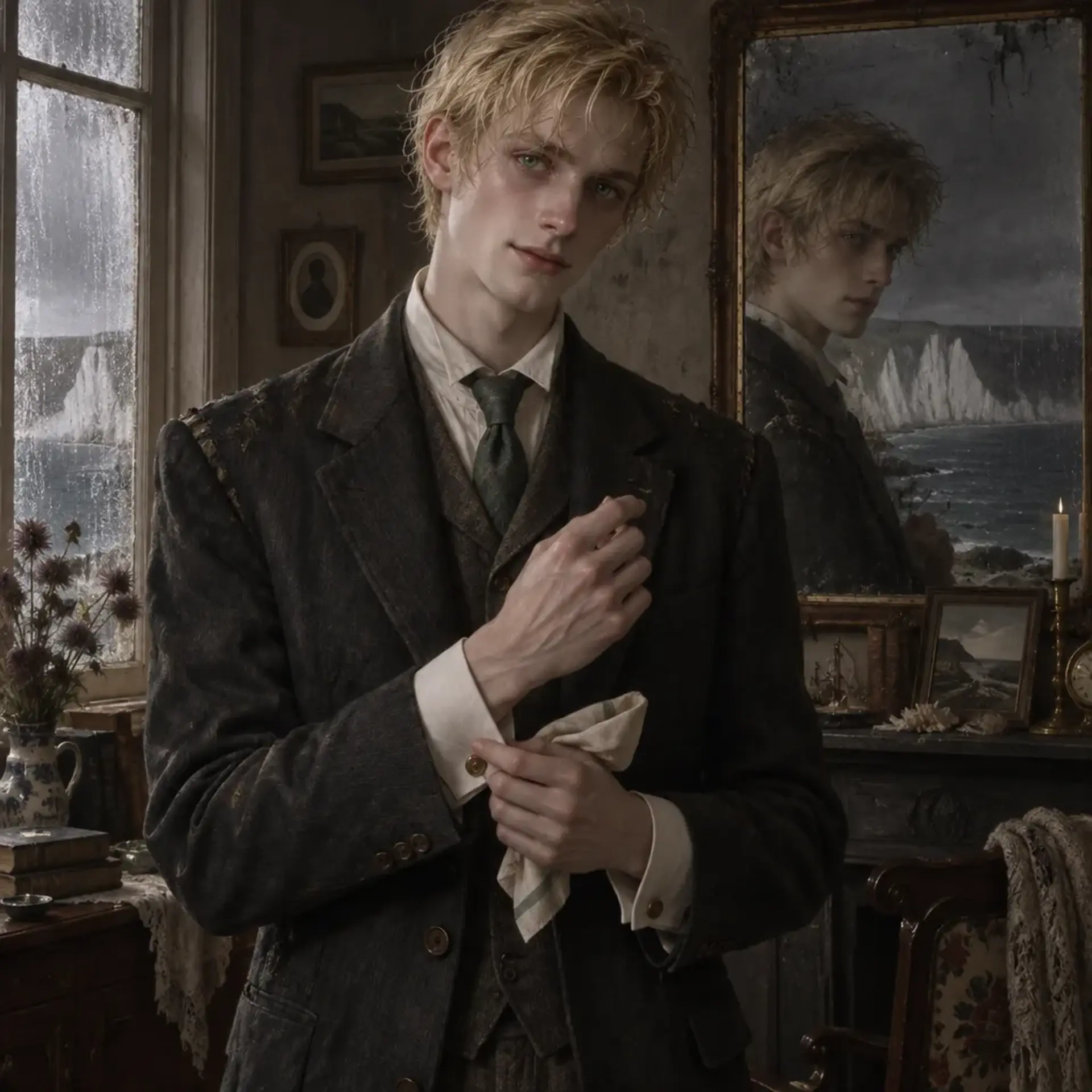
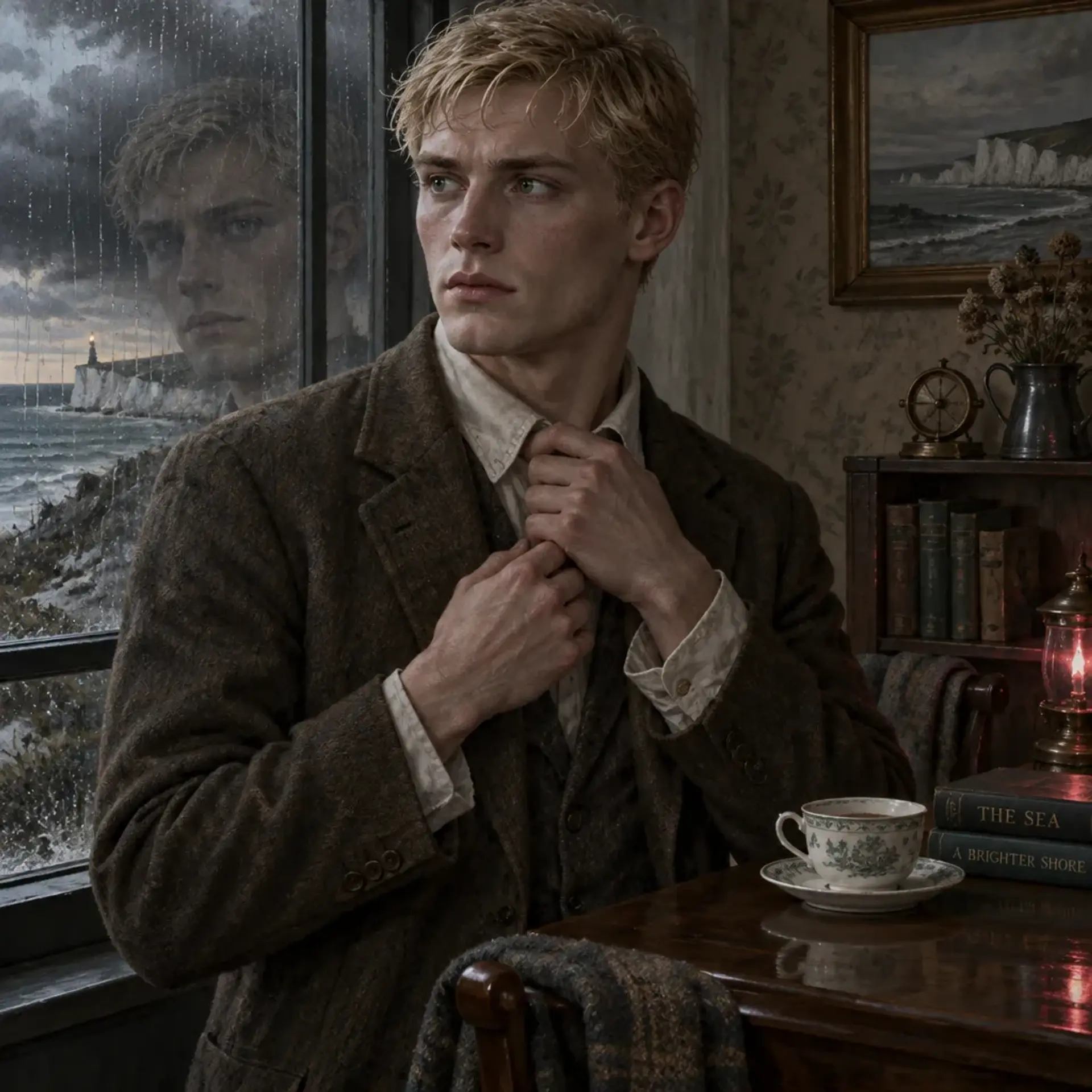
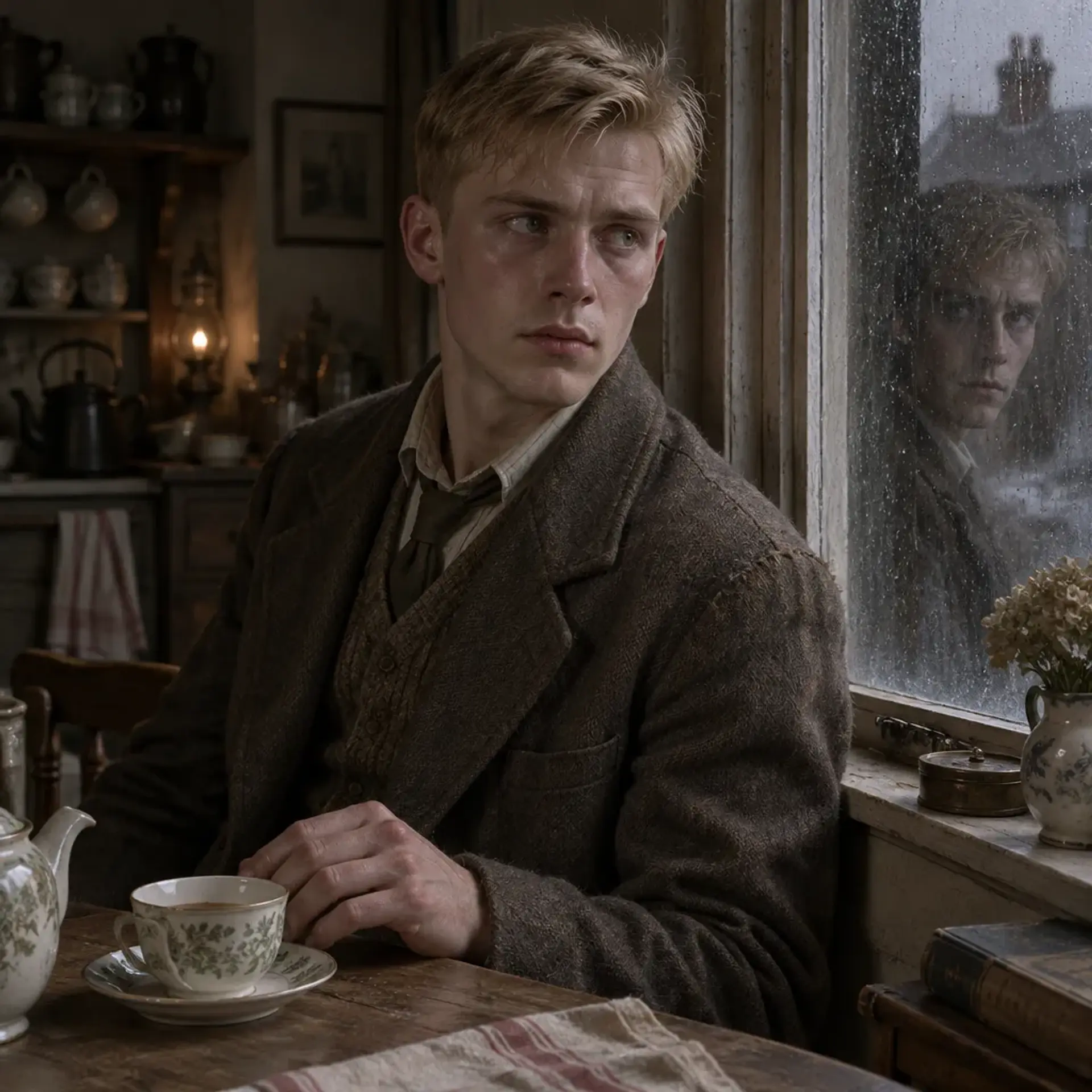
Kent appears as a handsome young man of eighteen, taller and broader than Mary, with a lithe, strong frame that makes her old dresses pull at the shoulders and split at the seams. His short fair-blond hair lies neatly when combed but springs up at the crown; his green eyes have a wet malachite gleam, as if something deep and tidal shifts behind them. His face is clean-lined, composed, and conspicuously not Mary's. His skin carries the pale, faintly wind-chapped look of someone who belongs near the coast, though he has no ordinary childhood of outdoor labor to explain it. When he moves, he seems to test each room before entering it, shoulders angled as though making room for an invisible companion. A detail at odds with his masculine self-presentation: he is fascinated by the exact arrangement of household tea things and can become absorbed in the pattern of cups and saucers. His presence leaves the impression of a well-mannered stranger who has arrived from a colder, older shore.
Clothing
Kent wants well-made men's clothes suited to his height and shoulders. He currently relies on borrowed garments and clothes bought or altered in haste; seams strain when he returns in Kent's body. Mary wears practical, mended day clothes suitable for work and childcare. The contrast between her wardrobe and his body is an ongoing source of risk and embarrassment.
Body language
Kent stands as if his shoulders belong in a better-cut coat, but often holds his hands too still while deciding how to behave. He watches faces through reflective surfaces and turns his head toward the sea even when no sound is apparent. Mary, when in her own body, moves quickly and economically, habitually placing herself between the younger children and a quarrel.
- Height
- Kent is notably taller than Mary and larger than Simon; Mary is below average height.
- Build
- Kent is taller than Mary and has a lithe, solidly strong build. Mary is below average height, slight and malnourished from years of neglect and overwork.
- Eyes
- Malachite green as Kent; blue-grey as Mary.
- Hair
- Short fair blond as Kent; dark blond as Mary.
- Skin
- Mary is pale and looks undernourished; Kent has fair skin with a faint wind-chapped cast.
- Age
- 18
- Gender
- Male as Kent; Mary is female. Their current identity and embodiment are entangled and unstable.
- Size
- Mary is slight; Kent is taller and larger. No system size category is asserted.
Distinguishing features
Personality
19 traits and drivesKent and Mary pull against each other, and neither is reducible to a single temperament. Mary is capable and tender, but that competence is partly a survival habit: she will organize eight children's breakfast without complaint, then resent every person who assumes she will do it again tomorrow. She is curious about oddities and once liked collecting stones, yet she has learned to suppress curiosity whenever a practical need is waiting. With the children she is patient in small, repeated ways; with Simon and Malinda she can become clipped, watchful, and stubborn. She is not naturally fearless. She is practiced at acting before fear can stop her. Kent is shy, proud, and hungry for experience. He prefers a controlled entrance, well-fitting clothes, a proper cup of tea, and the impression that he belongs among respectable people. At the same time, a television or passing car can absorb him with the wonder of a child encountering a new world. He is more of a homebody than Mary expects: he likes pictures, familiar rooms, and the comfort of a household rhythm, even as he resents the role Mary has been forced to play in that household. He can behave like a man with firm opinions about masculinity, disliking feminine clothing and actions, but his confidence is uneven. He wants to be considered high-class while having little lived knowledge of class beyond manners and appearance. Their difference is sharpest around freedom. Mary wants to use Kent's body to leave the house, walk by the coast, climb, and explore places where nobody needs her. Kent initially accepted this as a shared convenience. Now he has his own destinations. He may turn a planned errand into a visit to a pub, insist on watching television, or linger over clothes while Mary worries about getting home before Simon. He wants to court women; Mary does not want that for herself, and neither a shared body nor confused memories make consent interchangeable. This is a real conflict, not a charming misunderstanding. Kent must learn that an opportunity available to him through Mary's life is not automatically his to take. Their moods are situational. Mary jokes when tired, becomes brisk when the children need her, and goes quiet when a parent makes a demand she cannot safely refuse. Kent performs formality with strangers, drops it when surprised, and grows prickly when treated as a symptom rather than a person. When frightened, he becomes intensely attentive to exits and reflections. When comfortable, he asks questions, watches television, and fusses over tea. Neither is consistently brave or wise. Their central emotional danger is not simply that one will overpower the other, but that blurred memories will let them mistake accommodation for agreement and affection for ownership.
- Alignment
- Not applicable as a canonical Secret Histories statistic. In ordinary terms, protective and self-interested, with a growing capacity for both tenderness and harm.
Quirks
Habits
Traits · 5
Flaws · 5
Fears · 5
Wants and needs · 4
Combat
HP 0Avoids a fair fight. Kent uses his greater reach to make space, shove a pursuer away, and escape toward a doorway. Mary prioritizes protecting the children and getting help. Neither has formal combat training. Treat any supernatural effect as a custom narrative possibility, not a standard attack or guaranteed power.
Kent
Actions
Reactions
Services they sell
Rewards they can give
Equipment
- Ill-fitting coat (clothing)A borrowed or second-hand coat that fits Kent poorly and is rubbed shiny at one cuff from repeated use.
- Tea things (household)The family's ordinary kitchen crockery; Kent prefers a particular cup and arrangement.
- The Heart of England (occult object, absent)The missing, crude chalk-and-scale object with a sea-pink glow when wet; its current location is unknown.
Possessions
Background
Mary Bell is eighteen, the eldest of eight children in a Rochester household that has money enough to look respectable and affection too rationed to feel safe. Her parents, Malinda and Simon, are often careless with the children and cruel to each other in the ordinary, wearing ways of a bad marriage. Simon leaves for work whenever he can and returns unpredictably. Malinda drinks, sometimes forgetting meals and sometimes remembering every slight. Mary has learned to keep the younger ones washed, fed, and out of the worst arguments while trying to continue her schooling and take part-time work. She loves them, but love has become a rota of chores. Trudy, a short, wiry young woman with dirty-blond hair and hazel eyes, is her friend outside the house. Trudy calls herself a rebel, dresses in an alternative fashion that draws looks, and helps with the children when she can. She insists that Mary should go to college with her, an idea Mary privately wants and publicly treats as impractical. Mary's siblings are Henry, fourteen, increasingly rowdy and cunning in his resentment; Matilda, twelve, her sweetheart and willing helper, whom Mary refuses to let their parents turn into a replacement servant; Olympia, ten, close to Chrissy; Chrissy, nine, whose father is Jamaican and unknown to the family; Abigail, four, red-haired and favored by Simon for resembling his grandmother; Jonas, five, Simon's son from elsewhere, bright blond and blue-eyed; Belladonna, five, whose parentage is uncertain; and Oswald, two, who follows Mary with his blanket and settles when she carries him. Their exact alliances shift with the day's quarrels, but Mary is the person most of them seek when frightened. The object that changed everything had once been offered at Hush House by the amateur alchemist Bartholomew Golden, wrapped in newspaper as payment for entry. He called it the Heart of England, a living heart forged of heart and scale, capable of bringing servants from man's shadow out of chalk cliffs and borderlands. It was crude, anatomical in shape, and easy to mistake for a piece of Dover chalk. Barnacles and scraps of sea grass clung to its surface. Golden was forbidden to return to Brancrug. The object was thrown into the sea, then returned to shore washed in salt and black ooze, with a red-pink glow beneath its stone crust. Abraham Groff found it and carried it home. Its pulse frightened and fascinated him. It seemed to die in company, then reddened again when immersed in water. In his house, footsteps crossed empty rooms, doors shifted, and voices seemed to move through the stairs. He sold it to a seventeen-year-old local, William Windon, who had once struck it with a hammer and watched its pulse stop. William hid it in a log. Malinda later found the queer stone there and gave it to Mary for her eighteenth birthday, partly because Mary liked strange rocks and partly because Malinda had not thought much beyond the gesture. Mary was grateful, although the gift felt like a damp lump rather than jewelry. At first the Heart only beat in time with Mary's own. Then, when she looked in a mirror, she saw a young man with cropped fair hair, green eyes, and a handsome, unfamiliar face. The reflection's expressions changed independently. Sometimes it looked away when she met its gaze. Mary thought it was a trick of exhaustion and household stress; there were children to feed, shifts to work, and no spare room in her life for a supernatural crisis. The first night she woke in Kent's body after a bad dream. The change was not a clean transformation with an explanation attached. She felt the ceiling at a different height, her balance altered, her hands larger, and her voice unfamiliar in her throat. Panic gave way to the startling discovery that she could leave the house without being recognized as Mary. Kent's body felt like an escape route. She wandered toward the coast, climbed a tree, and explored an abandoned building, clumsy at first with the longer stride and fascinated by how the night air sat differently in her lungs. At dawn she was herself again. She told herself it was a private convenience, not a second life. One early return nearly exposed her. Simon came home sooner than expected while Mary was still Kent, dressed in borrowed clothes that fitted badly. She heard his key, ducked into a cramped side passage, and tried to pass as a visitor leaving by the back way. Simon halted her with a question about who she was and why she knew the house. Mary could not answer without giving herself away. She mumbled a plausible excuse about looking for a neighbor and escaped into the lane, then made the long, humiliating walk home after dawn. The incident taught her that Kent's freedom depended on timing, clothing, and luck. Another evening Malinda, drunk and angry, caught Kent trying to slip out. She demanded to know why a strange young man was in her house. Mary was trapped between correcting her mother and sustaining the disguise. Malinda's suspicion sharpened when Kent answered in Mary's familiar phrasing. Mary improvised a story about a boy from work who needed help; Malinda alternated between insults and questions, then lost interest when her drink spilled. Mary left shaken, and afterward spent hours washing the smell of spilled gin from the borrowed coat. Kent began to resent being treated as a costume Mary put on for convenience. The pub adventure changed their arrangement. Kent went to a local pub intending to observe, but, once there, redirected Mary's plan. He chose a seat with a view of the door, ordered tea first, and watched the television as if its moving pictures were a marvel. Cars passing beyond the window fascinated him; when one came too near the pavement, he recoiled with an instinctive, almost animal alarm. He was shy with strangers and wanted to seem high-class, holding himself stiffly and choosing careful phrases, yet his curiosity kept pulling him toward the noise and ordinary life of the room. He spoke to a woman at the bar because he wanted to, not because Mary did. Mary wanted to leave; Kent insisted on finishing his tea. His preferences were not Mary's, and neither of them yet knew how to negotiate that fact. Trudy saw Kent next. She recognized Mary's habits in his way of checking exits and the small pause before answering a personal question. Mary confessed enough to prove it was not a joke. Trudy's first response was practical: she asked whether Mary was safe, whether Kent could hurt her, and how they would keep Simon from finding out. Her second was anger that Mary had carried something so frightening alone. She agreed to help with clothes and cover stories, but warned Kent directly that he could not use Mary's body or her friendships as if they were his property. Kent disliked being corrected by a working-class girl he considered socially beneath him, then found himself thinking about her judgment long after the conversation ended. The changes became less predictable. Sometimes they happened in daylight. Kent's reflection began appearing in windows and water even when Mary remained herself. After the Heart disappeared, the separation worsened: Kent spoke aloud, formed opinions about Mary's family, reacted to new technologies with open curiosity, and increasingly altered plans when he emerged. Henry noticed more than he said and watched the apparent young man closely. Strangers began asking around for a blond young man with green eyes, unsettling both Mary and Kent. A sea-drowned-looking woman, straw-haired with eyes nearly black, started appearing at night. She called Kent her brother and promised that she would bring the others. She appeared independent of the people searching for him. Kent was shaken by the word brother, though he could not say what it meant. Four months after the first transformations, on May 30, Mary lost her face. She woke with the sense of a layer being stripped away, not in blood or pain but in the awful certainty that something had finished replacing her. The face in the mirror was Kent's; the body that followed it was no longer a temporary disguise. The family's morning routine made the change more frightening. Kent came downstairs dressed in ordinary clothes and began preparing breakfast. He lifted Oswald gently but firmly into a chair, as if he had done it every day. Simon came down ready for work, saw him, and stopped. Kent did not understand why Simon looked stricken. He thought he was being himself, or Mary, or both. His memories had become muddled, and the feelings attached to them no longer belonged neatly to either name. Simon and Malinda were alarmed for their daughter, not merely embarrassed by the apparent change in her sex. Simon arranged private examinations because he feared public gossip as much as he feared illness. Dr. Bronson, an English physician of mannered London speech, interviewed Kent about memory, sleep, and identity, carefully avoiding a direct accusation of delusion. Dr. Maylor, a physician from East Anglia, examined his health and recorded the physical changes with guarded clinical language. Neither had an ordinary explanation. Simon insists that Mary will get better and wants the doctors' repeated check-ins to confirm it. Kent attends, answers questions, and pretends to expect recovery because he sees how frightened Simon is. Malinda sometimes watches him with suspicion and sometimes with grief. Mary remains present in Kent's memories, but cannot tell whether she is still a separate person, an earlier self, or a name attached to a set of feelings. Now Kent is more alive, but not more settled. He wants proper clothes that fit his frame, a private life, and the freedom to choose where he goes. He wants to be regarded as a gentleman, though his ideas of class are an anxious imitation of middle-class respectability. He dislikes feminine clothes and behaviors and resents being returned to Mary's old shape when the change reverses. He wants romantic and sexual experiences Mary does not want, a conflict that demands boundaries rather than easy compromise. He has begun to make plans for himself. The missing Heart may be the reason he can speak and act with greater independence, or merely the first visible sign of a deeper change. The family still lives in Rochester, Trudy remains close, Henry watches, and the sea-woman continues to call from the dark.
Role in the story
A domestic supernatural mystery and an ethical relationship under pressure. Mary and Kent offer a human-scale view of the occult: care work, privacy, bodily autonomy, and family strain collide with principles and a missing object whose origins reach toward Hush House.
“Her parents, Malinda and Simon, are often careless with the children and cruel to each other in the ordinary, wearing ways of a bad marriage.”
- Faction
- No confirmed faction. The Heart's former association with Hush House and Bartholomew Golden is historical, not evidence of present membership.
Known connections
Media
0 imagesNo images yet.
Turn Kent into a sheet
A high-res, share-ready sheet you can post or print.