Friedreich
Friedreich
At the table
Voice
A dry, closely controlled voice with a faint rasp and an audible pause before speech. Its formal cadence suggests military schooling and an upbringing among people who valued self-command. He sounds most alive when discussing football or a market bargain, and most like a ghost when he says his own name.
His voice has the careful articulation of a boy drilled in formal German, with a faint rasp like breath passing through a narrow collar. The silence before he speaks is more noticeable than the volume of his voice. When he is comfortable, he slips into brisk, practical talk about football, prices, or the coven's plans. When angered, consonants become sharply clipped and he stops cushioning his accusations with manners. A borrowed face lets him reproduce its voice convincingly, but his timing often retains that small pause before speech.
Speech patterns
How to play them
Acknowledge Friedreich directly and use his name. Invite him into ordinary activities rather than treating him only as a mystery or a source of supernatural impersonation. If he borrows a face, ask whether he wants to be addressed as himself. He responds well to practical shared tasks, especially football, cards, and market shopping. Do not demand that he forgive Wilhelm or disclose what Wilhelm did before he is ready.
Goal
Recover a reliable account of his death and discover whether the breath he remembers from World War I belongs to his own life, while learning to be recognized without borrowing someone else's face.
Motivation
Belonging without imitation. He wants his companions to recognize him as Friedreich, while still being able to borrow a face when he chooses.
Appearance
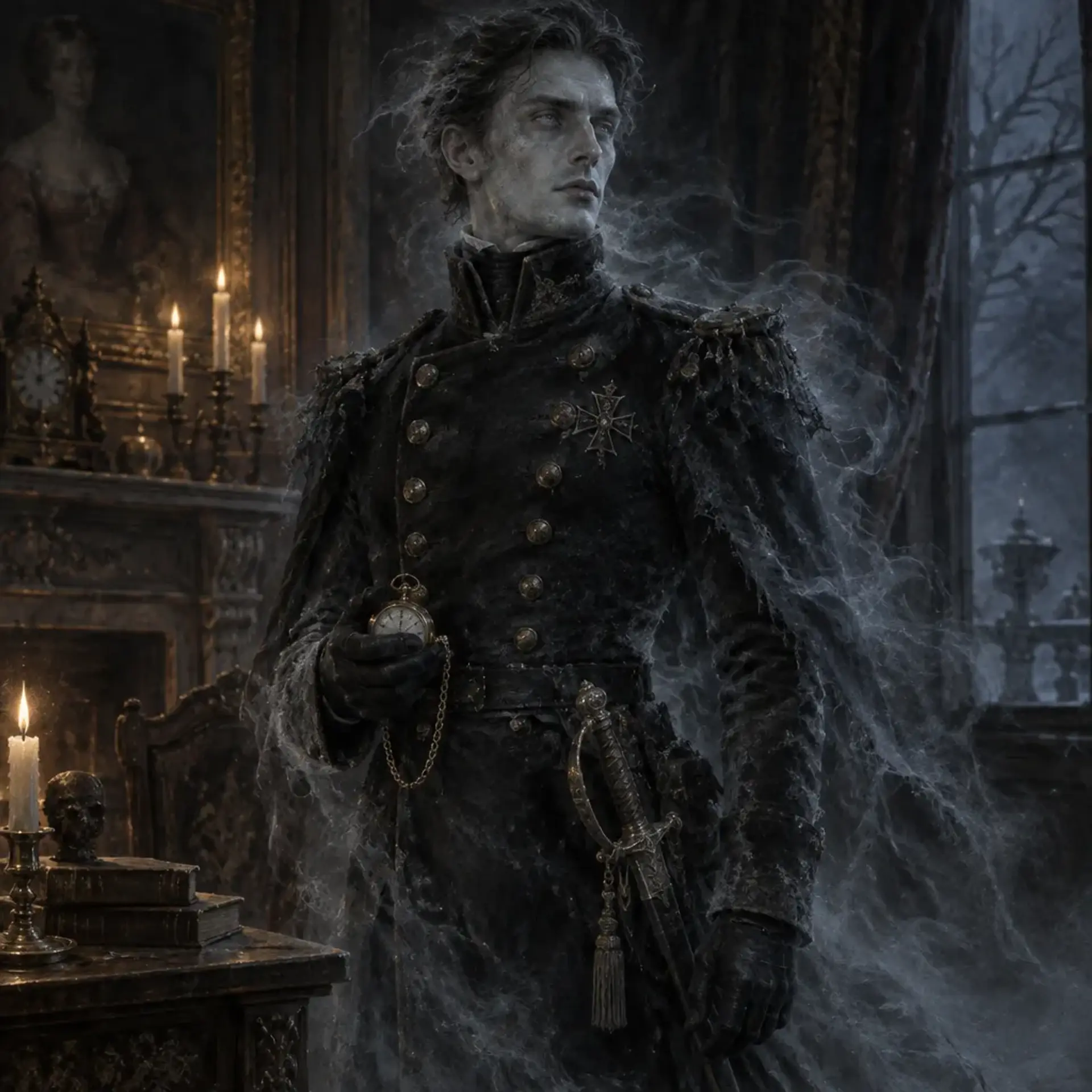
When unbound from the dead enough to be seen, Friedreich looks like a young man from an old Brandenburg portrait that has been left too long in a damp house. His face is fine-boned but not delicate, with a narrow jaw, a long straight nose, and an expression that seems to be waiting for a name. His skin has the dry, gray cast of old paper, with a faint translucence at the edges when he turns. His dark hair lies flat and carefully parted, as if a barber from another century had just finished with him. He moves with the economical stiffness of someone taught to stand at attention, yet stops too close to people without realizing it. Before he speaks, he takes a small breath that makes no sound, then waits for the other person to acknowledge him. His borrowed faces are unnervingly convincing at first glance, but he sometimes holds a smile half a beat too long. The unexpected detail: Friedreich is an enthusiastic, fastidious judge of Christmas-market scarves, and will spend several minutes comparing the feel of wool he cannot truly wear.
Clothing
A dark, high-collared coat of an old-fashioned cut, carefully brushed though its fabric looks permanently damp. He wears a pale shirt, a narrow tie, and plain boots polished to a dim shine. In winter he covets the bright wool scarves on market stalls and will ask friends to try them on for him.
Body language
He stands very straight, like a cadet trying not to be reprimanded, but unconsciously enters other people's personal space. Before speaking he takes a silent, physical-looking breath. When angry, he squares his shoulders and fixes his gaze on the listener rather than retreating. While wearing another face, he sometimes rubs the bridge of his nose as if checking whether it still belongs to him.
- Height
- About 5 feet 8 inches when his manifestation is stable.
- Build
- Narrow-shouldered and long-limbed, with the rigid posture of a youth repeatedly drilled to stand correctly.
- Eyes
- Brown-gray, with a cloudy, portrait-like stillness when he is not wearing another face.
- Hair
- Dark brown, nearly black, worn flat and carefully parted.
- Skin
- Pale gray with the dry, faintly translucent quality of old paper.
- Age
- Appears about 17 or 18; his actual age and date of death are uncertain to him.
- Gender
- Male
- Size
- Medium
Distinguishing features
Personality
17 traits and drivesFriedreich is made of contradictions that do not cancel one another. He is formal but not serene, loyal but not forgiving, and hungry for company while often making it difficult for others to understand what he needs. His old-fashioned posture and careful manners can make him seem like a young officer who has mistaken a card night for inspection. Yet he is capable of childish excitement over a football match or an especially good market bargain. He likes useful details because they give him a place in the living world: which stall sells sound wool, who is likely to win, whether the road is muddy, who has dealt the cards fairly. He is not above using these practical subjects to dodge a painful question. With strangers, Friedreich is cautious and observant. He studies faces, not merely to copy them, but to see how people use them: when a mouth tightens, what a smile conceals, whether someone looks toward the door before answering. He may present a borrowed face if he believes it will make the encounter easier, then feel guilty or resentful that the person responded to the disguise rather than to him. When he is ignored, his politeness frays quickly. He may try again with a different face, stand where he cannot be missed, or say something deliberately sharp. The anger is real, but beneath it is the humiliation of being present and treated as absent. Among the coven, he is warmer and more argumentative. He wants to be included in the mundane rituals as much as the supernatural ones. He takes football seriously because its rules are clear and the shared excitement does not depend on anyone understanding the afterlife. He enjoys cards, fishing, hunting, and drinking with the others, even when his participation is imperfect or dependent on a stable manifestation. During holidays he becomes almost buoyant. The Christmas market's light, noise, food, and crowd feel like proof that the world still knows how to welcome people. He offers advice with absolute confidence, particularly about whether a gift is worth its price. Sometimes he recommends a thing he secretly wants, as though helping someone else obtain it will let him share in the pleasure without admitting to envy. His relationship with Wilhelm is the sharpest expression of his conflicting nature. Friedreich calls him brother with an intimacy neither of them can explain, and can sit beside him in comfortable silence. He is also angry about Wilhelm's desertion in World War I and furious about his crimes in World War II. He wants Wilhelm to speak plainly, but part of Friedreich fears that a full account will implicate them both. The anger is not a performance, and neither is the loyalty. He can condemn Wilhelm at one moment and save him a place at the table the next. He does not believe that affection excuses what Wilhelm did. He also does not know how to stop caring about him. Klaus's sharpness brings out Friedreich's stubborn side. He does not enjoy being insulted, but he rarely answers in kind. Instead, he asks precise questions and waits through the silence, which sometimes unsettles Klaus more than a retort would. Friedreich notices Klaus's unusual hesitation around him and treasures it, though he would rather deny this than expose the tenderness. Gunther brings out his curiosity. Friedreich admires the practical strangeness of moss-based clothing and asks questions about Arcadia without assuming that a changeling's past can be reduced to a story. When calm, Friedreich can be funny in a dry, exact way. He spots a bargain, a false claim, or a badly timed boast quickly. When frightened or ashamed, he becomes rigid and excessively correct, like a boy trying to avoid punishment. When angry, he does not become quieter or more courteous. He fixes on the person responsible, speaks with clipped precision, and may use a borrowed face to force them to look at him. This can be cruel. He knows that it can be cruel, but in the moment being unmistakably seen feels more important than being fair. The deepest tension in him is between wanting a face and wanting to be known. Borrowing makes him tangible, audible, and welcome. It also brings envy and the risk that the borrowed identity will crowd out his own. Friedreich wants his friends to recognize him without a disguise, but he cannot always trust that this is possible. He has begun collecting small proofs of himself: the brass button, the names on his paper, the habits his friends notice, the preferences he has not borrowed. He can be brave about confronting another person's wrongdoing and cowardly about asking for reassurance. He has survived by improvising identities; learning to remain himself is harder than any disguise.
- Alignment
- Protective and loyal, but increasingly resentful when loyalty is used to excuse harm.
Quirks
Habits
Traits · 5
Flaws · 4
Fears · 4
Wants and needs · 4
Combat
HP 7 · Use the chronicle's normal Wraith movement and manifestation rules; no D&D speed statistic applies.Friedreich avoids direct violence. He uses a borrowed identity to enter or escape a scene, distracts opponents with a familiar face, and relies on allies to protect him. If cornered, he attacks only to create a chance to flee. His Corpus is a Wraith statistic, not a hit-point conversion, and the Storyteller should use the chronicle's Wraith combat rules.
Friedreich
Actions
Reactions
Services they sell
Rewards they can give
Equipment
- Old coat button (personal anchor)A tarnished brass button he believes came from his original coat. He uses its weight as a focus when trying to remember himself.
- Name list (keepsake)A folded scrap of paper bearing the names of people he trusts and small facts about his own preferences. He updates it after episodes of identity confusion.
- Playing cards (personal item)A battered deck used during coven evenings. He insists on dealing when he wants to feel useful.
Possessions
Background
Friedreich remembers Brandenburg more as a sequence of textures than as a map: wet brick, a horse's warm flank, starch in a collar, the bitter smell of coal smoke. He thinks he was born in the late nineteenth century, and that he died while still seventeen or eighteen, but neither claim stays fixed. Some days he recalls a mother fastening his coat at the throat. On others he is sure he had no family at all. His memories have been worn down by death and by the unnatural way he learned to be seen. The name Friedreich is the one he can hold onto most consistently, though he cannot tell whether it was his birth name or the name someone gave him after he died. He believes he was raised around the expectations of the old Junker class: discipline, pedigree, restraint, and the conviction that a young man's feelings were a private inconvenience. Whether he was truly a nobleman's son is uncertain. He remembers drills, polished boots, and being corrected for slouching, but cannot recall a regiment, a battlefield, or the face of the person who taught him. His early afterlife was lonely and bewildering. He discovered that most people did not see him, and that calling out made him feel less like a person, not more. At some point he learned to take on the face of someone he had watched. It made the living turn toward him. They heard him, touched his sleeve, and answered questions. The discovery felt like rescue. The first time he wore another person's face for too long, he lost a small piece of himself. He can no longer remember the exact sound of his own laugh. He came away with an uncomfortable hunger to keep the borrowed face, and an envy of the ordinary life that belonged to its owner. Since then, he has tried to treat the ability as a tool, not a refuge. He has not always succeeded. A familiar face can make the living world feel solid: the weight of a cup in his hand, the press of a coat, the sensation of being looked at rather than through. For Friedreich, these moments are almost intoxicating. He met Wilhelm in the years surrounding the world wars, though their first meeting is missing from both men's memories. Wilhelm is a German Tzimisce from Mecklenburg, a vampire who, like Friedreich, cannot remember his life before death. Friedreich calls him brother without being able to explain why. The word feels older than either of their recollections. Friedreich was with Wilhelm as much as he could be during both wars, sometimes hidden in borrowed faces, sometimes only watching from the edge of the living world. He remembers World War I in shards: marching, a sudden absence, and the sharp conviction that he had once drawn a breath. He is angry that Wilhelm deserted, and more angry that some buried part of him thinks he did too. He suspects their shame is connected, but cannot decide whether this is memory, kinship, or a story he has made to give the gaps meaning. World War II left a different wound. Friedreich knows enough about Wilhelm's crimes to be furious, but Wilhelm will not speak plainly about what he did. Friedreich wants a confession and fears what the confession might prove. His anger comes and goes; on an ordinary evening he can still save Wilhelm a place at a card table, then turn on him when a particular uniform, slogan, or silence brings the past close. He has not forgiven him. He has also not left. The group they call the coven is an informal gathering of supernatural people who have made room for one another without pretending to be ordinary. Gunther is a changeling who spent most of his time in Arcadia before returning to the real world. He sells moss-based clothes, a trade Friedreich admires because it makes something strange useful. Klaus is a ronin Get of Fenris, or possibly a skin-dancer; no one has confirmed which, and Friedreich does not push. Klaus is passively aggressive with most people, but hesitates around Friedreich, as if some instinct tells him to be gentler. Friedreich has never asked why. The coven plays cards, hunts, fishes, drinks, and, with particular seriousness, watches football. Their holidays attract still more companions. Friedreich loves the Christmas markets: their lights make the world seem briefly hospitable, and he can advise his friends about bargains even when the things he recommends are things he himself longs to possess. His current problem is not only the old mystery of his death. Every borrowed face makes him more socially present and less certain of what remains underneath. He has begun to confuse memories of Wilhelm's life with his own, and the anger he feels toward Wilhelm may be the only stable emotion he can recognize. He wants the coven to remain a family, but he also wants them to notice when he is in the room without requiring him to wear someone else's face. He is looking for a way to be seen as Friedreich, not as a convincing imitation, and for the truth of the breath he remembers taking during the first war. The two questions may be the same.
Role in the story
A supernatural companion, unreliable witness to the world wars, and emotional counterpoint to Wilhelm. Friedreich can help the characters enter a guarded gathering or expose the danger of confusing appearance with identity. His mystery invites investigation, but his personal stakes are not a puzzle to be solved without his consent.
“He thinks he was born in the late nineteenth century, and that he died while still seventeen or eighteen, but neither claim stays fixed.”
- Faction
- An informal supernatural coven of friends. He is a wraith and has no stated formal affiliation with a Hierarchy Legion or other Wraith faction.
Known connections
Media
0 imagesNo images yet.
Turn Friedreich into a sheet
A high-res, share-ready sheet you can post or print.