Friedreich
Friedreich
At the table
Voice
A dry, lightly breathy voice with a woolly rasp, as if shaped by cold air, old stone corridors, and the habit of addressing people formally. His words carry a clipped, imitative military rhythm, but his pace quickens around football and market bargains. When angered, he becomes more exacting rather than softer.
His voice sounds as if it comes through a wool collar and a room with hard floors: dry, lightly breathy, and edged with the small rasp of someone used to cold air. His Brandenburg German is formal and carefully enunciated, with a soldierly clipped cadence acquired from imitation, memory, or both. He makes dates and prices sound exact. When discussing football or a Christmas-market bargain, his sentences speed up and pick up local colloquialisms. When a wartime memory surfaces, he loses the polish and speaks in short sensory fragments. Anger does not make him quiet; it makes him more precise, with each word placed like a reprimand.
Speech patterns
How to play them
Meet Friedreich through a shared activity rather than an interrogation. A football match, market visit, card game, or holiday gathering gives him a reason to stay. Show interest in his advice, but do not flatter him by pretending to know his past. Treat his attachment to Wilhelm as real even if its origin is uncertain. If he borrows a face, respond to the person beneath the imitation rather than rewarding the theft. He is more likely to disclose a fragment of memory after being allowed to remain uncertain without being mocked.
Goal
Discover whether his remembered wartime breath and the young man with his face belong to his own history, without sacrificing his chosen family or stealing a living person's identity.
Motivation
Belonging without pretending. Friedreich wants a past he can trust and a future in which his friends recognize him without needing him to wear someone else's face.
Appearance
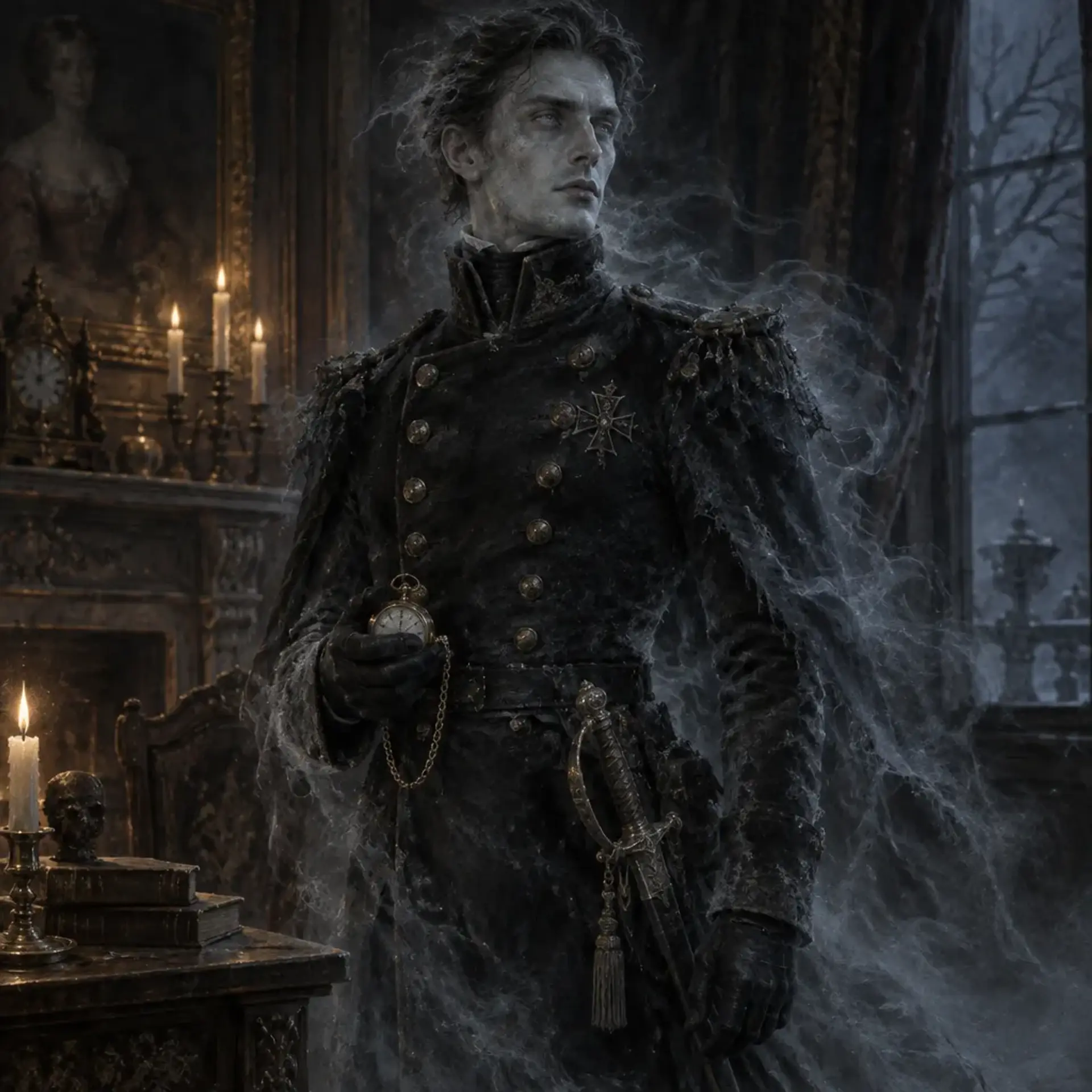
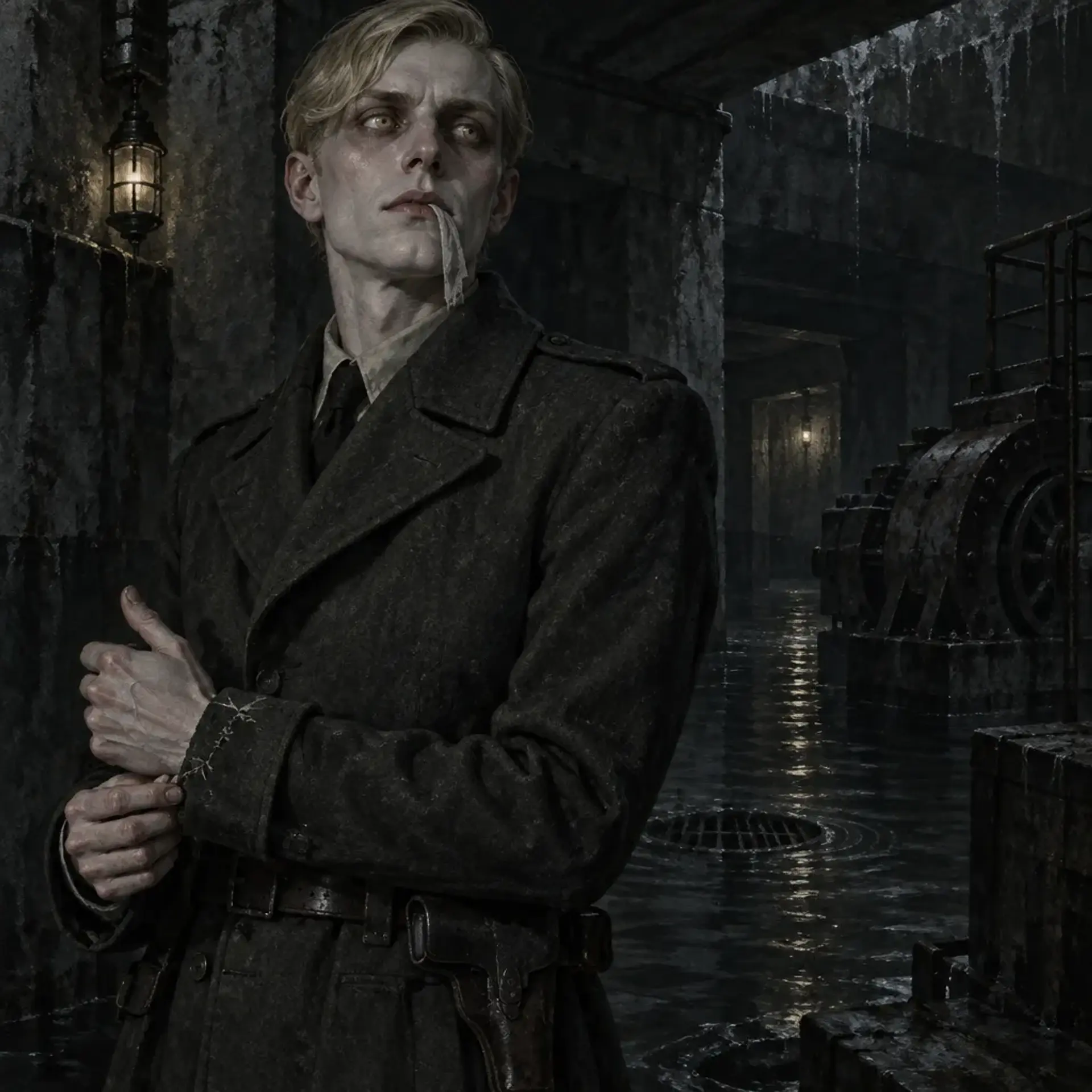
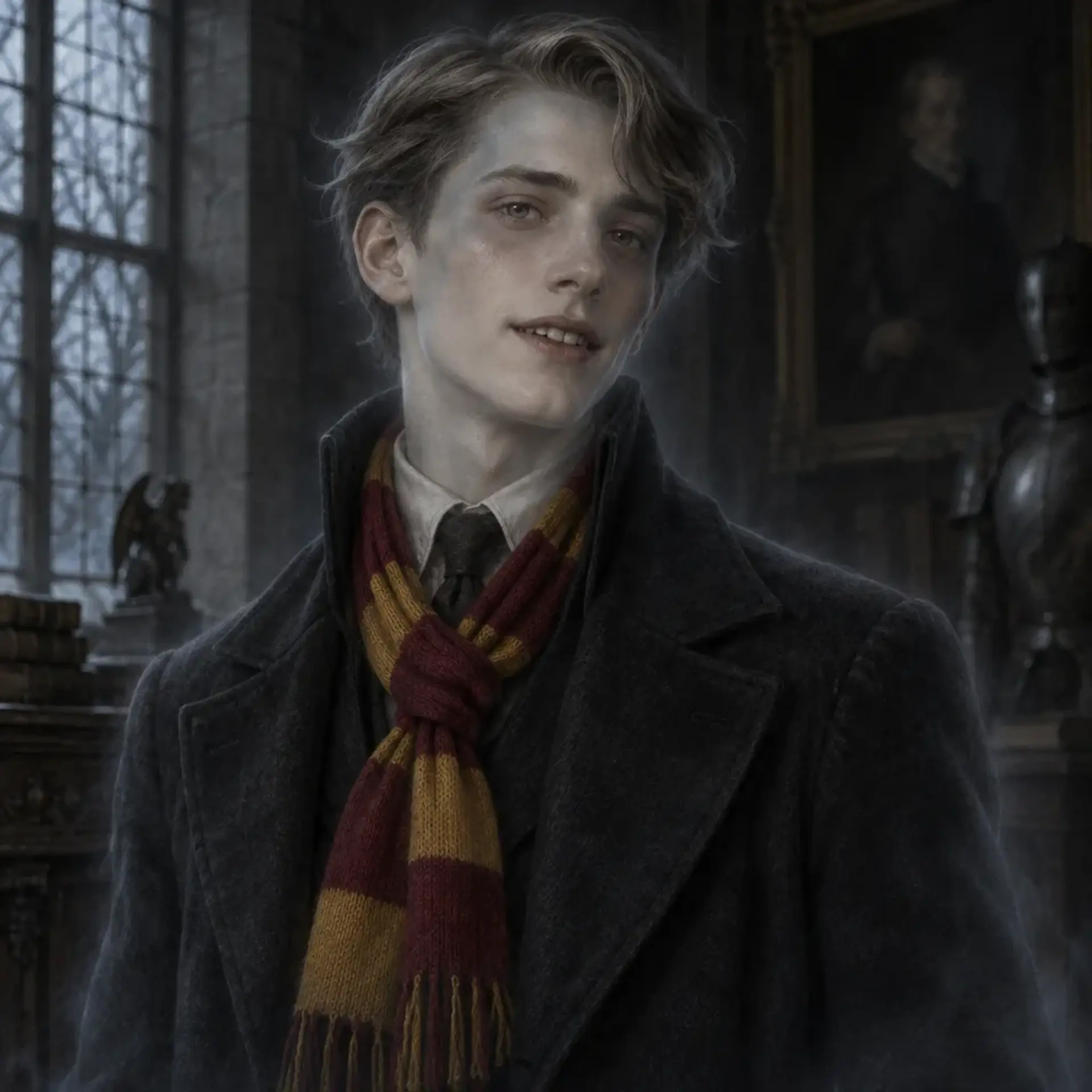
When visible, Friedreich looks like a narrow-shouldered Brandenburg youth caught between a cadet's portrait and a half-remembered family photograph. His face is handsome in the severe, unfinished way of a teenager still growing into his jaw: a wide, square hinge beneath a fine nose, with two unusually prominent incisors that show when he grins. He eats by habit although food cannot nourish him, biting carefully and then stopping as if surprised by the taste he cannot quite recover. His skin has the waxy translucence of old paper held to a window, with a faint grey-blue cast at the temples. His dark blond hair is brushed to a period-correct side part, but individual strands sometimes drift as though underwater. His eyes are a clear, ordinary hazel until someone tries to hold his gaze; then the reflection seems to belong to the room behind them. He walks with a measured, heel-first military step, always favouring the right as if keeping pace with an unseen companion. When waiting, he becomes unnervingly still. On Unbinding Days, the outline of his coat and face sharpens, and he looks less like a ghost and more like a boy who has been standing in the cold too long. The unexpected detail is his appetite for football scarves: he knots them with the meticulous care of an old Junker officer, then wears the brightest one he can find.
Clothing
A carefully maintained dark wool coat with a high collar, a pale shirt, and a narrow tie reminiscent of an old Prussian family portrait. He sometimes adds an obsolete-looking cadet-style cap, though no badge or insignia stays visible for long. At football gatherings he wears a bright scarf chosen to match neither his coat nor his solemnity.
Body language
He stands as if awaiting inspection, shoulders squared and chin slightly raised, but his weight rests more heavily on his right foot. He makes small uniform-adjusting gestures even when wearing modern clothes. At cards he keeps his hands close to the table and watches other players' faces rather than their cards. When ashamed, he presses his tongue behind his prominent incisors and holds perfectly still.
- Height
- About 170 cm when clearly manifested; his apparent height fluctuates with the strength of his manifestation.
- Build
- Slim, long-limbed, and adolescent, with the disciplined posture of someone trying to take up less room than his uniform suggests.
- Eyes
- Hazel, with reflections that sometimes seem to show the room behind the viewer.
- Hair
- Dark blond, brushed into a careful side part; individual strands sometimes drift as though underwater.
- Skin
- Pale, translucent grey with a faint blue cast at the temples, like old paper held against winter light.
- Age
- Appears 17 or 18; the age he remembers is uncertain.
- Gender
- Male
- Size
- Medium, when manifested; otherwise a wraith's presence is not measured by ordinary physical size.
Distinguishing features
Personality
18 traits and drivesFriedreich has built a young man's self around the manners of an old household. He is courteous, observant, and surprisingly good at noticing when someone has been left out, but he can make that kindness feel like an inspection. He will offer a seat, remember a preference, and then correct the way a person holds a cup. This is not simple hypocrisy. He learned that exactness can keep panic away, and that service is a safer way to ask for affection than admitting he needs it. Around strangers he is formal and watchful. Around the coven he becomes teasing, even competitive, particularly during cards or football arguments. He likes to be useful and likes being praised for it, then feels ashamed when praise matters too much. His attachment to Wilhelm is direct in a way little else about him is. Friedreich calls him brother as though the title were a fact older than memory. He is protective without being possessive when Wilhelm is steady, but if Wilhelm is threatened or speaks of his lost past, Friedreich may become controlling. He tries to keep Wilhelm safe from questions that Friedreich himself longs to ask. Their shared memory loss feels like kinship, yet it also frightens him: perhaps they have mistaken the same wound for a bond. He will not voice that fear unless exhausted or caught in an unguarded moment. Friedreich wants to be seen, but distrusts the means by which he achieves it. Borrowing a face lets him join a conversation, cross a room without being ignored, or stand among the living on a rare day when the world grows permeable. It also makes him feel like a thief. He is careful about whose appearance he takes and avoids using a loved one's face, yet the boundary is not perfectly safe. If lonely, he may linger in an assumed face after the immediate need has passed. He tends to call this practical. His Shadow calls it proof that he has no self to protect. He resists that voice by tending to routines: a place at the table, a football scarf, the same jokes at the Christmas stalls, the same people choosing to meet again. At the Christmas market, he is almost cheerful. He gives unasked-for assessments of workmanship, prices, and whether a gift will last. He has strong opinions about which stalls overcharge and which sellers are honest. He will encourage others to buy a beautiful thing he cannot touch, then claim he only wanted to help. Sometimes the generosity is genuine. Sometimes it is grief with good manners. He is capable of resenting the living for owning ordinary pleasures, and then resenting himself for the resentment. On difficult days, he can become sour and picky, finding fault with the very gathering he begged to attend. He is embarrassed by this, but may defend himself by saying that someone had to notice the poor quality of the sausages. His memories do not arrive in a reliable sequence. A smell or a uniform may bring up a detail with absolute clarity, followed by a complete blank about the people involved. He tells fragments as if reporting observations, not confessing. When nervous, he adds dates, locations, and careful qualifiers; when emotionally struck, he drops all that formality and speaks like a frightened boy. He can be stubborn about a remembered detail even when he knows it may be wrong. The memory of a breath in the First World War is the clearest example. He does not know whether it was his last breath, another person's, or an image borrowed from the dead. Still, he guards it as if losing it would mean there had never been a life before death. With Gunther, Friedreich is curious and respectful. Gunther's moss-based clothes seem to Friedreich like proof that a person can make a life from what the world calls strange. Friedreich offers quality advice, then asks questions about Arcadia without admitting how much he fears a place that can reshape identity. With Klaus, he becomes more cautious. Klaus's usual passive aggression does not work as well on him, because Friedreich does not always know when an insult is intended. When Klaus hesitates around him, Friedreich notices, but has not decided whether to treat the hesitation as kindness or a warning. He can be patient with the ambiguity for a long time, then suddenly ask a blunt question at a badly chosen moment. Friedreich's courage is real but uneven. He will put himself between danger and a friend, even when he has little ability to hurt the threat. He is less brave when asked to say plainly what he wants, to risk being refused, or to admit that his sense of identity might depend on other people's recognition. He dislikes cruelty, but his own fear can make him manipulative. He may withhold information to keep someone close or steer them toward a purchase that gives him vicarious pleasure. If confronted without contempt, he can acknowledge the wrong. If cornered or mocked, he retreats into rank, protocol, or a cold insistence that he was only being sensible. In short, Friedreich is both a careful host and a restless boy, a source of advice and a person who wants others to choose for him, a ghost who envies the living and a friend who genuinely delights in their company. He is not waiting to be restored to who he was. He is trying, with uneven success, to make his repeated acts of loyalty count as a self.
- Alignment
- Protective of his chosen people, suspicious of strangers, and capable of petty spite. No D&D alignment applies.
Quirks
Habits
Traits · 5
Flaws · 4
Fears · 4
Wants and needs · 5
Combat
HP 5 · No canonical numeric movement rate specified for this profile. Use the Storyteller's normal Wraith movement rules and the scene's conditions.Friedreich avoids a fair fight. He uses confusion, borrowed appearances, and the cover of stronger allies to escape or create an opening. He will grapple or shove if cornered, especially to protect Wilhelm, but he is not a trained soldier in any mechanically confirmed sense. His old-fashioned bearing should not be mistaken for combat experience. A Storyteller should use the listed dice pools as suggested pools and set difficulties according to the current Wraith rules and scene.
Friedreich
Actions
Reactions
Services they sell
Rewards they can give
Equipment
- Dark wool coat (clothing)A spectral wool coat maintained as carefully as if it were a family uniform. Its buttons sometimes appear to be from different decades.
- Football scarf (personal token)A bright scarf from a football gathering. He cannot keep it physically, but it is a cherished personal token in the Shadowlands.
- Card deck (keepsake)A small, worn card deck used during the coven's gatherings. The faces of the cards occasionally shift when Friedreich's attention wanders.
Possessions
Background
Friedreich remembers Brandenburg in fragments: a gravel drive, the smell of damp wool, the long echo of boots on a stair, and an adult hand correcting how he held a spoon. He cannot say whether these are memories of his life or images assembled from the people he has watched. His name survives with more certainty than his family. Sometimes he insists he was born in 1900; sometimes he says 1901, and once, in a rare moment of clarity, he admitted that he might have chosen the date because it made him seem old enough to have belonged somewhere. His face, when the dead world loosens its grip and he can be seen clearly, suggests seventeen or eighteen. He remembers a household that prized rank and composure, and he has made the manners of an old Junker family into a shelter. He straightens cuffs, gives advice about proper conduct, and speaks of duty with a conviction that can sound borrowed. Beneath that posture is a boy who wants someone to tell him where he belongs. His first formative rupture came during the First World War. Friedreich recalls being near soldiers, mud, and a field dressing station, though he cannot tell whether he served, followed a relative, or merely died close enough to the war for its impressions to mark him. The memory that returns most sharply is not a battlefield: it is a breath. He remembers inhaling cold air, tasting iron, and hearing a wounded man ask for his mother. Then there is a blank. He does not know if this was his last breath, a breath he witnessed, or an echo picked up from someone else's death. The uncertainty makes him cling to the memory. It is proof, however unreliable, that he once had a body and a life that belonged to him. After death, Friedreich found that the living usually could not see him. He learned to borrow a face by watching people closely and taking on the appearance of someone they already expected to see. This Borrowed Face is his own custom ghostly knack, not an established Arcanos. It gives him presence, but not substance, and the imitation has limits. It cannot supply the original person's memories or voice. The longer he wears a face, the harder it becomes to remember what his own looked like. That cost is why he avoids taking the likeness of someone he loves. He fears that recognition might become a kind of theft, and that he will eventually forget the difference between being welcomed and being mistaken for someone else. He encountered Wilhelm amid the upheavals of the World Wars. Wilhelm is a German Tzimisce vampire from Mecklenburg who, like Friedreich, cannot remember his life before death. Friedreich was with him as much as he could be, sometimes visible only through a borrowed face or a fleeting impression at the edge of a room. Their companionship never required a complete explanation. Friedreich calls Wilhelm brother, and the word feels older than any evidence he has for it. He cannot tell whether they knew each other in life, met first among the dead, or have made the relationship real through years of choosing it. Wilhelm's own missing past reflects Friedreich's, and that likeness comforts him while also making him afraid. If one of them remembers, what if the memory changes everything? Over time, their loose circle became the group they call the coven, although its members come from very different supernatural lives. It is a social refuge rather than a formal occult organization. They play cards, hunt, fish, drink, argue over football, and make room for holidays. Gunther, a changeling who spent much of his time in Arcadia before returning to the real world, sells clothes made with moss. Friedreich respects Gunther's ability to turn something strange into a useful living, and he will inspect a moss garment as if it were a uniform needing review. Klaus is a ronin Get of Fenris, or perhaps a Skin-dancer; no one has settled the matter, and Klaus does not encourage questions. He is passive-aggressively mean to most people, but he hesitates around Friedreich. Friedreich does not know whether this is affection, guilt, recognition, or simply a private exception. The coven's holidays matter because they give Friedreich a calendar to inhabit. Christmas markets are a particular joy. He can sometimes be seen more clearly on the days when the world unbinds itself from the dead, and on those days he joins the others among stalls of carved toys, paper stars, hot food, and woollen goods. He advises everyone on bargains, quality, and what is worth buying. His advice is sometimes excellent. At other times, he persuades a friend to buy the very object he secretly wants, because he cannot take it himself and would rather see it belong to someone than admit how much he misses having hands that can own things. He values the ritual of choosing and gifting more than he admits. His current problem is that his impressions of the past are changing. He has begun to remember a particular young man in a military coat whose face is disturbingly close to Friedreich's own borrowed image. The figure appears at the edge of dreams and in reflections that should not hold a wraith. Friedreich fears that this person is connected to his death, or that the face he calls his own was always someone else's. He has not told Wilhelm the whole thing. Meanwhile, his Shadow uses these uncertainties to press him toward a cruel solution: choose one living person, take their face, and keep it until the world accepts him as real. Friedreich resists because he wants to be recognized as Friedreich, not merely as a convincing imitation. He wants to learn his past, but he also fears the answer will take away the family he has made after death.
Role in the story
A socially rooted wraith companion whose face-borrowing lets him cross the boundary between the dead and living, while his uncertain history and loyalty to Wilhelm make him a source of emotional stakes, clues, and difficult choices.
“He cannot say whether these are memories of his life or images assembled from the people he has watched.”
- Faction
- The coven, an informal supernatural social circle. Friedreich is a wraith and is not assigned to a canonical wraith faction here.
Known connections
Media
0 imagesNo images yet.
Turn Friedreich into a sheet
A high-res, share-ready sheet you can post or print.