William Windon
William Windon
At the table
“s comments are clipped, dry, and pointed:”
Voice
William's own voice is young and clear, with a practical edge shaped by giving instructions over chores and by growing up among people who expect plain answers. He tends to use a little more breath than he needs when nervous, then clips the ends of his sentences short. The reflection's voice comes through the same mouth but has a heavier, older cadence: dry, exact, and faintly impatient. When William is startled, his breath catches and the stranger's next words can seem to arrive on the exhale.
William speaks in an ordinary, practical Wiltshire manner, with local phrasing and a tendency to qualify claims he fears will sound foolish. Stable work has given him a breath that is steady during routine tasks and a short, nasal pull when he is concentrating. When rattled, his breath catches high in his chest and he must force his next words out. The reflection uses his mouth but sounds older: a deeper, more measured voice with dry timing and the composed delivery of someone who expects to be obeyed. Its comments often sound like observations rather than threats.
Speech patterns
How to play them
Treat William as a frightened young person with real responsibilities, not as a possessed curiosity. Ask what he wants before examining him or any reflective surface. He responds best to practical help, patience, and direct questions. Do not mock his rural background or repeat the reflection's slur. Mentioning Elizabeth can make him more candid, but threats toward her make him defensive. If players earn his trust, he will share his notes and admit that he sometimes agrees with the reflection's wit. Mechanics note: the value of 3 hit points is a custom scenario convenience only, not a verified Secret Histories statistic.
Goal
Find the heart-rock and Abraham Gorff before the reflection's influence grows further, while keeping Hector and Elizabeth out of danger.
Motivation
William wants his familiar life back, but he also wants an explanation that respects what he experienced. He is afraid of the reflection, resentful of it, and curious about the family it claims to have. He wants to protect Elizabeth without treating her like a child, and to challenge Hector without making their home feel unsafe.
Appearance
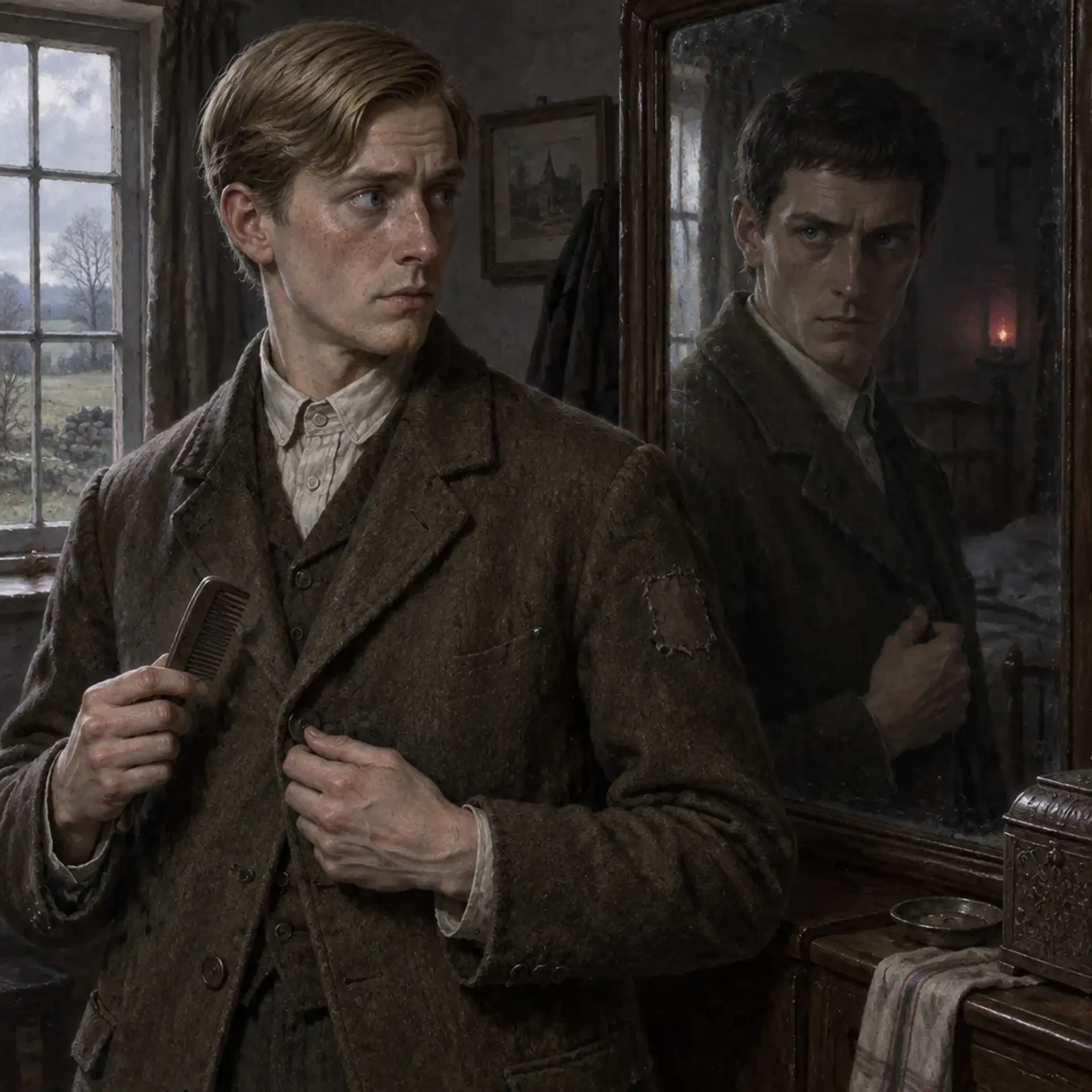
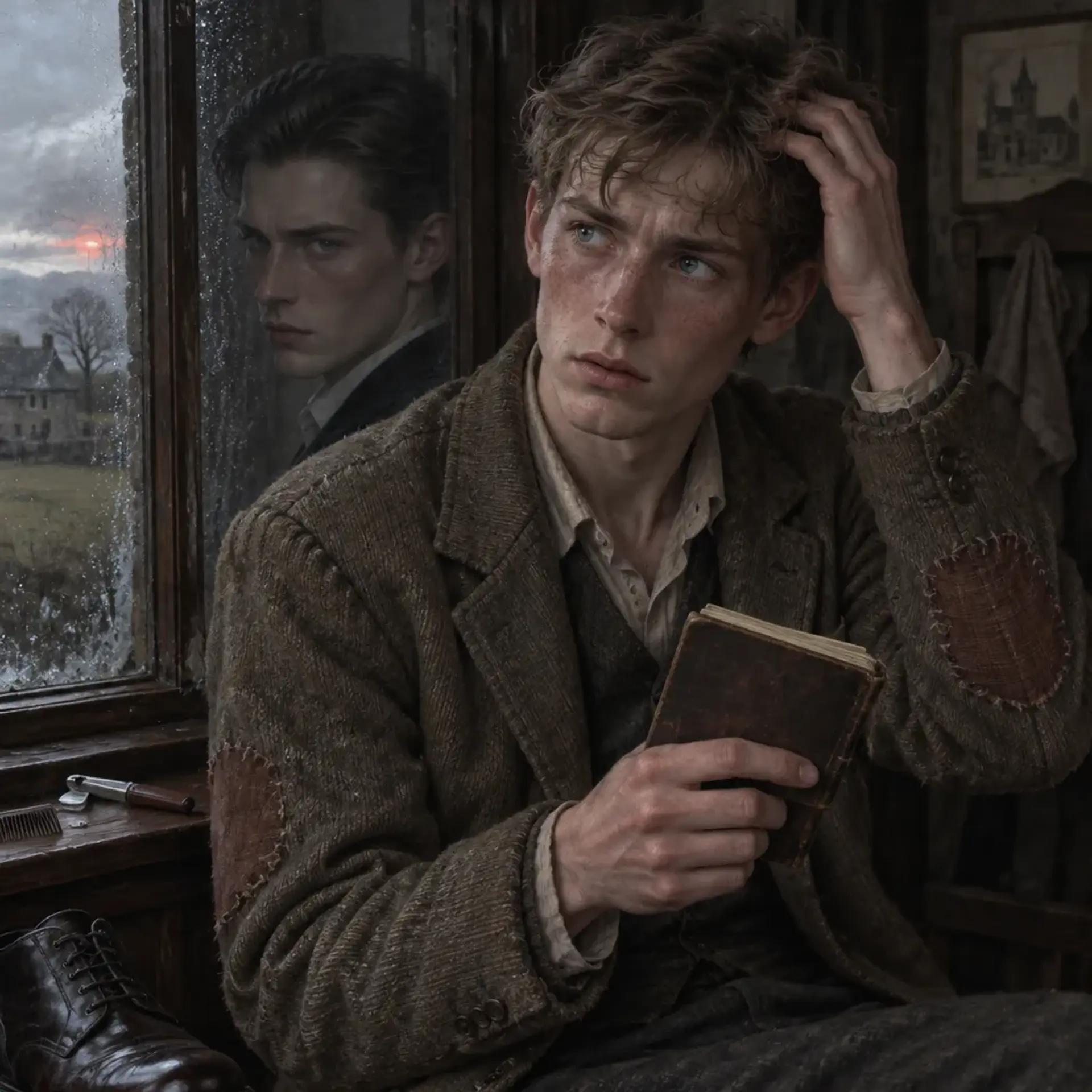
William Windon is a country-bred young man with a long, open face, blue eyes, and brown freckles scattered across his nose and upper cheeks. His dark-blond hair is fine and stubborn, usually combed back with water, though small wisps spring loose above his ears by midday. His skin is weathered pink at the nose and knuckles from outdoor work, and his clothes often carry a faint trace of hay, soap, and damp wool. He is tallish and rangy, with the slightly forward shoulders of someone accustomed to bending over a stable trough. When waiting, he puts his weight on the outer edges of his boots and keeps one heel poised as if expecting to step away. He breathes through his nose in small, measured pulls; when frightened, his breath catches at the top of his chest and a second, slower rhythm seems to answer from somewhere behind his sternum. His unexpected detail: he is meticulous about grooming and will stop in the middle of a muddy task to smooth his hair if he catches sight of himself in glass. In a mirror, however, that familiar routine has become a private negotiation with the stern, black-haired stranger looking back.
Clothing
Practical Wiltshire clothes: a worn dark jacket, a plain waistcoat, a clean but frequently mended shirt, sturdy trousers, and muddy boots. He tries to keep the collar straight and the hair combed back. He owns one better coat for visits and worries that the reflection disapproves of its fit.
Body language
William waits with his weight on the edges of his feet and his shoulders slightly forward, as if ready to move but unsure in which direction. He presses two fingers to his breastbone when the second heartbeat comes, then catches himself and turns the gesture into a tug at his collar. He smooths his hair when anxious. If someone asks about the reflection, his gaze goes to the nearest pane before returning to their face.
- Height
- Tallish for his family, approximately 178 cm
- Build
- Tallish, narrow-shouldered and wiry, with the unshowy strength of someone used to outdoor chores rather than formal exercise.
- Eyes
- Blue, clear and pale in strong daylight
- Hair
- Dark blond, fine and inclined to spring loose
- Skin
- Fair, weather-pink at the nose and knuckles, with brown freckles across the nose and upper cheeks
- Age
- Young adult, about 18
- Gender
- Male
- Size
- Medium
Distinguishing features
Personality
19 traits and drivesWilliam wants to be thought decent and capable, yet he is more proud than he likes to admit. He tries to speak carefully and behave properly, but a sharp joke can give him a momentary thrill, especially when someone pompous deserves it. The reflection has noticed this and supplies the insults William would never willingly claim as his own. Around strangers he is cautious and plain-spoken; around family he can be impatient, teasing, and unexpectedly tender. With Elizabeth he tries to be the reliable older brother, even when her questions about boys, clothes, and appearances leave him blushing or exasperated. He listens more closely than he admits and remembers what she likes. If she is embarrassed, he changes the subject or finds a practical reason to leave the room with her. If the reflection makes a cutting comment about her, William's politeness vanishes: he answers it aloud, even if that means looking mad in front of her. With Hector, William is respectful until he cannot bear another dismissive remark. He dislikes Hector's habit of describing ordinary country people as foolish, and the reflection's insult made that resentment public before William was ready. He is ashamed of the incident, but not sorry that Hector was challenged. His strongest instinct is to keep peace at home; his second strongest is to correct an injustice once he sees it. Those instincts pull against each other and leave him slow to act, then suddenly blunt. Fear makes him methodical. He checks the glass, checks his pulse, and repeats the facts of the haunting in his head. He takes comfort in chores that have visible results: a clean stall, a straightened room, a brushed coat. He dislikes being pitied and may claim to be tired or cold rather than admit terror. At his worst, he becomes secretive and defensive, deciding that no one else can be trusted with the heart-rock. At his best, he is candid, observant, and willing to accept help, though he needs time to reach that point. The reflection complicates his self-image. Its dry wit can be funny, and William sometimes catches himself waiting for the next comment. He resents its intrusions, especially when it speaks through his mouth, but its attention can feel like companionship during sleepless nights. When it describes its father and its forty-eight siblings, William hears loneliness in the pauses, though he cannot tell whether the presence is lonely, manipulating him, or simply using words poorly. He is unsettled by the possibility that compassion is another way to be drawn in. The 2,000-word personality request is interpreted as a request for depth, but condensed to fit a practical NPC entry. At the table, portray William through contradictions: neat hair with muddy boots, an apology followed by a stubborn refusal, a sincere concern for Elizabeth followed by embarrassment at her questions, and a quick flash of anger when someone treats his family or neighbors as foolish. The reflection should not be a constant stream of menace. Its comments can be dryly amusing, socially inappropriate, perceptive, or abruptly incomplete. Its reactions to Elizabeth are especially revealing: it notices William's affection and teases him about his anxious attentiveness, but becomes unexpectedly quiet when she is genuinely distressed. It may tell William, "She is not asking you to solve it, only to listen," then deny having offered advice.
- Alignment
- Not applicable as a verified Secret Histories rule; personally conscientious, defensive, and increasingly willing to deceive to protect his family.
Quirks
Habits
Traits · 5
Flaws · 4
Fears · 5
Wants and needs · 5
Combat
HP 3 · Custom scenario note: ordinary human walking pace; no verified Secret Histories speed statistic is supplied.William is not a trained combatant. In danger he tries to get between a threat and Elizabeth or another vulnerable person, then retreat toward a door. If cornered, he uses a stick or whatever tool is at hand and fights only long enough to escape. He avoids striking reflective surfaces because of the heart-rock's remembered pain. If the other presence speaks during a confrontation, William may lose a moment to its interruption or be distracted by what it says. Use the listed actions only as custom scenario prompts, not canonical Secret Histories mechanics.
William Windon
Actions
Reactions
Services they sell
Rewards they can give
Equipment
- Hairbrush (personal)A plain wooden-handled brush used in his bedtime routine; he has begun keeping it away from the mirror.
- Walking stick (tool)A household walking stick or stout length of wood, carried for muddy paths rather than fighting.
- Search notes (documents)Notes of dates, places, and names related to Abraham Gorff and the heart-rock, written in a small, increasingly disordered hand.
- Glass cloth (personal)A small cloth used to wipe condensation from glass; he carries it without admitting why.
Possessions
Background
William Windon was born in Wiltshire into a family whose ties to the parish ran back far enough that his father, Hector, can produce names, dates, and old boundary descriptions for nearly every field in the district. Hector works as a historian, and William grew up among books, farm chores, and family stories that were often more certain about dead landlords than about living neighbors. William learned early that respectable manners were treated as proof of good character. He is not naturally polished, but he cares about trying: he brushes his hair before breakfast, remembers to thank people, and dislikes being laughed at for country habits by visitors who have never mucked out a stall. His younger sister, Elizabeth, has lately become his most persistent companion and his sharpest critic. She asks him to judge the clothes she is considering, to hear the latest news about a boy she likes, and to explain whether a remark was rude or merely awkward. William pretends to be exasperated, but listens closely. He has often been the person she turns to when she wants an answer that is honest without being cruel. Their father is less easy. Hector can be generous with help and knowledge, yet speaks dismissively about people beyond his own intellectual circle. William has learned to swallow disagreement until it comes out at the worst moment. The heart-rock first entered William's life as an object of gossip. Abraham Gorff, a visitor from London, had brought it to the Hush House as payment for an entry he was never permitted to make. It was shaped like a human heart from pale cliff-stone, thick with barnacles and sea grass, and was said to be a fossilized living heart forged of heart and scale. Abraham eventually threw it into the sea. It washed ashore again, wet with saltwater and black ooze, with a muted red-pink glow beneath the stone's surface. A young man found it and took it home. That man was Abraham, who lived in Wiltshire for a time and came to believe the thing wanted to be his. He showed it to neighbors; in their presence it appeared dead, then revived when he brought it to a Hampshire shore and dipped it in water. Abraham grew protective of it, not from ordinary greed but from the conviction that the heart disliked company. The object brought noises and hauntings to Abraham's home: voices, moving doors, footsteps on stairs where no one stood. Eventually he sold it to William, then seventeen, one of the people who had seen it fail to stir. William was proud of the strange purchase. He thought it was a rare curiosity, a thing he could study and show off on his own terms. Then he began to feel a beat in his chest that seemed to match the stone's pulse. After a spell of tasting saltwater, blood, and soil in his mouth, he tried to break it with a hammer. The blow did not seem to strike stone. Pain burst through his chest. He fell, groaning and coughing blood, and for one brief instant saw a muscle twitching under the rock. He woke with his mother's hands on his face and was told his heart had stopped. He left the heart in a hollow log. Days later it looked cold and untouched, despite the hammer blow. William told himself the danger had passed. Then he saw that his reflection was not his. The stranger in the glass was a young man with a long face, blue eyes like moonlight on a pond, and black hair combed neatly back. The stranger's expression was severe, as if William had made a poor impression. At first it only irritated him by seeming to hold still after he moved, or by looking toward a different corner of the room. One night, while William was performing his ordinary bedtime routine, the reflection spoke in William's moving mouth: "Well, it's not often you use that one." The voice had an older, deeper manner of speaking than William's own, dry and disapproving. The remark referred to William's brush, which he had picked up in his left hand for once. William searched for the heart and found the hollow log empty. He sought Abraham Gorff and learned that Abraham had moved to Canada. No explanation seemed to fit: the heart was gone, but the stranger remained. Windows, dark panes, polished metal, and still water increasingly returned the same unfamiliar face. It began making changes while William slept. His clothes might be folded differently, his brush turned the wrong way, or a chair set facing the bedroom mirror. William has no proof the presence can touch anything; he only knows the room is never quite as he left it. The reflection comments on his combing, his clothes, and the way he speaks. It has stopped him mid-sentence when it judges his words improper, sometimes by making his reflected mouth continue while his own fails to finish. It has made remarks about Hector's pride and about neighbors it considers vulgar. Once, after a neighbor's child accidentally ran into William with a toy wagon and tearfully apologized, the reflection used a slur against the Welsh neighbor. William was made to muck out the neighbor's stables as an apology. He will not repeat the slur. He is ashamed that he let the reflection's insult escape through his mouth, and more ashamed that a part of him found the sharpness satisfying. The worst domestic incident began when Hector complained about how silly country people were. The reflection delivered a cutting reply in William's voice. Hector blamed William, and William received the consequences, but his father also looked at him with a new uncertainty. William has not told Hector the whole truth. He fears that his father would treat the matter as an historical curiosity first and his son's terror second. The presence is not a simple tormentor. It speaks more often at bedtime, when William is combing his hair or lying awake. It claims to have a father and siblings. It describes them as if they were tides, weather, or a persistent ache rather than people: a father whose presence is "the deep before the wave," siblings who are "many small pulls at once." It once gave the number forty-eight as if that were an adequate introduction, then fell silent when William asked what the number meant. The reflection seems to want to be understood, but reveals itself only in fragments. William does not know whether it is the heart's former owner, a thing created by the heart, or something that found a way into him when his own heart stopped. Now William is trying to locate the missing heart, find Abraham Gorff, and keep his family safe without surrendering his own life to the mystery. He has made inquiries through Hector's historical contacts, but cannot explain what he is looking for without sounding mad. He watches shop windows and puddles for the stranger's expression. He avoids standing near still water alone, though he is drawn to the coast and has begun dreaming of a shore in Hampshire. His ordinary life continues: chores, family meals, errands, and Elizabeth's questions about boys and pretty things. These daily obligations are not a distraction from the haunting. They are what he is fighting to preserve.
Role in the story
A human witness to a supernatural object and its lingering presence. William is a vulnerable ally, a source of clues about the heart-rock and Abraham Gorff, and a domestic focal point for the consequences of an unexplained haunting. The stranger in the reflection can act as an ambiguous informant, antagonist, or something in between.
“William learned early that respectable manners were treated as proof of good character.”
- Faction
- None known. His father has contacts among historians, but William has no formal affiliation.
Known connections
Media
0 imagesNo images yet.
Turn William Windon into a sheet
A high-res, share-ready sheet you can post or print.