
Best Free Digital Tools for TTRPG Players and DMs 2026
The best free digital tools for TTRPG in 2026: VTTs, map makers, character builders, generators and audio compared, with real free-tier limits and prices.
You can run an entire tabletop campaign, from session zero to the final boss, without paying for a single piece of software. The best free digital tools for TTRPG play in 2026 have quietly become good enough that a paid subscription is now a convenience rather than a requirement. The core rules of the world's biggest system are free: the D&D System Reference Document 5.2.1 went up as a downloadable PDF under a Creative Commons Attribution 4.0 licence on 1 May 2025, so the ruleset itself costs nothing to read, quote, or build on.
I run a weekly game and I'm tight with money, so I've spent a lot of evenings working out which free tools are genuinely free and which ones dangle a three-map trial before asking for a card. This is the list I actually reach for, split by the job each one does at the table. Some are free forever, some have a free tier that is more generous than it has any right to be, and a couple of paid tools are worth naming so you know exactly where the free ceiling sits.
How I picked these tools
Four rules kept a tool on this list. First, the free option has to be real, not a countdown timer. A seven-day trial is marketing, not a free tier. Second, the free version has to be useful on its own, not a crippled demo that only exists to sell you the upgrade. Third, the tool has to be alive in 2026, still getting updates or at least still working. Fourth, it has to earn its place for a player or a DM, ideally both, and not just for one narrow system.
That last point matters more every year. One table runs D&D 2024, another is deep in Pathfinder 2e, a third bounces between Daggerheart, Call of Cthulhu, and homebrew. A tool locked to a single ruleset is less useful than one that helps with the jobs every system shares: rolling dice, drawing maps, tracking a world, and making characters your players care about.
The quick list: free TTRPG tools at a glance
| Tool | Category | Free tier | Best for |
|---|---|---|---|
| Owlbear Rodeo | Virtual tabletop | Yes (Nestling, 2 rooms) | Fast browser battlemaps |
| Alchemy RPG | Virtual tabletop | Yes (unlimited) | Theatre-of-mind, any system |
| Roll20 | Virtual tabletop | Yes (1 game, 5 players) | Marketplace and character sheets |
| Foundry VTT | Virtual tabletop | No ($50 one-time) | Automation and modding |
| D&D Beyond | Character builder | Yes (6 characters) | Official 5e sheets |
| Pathbuilder 2e | Character builder | Yes | Pathfinder 2e |
| Azgaar's Map Generator | Maps | Yes (open-source) | Procedural world maps |
| Dungeon Scrawl | Maps | Yes (unlimited) | Quick grid dungeon maps |
| Inkarnate | Maps | Yes (3 maps) | Hand-painted style maps |
| donjon | Generators | Yes (all of it) | Instant tables and loot |
| Eigengrau's Generator | Generators | Yes (all of it) | Read-aloud towns and NPCs |
| Kanka | Campaign wiki | Yes (unlimited entries) | Free campaign database |
| World Anvil | Campaign wiki | Yes (Freeman) | Structured worldbuilding |
| Obsidian | Notes | Yes (personal use) | Private linked notes |
| Tabletop Audio | Audio | Yes (all of it) | Free ambience and SFX |
| CharGen | AI generators + art | Yes (gold-based) | Art, NPCs, whole locations |
| AnyDice | Dice probability | Yes (all of it) | Modelling homebrew dice mechanics |
| Improved Initiative | Combat tracker | Yes (open-source) | Browser initiative and HP tracking |
| DriveThruRPG | Asset marketplace | Yes (free/PWYW titles) | PDFs, map packs, and print-on-demand |
Every row on that table has a working free option except Foundry, which I have kept in because it is the one paid tool most groups eventually buy. The rest of this guide goes deeper on each category, with the exact limits so you know when a free tier runs out.
Virtual tabletops that cost nothing to start
The virtual tabletop is where an online game lives, and the free options here are strong enough that most groups never need to pay.
Owlbear Rodeo is my default recommendation for a group that just wants a map and some tokens without a login for every player. The free tier, called Nestling, gives you 200MB of storage and two saved rooms with access to every tool. Players join by clicking a link, no account needed. If you outgrow it, Fledgling is $3.99 a month and Bestling is $7.99 a month, but plenty of tables never leave the free tier because two rooms is enough for one ongoing campaign.
Alchemy RPG is the surprise of the category. Its free plan is called Free Unlimited and it means it: unlimited games, characters, and universes, voice and video chat, asset uploads, every supported game system, and a homebrew system builder, with the site's own words being "no pay walls, no limits, and no catches, ever." The optional Alchemist supporter tier is $8 a month and mostly buys you a badge and a small marketplace discount. For narrative, theatre-of-mind play across systems, it is hard to argue with free and unlimited.
Roll20 is the big one, the tabletop that crossed 8 million users back in the Orr Group's Q4 2020 industry report and has kept growing since. The free Base plan runs one game for up to five players with 100MB of storage, no dynamic lighting, and access to the marketplace and character sheets. Only the person creating the game needs a subscription for the whole table to feel the benefit, and the paid tiers start at $49.99 a year for Plus. The free tier is genuinely playable, it just asks you to be tidy about storage.
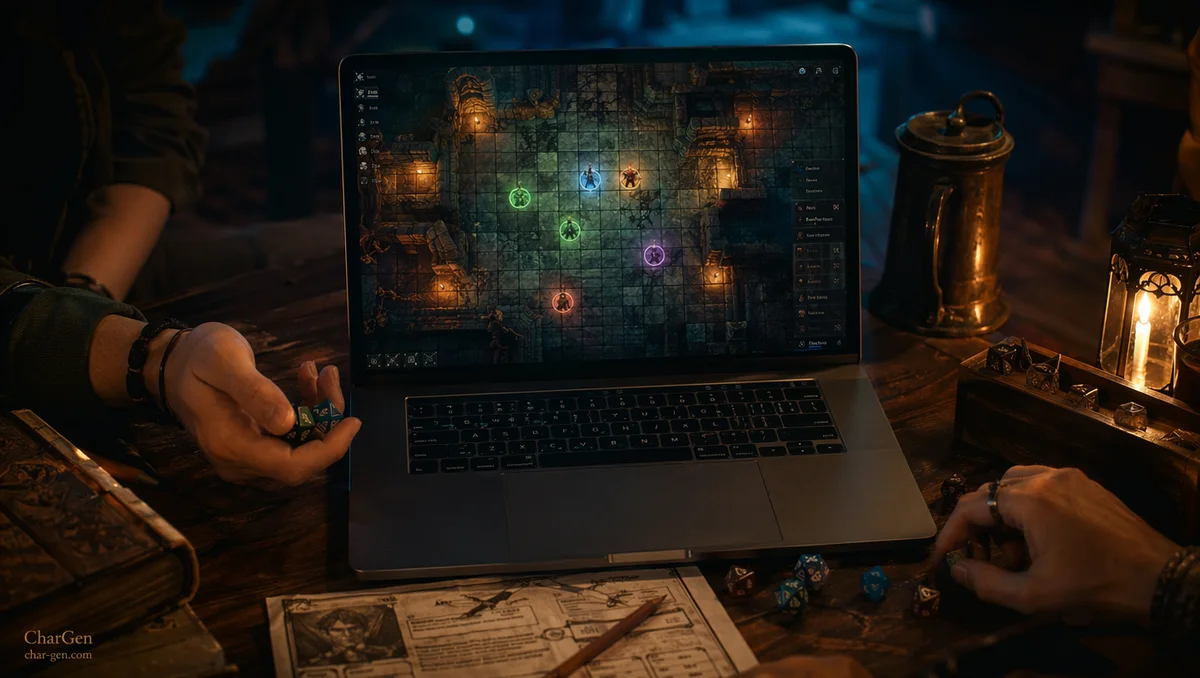
Foundry VTT is the exception on this list because there is no free tier. It is a one-time $50 purchase, shown as roughly £39.28 for buyers in the UK, and only the host needs a licence for the whole group to play. There are no per-player fees and no subscription, so the up-front cost is the entire cost forever. I mention it because it is the tool most groups graduate to once they want heavy automation and community modules, and knowing the number ($50, once) helps you decide whether the free tiers above are enough for now. For most new groups, they are.
Free character builders and free rules
Making a character should not cost anything, and mostly it does not.
D&D Beyond is the official home for 5e sheets, and a free account lets you build up to six characters using the free and basic content. The D&D Beyond Basic Rules are free to every player regardless of subscription, so a new player can roll up a fighter or a wizard without spending a penny. The paid tiers add the rest: Hero from $2.99 a month removes ads and the six-character cap, and Master from $5.99 a month lets one person share their purchased books with a whole campaign group. If your table has one person who owns the books, Master is often the only subscription the group needs.
Pathbuilder 2e is the tool Pathfinder 2e players swear by. It is a free download, and paying once (a one-time in-app purchase, not a subscription) removes the limits: $6.99 on iOS, for example. The free version already handles the whole character build, so that purchase is a thank-you and a few convenience features, not a wall. Note that the web, Android, and iOS versions are separate products with separate unlocks, so buying one does not carry across.
For 5e specifically, Aurora Builder is a free Windows app that ships with all the SRD content under the Open Gaming Licence, extendable with community content files. It is worth an honest warning: development has been "postponed indefinitely" since around 2020, so it is a stable old tool rather than an actively growing one. It still works, which is why it stays on the list, but I would not build a five-year campaign's whole workflow around it.
If you only take one fact from this section, take this one: the SRD 5.2.1 is a free CC-BY-4.0 download, which means the rules a character builder needs are legally free for anyone to use. That is why so many free builders exist at all.
Maps and battlemaps without a subscription
A map is the single most useful prop a DM can bring, and you do not have to pay to make good ones.
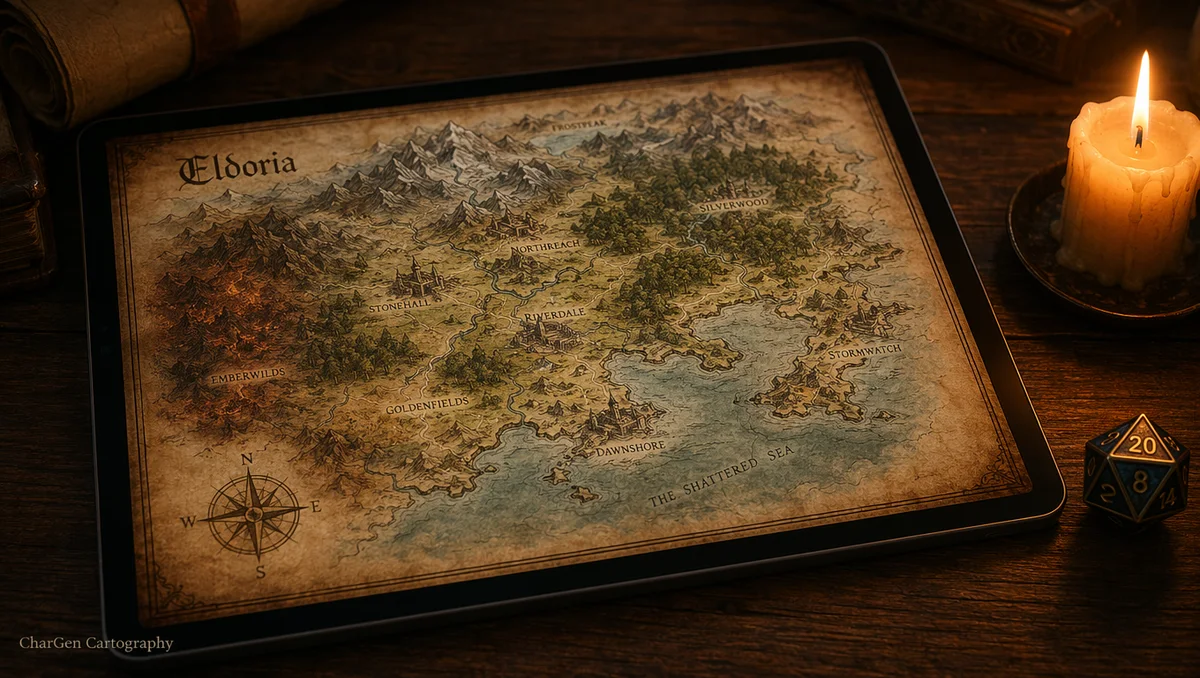
Azgaar's Fantasy Map Generator is the one I recommend first for whole-world cartography. It is free and open-source under the MIT licence, runs in a browser, and the licence explicitly grants commercial use of the maps you make. It generates continents with cultures, states, biomes, rivers, routes, and labels in seconds, and you can edit every layer by hand afterwards. For a homebrew world map, nothing free comes close.
Dungeon Scrawl is my pick for fast tactical dungeon maps. The free version gives you unlimited maps and PNG exports, including isometric support, and it stays free: it was created by Keir Moffatt, and Roll20 announced it had taken the tool under its wing in September 2023, keeping the core free for everyone. You can draw a dungeon in about the time it takes to describe one.
Inkarnate is the prettiest of the free options if you like a hand-painted look. The free Hobby tier gives you over 1,000 HD art assets, 2K export, and three saved maps for personal use. Three maps is the real ceiling here, so it suits a DM who wants one gorgeous regional map rather than a mapmaker churning out dozens. Paid Creator is $7.99 a month and Studio is $14.99 a month if you need more maps or commercial rights. If you want the deep comparison of map tools specifically, I wrote a whole piece on the best D&D map generators that goes further than I can here.
Generators and the AI prep layer
This is the category that has changed most, and it is where I spend the most prep time. Generators turn a blank page into a starting point, and the free ones range from decades-old table rollers to AI tools that draw the thing for you.
donjon is the grandparent of the lot, its code copyrighted from 2009 to 2026 by a developer known as drow, and it is entirely free with no account and no premium tier. It rolls dungeons, towns, world maps, names, NPCs, treasure, and encounters across a long list of systems, from old-school AD&D to 5e and sci-fi games. When I need a loot pile or a quick town in under ten seconds, donjon is still the fastest page on the internet.
Fantasy Name Generators has been running since around 2012 and now hosts over 1,400 named generators, all free and ad-supported. When a player asks for the tavern owner's name and I have not prepped one, this is the tab I open. The names are free to use in your own material as long as they are not already trademarked. When I want a batch styled to one region of my world, say Norse dwarves or Celtic elves, with a short meaning attached to each name, I use my own free fantasy name generator instead: 10 names per click, no account.
Eigengrau's Generator takes a different approach to the same table-roller category: it writes a town, its buildings, and the NPCs inside them as prose paragraphs meant to be read straight to the players, not a list of fields to translate on the fly. Click through from a building to the person running it and you get a name, a description, and a personality in one go. It is free, open source, and needs no account, the same as donjon, though the two do not overlap much: donjon is broader and faster for a flat table roll, Eigengrau's Generator is the one I reach for when I want the town to sound like something worth saying out loud. I went deeper on how it stacks up against the other free generators in my Eigengrau's Generator alternatives comparison.
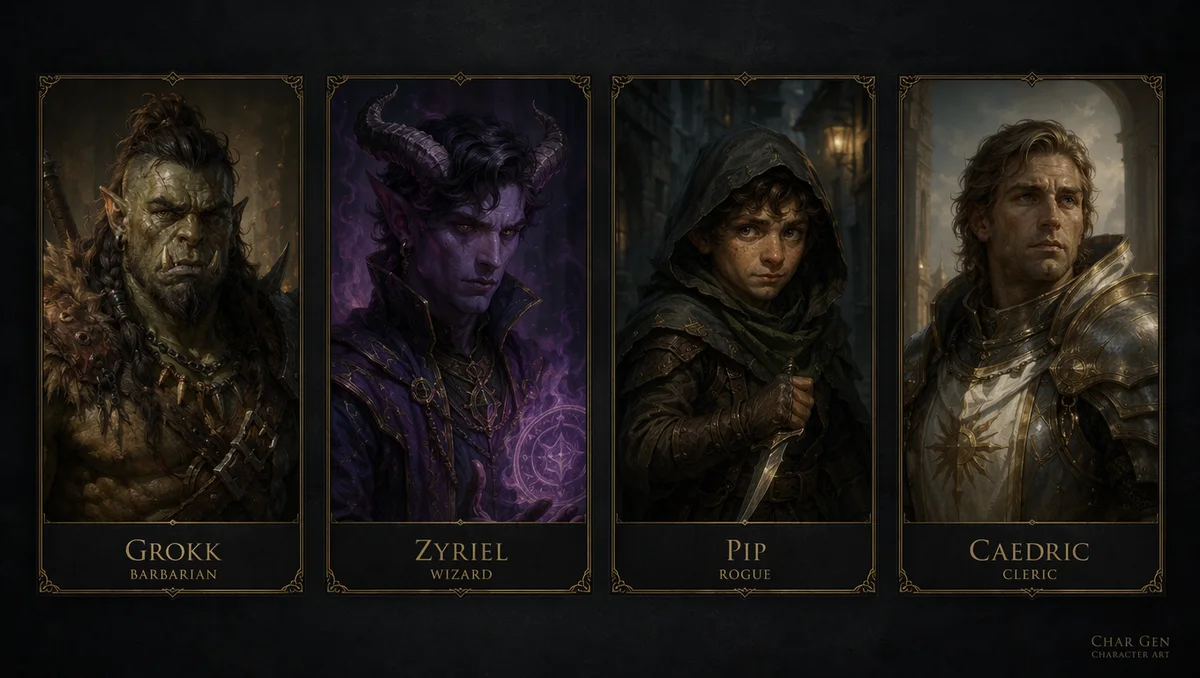
Where the older generators give you text, CharGen gives you the finished thing: a named NPC with a backstory, a shop with its keeper and stock, a settlement, a monster, and the art to show the table, all in one pass. It runs on a gold-based free tier, so it is free to start with no credit card: you get 25 gold when you sign up, 10 more each day you log in, and extra gold for commenting, posting, and joining competitions. One generation spends gold, and people who log in regularly build up more than enough to keep going. The platform carries over 160 AI models and 70-plus art styles, and its community has generated more than 830,000 images.
The reason CharGen sits in my prep routine is breadth. A single NPC generator is handy, but a stuck DM usually needs three things at once: the person, the place, and a picture. I generate the town in the RPG Workshop, stock it with owners from the NPC generator, drop a dungeon under it, and let the image generator draw the villain's face. If you specifically want the AI-only tools weighed against each other, I compared them in my roundup of the best AI TTRPG tools; this guide is the wider, free-first view that puts those AI tools next to the free dice rollers and map makers you will use alongside them.
Campaign notes and worldbuilding wikis
Every campaign eventually needs a memory, a place to keep who owes what to whom. The free tiers here are strong.
Obsidian is my personal choice for campaign notes. It is free for personal use with no sign-up and no limits, storing everything as plain text files on your own machine, which means your world is never locked behind someone else's server. A commercial licence is $50 per user per year if you are running a business off it, and optional Sync ($4 per user a month, billed annually) or Publish ($8 per site a month) add-ons exist, but a solo DM pays nothing. The linked-note structure is perfect for a world where the exiled prince connects to the border war connects to the missing caravan.
Kanka is the purpose-built option if you want a shared campaign database rather than a pile of notes. Its free Kobold tier gives you unlimited entries and unlimited campaigns with no credit card, which is unusually generous. Paid tiers (Owlbear at $4.99 a month, Wyvern at $9.99, Elemental at $24.99) mainly add premium campaigns, bigger uploads, and an ad-free experience. For a group that wants a wiki everyone can edit, free Kanka does the job.
World Anvil is the heavyweight, home to over 3.5 million worldbuilders. The free Freeman tier is more limited than the others, capping you at 2 worlds, 5 articles, 2 maps, and 100MB of storage with adverts, so it suits testing the water more than housing a huge setting. The paid Guild tiers start at $4.50 a month for Master when billed annually. It is the most structured tool of the three, which is a strength if you love templates and a burden if you just want a quick note.
Free ambient audio
Sound is the cheapest way to change the mood at a table, and the best option is completely free.
Tabletop Audio is ad-free and user-supported, with more than 500 ten-minute ambiences, over 80 hours in total, plus a SoundPad tool holding 1,100-plus sounds you can trigger on the fly. Everything streams free, and support is an optional Patreon rather than a paywall. It is the first tab I open before a session.
The paid contrast worth knowing is Syrinscape. A free Syrinscape account only lets you join a game someone else is hosting; to run your own soundscapes you need a SuperSyrin subscription at $12.99 a month, or cheaper system-specific packs at $8.50 a month each. It is more powerful and more interactive than Tabletop Audio, but for a DM on zero budget, Tabletop Audio covers the need without the invoice.
Dice and probability tools, free
Sometimes you don't want to roll, you want to know the odds before you write the house rule.
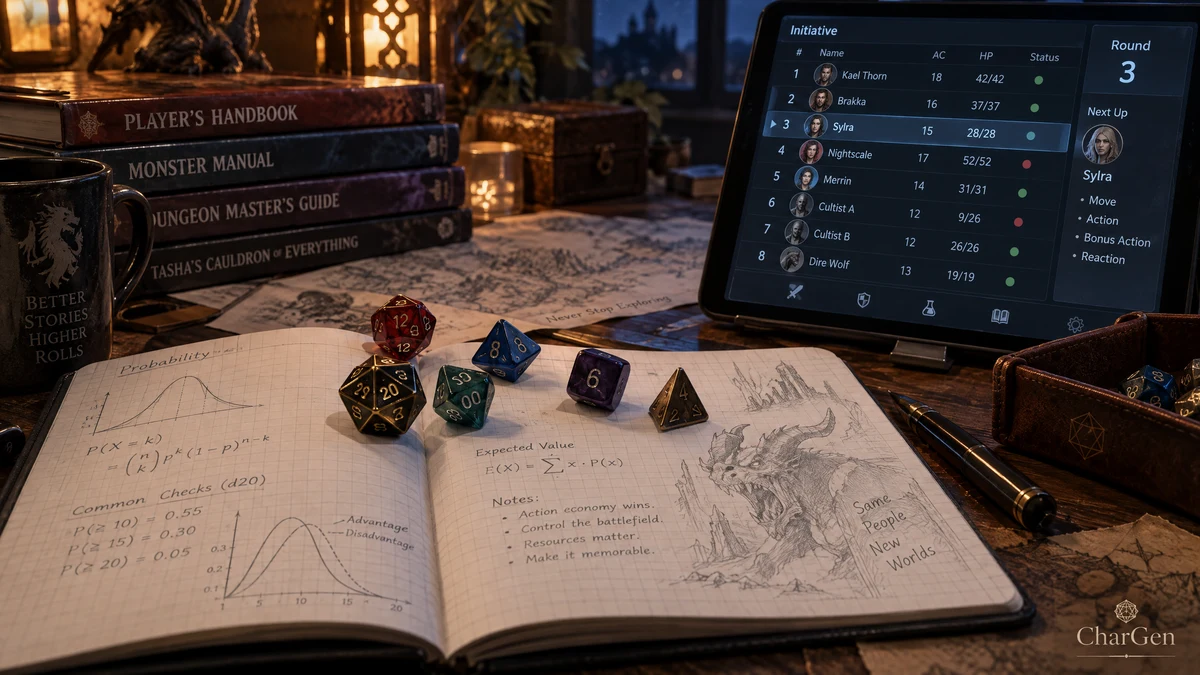
AnyDice is the one I reach for when I'm testing a homebrew mechanic. It's a free dice-expression calculator with no login: type in a roll, including exploding dice, drop-lowest, or custom-sided dice, and it plots the full probability distribution as a graph. If you're weighing whether advantage on a new class feature is too strong, AnyDice gives you the actual curve instead of a guess.
For a quicker single-roll question, the Awesome Dice Probability Calculator is a free one-page tool built for d20 systems specifically: put in the DC and your bonus, toggle advantage or disadvantage, and it gives you a straight percentage. No graphs, no scripting, just the number you needed before setting a trap's DC.
Combat and initiative trackers, free
Turn order is the bit that eats table time if you're doing it on paper, and the free web trackers handle it without asking for an account.
Improved Initiative is my pick: free, open-source, and installable as an offline app so a dodgy venue Wi-Fi doesn't stall the fight. It tracks HP and conditions, rolls initiative for you, and gives players their own shareable link showing just the turn order, so nobody is craning over the DM's screen to see who's up next.
Kobold Plus Fight Club is free and browser-based too, and its edge is the "Run" button: build your encounter with its SRD monster database, then flip straight into a live tracker with HP and a round counter, no retyping stat blocks into a second tool.
Free and paid asset marketplaces
Free tools cover prep. Sooner or later most tables buy something, an adventure, a map pack, a token set, and it's worth knowing where that money actually goes.
DriveThruRPG is the largest storefront by a wide margin, with thousands of free and pay-what-you-want titles alongside paid PDFs from $0.99 and full rulebooks typically $10 to $30. It's system-agnostic, so it's the first stop regardless of what you're running.
Dungeon Masters Guild is the official D&D-licensed marketplace, the only place fans can legally sell content set in the Forgotten Realms, Ravenloft, or Eberron. Adventures start around $2.95, with a good number of free and PWYW titles alongside the paid catalogue. If you specifically want more D&D content, this is a tighter, more curated search than the wider DriveThruRPG catalogue.
A zero-budget session-prep routine
Here is how these pieces actually fit together on a normal Tuesday, when I have about forty minutes before players arrive and no intention of spending anything.
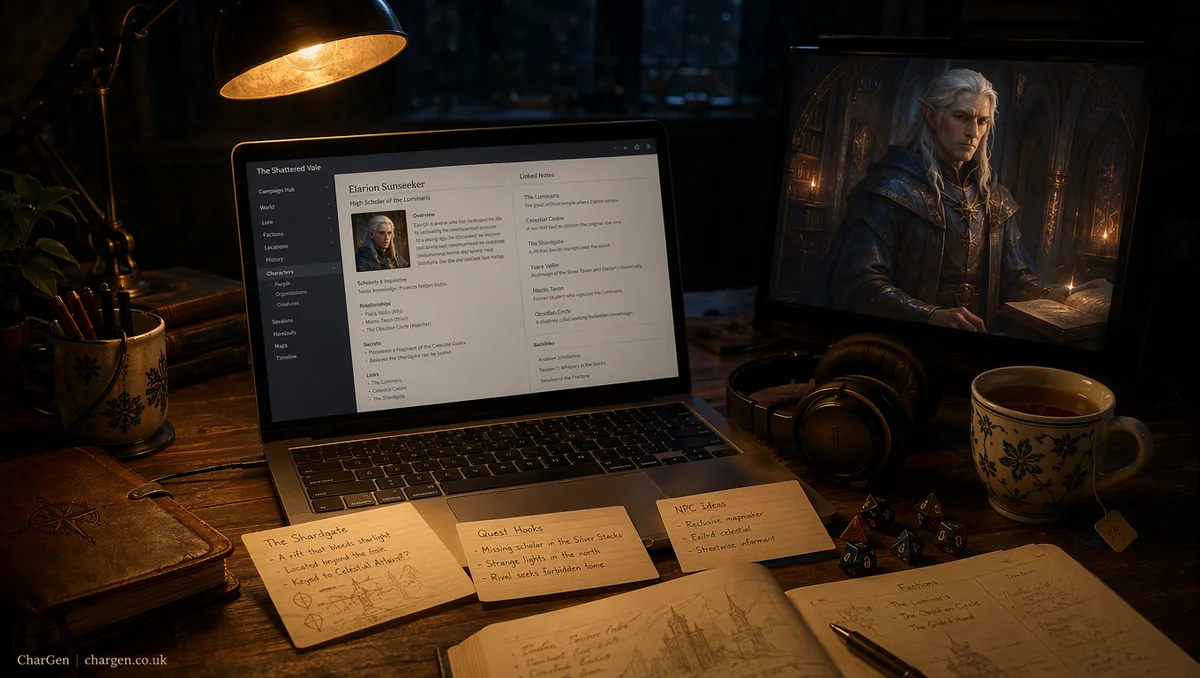
I start in CharGen's RPG Workshop and generate the location the party is heading to, the town or the dungeon, because the art and the NPCs come out together and that saves the most time. I pull the villain's portrait from the image generator so I have a face to show. Then I open Dungeon Scrawl if the session needs a tactical map, or Azgaar if the party is travelling and I need to point at the wider world. I drop the map and tokens into Owlbear Rodeo for the actual play. Names come from Fantasy Name Generators on demand, notes go into Obsidian, and Tabletop Audio runs the background the whole time. Total spend: nothing.
The point of a routine like this is not that free tools match every paid feature, because they do not. The point is that the friction of prep, the reason a session goes unprepped, is almost never money. It is time and blank pages. Free generators kill the blank page, free maps kill the drawing time, and a free VTT means the whole table can see the same thing.
Where free tiers actually stop
I would be lying if I said free covers everything, so here is the honest map of the ceilings. Owlbear's free tier caps you at two rooms, which bites if you run several campaigns at once. Roll20 Base is one game and 100MB, so a media-heavy campaign fills up fast. Inkarnate's three-map limit is the tightest on the list. World Anvil's free tier is genuinely restrictive at five articles. And Foundry has no free tier at all, though its $50 one-time cost undercuts years of any subscription.
The pattern is clear once you see it. Free tiers are generous on the things that scale cheaply, storage-light generation and single-campaign play, and stingy on the things that cost the provider real money, cloud storage and multiple concurrent games. If you run one campaign, you will rarely hit a wall. If you run four, you will eventually pay someone, and the cheapest honest answer is usually a single Roll20 or D&D Beyond subscription shared across the group, or the one-time Foundry licence.
FAQ
What are the best free digital tools for TTRPG in 2026?
For play, Owlbear Rodeo and Alchemy RPG both have strong free tiers, and Roll20's free Base plan runs a full game for five players. For maps, Azgaar's Fantasy Map Generator (open-source, MIT licence) and Dungeon Scrawl (free unlimited maps) lead. For prep, donjon is free for tables and loot, and CharGen has a free gold-based tier for AI NPCs, locations, and art. Tabletop Audio covers ambience for free.
Can you actually run D&D completely free?
Yes. The SRD 5.2.1 rules are a free CC-BY-4.0 download, D&D Beyond's Basic Rules and its builder (up to six characters) are free, Owlbear Rodeo or Alchemy handle the tabletop for free, and free generators and map makers cover prep. You only start paying when you want more concurrent games, more storage, or official published books beyond the basic rules.
What is the best free virtual tabletop?
For most groups, Owlbear Rodeo, because players join by link with no account and the free Nestling tier includes every tool with two saved rooms. Alchemy RPG's free tier is unlimited and better for theatre-of-mind across systems. Roll20's free Base plan is the best if you want the built-in marketplace and character sheets.
Is CharGen free to use?
Yes, it is free to start with no credit card. CharGen runs a gold-based system: 25 gold on signup, 10 more each daily login, and extra gold for commenting, posting, and competitions. Generations spend gold, so logging in regularly keeps you generating characters, NPCs, locations, and art without paying. Paid Plus (£9.17 a month) removes the gold constraint.
Which free tools work for Pathfinder, not just D&D?
Plenty. Pathbuilder 2e is the free go-to character builder for Pathfinder 2e, Alchemy RPG and Foundry both support Pathfinder, donjon has Pathfinder generators, and Syrinscape and Tabletop Audio are system-agnostic for sound. CharGen's art and worldbuilding generators are system-agnostic too, since an NPC portrait or a town does not care which ruleset you play.
If you only grab three tools to start, make them a free VTT, a free map maker, and a free generator: Owlbear Rodeo for play, Azgaar or Dungeon Scrawl for the map, and CharGen for the NPCs, locations, and art that turn a map into a place. Add Obsidian for notes and Tabletop Audio for sound when you want them, and you have a full campaign stack that cost you nothing but the time to set it up.