
DND Campaign Tracker: Keep Quests and NPCs Linked
Use a dnd campaign tracker to keep session notes, quests, NPCs, factions, and art linked without rebuilding prep after every game.
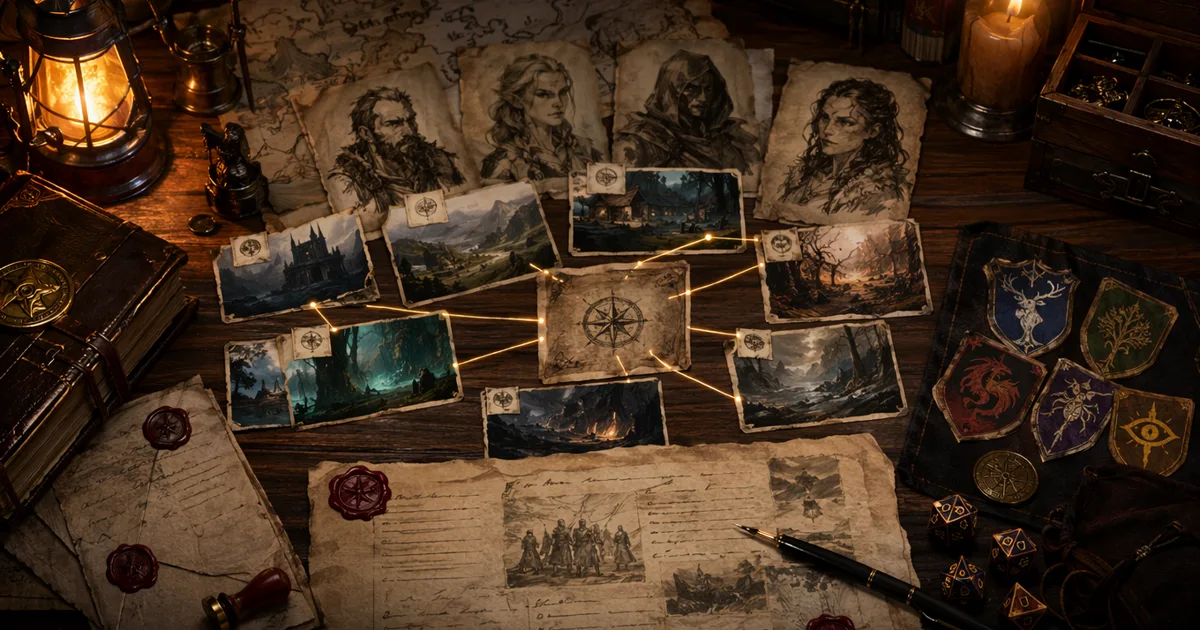
A dnd campaign tracker earns its keep when the party asks, "Wait, did we promise the grave priest we would find his sister, or did we threaten him?" That is the moment scattered notes turn into archaeology. I have done the tab shuffle: one Google Doc for session notes, one spreadsheet for NPCs, one Discord message with the actual clue, and a token file named final-final-actually-use-this.png. It works until it does not.
CharGen has been moving hard into this exact problem. The recent World Graph view shows NPCs, settlements, factions, shops, monsters, items, and other campaign pieces as a connected network inside World Codex. Quest and thread tracking now sits inside campaign and session pages, with objectives, rewards, progress notes, linked entities, and session-level movement. Pair that with RPG Session Notes, and you get something more useful than a pretty wiki: notes that turn into table actions.
I am not pretending every DM needs software for this. If your campaign is three sessions long and everyone remembers the goblin's name, paper is fine. For long campaigns, political games, mystery arcs, West Marches tables, or groups that meet once a month, I want the machine to remember the boring parts. Not the story decisions. The boring parts.
What a dnd campaign tracker needs to remember
Most campaign tools solve one slice of the job. A notes app stores text. A wiki stores pages. A VTT stores maps and tokens. A quest tracker stores checkboxes. The real campaign is messier than that.
Here is the minimum I want from a tracker before I trust it with a serious campaign.
| Need | What good looks like | What breaks at the table |
|---|---|---|
| session memory | recaps, decisions, unresolved clues, loot, and promises tied to dates | one huge note nobody rereads |
| NPC tracking | motives, last appearance, relationships, images, and secrets | "Boblin 2" with no reason to exist |
| quest state | open, active, completed, failed, rewards, objectives, and progress notes | players chase a thread I quietly forgot |
| relationship view | people, places, factions, shops, and items shown in context | every page feels isolated |
| player-safe notes | spoiler-free recaps and DM-only material kept apart | one accidental reveal wrecks the mystery |
| visual handoff | portraits, tokens, maps, and item art attached to the records they belong to | art files drift away from the canon |
That last row is where CharGen is different from a normal campaign manager. It is not only storing text. It can generate the NPC portrait, make the faction, create the magic item, turn a session into a recap, and then show how those pieces touch each other later.
The broader DM tool market is clearly circling the same pain. Runekeeper talks about automatic note linking and interactive campaign maps. Quest Scribe pitches a shared party memory with recaps, NPC tracking, and campaign maps. The Chronicler records sessions and extracts NPCs, quests, and plot threads. Bardlog focuses on Discord recording, transcripts, AI summaries, and campaign wiki extraction. Those tools exist because most DMs have the same quiet problem: we can improvise drama, but we cannot always remember which minor noble funded it.
The campaign tracker problem is not note taking
Bad campaign tracking usually starts after a good session. The table was lively. Players made choices. You scribbled three words about the smuggler captain, promised yourself you would tidy the notes later, then ran out of time. Two weeks later the same captain returns, except now you cannot remember whether she had a scar, a sister, or a debt to the shrine.
That is not a moral failure. It is normal.
The useful question is not "how do I take perfect notes?" It is "which details need to survive until they matter again?" Mike Shea's Sly Flourish note organisation advice is good here because it keeps prep centred on characters, NPCs, session notes, secrets, clues, locations, monsters, and treasure. You do not need to write a novel. You need reusable handles.
For my own campaigns, I care about five handles:
| Handle | Example |
|---|---|
| who changed | The captain now distrusts the cleric because he lied about the relic. |
| what moved | The missing bell quest advanced when the party found the chapel map. |
| who saw it | The rogue and paladin witnessed the ghost, but the wizard was away. |
| what is now visible | The Saint Marrow faction knows the party entered the crypt. |
| what image belongs to it | The captain portrait and token are now the public reference. |
If my tracker stores those five things, the next session starts cleaner. If it does not, I am just making prettier clutter.
Where CharGen's World Graph helps
CharGen's World Graph is the bit I wanted years ago. Open World Codex, switch from Cards or List to the Graph view, and your campaign entities appear as connected cards on a canvas. NPCs, factions, shops, settlements, regions, dungeons, monsters, taverns, items, and other records can all show up with links between them.
The practical parts matter:
| Feature | Why it helps |
|---|---|
| Graph view inside World Codex | you can see connections instead of opening pages one at a time |
| image-backed cards | portraits and icons make the graph readable at a glance |
| saved card positions | you can drag the important cluster into a layout that makes sense to you |
| search by name | the graph focuses on one entity and its direct connections |
| Campaign and Bundle filters | one campaign or prep bundle can be shown without unrelated clutter |
| type chips | quickly show only NPCs, factions, shops, items, or other entity groups |
| Hide unconnected toggle | removes lonely records while you are scanning story links |
| entity page preview | a small relationship map appears in the entity's Relationships section |
| Open in World Graph | jumps from one entity page to the full graph focused on that entity |
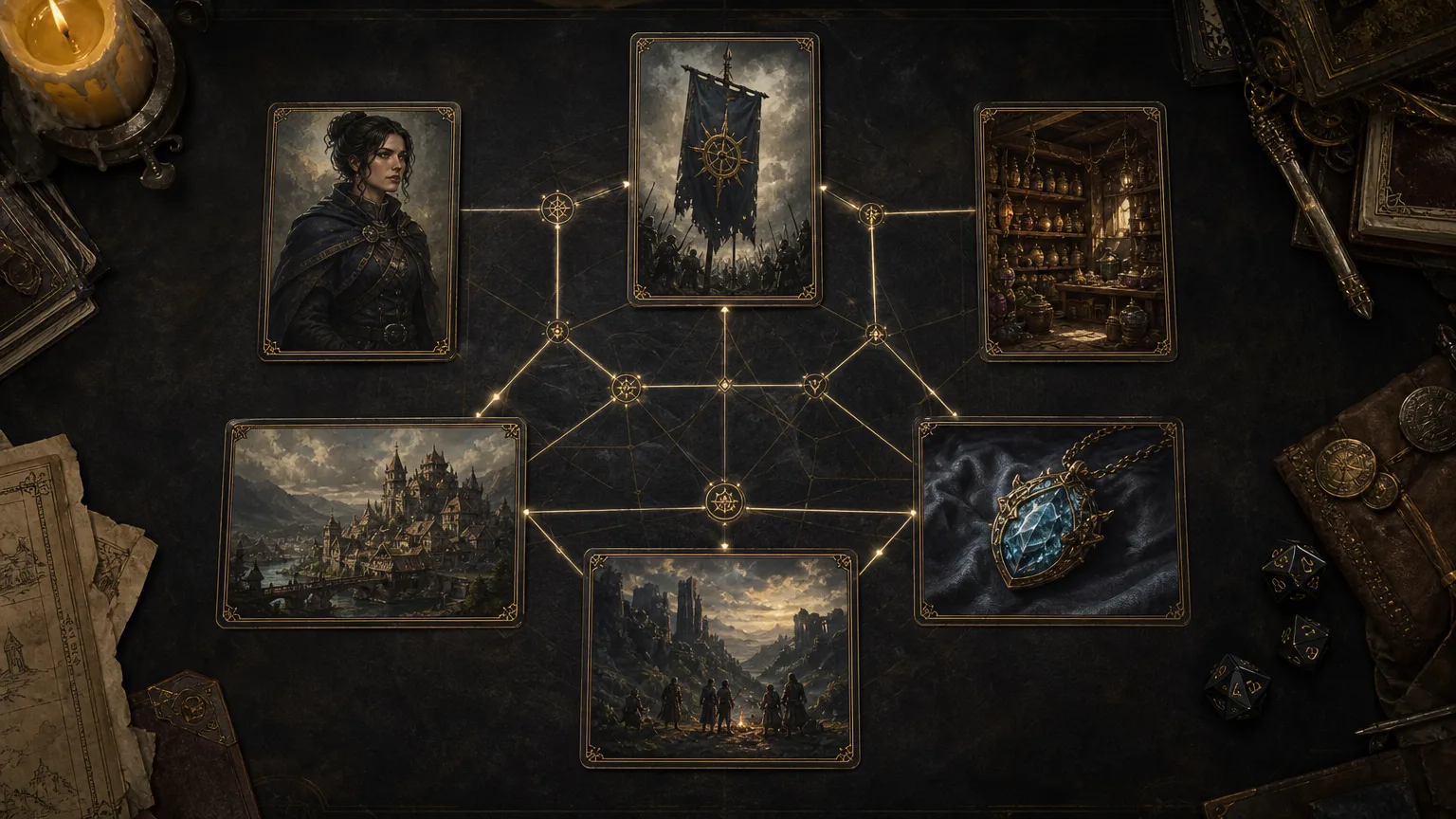
Here is a concrete example. Say the party meets Harra Vale, a half-orc undertaker in a river town. She runs the ash house, owes money to the Saint Marrow faction, keeps a haunted lantern hidden behind the counter, and knows where a missing child was last seen. In a flat notes app, that becomes a paragraph. In World Graph, Harra links to the settlement, the faction, the magic item, and the active quest. When the players say "let's go back to the undertaker", I can see the whole knot.
That visual context is more useful than it sounds. It stops me treating NPCs as vending machines for clues. If Harra links to a faction and an item, I am more likely to play her as someone under pressure. If the haunted lantern links to a quest reward and a session recap, I am less likely to forget who took it.
Quest and thread tracking should live beside session notes
A dnd quest tracker is not only a list of open jobs. It should tell you what moved last session, who was involved, what reward was promised, and which loose thread can become a real quest.
CharGen's newer quest and thread tracking does that in a way I like. Quests now have status badges, objective progress bars, rewards, progress notes, and quick objective check-offs on the card. Loose threads can be promoted into full quests, and CharGen can pre-fill them from recent session events so you can edit before saving.
The tabs matter too. Quests and Threads now sit inside campaign pages alongside the rest of the campaign material. Session pages can show Quests and Threads inline, and a session can show which quests advanced during that game. That last line is tiny, but it is exactly the thing I forget when I am tired.
| Campaign moment | How I would track it |
|---|---|
| party accepts a rescue job | create a quest with objectives, linked NPC, and promised reward |
| players find a clue but ignore it | keep it as a thread, not a full quest yet |
| faction makes a threat | link the faction, target NPC, and relevant session |
| reward changes | update the Rewards line instead of burying it in recap prose |
| players resolve it badly | mark failed or resolved, then note the fallout |
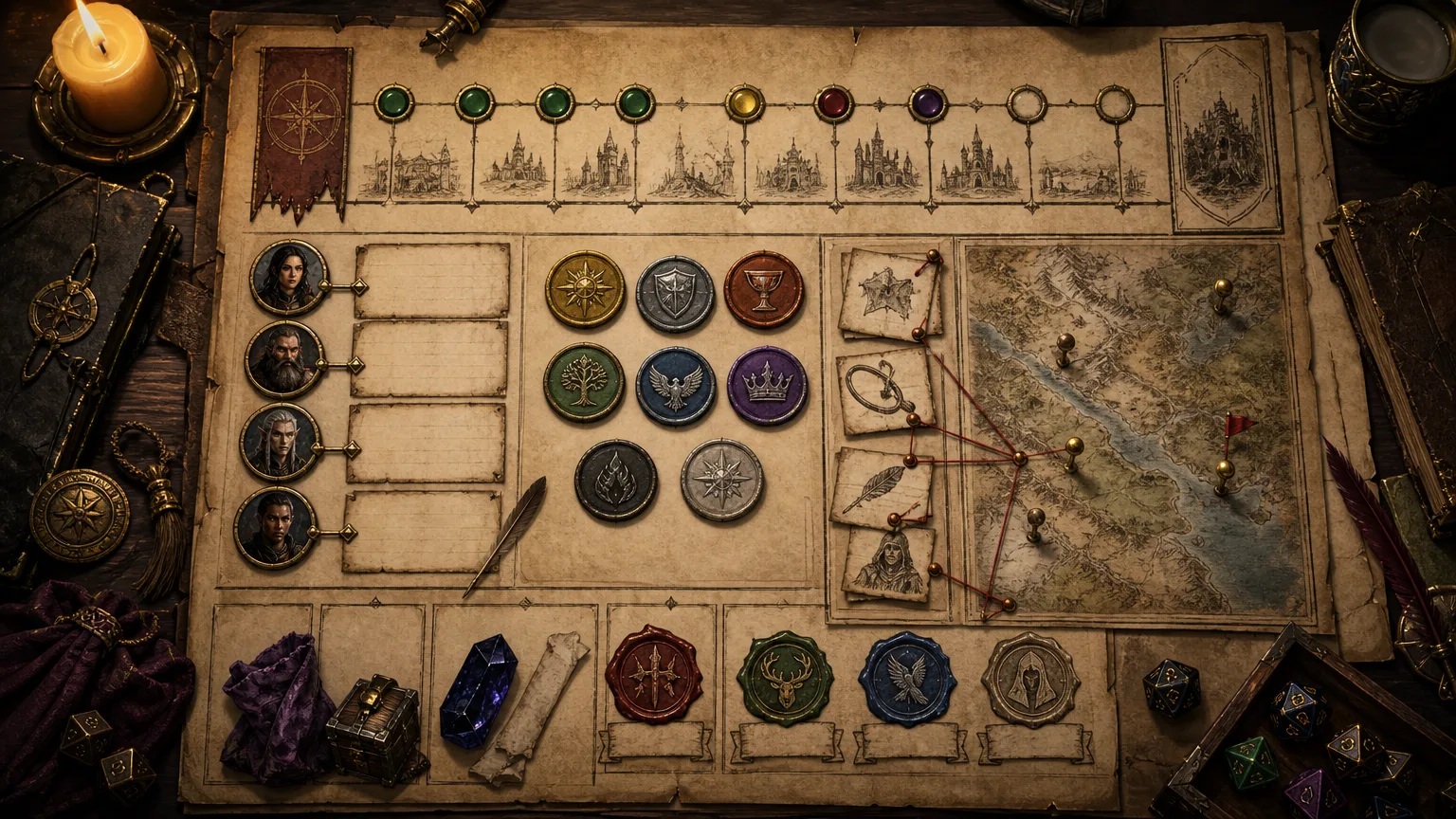
I would use this for a city intrigue arc. The active quest is "Return the Funeral Bell". The objectives are find who stole it, enter the drowned chapel, and decide whether Harra keeps it. The rewards line says rare lantern, Saint Marrow favour, 150 gp. The linked entities are Harra Vale, Saint Marrow, the drowned chapel, and the Lantern of the Last Door. If the party gives the bell to the wrong faction, the quest does not vanish. It changes state.
That is the difference between a tracker and a to-do list.
My CharGen workflow after a session
I do not want admin work after a four-hour game. My post-session routine has to be short or I will skip it.
This is the workflow I would actually use.
| Step | Time | CharGen area | What I do |
|---|---|---|---|
| capture recap | 5 minutes | RPG Session Notes | paste notes or transcript, then generate a recap |
| review player-safe text | 3 minutes | session recap | keep spoilers out of the visible summary |
| approve entities | 5 minutes | campaign review | approve or edit NPCs, places, factions, items, and threads |
| update quests | 5 minutes | Quests and Threads | tick objectives, add rewards, promote loose threads if needed |
| check the graph | 3 minutes | World Graph | search the main NPC and confirm links look sane |
| attach images | optional | entity pages and generators | generate portraits, item art, or tokens for recurring pieces |
The optional image pass is where CharGen feels most joined-up. If the party met a new rival, I can use the NPC Generator to make the record more memorable. If they gained a strange reward, I can use the Magic Item Generator and link it back. If the next game needs a location, Region Generator, Dungeon Generator, or Shop Generator can build the next piece from the same campaign context.
I try not to overdo it. Not every barkeep needs a portrait, a voice note, a tragic childhood, and a token. That way lies madness and six tabs of unused material. I give assets to the characters and objects that players are likely to see again.
Start Tracking Your Campaign FreeComparison: CharGen versus campaign notes tools
There are a lot of good tools in this space now. I would not call CharGen the best choice for every table, because that depends on what you are trying to protect.
| Tool | Best for | Strength | Limitation |
|---|---|---|---|
| CharGen | AI session notes, entity generation, relationship graph, visual campaign assets | joins recaps, NPCs, factions, quests, items, images, and World Graph | not a rules-first VTT or official sheet manager |
| Obsidian | text-first DMs who like local Markdown | backlinks, canvases, plugins, offline control | you build the structure yourself |
| Notion | shared campaign wiki and databases | flexible tables, player pages, templates | can become slow and fussy in large campaigns |
| D&D Beyond | official character and campaign account flow | player sheet access and official content support | weaker for freeform world relationships and custom art |
| Runekeeper | campaign notes, maps, scheduling, party coordination | built around shared campaign management | less focused on AI image and entity generation |
| Quest Scribe | shared party memory and searchable recaps | party-facing canon and session recall | art and token workflows sit elsewhere |
| The Chronicler | audio-led AI campaign memory | records sessions and extracts NPCs, quests, and threads | recording consent and audio quality need care |
| Bardlog | Discord recording and transcript review | speaker-separated recording and synced playback | the main strength is transcript memory, not visual worldbuilding |
If your notes are already excellent in Obsidian, do not move everything just because a new graph exists. Use the tool that matches the pain. If your pain is "I cannot find the note", Obsidian or Notion may be enough. If your pain is "I need the NPC, art, recap, quest, faction, and token to stay connected", CharGen is the cleaner fit.
Worth mentioning though: audio recording needs consent. A recent Reddit thread about AI note-taking had people reacting badly to a DM recording without clear agreement. I think they were right to be annoyed. If you record sessions for any AI recap tool, say so before the campaign starts, explain what gets stored, and give players a real chance to opt out. The best campaign tracker in the world is not worth breaking table trust.
A practical campaign tracker template
If you are setting up a campaign from scratch, start smaller than you think. I would create these buckets and stop.
| Bucket | Keep |
|---|---|
| Cast | PCs, recurring NPCs, villains, hirelings, family members |
| Places | settlements, dungeons, regions, shops, temples, safe houses |
| Factions | goals, leaders, enemies, resources, current opinion of the party |
| Quests | objective, reward, status, linked people and places, last movement |
| Threads | clues, rumours, unresolved questions, player suspicions |
| Items | magic items, keys, relics, dangerous evidence |
| Sessions | recap, decisions, loot, absences, changed relationships |
| Visuals | portraits, tokens, maps, item art, storyboard images |
The trick is linking each new detail to at least one other thing. A quest with no person, place, or faction attached is probably too thin. An NPC with no motive or relationship is probably just a name. A magic item with no owner, maker, or location is loot confetti.
Here is my quick rule: every important record gets one anchor and one pressure.
| Record | Anchor | Pressure |
|---|---|---|
| NPC | where they belong | what they want now |
| faction | who leads it | what it will do if ignored |
| quest | who cares | what gets worse with time |
| item | where it came from | why it is risky |
| location | who controls it | what changed recently |
Use that inside CharGen and the World Graph becomes more than a pretty diagram. It becomes a check on whether your campaign has working connections.
Common campaign tracking mistakes
I have made all of these.
| Mistake | Better habit |
|---|---|
| tracking every detail | track details that change future play |
| writing only prose recaps | pull out quests, NPC changes, rewards, and clues as separate records |
| no player-safe version | keep spoiler-free recap text separate from DM notes |
| NPCs without motives | add one want, fear, or pressure |
| quests without rewards | record coin, favours, items, information, or consequences |
| images outside the record | attach portraits, maps, and item art to the entity they depict |
| graph with too much noise | use Campaign filters, type chips, and Hide unconnected |
| never closing loops | mark failed, completed, abandoned, or transformed quests |
The biggest one is tracking everything. A tracker should reduce cognitive load. If it becomes a second campaign you have to run, it has failed.
How I would prep next session from the tracker
Imagine last session ended with the party finding the drowned chapel map, angering Saint Marrow, and promising Harra Vale they would retrieve the stolen bell.
My next prep pass would look like this:
| Prep question | Tracker check |
|---|---|
| who matters tonight | search Harra Vale in World Graph and pull her direct links |
| what quest moved | open Quests and check objective progress for Return the Funeral Bell |
| what changed politically | open Saint Marrow and check linked sessions and enemies |
| what can players see | review the spoiler-free recap before sharing |
| what asset is missing | generate a bell relic image or chapel map if the next scene needs it |
| what clue should return | turn the ignored chapel inscription into a thread note |
That takes ten minutes. More importantly, it starts from what the party actually did, not what I hoped they would do.
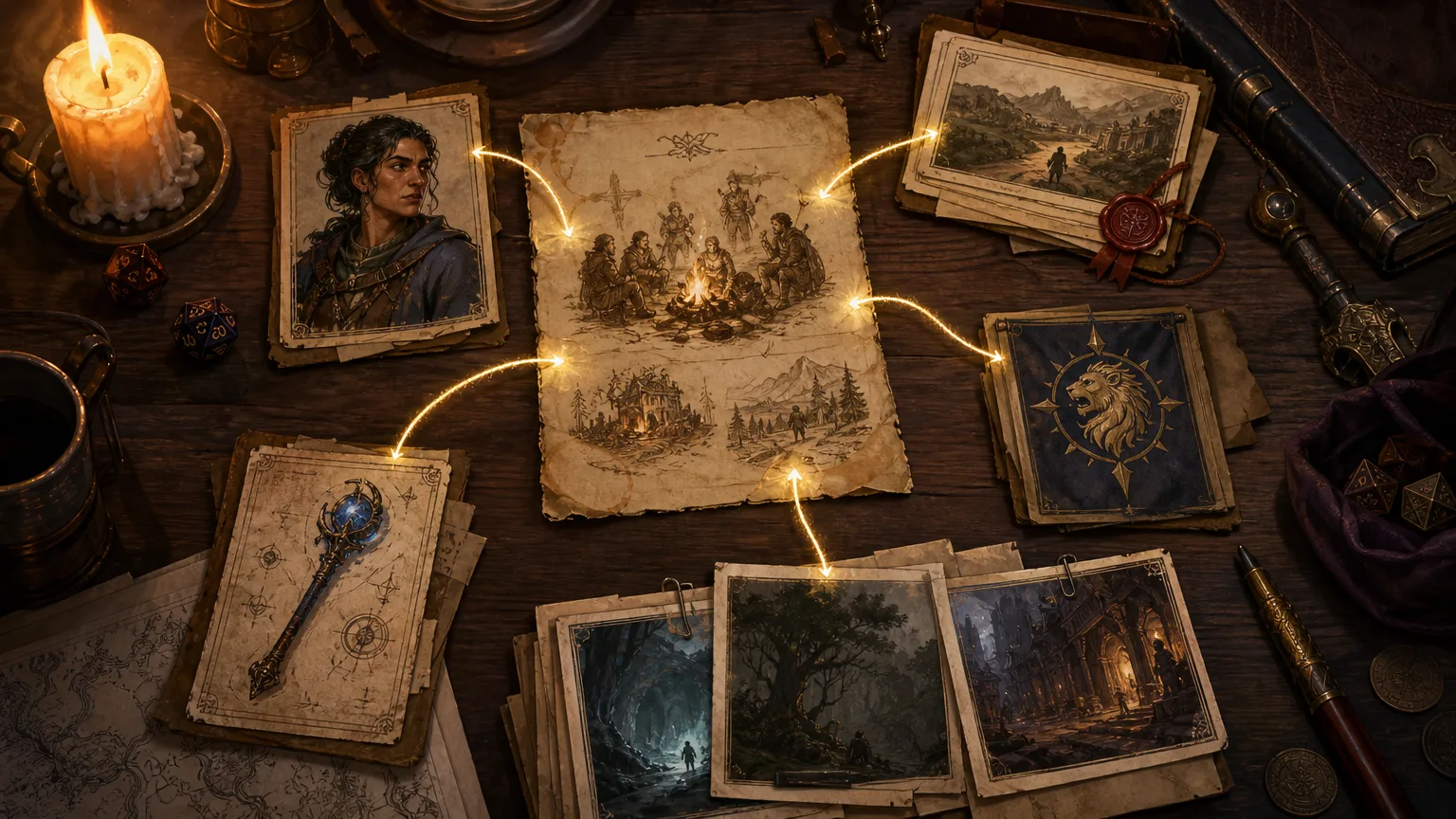
I like ending prep with one sentence per active thread:
| Thread | Next pressure |
|---|---|
| Return the Funeral Bell | Saint Marrow sends someone else after it at midnight. |
| Harra's debt | Harra offers information if the party clears one ledger entry. |
| Lantern of the Last Door | the lantern reveals a ghost only one character can hear. |
That is enough. I do not need to script the whole night. I need the tracker to hand me the live wires.
FAQ
What is the best dnd campaign tracker for long campaigns?
For long campaigns with linked NPCs, quests, factions, session recaps, and art, I would start with CharGen's World Codex and World Graph. If you only need text notes and local files, Obsidian is still excellent.
Can CharGen track D&D quests?
Yes. CharGen supports quest and thread tracking with status badges, objectives, rewards, progress notes, linked entities, and session-level movement. Loose threads can also be promoted into quests.
What should I track after each D&D session?
Track decisions, changed relationships, open quests, resolved quests, new NPCs, important items, clues found, clues missed, rewards, and anything that affects the next session. You do not need a full transcript unless your group wants one.
How do I track NPC relationships in D&D?
Give each important NPC a motive, a current attitude, links to factions or places, and the last session where they changed. A graph view helps because it shows who is connected instead of hiding everything in separate pages.
Should I record sessions for AI notes?
Only with clear table consent. Tell players what you are recording, what tool processes it, where it is stored, and who can access the recap. If anyone is uncomfortable, use written notes instead.
Summarise a SessionMy final recommendation
Use a campaign tracker for continuity, not control. The job is to remember names, promises, quest movement, faction pressure, and visual references so you can run the table with less rummaging.
CharGen is strongest when your campaign notes and generated assets need to live together. Start with RPG Session Notes, approve the useful entities, open World Codex, and check the Graph view before your next session. If the graph shows who wants what, which quest moved, and what image belongs to the scene, you have enough to run the next game.
One last practical rule: after every session, update only the three things most likely to matter next time. The tracker can hold the rest, but your prep should stay light.
Image credits
Images in this post were generated with WaveSpeed GPT Image 2 at medium quality, then cropped, resized, and converted to WebP for web use.