
The Ashcombe Legacy Circle
Ashcombe's expedition departed in 1918 during the final years of the Great War, advertised as a scientific and geographical mission but partly financed through military intelligence and private collecting interests. Thirty-six men entered the Green Expanse. Only seven returned. Their reports contradicted one another so completely that the public assumed trauma and exhaustion had damaged their memories. Ashcombe used this confusion to conceal the artifact, presenting botanical samples, maps, and animal trophies as the expedition's principal achievements. In 1919 he was knighted, became wealthy through private sales, and established the Blackwood circle to control the remaining evidence. The first watershed moment came in 1920, when a London photographer produced a plate showing a small ash-covered figure standing behind Ashcombe during a formal reception. No one remembered the figure being present. Within weeks, the photographer disappeared, three guests reported the same dream, and Ashcombe ordered every copy destroyed. The second watershed moment came six months before the household was abandoned. A maid found dozens of tiny footprints leading from the museum wing to the nursery, where every mirror had been turned toward the wall. That night, several clocks stopped at the same minute, and Ashcombe sealed the lower vault. The household fled over the following weeks. Since then, the faction has survived as a struggle among people who want to inherit, sell, redeem, or bury the Ashcombe legacy.
The Ashcombe Legacy Circle
- Type
- Legacy network
- Size
- 60 members
- Reach
- Moderate in public…
- Base
- Blackwood Hall, outside the village of Merecombe in rural England, with active contacts in London museums, military clubs, auction houses, and private collections.
Overview
Ashcombe's expedition departed in 1918 during the final years of the Great War, advertised as a scientific and geographical mission but partly financed through military intelligence and private collecting interests. Thirty-six men entered the Green Expanse. Only seven returned. Their reports contradicted one another so completely that the public assumed trauma and exhaustion had damaged their memories. Ashcombe used this confusion to conceal the artifact, presenting botanical samples, maps, and animal trophies as the expedition's principal achievements. In 1919 he was knighted, became wealthy through private sales, and established the Blackwood circle to control the remaining evidence. The first watershed moment came in 1920, when a London photographer produced a plate showing a small ash-covered figure standing behind Ashcombe during a formal reception. No one remembered the figure being present. Within weeks, the photographer disappeared, three guests reported the same dream, and Ashcombe ordered every copy destroyed. The second watershed moment came six months before the household was abandoned. A maid found dozens of tiny footprints leading from the museum wing to the nursery, where every mirror had been turned toward the wall. That night, several clocks stopped at the same minute, and Ashcombe sealed the lower vault. The household fled over the following weeks. Since then, the faction has survived as a struggle among people who want to inherit, sell, redeem, or bury the Ashcombe legacy.
How it began
Sir Reginald Ashcombe founded the circle after returning to England in 1919 with six surviving members of an expedition that had begun with thirty-six men. During the public triumphal tour, Ashcombe presented himself as a disciplined explorer who had overcome disease, hostile terrain, and logistical disaster. Privately, he gathered his secretary, trusted servants, military patrons, curators, and financiers in Blackwood Hall and made them swear to protect the expedition's records until he decided how to reveal his greatest discovery. The oath was less a brotherhood than a bargain. Each participant received money, status, access to artifacts, or a promise of future recognition. None received the entire truth. After Ashcombe died or vanished from public life, the circle fractured into competing custodians. Some believed the artifact should be displayed as the crowning achievement of British exploration. Others wanted to sell it to an aristocratic collector. A frightened minority understood that every conversation about the fetish seemed to coincide with disappearances, altered memories, and impossible disturbances. They chose silence, but never agreed on what silence required.
How to know them
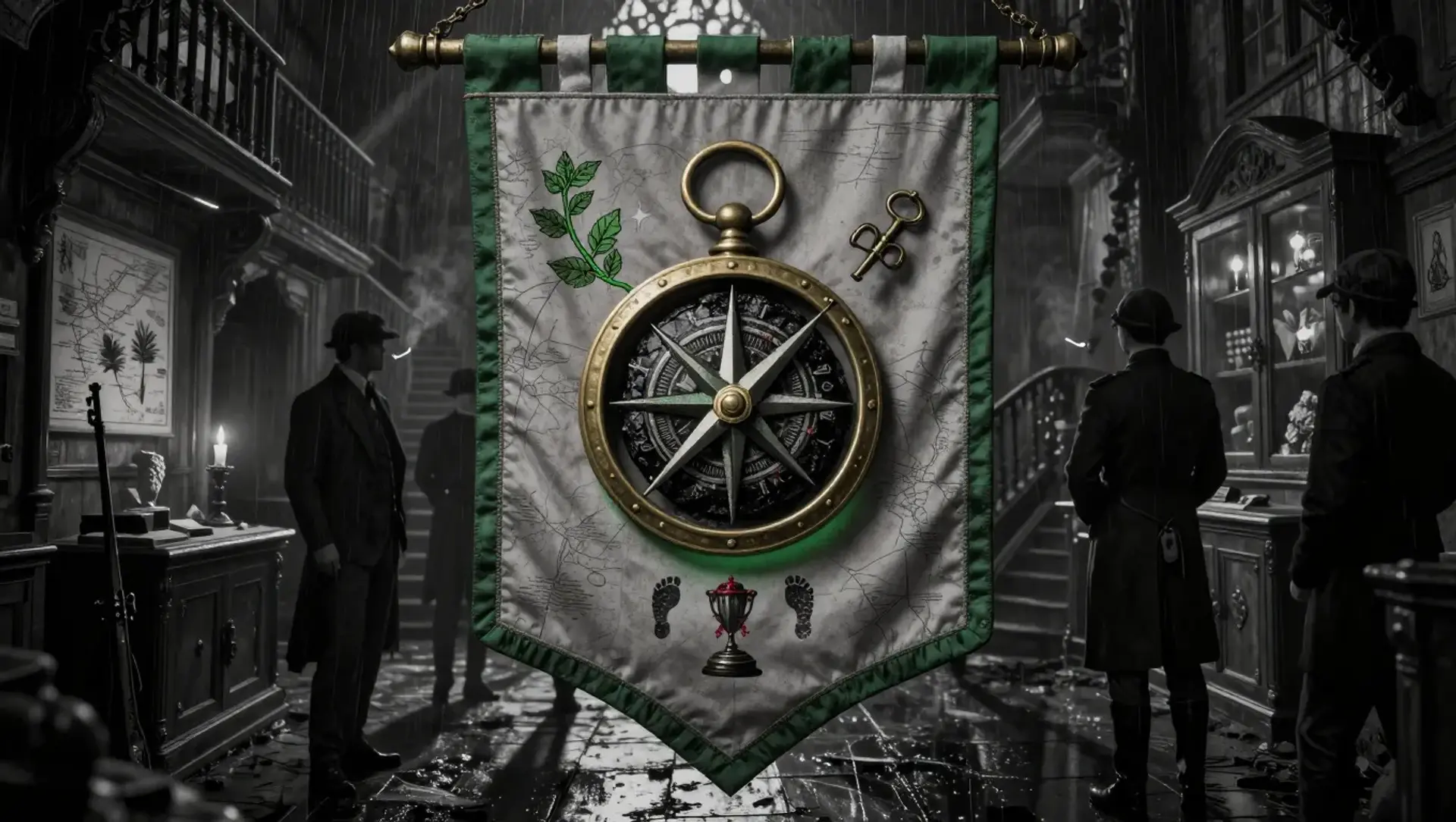
- Bottle green
- Tarnished brass
- Ash gray
- Blood red used only in private insignia
- A black stone enclosed by a compass ring
- Three tiny footprints pointing away from a trophy pedestal
- A green thread stitched inside the cuffs of senior servants
- A brass key with no visible lock
- The phrase Stone is not prison, used only by those who have heard Toma speak
Standing
What they say they want
What they are doing now
Where it leads
The faction's competing visions cannot coexist. The museum members imagine a controlled institution dedicated to Ashcombe's discoveries. The military patrons want a national legend and future expeditions. The collectors want private ownership. Edith Vale and a few frightened survivors want the artifact returned to the Green Expanse and the records destroyed. The most dangerous long-term possibility is that the faction succeeds in creating an international sensation around the fetish, turning the Hunter's attention toward London and everyone who has learned its story.
How others see them
To respectable society, the circle appears to be an informal but prestigious network of explorers, scholars, officers, servants, and patrons preserving the memory of a celebrated adventurer. Some see them as guardians of national heritage. Others regard them as eccentric aristocrats protecting a scandal. In Merecombe, they are associated with unpaid debts, abandoned servants, strange noises, and the deaths of people who asked too many questions.
People
5 ranks
Executor of the Ashcombe Estate
Measured, observant, and socially formidable. She is capable of genuine compassion, but years of secrecy have made her view deception as a form of care.
- The Ashcombe Executor1 member
Controls the surviving legal estate, decides which records are released, negotiates with museums and buyers, and claims authority over all legitimate recovery efforts.
- The Four Custodians4 members
Represent the estate, military patrons, museum interests, and private collectors. They vote on major decisions, but each controls separate information and resources.
- The Returned Men7 members
Surviving expedition personnel who provide testimony, security, field knowledge, and competing interpretations of the Green Expanse.
- The Blackwood Retainers18 members
Former servants, estate workers, drivers, clerks, and house staff who maintain old contacts and know the physical secrets of Blackwood Hall.
- The Corresponding Patrons30 members
Collectors, officers, academics, journalists, and financiers who provide money, introductions, transportation, and social pressure without being told the full truth.
Other key members
- Thomas Rook Surviving rifleman and reluctant witness
- Dr. Miriam Bell Scientific curator of the Ashcombe Collection at the Royal Museum of Antiquities
- Lord Silas Vane Aristocratic buyer and principal financier of the recovery effort
- Colonel Alistair Harcourt Military patron and chair of the Imperial Sporting Committee
- Toma Elderly guardian, historical adversary, and hidden resident of Blackwood Hall
How they are organised
- A personal connection to Ashcombe, Blackwood Hall, the expedition, or one of the institutions controlling its records
- Willingness to protect the faction's secrecy and accept that official history may differ from personal knowledge
- Access to money, authority, scholarship, transportation, or useful testimony
- For inner-circle membership, direct knowledge of the artifact or possession of a document that could affect its ownership
Relations
14 factionsSeveral London museums and learned societies value Ashcombe's maps, journals, specimens, and reputation. Their curators provide credentials, transport, legal cover, and discreet access to archives, though most do not understand the danger of publicizing the artifact.
Operations
What they do
How they do it
Services for hire
- Ashcombe AuthorityA substantial fee or a favor owed to the estateProvides a forged letter of introduction, museum credential, military pass, or legal claim to justify entry into restricted locations.
- Quiet PassageA share of recovered valuables or future patronageArranges discreet transport of expedition relics through London warehouses, private rail compartments, or shipping contacts.
- The Blackwood InquiryAccess to a personal secret, criminal record, or damaging correspondenceUses its network to investigate a person connected to the expedition, the estate, or a competing claimant.
- Restricted ConsultationA promise never to publish or repeat the resultAllows trusted investigators to consult journals, maps, survivor statements, and catalogued specimens.
- Expedition SupportA favor of equal dangerProvides armed escorts, estate keys, servants' maps, or specialized equipment for recovering objects from Blackwood Hall.
What they can do
What they have
Where they are weak
Territory
Headquarters
Blackwood Hall, outside the village of Merecombe in rural England, with active contacts in London museums, military clubs, auction houses, and private collections.Blackwood Hall is a sprawling Jacobean revival manor surrounded by wet lawns, neglected glasshouses, overgrown hunting paths, and a private museum wing. Its public rooms display trophies from the expedition, including weapons, botanical cases, maps, masks, and animal specimens. The lower vault is concealed behind a false wall beneath the museum's cartography room. The estate is both headquarters and trap. Documents have been hidden in servant passages, trophies have been rearranged to conceal missing pieces, and the manor's clocks stopped at one minute because the household staff fled simultaneously after witnessing the first major manifestation of the Hunter.
Lands they hold
Outposts
- The Royal Museum of AntiquitiesLondon, KensingtonHolds catalogued Ashcombe specimens, altered expedition reports, and Dr. Bell's private research files.
- Vane HouseLondon, St. James'sPrivate meeting place for collectors, military patrons, auctioneers, and potential buyers.
- The Blackwood LodgeMerecombe villageFormer estate office where servants, drivers, and local informants exchange keys, rumors, and copies of documents.
- Ashcombe Shipping Locker 17Southampton docksContains crates, forged manifests, expedition equipment, and a reinforced case intended for the artifact.
Secrets
Plot hooks
9 hooks- 1The Page That Was Cut OutLow to moderateReward: Money, estate access, and a letter of introduction to a museum or military patronEdith Vale hires the characters to recover a missing journal from a London book dealer before Dr. Bell or Lord Vane learns that it contains a drawing of the guardian's people and a warning about awareness.
- 2The Rifleman RemembersModerateReward: A survivor's testimony, a weapon, and the truth about one expedition disappearanceThomas Rook asks the characters to escort him to Blackwood Hall. He claims he wants to retrieve his rifle, but actually intends to destroy the expedition's original map before the circle can use it to locate the Green Expanse.
- 3A Proper Place for the ImpossibleHighReward: Institutional support, research resources, and legal protectionDr. Bell offers official authority and expert assistance if the characters recover the fetish for the Royal Museum. Her documents are genuine, but the mission would place the artifact in a crowded London institution and expose thousands to its story.
- 4The Collector's ConvoyHighReward: A powerful patron, stolen resources, or evidence of the faction's crimesLord Vane dispatches hired men to Blackwood Hall with a reinforced case. The characters must decide whether to oppose them, infiltrate the team, or let the transfer proceed while tracking the artifact's growing influence.
- 5The Ghost in the Servant StairsModerateReward: The guardian's trust and access to hidden estate passagesA former servant claims the guardian is murdering trespassers inside the manor. The characters are asked to capture him alive and deliver him to the authorities, but the evidence reveals that the apparent attacks are staged echoes and that the real guardian is hiding nearby.
- 6An Evening of ExplorationVariableReward: Prevention of a mass exposure event and influence among frightened insidersThe party finds a public lecture advertised under Ashcombe's name. The speaker intends to reveal the existence of the fetish through carefully chosen slides. Stopping the lecture may require social pressure, sabotage, or explaining an impossible danger to people who think they are attending entertainment.
- 7Seven Stories, One DoorHighReward: A method for reducing awareness and a clue to the Hunter's behaviorA survivor's testimony changes every time it is retold. The characters must determine whether the witness is lying, possessed, or unconsciously repeating descriptions that allow the Hunter to perceive new minds.
- 8Authority in a Locked CaseHighReward: Control of the artifact's immediate fate and proof of the circle's internal conspiracyThe characters recover a forged museum order authorizing the artifact's transfer. Three different groups possess copies, each bearing a different signature. The investigation becomes a race through London archives, auction houses, and railway depots while the artifact's influence causes streets and buildings to seem subtly rearranged.
- 9The Hunter's TrophyExtremeReward: The chance to prevent a spreading supernatural catastrophe and reshape the legacy of an empireA campaign-scale conflict begins when the Imperial Sporting Committee announces a national exhibition of Ashcombe's discoveries. The faction plans to display the fetish behind armored glass, while Edith Vale secretly wants the characters to return it overseas and Toma insists that the only safe route is through the Green Expanse itself.
Work they offer
What gets in the way
Rumours
Media
0 imagesNo images yet.
Turn The Ashcombe Legacy Circle into a sheet
A high-res, share-ready sheet you can post or print.