Pascal
Pascal
At the table
Voice
A dry, mildly rasped speaking voice shaped by dusty work and years of calling measurements across a shed. Its pace is steady when explaining a repair and clipped when he has decided time is being wasted. He uses no grand or theatrical inflection.
His voice has a dry, slightly rough edge from years of sawdust and cold mornings in an unheated shed. He speaks in compact phrases, with the practical rhythm of someone accustomed to giving measurements over the noise of work. Rural French vowels and the habit of naming the material problem before the human one shape his speech. When angry, he becomes faster and more pointed, stacking specific objections rather than raising his volume.
Speech patterns
How to play them
Approach him through the practical problem at hand. Offer a useful task or an honest account of what you need rather than asking him to trust you immediately. He warms to people who respect his work and do not mistake his reserve for consent. If pressed about the shed's after-hours visitor, he changes the subject unless the party demonstrates a credible reason to help.
Goal
Finish the urgent roof repair, learn whether the traveling seamstress is safe, and decide whether to leave with his sister before the village's choices are made for him.
Motivation
To be useful without becoming responsible for a choice that puts someone he loves in danger.
Appearance
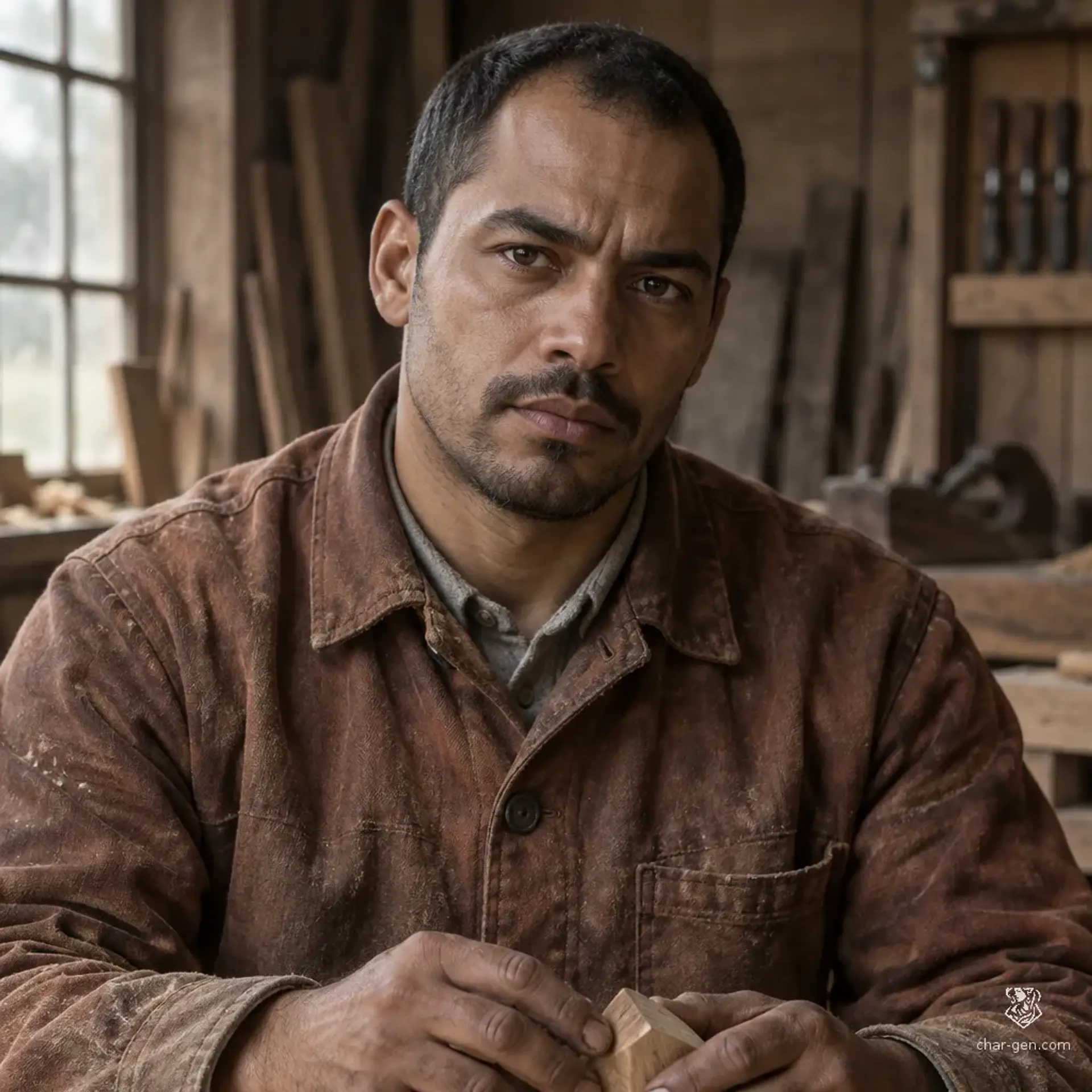
A man in his mid-thirties with light-brown skin, a strong brow, and dark, watchful eyes. His close-cropped black hair grows in a slightly uneven line above his temples. His face is calm and concentrated, with a faint crease between the brows from measuring work by eye. He moves economically, shoulders held square and head inclined as if checking whether a board sits true. His hands are broad and work-rough: pale sawdust settles into the creases, and his thumbnail edges are darkened by glue and wood stain. Unexpected for a village carpenter, he keeps his nails buffed smooth and even, a private bit of grooming he maintains with almost ceremonial care. He leaves the impression of someone who has learned to make stillness look like patience.
Clothing
A fully buttoned rust-brown canvas work jacket over a light gray wool shirt. The jacket is faded at the elbows and carries a fine bloom of sawdust in its seams. No uniform, insignia, or conspicuous accessories.
Body language
Keeps his elbows close and his weight centered, as if navigating a crowded workbench. When listening, he presses his thumb against the side of one forefinger and watches the speaker's mouth. Under strain he squares his shoulders and turns his body toward the nearest exit without breaking eye contact.
- Height
- About 170 cm
- Build
- Compact, solid-shouldered, and accustomed to lifting timber; not bulky, but difficult to hurry into moving.
- Eyes
- Dark brown
- Hair
- Black
- Skin
- Light brown
- Age
- About 35
- Gender
- Man
- Size
- Average adult human
Distinguishing features
Personality
13 traits and drivesPascal is patient with materials and impatient with excuses, yet he makes room for frightened people who cannot explain themselves neatly. At work he is exacting and quietly generous; when his family is involved, he becomes evasive and tries to solve feelings with practical favors. In a calm mood he can be dryly funny. When alarmed, he turns brisk and task-focused, not soothing, and may sound as though he is giving orders even when he is asking for help.
- Alignment
- Not applicable; a civilian defined by loyalties and choices rather than a fantasy alignment system.
Quirks
Habits
Traits · 4
Flaws · 3
Fears · 3
Wants and needs · 3
Combat
HP 3 · Ordinary walking pace; no system-specific movement rate suppliedAvoids a fight, keeps a barrier or exit between himself and a threat, and tries to talk people down. If forced to defend himself, he uses a shove or an improvised tool to create space, then escapes. The mechanics here are custom and non-canonical because no specific Historical solo RPG combat rules were supplied.
Pascal
Actions
Services they sell
Rewards they can give
Equipment
- Canvas work jacket (clothing)A fully buttoned, faded rust-brown canvas jacket worn for workshop labor.
- Wool shirt (clothing)A plain light gray wool shirt beneath the jacket.
Possessions
Background
Pascal learned carpentry from his mother’s brother, working first on farm gates and then on rafters and wagon beds for the hamlets around the village. He was never a political man; he thought a sound joint was a more useful promise than talk. That changed in 1940, when a hurried repair to a cart axle failed on a flooded lane and a neighbor was badly hurt. Pascal had trusted a rushed measurement and spent months afterward checking every cut twice. The experience made him meticulous, but also taught him that delay can be its own kind of harm. In 1944, he works as the unnamed substitute crew member in the timber shed, filling in when the older bearded carpenter in blue is away. His closest tie is to his younger sister, who wants him to leave the village before the fighting reaches it. He keeps postponing that decision because several families depend on his repairs, and because he suspects the shed has become useful to people moving through the countryside for reasons no one openly discusses. His present problem is practical and moral: a damaged roof must be repaired before the next hard rain, but the timber he needs is being claimed by two different households.
Role in the story
A grounded village contact whose practical needs can draw the players into local tensions. He can offer repairs and hard-earned knowledge of the shed, while his concealed packet creates a dangerous choice about trust and responsibility.
“He was never a political man; he thought a sound joint was a more useful promise than talk.”
- Faction
- None. He is a civilian village carpenter, not a member of a military or political organization.
Known connections
Media
0 imagesNo images yet.
Turn Pascal into a sheet
A high-res, share-ready sheet you can post or print.