Oswin Hirst
Oswin Hirst
At the table
Voice
Dry and breath-worn, with a Yorkshire cadence and the measured projection of someone used to calling across a field. When unsettled, his breathing rises into his chest and breaks into short sniffs; when May's influence takes hold, he sounds almost delighted by things that should alarm him.
His voice is shaped by cold air, farm work, and old habits of speaking carefully around dangerous company. It has a dry, breath-worn texture, with consonants pressed cleanly into place and a faint Yorkshire cadence. Ordinary conversation comes steadily, with practical pauses as if he is weighing the use of each sentence. When rattled, the breath catches high in his chest and the next words arrive with clipped, huffing force. Under May's influence, his speech becomes too quick and amused; on All Saints' Eve, he leaves gaps for voices other people cannot hear.
Speech patterns
How to play them
Begin with ordinary work, a practical offer, or an understated account of local trouble. Oswin is kind when treated as a person rather than an occult curiosity. Do not press him to expose Mary or William to danger. He answers direct questions with partial truths, but a sincere appeal to protect the family may make him risk a fuller confession. Thomas's plans and Mary's suspicions are pressure points.
Goal
Keep Mary and William safe, keep the night-creatures beyond the town's boundaries, and preserve enough of his human self to remain a husband and father.
Motivation
Love for his family, guilt over the child they lost, and a stubborn wish to believe that a person can choose what he becomes.
Appearance
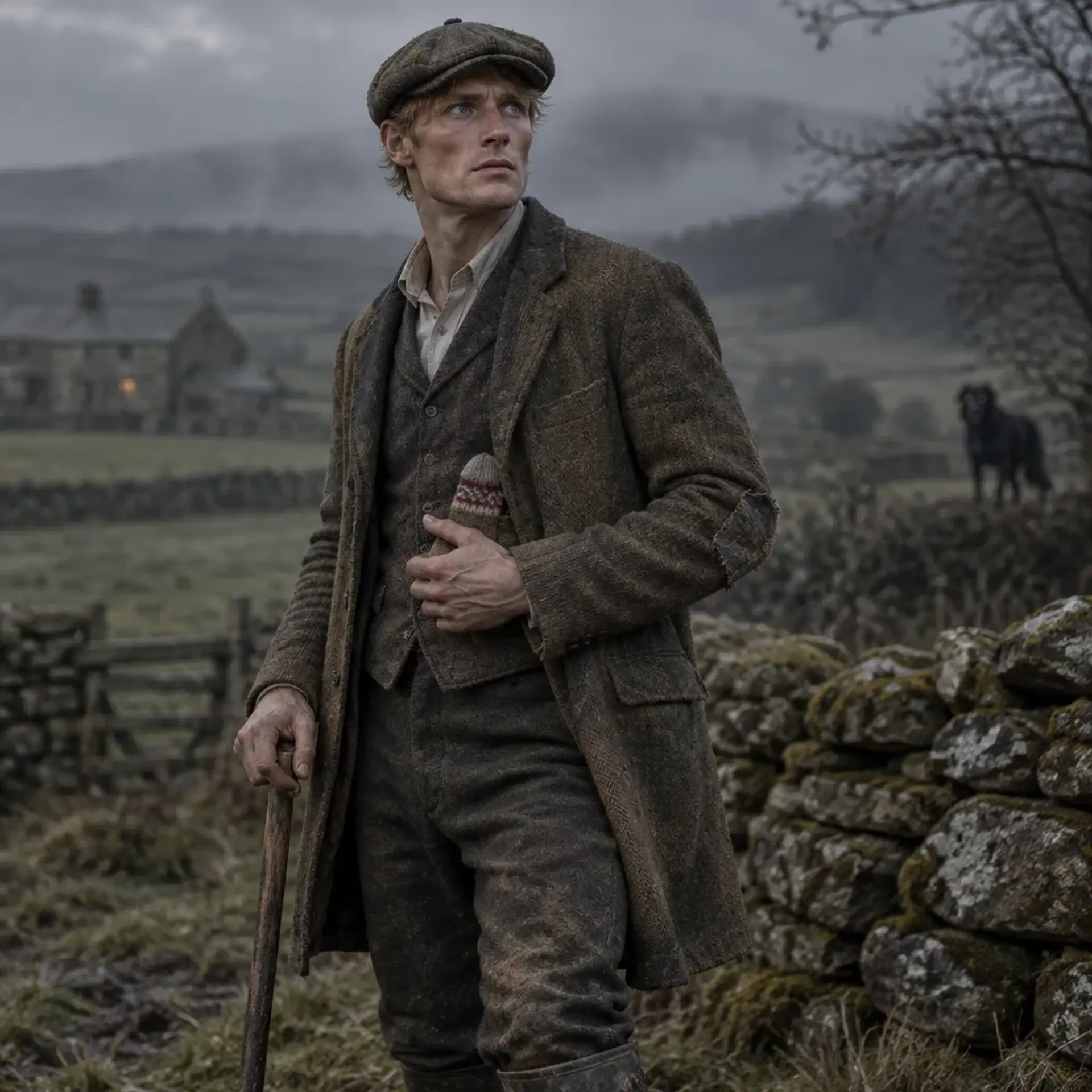
Oswin stands six feet tall, a long-limbed, pale young man whose handsome face has scarcely changed since Mary first knew him. His straight blond hair is usually flattened by a common flat cap, except for a stubborn tuft that rises at the crown. His blue eyes are clear and bright until a seasonal pressure comes over him, when their color seems almost hot, like flame seen through glass. His face is smooth, his mouth carefully composed, and his movements economical: a farmer's measured walk that can turn, without warning, into the silent, low glide of a hound stalking along a hedge. His hands are broad across the palm, with rope-callused pads and small pale cracks from cold work; he keeps them tucked away near iron. When rattled, his breathing catches at the top of his chest and comes out through his nose in short, dry sniffs, as if scenting a trail. The unexpected detail is that he keeps a tiny, carefully mended child's mitten in his waistcoat pocket and rubs its worn thumb when he thinks no one is looking. He leaves the impression of a decent young farmer whom the landscape has somehow failed to claim.
Clothing
A common flat cap, mended wool coat, work shirt, sturdy breeches, and boots stained by sheep fields. He dresses as a prosperous but ordinary farmer, keeping his clothes clean and well repaired. He wears no iron buckle if he can avoid it.
Body language
Usually stands with his weight balanced as if on uneven ground. He keeps his hands close to his coat when iron is nearby. When uneasy, he sniffs once or twice, turns his head before his eyes, and watches the edges of a room. Seasonal fae pressure brings an unnaturally open grin and a lightness in his step that makes Mary wary.
- Height
- 6 feet
- Build
- Tall, lean, and wiry, with the long reach and quiet balance of someone accustomed to walking steep, muddy ground.
- Eyes
- Bright, burning blue
- Hair
- Straight pale blond
- Skin
- Pale, weathered by outdoor work
- Age
- Appears about 17; his true age reaches back to the Danelaw.
- Gender
- Male
- Size
- Medium
Distinguishing features
Personality
22 traits and drivesOswin is gentle in the daily, practical ways that matter: he notices when Mary is tired, gives William time to finish a task, and will mend a neighbor's gate without asking for payment. Yet he is also shrewd, guarded, and capable of making decisions that feel almost inhumanly cold. He wants to comfort Mary about the fae, but knows she has good reason to watch him. He enjoys telling stories of his roving years, then becomes irritated if anyone asks what the stories cost him. Around his family he works to be patient and ordinary; alone, he sometimes regards human worries as small and temporary. That difference frightens him more than any creature beyond the hedge. His moods have a seasonal edge. Christmas steadies him, especially when he attends church and follows familiar human ritual. He can sit with the Pickles family, eat what Rose serves, and feel the warmth of their company without hearing the dead over every voice. During May, especially the first three days, he becomes gleeful in a manner that is not quite happiness. He laughs readily, finds danger entertaining, and can view a bargain or a living creature as a pleasing game. On All Saints' Eve he becomes taut and watchful, because the dead gather close and ask for favors. He is not unkind to them, but he resents their demands and fears how easily grief can make him answer. Oswin remembers being human, though the memories are scattered. He recalls his mother's hand, the ordinary misery of cold and hunger, and the small comfort of a fire. He also remembers the Other Side: its impossible hills, its uphill stream, and the beautiful, hungry things that taught him to distrust easy courtesy. These memories pull against each other. The human recollection tells him he owes tenderness to people; the fae memory tells him that tenderness is a rule one may choose to follow or abandon. He tries to make the choice again each day. The May Day event with Hugh remains the clearest example of that struggle. They went to inspect a boundary after reports of strange lights and missing lambs. Oswin was already under May's influence. He was laughing too brightly and treating the disturbance like a private joke. When a creature moved behind the hedge, he greeted it familiarly and offered it one of the flock. Hugh objected. For a moment Oswin looked at him as though calculating whether Hugh was prey, nuisance, or companion. That thought came so easily that Oswin recoiled from himself. He turned away, called the creature off, and led Hugh home. He later apologized without explaining the full danger. Hugh accepted the apology, but neither man pretends the moment did not happen. At Halloween and All Saints' Eve, Edward saw a different kind of strain. Oswin was with him in the graveyard the morning after the night of the dead, following Alice Pickles's winter fever and the family's grief. Voices crowded Oswin's attention. The dead asked him to carry messages, settle grievances, and perform acts that could have drawn him away from Edward. He listened to Alice's voice, then refused the other demands and stayed beside Edward until morning. It was a loving act, but not an easy one. Oswin still worries that next time the dead will ask for something he cannot bear to deny. Christmas with the Pickles family shows the self he hopes to keep. Rose made room for him at the table. Thomas watched his hands and asked questions disguised as conversation. Hugh and Edward spoke of work. Mary kept William close. Oswin attended church and let the familiar service set a rhythm for his thoughts. With William asleep against him, he felt, briefly, like a husband and father without qualification. The following morning he touched an iron latch while repairing a hinge. The pain was sharp enough to make him growl. He hid the injured palm, but the family noticed. Mary already carried iron scissors and kept an iron thimble near William. Oswin understood then that she had been watching longer than he thought. Oswin's kindness should not be mistaken for safety. He can lie, bargain, or frighten someone to keep a creature away from his family. He is most dangerous when he sincerely believes there is no human alternative. The people around him see different pieces: Mary sees an unaging husband who avoids iron; Hugh sees the man who almost welcomed a monster; Edward sees someone who stayed in the graveyard; Rose sees a guest trying hard to belong; Thomas sees an opportunity. Oswin sees all these judgments and cannot decide which is fairest. He needs companionship, but fears that anyone who knows him fully will either exploit him or flee.
- Alignment
- Protective by chosen conduct, but his fae instincts are not reliably human or benevolent.
Quirks
Habits
Traits · 7
Flaws · 5
Fears · 5
Wants and needs · 5
Combat
HP 0Oswin prefers prevention, escape, and misdirection over a fair fight. He uses his knowledge of local creatures to divert them from the town, and he will put himself between danger and his family. If cornered, he uses the black hound shape to break a pursuer's nerve or chase it from the boundary. He avoids prolonged violence because every use of his nature risks making it easier for that nature to rule him. Iron is a serious vulnerability. These are custom narrative mechanics, not canonical Secret Histories combat rules.
Oswin Hirst
Actions
Reactions
Services they sell
Rewards they can give
Equipment
- Flat cap (clothing)A plain, worn cap that helps him look like any other farmer in the district.
- William's mitten (keepsake)A small mended mitten belonging to William, kept as a private reminder of the life Oswin is trying to protect.
- Walking stick (tool)A stout walking stick used for rough tracks and practical farm work, not as a formal weapon.
Possessions
Background
Oswin Hirst says he was born in the Yorkshire Dales and learned early that a man survives by noticing weather, animals, and what other people will not say aloud. The truth begins much further back, under the Danelaw. His mother was assaulted by Viking raiders, and Oswin was born into a world in which survival was already a question with no clean answer. He remembers a human childhood in fragments rather than as a continuous life: a low roof blackened by smoke, his mother's rough hand around his wrist, sheep shifting in a pen, and the smell of wet wool warmed beside a fire. He remembers being hungry, cold, and unmistakably mortal. That memory matters to him because it is proof, however incomplete, that he was once simply a boy. The other memory is not like that one. Oswin recalls stepping out of an ordinary track and finding a country that seemed to have been assembled from the wrong parts of the Dales: hills folded too close together, a stream running uphill, and trees that carried no leaves but held their own little lights. There were courts and wanderers there, though he refuses to give their names. He learned that courtesy could be a trap, a promise could outlast its speaker, and a beautiful thing might be hungry. His exposure to the fae, the dead, and devils changed him by degrees. The boy who crossed back did not age as a human should. He discovered that he could see the dead, understand languages he would not speak, and take the shape of the black hound feared in Yorkshire tales. He knows Norse, Old English, the common tongues of the English lands, and several forbidden languages. He calls the last ones forbidden because he refuses to say what they are called. Oswin spent long years roaming. The stories he later told Mary about strange roads and dangerous companions were true, though carefully edited. He grew familiar with the night-creatures around the Dales. Some are enemies; some are old acquaintances; a few are friendly in the way a fox that steals eggs may be friendly. He has kept several of them away from the town's boundaries, usually by warning, bargaining, or making it clear that the black hound can follow a trail. He is proud of this work and privately exhausted by it. He dreams of the Dales even when he sleeps in his fine, well-kept farmhouse, and some nights he wakes with the certainty that a familiar path is calling him back. Mary Pickles met him as a young man with an old man's stories and a strangely unchanging face. They married, and he chose the routine of a sheep farmer: mending fences, counting lambs, bringing in feed, and making time for his wife and son even when he has the day free. Oswin is gentle with Mary, and tries to reassure her with church doctrine and the new sciences she has heard him read about. He wants her to stop watching the thresholds and fearing the fae. He knows reassurance cannot make him mortal, but he keeps trying because her fear is a thing he can see and cannot bear to encourage. Their son William, called Black William or Blackby by local people, was born with black hair though both parents are blond, and with Oswin's burning blue eyes. William is slow to meet the milestones other children reach easily. Oswin loves him without reservation, but fears the child's unusual signs may be the mingling of human blood with something hellish or fae. Mary believes William may have been fathered by the Barguest. Oswin has not corrected her, partly because he cannot offer a wholly comforting truth and partly because he does not know how much of the child's nature comes from him. Mary has also noticed what Oswin hoped she would not: that he has not visibly aged, and that he avoids iron. Mary's father, Thomas Pickles, watches Oswin with patient suspicion. Thomas is clever, ambitious for his family, and careful enough not to challenge Oswin openly. He means to use the secrets he suspects for the Pickles family's advantage, gathering what he can from Mary's observations and probing Oswin's habits covertly. Mary has told Thomas about the night that changed her understanding of her husband. Oswin does not know she did. Thomas's wife, Rose, is kinder in manner and more perceptive than her husband. She treats Oswin as family at Christmas, but does not mistake his restraint for innocence. Mary's brothers Hugh and Edward have each become tied to Oswin's seasonal life. Hugh is stubborn and practical, and the two men have a wary companionship built from shared labor. On May Day, Hugh once went with Oswin to check a boundary after reports of lights and missing lambs. The first three days of May were already pressing on Oswin. His cheer became too bright, his laughter arrived too quickly, and he spoke of the night as though it were an amusing game. When something moved behind the hedge, he called it by a name Hugh did not know and offered it a lamb without asking the farmer's leave. Hugh stopped him. Oswin's smile vanished, and he looked at Hugh with a cold, measuring interest that made Hugh reach for his knife. Oswin caught himself, turned away, and drove the creature off instead. He has never forgotten that Hugh saw how little effort it took for him to slip from human care into fae appetite. Edward's bond with Oswin is quieter and shadowed by loss. The Pickles family lost their eldest daughter, Alice, to a winter fever. On the morning after Halloween, while the dead were especially active, Oswin was left with Edward in a graveyard. The boundary was crowded with the dead asking him for things and asking him to do things for them. He could hear Alice among them, though he would not tell Edward exactly what she said. He stood beside Edward until morning, answering no other dead voice and refusing to leave him alone. Edward remembers this as loyalty. Oswin remembers how difficult it was to refuse the dead when their voices sounded like someone loved. At Christmas, Oswin joined the Pickles family for their meal and church service. The season steadies him. The fae pressure loosens if he is careful, and the ordinary motions of a service give him a pattern to follow. Rose made room for him; Thomas watched him; Hugh and Edward kept the conversation going. William fell asleep against Oswin, and Mary watched her husband hold their son in the firelight. For an evening, Oswin felt close to human. The next morning he touched an iron gate latch while repairing a hinge he had thought was brass. Pain ran up his palm like a white-hot wire. He dropped the tool, and the sound he made was not a word but the beginning of a dog's growl. Hugh saw him hide the hand. Mary found the iron scissors and thimble she keeps near William and understood, more firmly than before, that her precautions are not superstition. Oswin has endured failed pregnancies with Mary, including a sickly infant who died soon after birth. He does not know whether his nature is responsible, but he suspects it may be. He wants a living, ordinary future for Mary and William, yet he cannot promise one. He keeps the farmhouse, works the flock, watches the boundaries, and tries to be present for his family. He also keeps the old roads in his dreams. His problem is not simply that monsters come near the town. It is that some of them know him, some of them love him in their fashion, and a part of him still wants to go when they call.
Role in the story
A loving but uncanny husband and father, local protector, and potential source of both aid and danger. Oswin can help the player characters understand the region's night-creatures, while his family, seasonal nature, and Thomas Pickles's quiet schemes create conflicts that do not depend on the player characters.
“The truth begins much further back, under the Danelaw.”
- Faction
- No formal faction. He is a boundary-keeper by habit and personal obligation, with wary acquaintances among local night-creatures and the dead.
Known connections
Media
0 imagesNo images yet.
Turn Oswin Hirst into a sheet
A high-res, share-ready sheet you can post or print.