Maïssane
Maïssane
At the table
Voice
A dry, breath-worn rasp shaped by bakery heat and shelter smoke, with crisp French consonants and a slight southern lilt. Their laugh is rough-edged and unexpectedly expansive.
Their voice has a dry, breath-worn rasp from bakery heat, smoke, and long shifts in a crowded shelter. French consonants come out crisp and practical. They speak in measured phrases, with a slight southern lilt inherited from home; when amused, the rasp breaks into a broad, rough-edged laugh.
Speech patterns
How to play them
Treat Maïssane as a capable civilian with limited power, not as a quest-giver with secret authority. They respond to practical help, honesty about shortages, and attention to people who have been missed. They are wary of grand promises and will ask what a plan costs the shelter's other visitors.
Goal
Keep the shelter supplied and make sure no one is forgotten when the next wave of displaced villagers arrives.
Motivation
Make practical care reach the people least able to demand it, while preventing the shelter from drawing dangerous attention.
Appearance
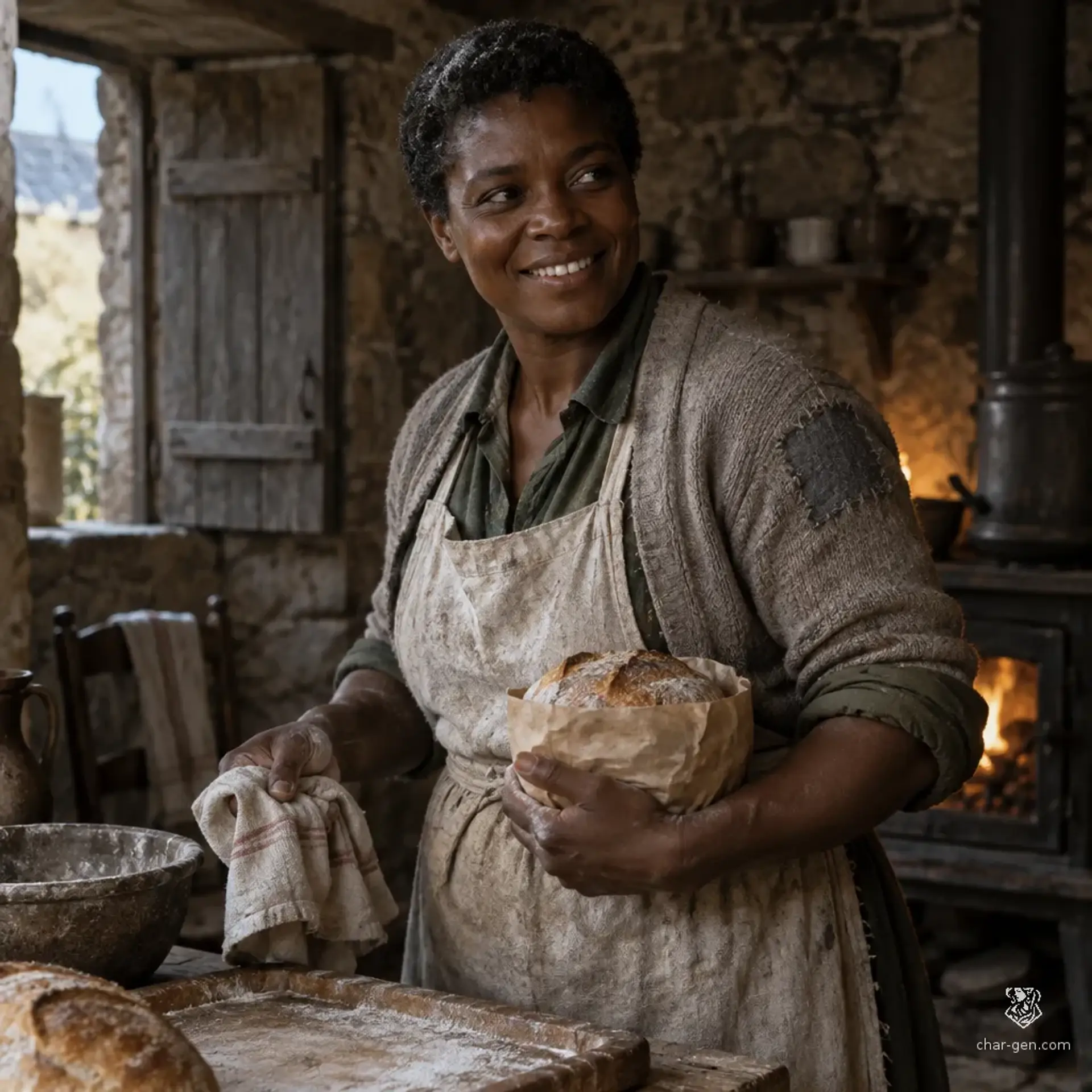
At the bread board, Maïssane stands with a folded cloth in one hand and a plain wrapped loaf in the other. Their high cheekbones sharpen a broad, attentive face; cropped black hair grows in close, soft coils, with a pale flour trace often caught at the hairline. Their dark skin has a matte, warm sheen in the stove light. They move economically, feet planted before they reach, as if every gesture must leave room for someone else to pass. Their cardigan is visibly mended at one elbow, and their flour-dusted teeth show in a brief, unexpectedly wide grin when a child makes them laugh. They smell distinctly of woodsmoke, damp wool, and toasted crust, a combination they notice only when someone else mentions it. The impression is of a person quietly keeping a crowded room from coming apart.
Clothing
Plain light gray wool cardigan, carefully patched at one elbow, over a green work shirt with the sleeves rolled to the forearms; faded canvas apron with a floury hem. Practical, civilian clothing, without insignia.
Body language
Usually keeps one shoulder angled toward the doorway and leaves a clear path around the bread board. Their hands are steady and purposeful; when troubled, they press the folded cloth flat with both palms. They meet a speaker's eyes directly when listening, but glance down at the loaf when they need time to decide.
- Height
- About 165 cm
- Build
- Compact, sturdy build from years of kneading dough, hauling baskets, and standing through long shifts.
- Eyes
- Deep brown
- Hair
- Black
- Skin
- Deep brown with a warm, matte sheen
- Age
- About thirty-two
- Gender
- Unspecified; they/them
Distinguishing features
Personality
12 traits and drivesMaïssane is brisk and fair-minded, yet privately sentimental about the small rituals that make a shelter feel like a home. In a crowd they are decisive and economical with words; with children or the exhausted they become unexpectedly playful. They distrust dramatic displays of courage but can be moved by a plain admission of fear. Their compassion pulls them toward taking on too much, while their training in rationing makes them capable of saying no even when it hurts.
Quirks
Habits
Traits · 3
Flaws · 3
Fears · 3
Wants and needs · 3
Combat
HP 0A civilian shelter volunteer, not a combatant. Maïssane avoids fighting, gets people away from danger, and uses the room's layout to keep a route to the exit open. No combat rating or weapon training is assumed.
Maïssane
Actions
Reactions
Services they sell
Equipment
- Wrapped loaf (food)A plain wrapped loaf set aside for distribution, with no mark or message on the wrapping.
- Folded cloth (practical supply)A clean, folded square used to cover food, wipe a board, or make a quick sling for a small bundle.
- Bread knife (tool)A small, blunt kitchen knife used for cutting bread and food, not carried as a weapon.
Possessions
Background
Maïssane was born in a river port in southern France to a mother who had come from Algeria as a young adult and a French father who repaired carts. The family settled inland when Maïssane was a child. Before the war, they worked in a bakery and learned to judge a loaf by weight, crust, and the sound it made against a board. In 1940, during a night of flight and confusion, Maïssane left a neighbor's elderly mother behind while helping a group of children reach shelter. The woman survived, but Maïssane has never forgiven themself for not going back sooner. That experience changed their instinct from rushing to help whoever shouted loudest to quietly checking who had been overlooked. Now they volunteer at the village stone shelter, portioning bread and keeping track of the people who pass through. Their mother, Aïcha, lives nearby and wants Maïssane to stop taking risks for strangers. The former baker who taught them, Étienne, has been pressed into supplying flour to the occupation authorities and privately asks Maïssane to help hide a small reserve. Maïssane is trying to keep the shelter fed without making it a target, while the next delivery is late and several families are already counting on it.
Role in the story
A grounded point of contact in the shelter whose decisions reveal the strain of occupation, rationing, and mutual aid. Maïssane can connect the characters to practical needs and personal stakes without being a combatant or an authority figure.
“The family settled inland when Maïssane was a child.”
- Faction
- Village shelter volunteers; no formal political or military affiliation.
Known connections
Media
0 imagesNo images yet.
Turn Maïssane into a sheet
A high-res, share-ready sheet you can post or print.