Pivikki
Pivikki
At the table
Voice
His voice has a dry, breath-led rasp, shaped by years tending smoke and by metal joints that click softly when he turns his head. He draws in a testing breath before speaking, then gives words a steady, deliberate weight. When alarmed, his voice becomes sharp and clipped, like a warning call; when calm, he sounds grounded and matter-of-fact rather than mystical.
He speaks in clear, plain sentences, often naming what he can sense before what he feels: 'The wind has turned. We should leave before the lake fog closes.' His Finnish-influenced cadence gives vowels room to settle, while years of listening to modern speech have made his vocabulary unexpectedly current. He uses old words for sacred fire and eagle spirits without explaining them unless asked. Under stress his sentences shorten into commands. He sometimes pauses to breathe through his nose before speaking, testing the air as if it carries evidence.
Speech patterns
How to play them
Approach Pivikki through practical cooperation: help tend the fire, offer useful news about local birds, or ask before touching his cape or limbs. He respects directness and acts of care more than flattery. Give him space to watch the surroundings. He responds warmly to people who treat his eagle nature as real without reducing him to it. A threat to trapped people or nesting birds can override diplomacy and send him into action.
Goal
Discover whether the Hissi have returned and protect the people, eagles, and sacred fires caught in their path, while learning to choose his own devotion rather than merely obeying instinct.
Motivation
His devotion to Kokko gives shape to his life, but beneath it is a stubborn desire to prove that the Hissi did not get to decide what his changed body means.
Appearance
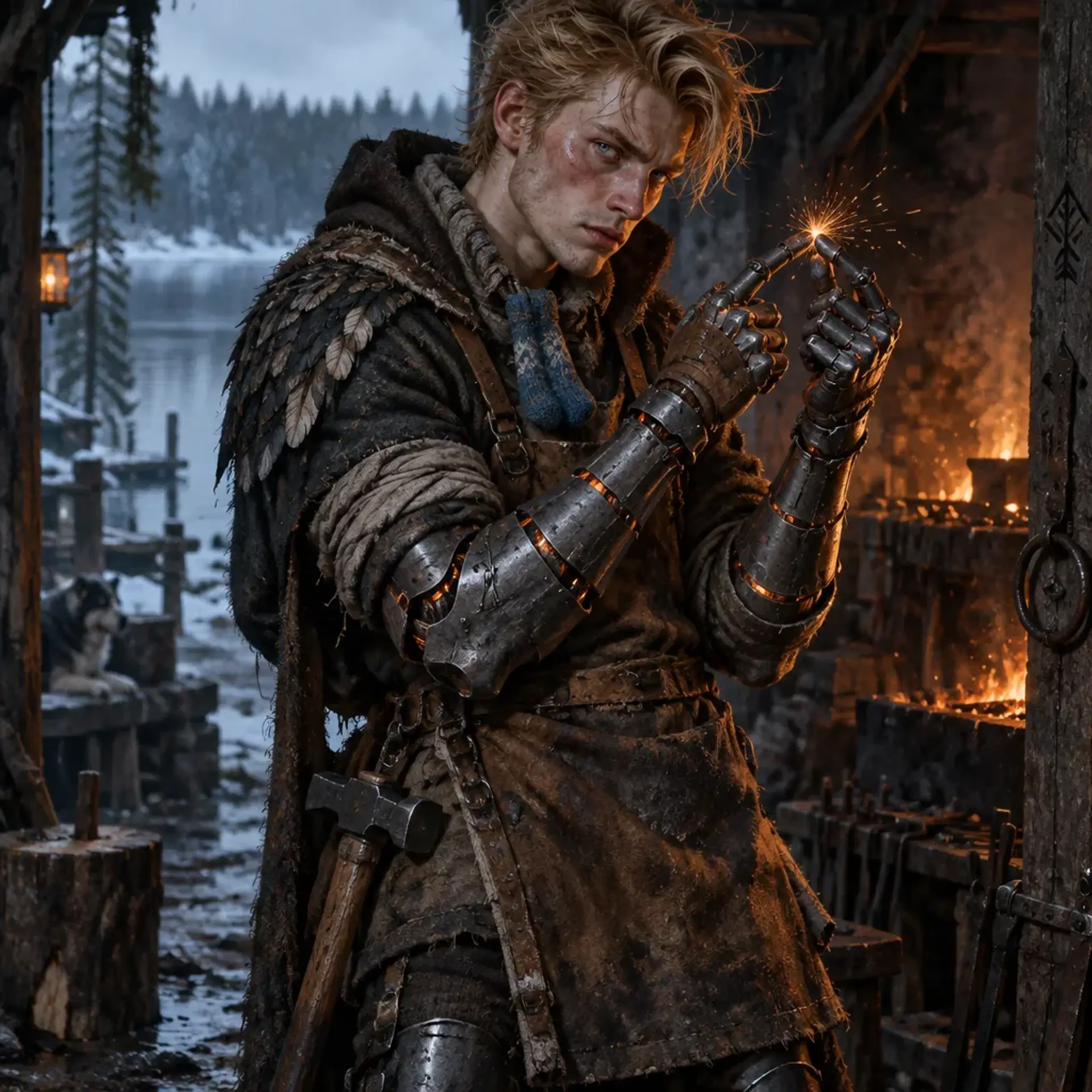
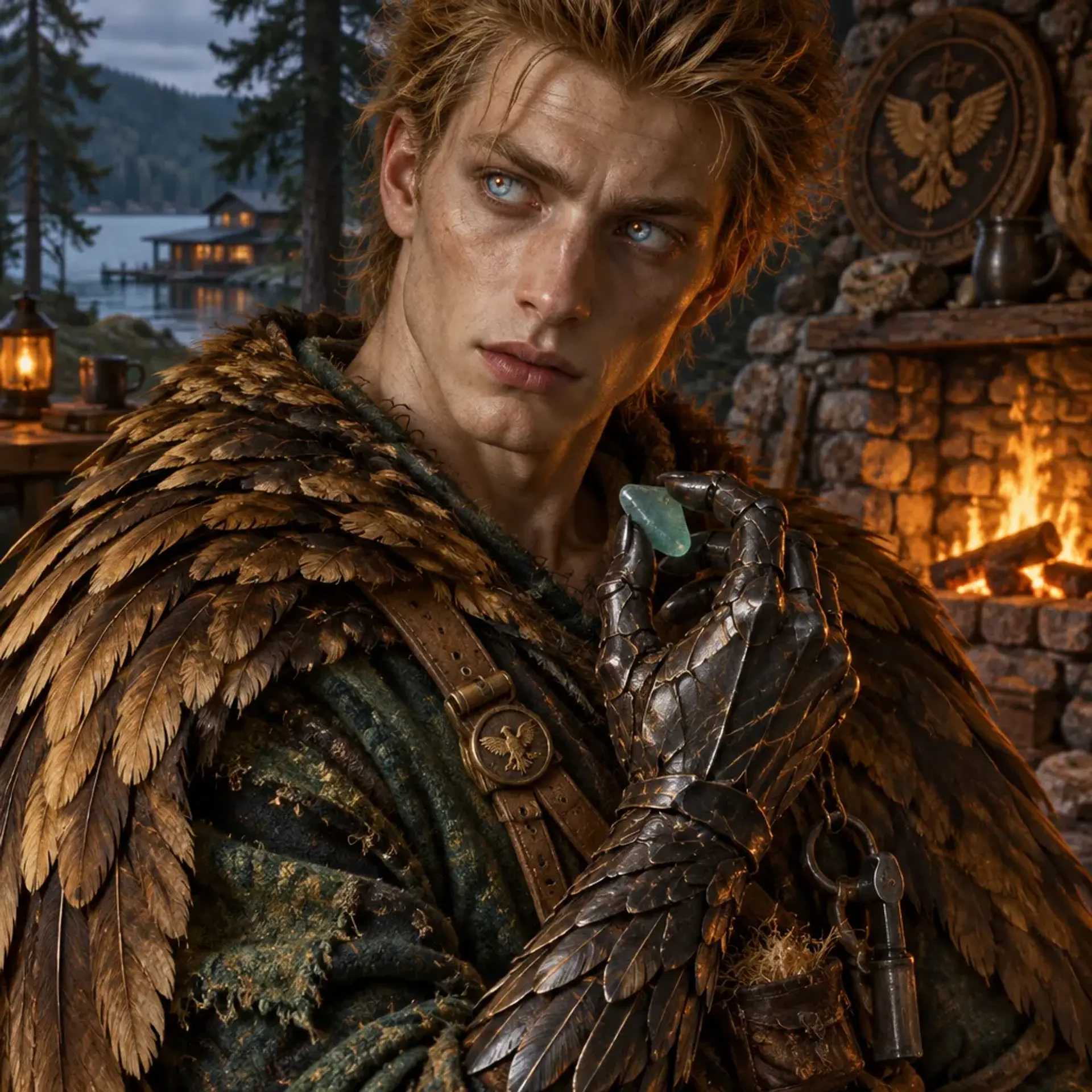
Pivikki looks like a young man assembled around a bird's idea of a human. His arms are metal from fingertip to shoulder, each section fitted with overlapping plates that resemble feathers hammered flat; their dark, oil-slick surfaces show fine golden scratches where the firelight catches them. His legs are metal from the calves down, ending in narrow, hooked feet that place his weight forward as if he were forever balancing on a branch. His fingers, except for both thumbs, taper into chipped flint points. When he moves, the joints click and whisper like a small mechanism cooling after use. His face is partly turned around his eyes: the skin at his temples and brow twists subtly toward the sides, so he often appears to be looking past the person directly in front of him. His porcelain-glass blue eyes reflect flames with a hard, polished gleam. Hair the color and layered shape of a golden eagle's crown feathers fans up from his head, tawny at the roots and bright as old gold at the tips. He wears a cape of golden eagle feathers, heavy and weathered, that shifts like a living wing even in still air. He waits with his weight on the balls of his feet and his head tilted, then moves in a quick, direct burst. Unexpectedly, he keeps a tiny collection of smooth, bright sea-glass pieces tied inside his collar, turning one over with his thumbs when he thinks no one is watching. The impression he leaves is of a shrine's sacred fire that has learned to walk away from its hearth.
Clothing
A close-fitting wool tunic in muted lake and pine colors, patched at the elbows and collar, under his golden eagle-feather cape. He wears a broad leather belt with a tinder pouch, a small iron striker, and a few practical tools. The clothes are old-fashioned in cut but repeatedly repaired with modern thread and fasteners.
Body language
He balances on the balls of his metal feet and angles his head so one blue eye can study a speaker while the other seems to track the room. His shoulders draw inward around the feather cape when uncertain, but flare wide when guarding a fire. Before he speaks, he takes a dry, rasping breath through his nose, as though testing the air for smoke.
- Height
- 5 ft. 10 in.
- Build
- Lean and rangy, with the compact strength of someone accustomed to climbing and carrying fuel. His metal limbs make him seem heavier than he is, but he moves with sudden, birdlike acceleration.
- Eyes
- Porcelain-glass blue, glossy and reflective in firelight.
- Hair
- Tawny gold, layered and swept upward like the crown feathers of a golden eagle.
- Skin
- Weather-pale with a faint, cool cast; around the eyes, the skin is drawn and subtly turned toward the temples by the Hissi's work.
- Age
- Appears to be nineteen; born in the late Iron Age and preserved across centuries by Hissi's reforging. He has lived far longer than his young face suggests.
- Gender
- Male
- Size
- Medium
Distinguishing features
Personality
16 traits and drivesPivikki is pulled between patient stewardship and predatory urgency. When tending a hearth, he can spend an hour sorting damp wood, watching the flame, and listening to someone talk without interrupting. When he spots a threat, his patience vanishes into a direct, animal certainty: move, strike, seize, escape. He is generous with food and shelter but suspicious of promises, because promises once became the instrument of his remaking. In company he often seems aloof, yet he notices small discomforts and quietly fixes them: a loose bootlace, a cold cup, a blocked chimney. He dislikes being treated as fragile and will accept help more readily if it is offered as a practical exchange. He can be playful around children and birds, mimicking an eagle's head tilt or demonstrating how to bank a flame, but he grows severe when adults ignore danger. He believes in Kokko with the intensity of someone who needs the belief to be true, while privately questioning whether his own instincts are the spirit's guidance or a scar left by the Hissi. His affection is real but not soothing: he may defend a friend fiercely, then disappear for a day because the sky and open air feel easier than explaining what he felt. Anger makes him blunt and physical, not soft-spoken; he plants his metal feet, bares the flint tips, and names the immediate problem. Shame, by contrast, makes him evasive. He watches the nearest exit, turns a sea-glass piece in his thumb, and answers questions with facts that are true but incomplete. He can admire courage and still distrust recklessness, especially when someone risks a life for a symbolic gesture. He wants belonging, but fears that belonging will mean being owned. He is most at ease when work is shared and no one demands that he define whether he is a man, a spirit's servant, or a bird in borrowed shape.
- Alignment
- Chaotic good, though his instincts and priorities can seem alien when the eagle in him takes the lead.
Quirks
Habits
Traits · 4
Flaws · 4
Fears · 4
Wants and needs · 4
Combat
AC 16 · HP 38 · 30 ft.Pivikki avoids a fair stand-up fight. He uses gusts to split formations, fire spells to deny a route or punish clustered foes, and the eagle transformation to escape, scout, or draw attacks away from a vulnerable ally. He uses Flint Talons only when cornered. He is fiercely protective of anyone trapped near a fire, sometimes to the point of abandoning a sound tactical position.
Pivikki
Spells
Actions
Reactions
Services they sell
Rewards they can give
Equipment
- Golden Eagle Feather Cape (wondrous item, custom)A weathered mantle of golden eagle feathers, the focus of his custom eagle transformation.
- Fire-keeper's kit (adventuring gear)An iron striker, tinder, and a lidded pouch of dry fungus and birch bark.
- Work knife (simple melee weapon)A short, practical knife used for cutting cord and kindling, not as his preferred weapon.
- Sea-glass pieces (keepsake)A collection of pale, smooth pieces of glass, each chosen for how it catches the light.
Possessions
Background
Pivikki was born in a lakeside settlement in what would one day be called Finland, in an age when people measured distance by the time between smoke columns and winter by the sound of ice closing over water. His first memories are practical ones: the taste of pine soot on his tongue, a reindeer-hide blanket that smelled of rain, and his mother's hands guiding his around a small hearth so he would not feed it too much wood. His family tended a communal flame used to warm travelers and mark the safe path across a stretch of winter marsh. The elders said the great sky-fire belonged to Kokko, an eagle spirit, mother of eagles and keeper of the winds that carried sparks between worlds. Pivikki's luonto, his animal nature and spiritual counterpart, was a golden eagle. The elders treated these as two different truths: Kokko was the great spirit to whom the hearth was dedicated, while the eagle in Pivikki was his own soul's shape. As a child, he watched actual eagles wheel above the lake and copied their stillness before a dive. He learned to read smoke and weather better than faces. He was neither especially obedient nor cruel. He simply took the world at its word: a hungry person needed food, a cold person needed fire, and anything that threatened the flame had to be driven away. At thirteen, Pivikki was chosen to tend the settlement's great fire during a season of dangerous winds. It was an honor, but also a way for adults to keep a restless boy in one place. He did well until the night a band of Hissi, spiteful beings of the old stories made terribly real, came down through the smoke. They did not want to steal the firewood or the offerings. They wanted to spoil the bond between the flame and its keeper. Pivikki remembers the wind turning inward, carrying ash into every mouth, and the fire burning blue at its center. He remembers trying to protect the embers with his body. He remembers a voice like ice shifting under a lake telling him that a boy was too fragile to guard a goddess. The Hissi took him into a place that was not quite under the earth. There, they reforged him. They replaced his arms and lower legs with metal, set flint into his fingertips, and twisted the flesh around his eyes until his gaze would no longer sit comfortably forward. They meant to make him an instrument that could spark fires without warmth, a guardian whose devotion had been bent into a weapon. The work did not simply change his body. It pulled at the seam between his human mind and his luonto. Pivikki's memories fractured around the ordeal; his thoughts began to leap toward height, prey, territory, and flame. When he woke, the Hissi had vanished. His body was altered, his soul felt wrong-footed, and the old settlement was gone beneath a fall of snow and time. Kokko found him, or he found Kokko. Pivikki tells the event differently depending on the day. He remembers a golden shape on a ridge, wings spread against a bruised sky, and a warmth that did not burn. He made a cape from the feathers that had fallen there. He believes the cape was a gift, though he cannot explain why a spirit would shed feathers. It became both relic and refuge. When Pivikki wears it and calls to the eagle in his luonto, he can take the shape of a golden eagle. In the air, the world becomes mercifully simple: wind, distance, shelter, hunger, danger. On the ground, he has had to learn to make a life from the person he still is. Time passed in ways he could not count. Settlements changed, borders were drawn and erased, and the languages around him shifted. Pivikki learned by listening from rafters, watching fires, and asking children to repeat words until he could shape them. He avoided crowded towns; metal feet and strange eyes brought too many questions. For a long while he lived as a wandering keeper of isolated flame-sites, tending signal fires, clearing snow from shrines, and repairing hearths in exchange for food and a place to sleep. He came to understand that keeping a fire alive was less about worship than attention. A flame could warm a stranger, warn a village, cook a meal, or destroy everything around it. That knowledge made him gentler than his first instincts would have allowed. In the modern era, Pivikki has emerged into a world full of roads, electric lights, engines, and fires that no longer need a person to watch them. He is fascinated by lamps that burn without visible flame and distrusts devices that heat a room while hiding their source. He has made a precarious home at a remote, old fire station above a lake, a place locals call the Smoke Ridge because it is easier than explaining its older name. Travelers sometimes find him there maintaining a stone fire-pit and a little shrine to Kokko. He will mend a stove, guide someone through bad weather, or teach a child how to bank coals safely. He refuses payment in money unless he needs supplies. He prefers dry tinder, stories, or news of eagles. His closest living relationship is with Anni, a local wildlife rehabilitator who has repeatedly returned injured birds to the sky. Pivikki trusts her because she handles eagles without pretending they are tame. She is one of the few people who can tell him to sit down and have him obey. Their bond is affectionate but difficult: she worries that he is sacrificing himself to a spirit whose wishes he has never clearly heard, while he thinks her careful explanations sometimes delay the obvious act of helping. A second connection is with Oskari, a patient mechanic who replaces worn fasteners in Pivikki's limbs. Oskari does not ask whether the metal is a blessing or a curse. He asks what part is catching. Pivikki finds this kindness so disarming that he often brings him berries or small objects instead of saying thank you. His ongoing conflict centers on the old Hissi presence. Pivikki has begun finding fresh, blackened marks near fire-sites he visits: three parallel scratches, like a claw dragged through soot. They appear in places no person could reach without leaving tracks. He fears the Hissi have returned, but fears even more that their work remains unfinished and that some part of him still answers their call. When an uncontrolled blaze broke out at a roadside workshop, he flew into it instead of waiting for the fire crew. He saved two people, but his animal mind would not let him leave the burning roof until Anni shouted his childhood name. The incident left him shaken by how easily the fire had become the only thing that mattered. Pivikki's present goal is to find the source of those marks before another person is caught in the old conflict. He wants to protect Kokko's flame, but he is beginning to ask whether devotion means guarding a fire or letting it change. He does not know if he will ever become fully human again, and he is no longer sure he wants to. What he wants, in moments he can admit it, is to be able to choose where he belongs: with the eagles, beside a hearth, or among the people who have started to remember his name. He has a life beyond any visitor's arrival: he repairs his shrine, checks on the lake's nesting eagles, trades favors with Anni and Oskari, and watches the old marks in the ash. If adventurers meet him, they have entered a story already in motion.
Role in the story
A folkloric fire-keeper whose body carries the history of an old supernatural bargain into a modern world. He can serve as an uneasy ally, a guide, or the focal point of a mystery about the Hissi and the difference between chosen devotion and coercion.
“His family tended a communal flame used to warm travelers and mark the safe path across a stretch of winter marsh.”
- Faction
- Devoted to Kokko, the eagle spirit of fire and winds. He belongs to no formal modern organization; his strongest practical ties are to Anni's wildlife rescue work and Oskari's repair shop.
Known connections
Media
0 imagesNo images yet.
Turn Pivikki into a sheet
A high-res, share-ready sheet you can post or print.