Skip to content
CreatePricing
The Bonefall of Shadow Kibwe - AI-generated fantasy Hazard

The Bonefall of Shadow Kibwe

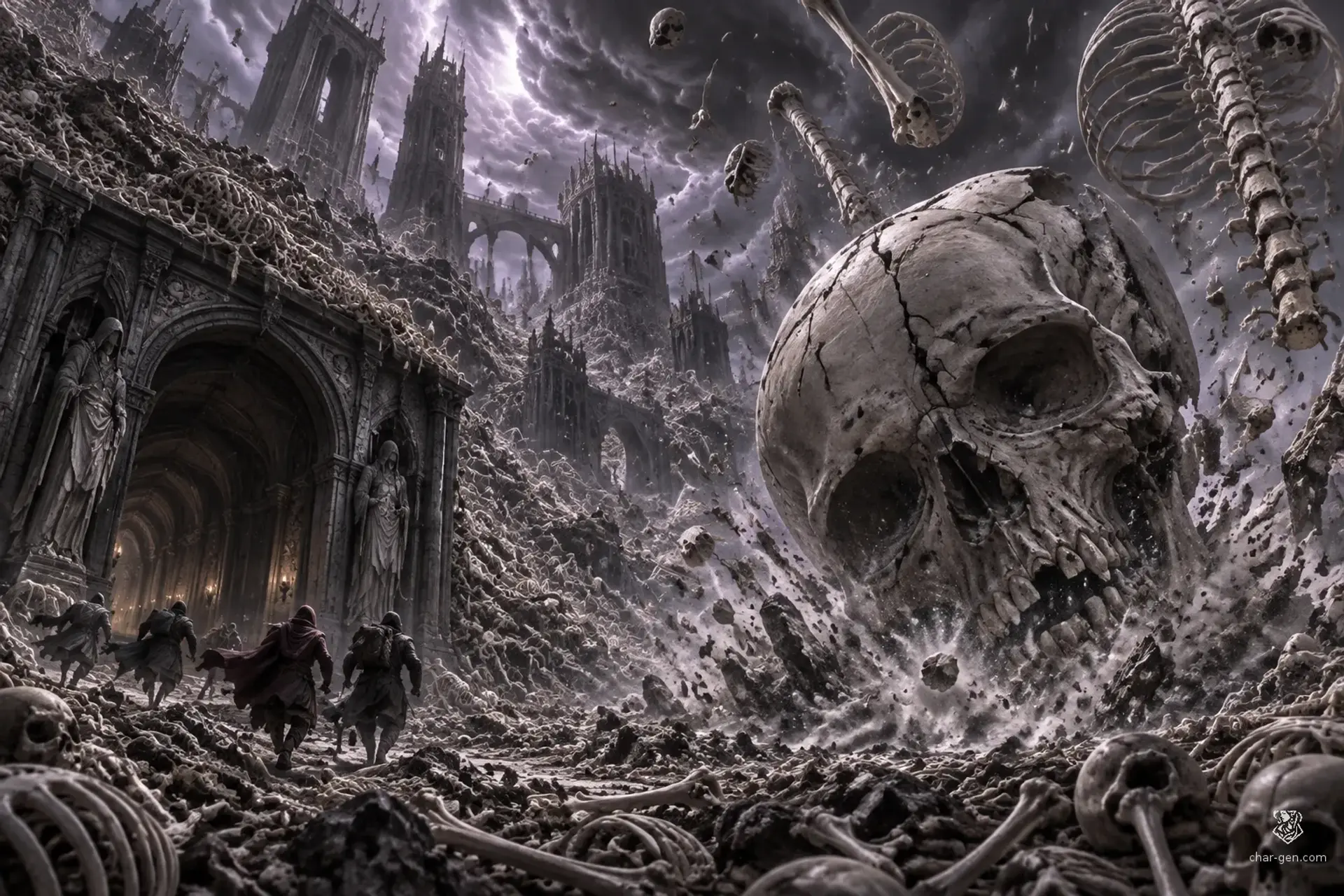
The dark counterpart of Kibwe suffers an unending, erratic rain of bones and skulls. Impacts fall at unpredictable intervals and strike scattered locations, making open ground perilous even when the sky seems quiet. Most impacts batter exposed travelers; occasionally a massive bone or skull crashes down, crushing victims and burying them beneath the accumulated bone fields. The phenomenon is not a mechanism that can be disarmed. It is a persistent planar hazard to be read, endured, and avoided.

Complex · Environmental · Level 12

The Bonefall of Shadow Kibwe

The dark counterpart of Kibwe suffers an unending, erratic rain of bones and skulls.
Disable
Cannot be disabled

At a glance

Level
12
Complex

Defences

Ref
32

Refagainst falling impacts


Disable Cannot be disabled

Initiative At the start of each round in the affected area

The hazard

The dark counterpart of Kibwe suffers an unending, erratic rain of bones and skulls. Impacts fall at unpredictable intervals and strike scattered locations, making open ground perilous even when the sky seems quiet. Most impacts batter exposed travelers; occasionally a massive bone or skull crashes down, crushing victims and burying them beneath the accumulated bone fields. The phenomenon is not a mechanism that can be disarmed. It is a persistent planar hazard to be read, endured, and avoided.

  • environmental
  • planar
  • complex
Trigger
A creature enters an exposed area of the dark counterpart of Kibwe or remains there when an impact round begins. The first round of exposure always produces an impact.
Disable
Cannot be disabled. The precipitation is an environmental planar phenomenon, not a device. No check or effect permanently stops it; use cover, predict impact zones, or leave the affected area.
Initiative
At the start of each round in the affected area, roll . On a 1, the hazard performs its routine. The first round of exposure always has an impact, establishing the danger.
Routine
On an impact round, the GM selects exposed creatures in the affected area and resolves Bonefall Impact. Once during that routine, the GM can resolve a Catastrophic Impact in a 10-foot burst. Impact locations should vary; do not repeatedly target a creature that has reached secure cover.
Reset
The hazard is continuous. After each round without an impact, the rain persists and may strike again on a later round.

Damage

Immunities
  • Critical hits
  • Object immunities are not applicable; the phenomenon cannot be attacked as a discrete target

Effects

2
  • Bonefall Impact

    DC 32

    The hazard's routine is a series of impacts, not a single attack against everyone in the area. The GM selects exposed creatures in the affected area as targets, favoring creatures in open or recently struck locations. Each selected creature attempts a Reflex save. Critical Success: No damage. Success: Half damage. Failure: bludgeoning damage. Critical Failure: bludgeoning damage and the creature is buried beneath bone debris. A buried creature is immobilized and off-guard until freed, and must hold its breath if it cannot breathe freely. It can use Escape against , and allies can dig it out with Athletics checks. Resolve crushing impacts and burial using the Catastrophic Impact rule.

  • Catastrophic Impact

    DC 32

    Once per round, the GM can designate one impact as a Catastrophic Impact. It targets a 10-foot burst within the hazard area. Creatures in the burst attempt a Reflex save. Critical Success: No damage. Success: Half of bludgeoning damage. Failure: bludgeoning damage and the creature is buried. Critical Failure: bludgeoning damage, the creature is buried, and it is stunned 1. A creature that would be buried is instead pushed to the nearest edge of the impact zone if a clear space is available, at the GM's discretion. Catastrophic impacts can also collapse fragile roofs or bury entrances, but do not automatically destroy sturdy structures.

Special rules

Shelter and Exposure.An impact targets only creatures exposed to the sky or standing beneath cover too weak to stop falling bones. Sturdy roofs, deep alcoves, and substantial bridges provide protection at the GM's discretion. A creature that reaches such cover is not selected by ordinary impacts.

Predict the Fall.A creature can spend an action to Seek and study the fall pattern, attempting a Perception check. On a success, it identifies one adjacent 5-foot space or a route of up to 20 feet that is likely to remain clear through the next impact; on a critical success, it identifies two such spaces or routes. This is predictive, not certain, and grants the creature a +2 circumstance bonus to its Reflex save against the next impact if it follows the indicated route or occupies the indicated space. On a failure, it gains no information.

Bone Fields.Bone drifts are difficult terrain. A creature buried by an impact is immobilized and off-guard until it Escapes or is dug free. A buried creature can breathe normally unless the GM determines that the debris has sealed its face or trapped it in a confined space.

Unstoppable Weather.The hazard has no disable check, initiative DC, or object statistics. Do not allow damage, dispelling, or ordinary environmental manipulation to end the rain. Effects that create sturdy cover can protect creatures locally, but the precipitation continues around them.

Spotting it

Discovery

The hazard is apparent once bones begin to fall, but its impact zones and timing cannot be reliably predicted by ordinary sight alone.

Perception

to notice the safest routes by identifying intact overhangs, fresh impact scars, and telltale tremors in unstable bone drifts.

Stop it

Signs of dangerPale streaks fall from the sky, but their shadows appear to rise from the ground. · A fresh skull impact leaves a ring of cracked stone and bone dust. · The compacted bone fields shiver moments before a massive impact. · Sheltered doorways are rimmed with old fractures where bones struck and glanced away.

Countermeasures

In short

This hazard cannot be disabled.

Its story

What it looks like

A black sky churns above the dark counterpart of Kibwe.

Why it is here

An enduring environmental threat that makes travel across the Shadow Plane's dark Kibwe tense and tactical, forcing characters to plan routes, seek shelter, and choose when to risk open ground.

Who made it

Unknown.

Lore

The rain has shaped this shadowed Kibwe over millennia.

Where it is found

Planar, the Shadow Plane; the dark counterpart of Kibwe

Variants

Whispering Skulls: Skulls murmur fragments of the memories of their dead owners. The whispers can reveal a clue, but distracted listeners take a -1 circumstance penalty to their next Perception check to predict an impact.
Red Dust Squall: Bone dust fills the air during impacts, making exposed creatures concealed beyond 20 feet until the start of the next round.
The Giant's Fall: Replace the Catastrophic Impact with a single enormous skull that strikes a 20-foot burst. Its impact leaves a temporary ridge that blocks a street and creates a new shelter on one side.
Borrowed Bones: Some impacts leave behind bones that reassemble into a recognizable shape after the storm passes, hinting at a victim or event from another reflection of Kibwe.

Plot hooks

A bone ridge has buried the only entrance to a shadow-market where a needed contact is waiting.
One falling skull bears the face of a living person in the party, and its jaw whispers a name before it strikes.
A community of scavengers has learned to read the impacts and offers safe passage in exchange for recovering a relic from an exposed tower.
An unusually large skull has landed near the city's counterpart of a sacred site. Its arrival may mark a coming disaster or an opportunity to learn what feeds the storm.

Media

0 images

No images yet.

Visual sheet

Turn The Bonefall of Shadow Kibwe into a sheet

A high-res, share-ready sheet you can post or print.