Skip to content
CreatePricing
Hexbrand - AI-generated fantasy Hazard

Hexbrand

Hexbrand is a persistent curse laid by a spellcaster or bound into a cursed item. It imposes a verdict on anyone the mark deems guilty, weakening the body's capacity to endure sickness, poison, exhaustion, and other physical trials. The brand does not decide guilt by a universal moral code: it enforces the judgment specified by its caster or item.

Complex · Cursed · Level 100

Hexbrand

Hexbrand is a persistent curse laid by a spellcaster or bound into a cursed item.
Spot
110
Disable
120
AC
130

At a glance

Level
100
Complex
Spot DC
110

Defences

AC
130
Fort
+110
Ref
+100
Will
+110
Hardness
200
HP
800
BT
300

ACmythic extrapolation for level 100

Fortmythic extrapolation

Refmythic extrapolation

Willmythic extrapolation

Hardnessmythic extrapolation

HPmythic extrapolation

BTmythic extrapolation


Disable DC 120 to Disable Magic or Religion

Initiative +50

The hazard

Hexbrand is a persistent curse laid by a spellcaster or bound into a cursed item. It imposes a verdict on anyone the mark deems guilty, weakening the body's capacity to endure sickness, poison, exhaustion, and other physical trials. The brand does not decide guilt by a universal moral code: it enforces the judgment specified by its caster or item.

  • Cursed
  • Divine
  • Magical
  • Mythic
  • Complex
Stealth
(mythic extrapolation); the brand is usually obvious once visible, but its curse is difficult to recognize before it acts.
Trigger
A creature that meets the Written Charge enters the brand's area, touches its anchor, or knowingly speaks a lie within 30 feet of it. The hazard rolls initiative and begins its routine.
Disable
to Disable Magic or Religion (mythic extrapolation). The hazard has three judgment-lines, each anchored to a visible inscription, relic, or branded surface. Disabling all three within 3 rounds suppresses the hazard until its reset. A critical success disables one line without requiring the 3-round window. Alternatively, a creature can destroy the anchor, though doing so triggers the hazard's final judgment.
Initiative
+50; the hazard acts when a creature fulfills its trigger, even if that creature has not yet acted.
Routine
On its initiative, the brand identifies one creature in its area that meets its stated condition for guilt. That creature attempts a Fortitude save. On a failure, it gains the Hexbrand Verdict penalty; on a critical failure, it also takes 50 damage. On a success, it is unaffected this round; on a critical success, it is immune to the brand for 1 hour. If no eligible creature is present, the brand's sigil turns toward the nearest creature and speaks its verdict but has no mechanical effect.
Reset
The brand resets after 1 hour if no creature remains in its area. If its anchor is a cursed item, it resets when the item changes hands or its bearer sleeps, whichever happens first. A creature already branded retains the penalty until it is removed.

Damage

Immunities
  • Critical hits
  • Precision damage
  • Mental effects
  • Object immunities appropriate to its anchor
Resistances
  • Physical 100, except adamantine or equivalent mythic materials
Weaknesses
  • A sincere act of restitution directly related to the written charge suppresses the hazard for 1 round.
  • The brand is vulnerable to effects that specifically break curses or sever divine bonds.

Effects

2
  • Hexbrand Verdict

    A creature struck by the judgment receives a persistent –5 status penalty to Fortitude saves. This is the hazard's specified Fortitude loss of 5 flat. The penalty does not stack with itself, but each new application refreshes its duration. It lasts until removed by remove curse or equivalent magic, or until the hazard is permanently disabled.

  • Sentence of the Closed Eye

    DC 120

    When the brand's final judgment is triggered, all branded creatures within the hazard's reach are also enfeebled by the verdict's weight: they take 100 damage (mythic extrapolation), with a Fortitude save for half damage. This damage is divine and curse-aligned for purposes of resistance.

Special rules

Written Charge.When created, the caster or item's maker specifies one transgression, such as breaking a sworn oath or entering without leave. The hazard targets only creatures it considers to have committed that transgression. If no condition was specified, it targets any creature that knowingly damages or steals from the anchor.

Meaning of Fortitude Loss.The Hexbrand Verdict is a curse effect. Its –5 status penalty applies to Fortitude saves only, does not stack with other status penalties, and is not ability damage. This wording translates the requested flat Fortitude loss into a clear, playable effect.

Spell or Cursed Item.The hazard can be cast by a spellcaster or bound into a cursed item. A spellcaster-created brand is anchored to an inscribed surface; an item-bound brand is anchored to the item itself.

Spotting it

Discovery

A creature examining the anchor can detect the curse with a successful Perception check or appropriate magic.

Perception

(mythic extrapolation) to notice the active curse's telltale distortion; see Discovery.

Stop it

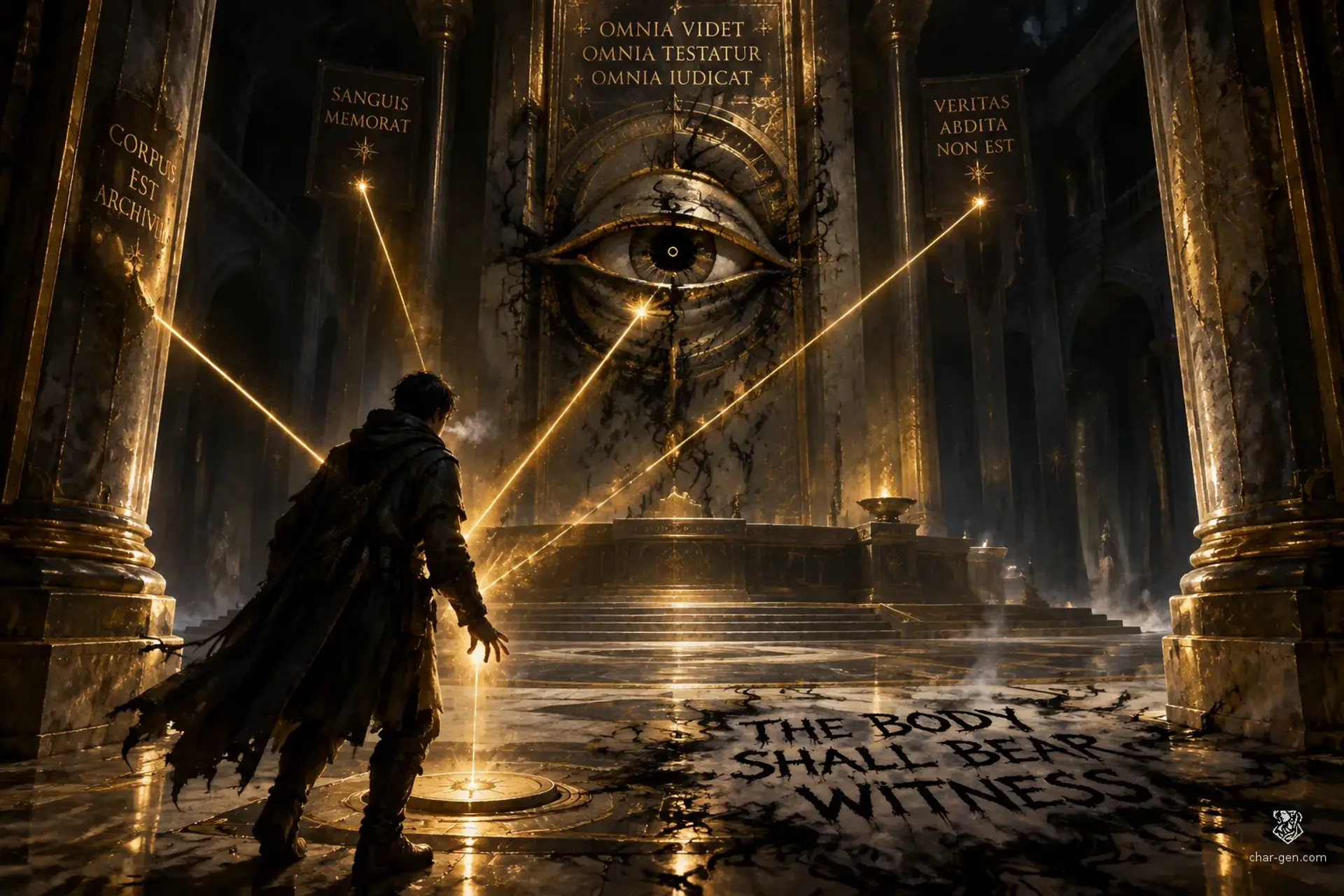
Signs of dangerMetal objects nearby acquire a thin, warm gold sheen despite the cold air. · A short phrase such as 'THE BODY SHALL BEAR WITNESS' appears in soot, dust, or condensation. · People within the area involuntarily hold their breath when they cross a particular line. · The faint sound of a clerk turning a page comes from the anchor whenever someone lies about the offense named in the curse.

Countermeasures

In short

Break the brand's line of judgment, present a sincere act of restitution, or disrupt its divine authority with powerful counter-magic.

Its story

What it looks like

A black-gold sigil shaped like a closed eye, branded into stone, flesh, or the face of a relic.

Why it is here

To punish a designated transgression, enforce a sentence, or deter intruders by weakening their resilience before a final judgment.

Who made it

A nameless celestial magistrate, or a mortal spellcaster who stole the magistrate's seal.

Lore

Hexbrands were once seals of divine courts, used to mark those awaiting judgment.

Where it is found

Temples, sealed courtrooms, reliquaries, execution halls, and cursed objects carried into otherwise ordinary places.

Variants

Merciful Appeal: A sincere apology or restitution attempt suppresses the brand for 1 round, even if the speaker does not know its charge.
Inherited Sentence: The curse targets descendants of the original offender, whether or not they know the history.
Redacted Verdict: The brand's charge has been deliberately erased. It judges anyone who reads the surrounding inscription until the missing words are restored.

Plot hooks

A revered judge is branded, and the court's rulings have become increasingly cruel as the curse erodes their ability to withstand its influence.
A cursed signet brands anyone who accepts its authority, but the original verdict was issued against a long-dead ancestor.
The party must enter a sealed sanctuary where the brand's judgment is based on a forgotten law that has since been repealed.
A spellcaster asks the party to remove the curse, claiming innocence, while the brand's inscriptions point to a concealed atrocity.

Media

0 images

No images yet.

Visual sheet

Turn Hexbrand into a sheet

A high-res, share-ready sheet you can post or print.