Write six short parts, in this order: subject, details, action, place and light, framing, finish.
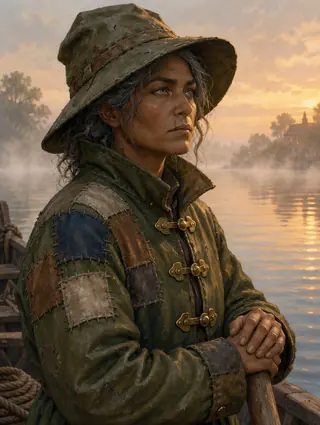
Portrait of a halfling river smuggler in her forties. Sun-browned skin, a small scar through her upper lip, grey-streaked curly hair under an oilcloth hood, a patched waxed coat with brass toggles. She leans on a barge pole and looks past the viewer. Dawn mist on a canal behind her, low warm light from the left. Waist-up, 85mm portrait framing. Painterly fantasy illustration with visible brushwork.
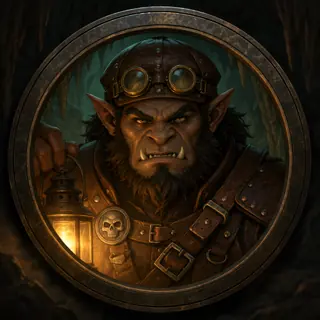
Round game token of a bugbear tollkeeper. Head and shoulders, facing the viewer, heavy brow, an iron-banded leather cap, lantern light from below. A thick dark bronze ring around the token. Painted fantasy style. Nothing outside the ring.
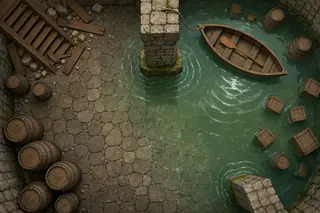
Top-down battle map of a flooded cellar under a tavern, seen from directly overhead with no perspective. Flagstone floor. The east half is under knee-deep green water. Stacked barrels along the south wall, a collapsed wooden staircase in the north-west corner, a small rowboat tied to a stone pillar in the water. Even light, hand-painted tabletop map style. One single view that fills the whole frame.
Kuaishou describes Kling Image 4.0 as one model that understands a prompt and generates the picture, aimed at photographic realism, sharp detail, and text you can read. They say it can go to native 8K, take prompts up to 15,000 tokens, and render text up to 2,000 characters across more than 70 fonts and 7 languages. CharGen uses that model for a new picture or for an edit. The price and the controls on this page are only the routes CharGen sends.
A prompt with no reference picture uses the text-to-image route. One or more reference pictures use the edit route, under the same name in the picker. You choose 2k, 4k, or 8k. You choose one of eight shapes. You can ask for 1 to 9 pictures. The file comes back as PNG. There is no negative prompt and no prompt-expansion switch. CharGen does not cut the prompt down to 2,500 characters the way Kling 3.0 Image does.
The provider lists $0.063 at 2k, $0.094 at 4k, and $0.157 at 8k for each output picture, plus $0.003 for each reference picture once per request. CharGen turns that dollar total into gold with the usual image margin, one rounding for the whole request. That is 9, 13, and 22 gold for a single picture with no references. A higher resolution never costs less than a lower one. Two pictures at 8k are 43 gold, not 44, because the rounding happens once.
The prompt guide on this page is those nine runs, all at 2k. A portrait asked for a scar on the upper lip and got it, but a hood came out as a wide hat and a halfling read as human. A token put a cave outside the ring and moved the lantern. A map put the water on the right and the broken wood at the top left, and the barrels were not clearly the south wall. An item made the ice needle and the cracked glass, and the compass letters were not N, E, S, and W. A wide scene added a face on the giant and came back 3136 by 1326, a little taller than a strict 21:9. A handout spelled the three lines that were asked for, and the long line did not wrap. Two words, a wizard, became a full study. An edit of the portrait kept the face, the hat, the coat, and the pole, and added night, rain, and a lantern on the right. That edit, with one reference, stayed at 9 gold.
Kuaishou also offers a consistent image set and a long page for shops and websites. CharGen does not send those routes. This model is not a Top Pick, so it is not on the phone app. The prompt guide on this page is nine live runs at 2k, including one edit of the portrait. The claims about text, fonts, and realism are Kuaishou's, and they stay attributed to them.
No. Kling V4 on CharGen is the video model. This page is Kling 4.0 Image, the still-image model Kuaishou shipped as Kling Image 4.0.
The reference charge is $0.003 per picture, once for the request, then converted with the same 1.20 image margin as the rest of the price. One reference does not raise a 2k picture above 9 gold. A 4k picture with one reference is 14 gold. Two pictures at 8k are 43 gold.
This model can make up to 9 pictures on the text or edit route. They are separate outputs of that call. They are not a cohesive set that holds one pose or one line of type across every picture.
No. The studio hides that field. A negative prompt left over from another model is not sent.
