Write five short parts, in this order: subject, what moves, camera, place and light, finish.
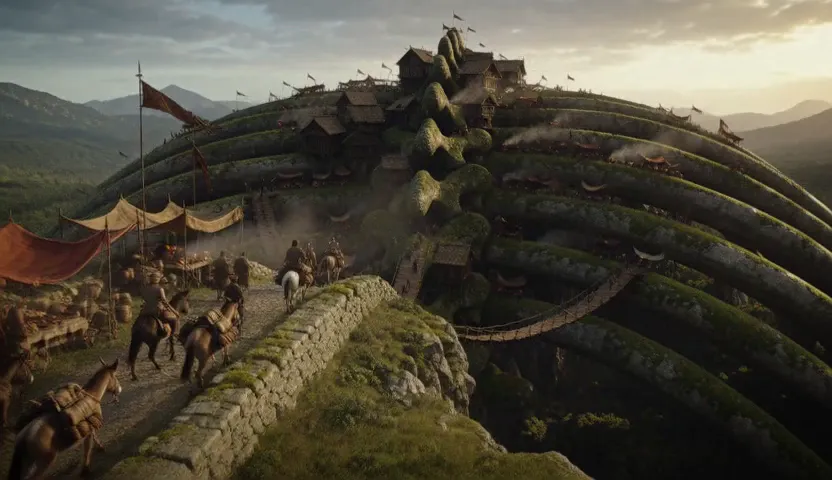
Wide establishing shot of a toll town built along the back of a fallen stone giant. Houses line the spine, rope bridges hang between the ribs. A mule caravan walks across a causeway in the foreground, market smoke rises and drifts, banners move in the wind. The camera pushes in slowly. Late afternoon, long shadows, muted greens and rust. Painterly fantasy landscape.
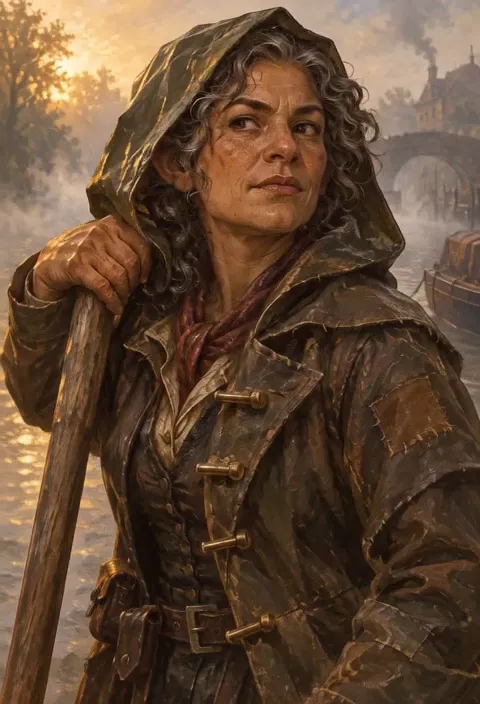
She shifts her weight on the barge pole and turns her head to look down the canal. Mist drifts behind her. The camera holds still.
MiniMax H3 Max is Fal's post-trained MiniMax H3 variant, offered on CharGen as a single entry covering three routes. Prompt alone and it generates from text. Add one image and it animates that image as an opening frame. Add more and it treats them as a cast of references to compose into a new scene. You pick the mode by what you upload, not by switching models.
H3 Max keeps the nine-image reference ceiling that makes party scenes and recurring NPCs stay recognisable, and it adds 1080p plus stronger prompt adherence than the WaveSpeed H3 route. Every route costs the same per second. Reference-to-video adds a small charge after the fourth reference image.
7 gold per second at 480p, 11 at 768p, and 22 at 1080p, the same for text, image and reference-to-video. Reference-to-video adds 3 gold for each reference image after the first four. A 5-second 480p clip is 35 gold. A 5-second 768p reference clip with two images is 55 gold.
One image is treated as the opening frame and animated. Two or more are treated as references: subjects and props the model composes into a new scene. Upload a second image and H3 Max switches modes automatically.
Any whole number of seconds from 5 to 15. Pricing is per second, so you only pay for the length you pick.
Yes. H3 Max outputs 480p, 768p, or 1080p on every route. 480p is the cheap draft tier. 768p is the native canvas. 1080p is a refined pass of that 768p source.
