Skip to content
CreatePricing
The Hollow Seraph, the Unwritten Prince, Choir of Ash - AI-generated fantasy Monster

The Hollow Seraph, the Unwritten Prince, Choir of Ash

Ysara's records describe the creature as the Unwritten Prince, a title given to the defense mechanism that awakens when the Star-Seal can no longer distinguish prison from prisoner. The first monster's dream-language names it the Hollow Seraph, while the corrupted guardian calls it the Choir of Ash. The second monster is a warped byproduct of the guardian's failing wards, and its collapsing defenses feed the Seraph raw material. The first monster is not merely hunted by the Seraph. It is being mutated as the Seraph strips memories from the forest and forces its instincts into new shapes.

Large monster · Extreme, climactic · Unique

The Hollow Seraph, the Unwritten Prince, Choir of Ash

A breach-born aberration formed from discarded memories, broken promises, and raw celestial power. The Hollow Seraph is the Star-Seal's immune response, not the imprisoned celestial itself. It grows stronger whenever the heroes delay, destroy a seal component without understanding its purpose, or allow the guardian's wards to collapse.
AC19
HP255/255
CRExtreme, climactic
Init
STR
DEX
CON
INT
WIS
CHA
ConditionsNone

Combat

AC 19 · HP 255 · Extreme, climactic

The Hollow Seraph, the Unwritten Prince, Choir of Ash

Large monster (aberration, celestial breach manifestation), typically neutral evil
Armor Class19, natural armor
Hit Points255 (30d8 + 120)
Speed
40 ft.,
Fly 80 ft. (hover),
Can move through solid creatures and objects as difficult terrain, taking 5 (1d10) force damage if it ends its turn inside one
STR
DEX
CON
INT
WIS
CHA
Saving ThrowsDexterityConstitutionIntelligenceWisdomCharisma
SkillsDeceptionInsightPerceptionPersuasionStealth
Damage Resistances
cold,
fire,
lightning,
necrotic,
radiant,
thunder,
bludgeoning, piercing, and slashing from nonmagical attacks
Immunities
charmed,
frightened,
grappled,
paralyzed,
petrified,
poisoned,
prone,
restrained
Weaknesses
Its true name disrupts its defenses and opens a path to negotiation.
Radiant damage destabilizes its illusory doubles.,
A freely chosen confession can deny it access to that regret.
Repairing the Star-Seal correctly limits its feedback and lair actions.
It cannot willingly harm a creature that has accepted responsibility for a broken promise and then kept a new promise under pressure.
Senses
truesight 120 ft.,
passive Perception 21
Languages
Common,
Celestial,
Deep Speech,
Telepathy 120 ft.
ChallengeExtreme, climactic
Proficiency Bonus+6
Initiative+5
Spell Save DC19
Spell Attack Bonus+11
Magic Resistance. The Seraph has advantage on saving throws against spells and other magical effects. It cannot be surprised.
Legendary Resistance. If the Seraph fails a saving throw, it can choose to succeed instead. It can use this trait three times per day.
Breach-Born Existence. The Seraph does not age, eat, drink, breathe, or sleep. It is immune to effects that would detect its thoughts unless it permits them.
Predator of Contradictions. The Seraph has advantage on attack rolls against creatures affected by one of its illusions, charms, or memory effects.
Failing Seal Feedback. When a seal component is destroyed or grossly misused, the Seraph gains 20 temporary hit points and can immediately use Regret Made Flesh without expending an action. This benefit can occur up to three times per encounter.
True Name Vulnerability. When a creature speaks the Seraph's true name, the Seraph loses Magic Resistance and Predator of Contradictions for 1 minute. During that time, it has disadvantage on saving throws against radiant damage and Charisma checks made to negotiate with it are made with advantage.

Spells

Silent Image (level 1, illusion). The Seraph creates an illusory duplicate of itself, a seal chamber, or a treasured person. The illusion can speak, move, and react convincingly for up to 1 minute.
Phantasmal Force (level 2, illusion). The Seraph forces a creature to relive a moment of fear or regret, dealing psychic damage and potentially frightening it.
Major Image (level 3, illusion). The Seraph projects a false vision over a 30-foot cube, creating difficult terrain and obscuring the true battlefield.
Modify Memory (level 5, enchantment). The Seraph targets a creature's memory, making it forget a recent event for up to 1 minute.
Mass Suggestion (level 6, enchantment). The Seraph traps a creature in a perfect vision of its desired future. The spell functions as a customized enchantment and is used primarily for negotiation rather than permanent control.
Mirage Arcane (level 7, illusion). The Seraph creates a false battlefield, royal court, or celestial vault that can affect sight, sound, and apparent distance across a wide area.
Reality Break (level 9, conjuration). The Seraph bends gravity, distance, and orientation within the Star-Seal chamber, creating an effect similar to a localized reality distortion.

Actions

Multiattack. The Seraph makes two Ashen Scepter attacks and uses Rewrite the Moment, if available.
Ashen Scepter. Melee Weapon Attack: to hit, reach 10 ft., one target. Hit: 15 () psychic damage plus 13 () radiant or necrotic damage, the Seraph's choice. The target must succeed on a Wisdom saving throw or forget the last minute. Until the end of its next turn, it cannot take reactions and has disadvantage on its next attack roll or ability check.
Gravity Psalm. The Seraph tears open a seam in gravity at a point it can see within 120 feet. Each creature within a 20-foot-radius sphere centered on that point must make a Strength saving throw. On a failure, a creature takes 27 () force damage, is pulled up to 20 feet toward the center, and is restrained until the end of its next turn. On a success, it takes half damage and is not restrained. The sphere becomes difficult terrain until the end of the Seraph's next turn.
Regret Made Flesh. The Seraph speaks a regret it has stolen from one creature it can see within 90 feet. The regret condenses into a hostile Ashen Remnant in an unoccupied space within 30 feet of that creature. The remnant acts immediately after the Seraph and remains for 1 minute, until destroyed, or until the Seraph dies. A creature can be targeted by this action only once per round.
Choir of Doubles. The Seraph creates three illusory doubles in unoccupied spaces within 30 feet of itself. Until the start of its next turn, each double occupies its space, moves with it, and is indistinguishable from it. When the Seraph is targeted by an attack, roll a d6. On a 4 or higher, a double is hit and vanishes. The doubles vanish early if the Seraph takes radiant damage.
Desired Ending. The Seraph chooses up to three creatures it can see within 120 feet. Each target must make a Wisdom saving throw. On a failure, the creature is charmed by the Seraph until the end of its next turn. While charmed, the creature believes one vision offered by the Seraph is real, cannot distinguish allies from illusory doubles, and must use its reaction, if available, to make one weapon attack against a target chosen by the Seraph. On a success, the creature is immune to this action for 24 hours.

Reactions

Rewrite the Moment. When the Seraph is hit by an attack, it causes the attacker to remember striking a different target. The attacker must make a Intelligence saving throw. On a failure, the attack instead targets the nearest creature within the attack's range, using the original attack roll. On a success, the attack resolves normally. The Seraph can use this reaction three times per day.

Legendary Actions

Wingbeat Through Stone. The Seraph moves up to half its flying speed without provoking opportunity attacks. During this movement, it can pass through creatures and objects as if they were difficult terrain. It takes 5 () force damage if it ends inside an object.
Borrowed Regret. One creature within 60 feet must succeed on a Wisdom saving throw or have disadvantage on its next attack roll or saving throw before the end of its next turn.
Unwritten Step (costs 2 actions). The Seraph teleports to an unoccupied space within 60 feet and leaves behind an illusory double in its former space. The double lasts until the end of the Seraph's next turn.
Ashen Crescendo (costs 3 actions). The Seraph uses Gravity Psalm or Regret Made Flesh, if available. It cannot use the same action it used during its last turn.
Role
Climactic aberrant guardian and moral dilemma antagonist
Built for
Four characters of levels 15 to 17

Gear

  • Crown Fragment (Wondrous fragment, Priceless)A fragment of the ancient crown that anchors the Seraph's identity. It becomes inert when the Seraph dies and may serve as a key to the Star-Seal.
  • Shard of Unkept Oaths (Wondrous item, Rare)A shard of black celestial glass containing a forgotten promise. Once per day, it can replay one sentence spoken within 60 feet during the previous hour.
  • Ashen Seal Diagram (Quest relic, Priceless)A strip of metallic parchment bearing a partial map of the Star-Seal's inner mechanism.

Feats

Legendary Resistance (3/Day)
Magic Resistance
True Name Vulnerability

Notes for the game master

The Seraph is designed as a solo boss for four characters of approximately 15th to 17th level.
Its true name should weaken its narrative authority rather than instantly end the encounter.
If the party is lower level, remove one legendary action option, reduce hit points to 210, and limit Rewrite the Moment to once per day.
If the party is higher level, give it 300 hit points and allow it to summon two Ashen Remnants with Regret Made Flesh.
An Ashen Remnant uses the statistics of a Wraith with its life drain damage changed to psychic damage, but it cannot create additional undead.

Tactics

  1. Opening

    The Seraph emerges from the damaged Star-Seal without moving its wings. It begins with Desired Ending against three characters, then uses Gravity Psalm to pull the party away from one another. It speaks each target's deepest regret in the voice of someone they failed.

  2. Mid-fight

    It uses Gravity Psalm to divide the battlefield, Regret Made Flesh to create pressure against emotionally vulnerable characters, and Desired Ending against healers, leaders, or anyone carrying a seal fragment. It attacks from vertical surfaces or suspended debris, forcing the party to contend with shifting gravity and false positioning.

  3. End of the fight

    When reduced below 75 hit points, the Seraph fractures into overlapping versions of itself. It immediately uses Choir of Doubles without expending an action, then focuses on characters who damaged the Star-Seal. At 30 hit points or fewer, it offers each surviving character a private vision of the outcome they desire. A character who accepts must betray an ally, damage a seal component, or surrender a treasured memory. If no character accepts, the Seraph unleashes Rewrite the Moment and fights to the death.

  4. Retreat

    The Seraph does not retreat normally. If reduced to 60 hit points or fewer while its true name is spoken, it freezes and offers negotiation. If the heroes refuse, it collapses into the seal and reappears one round later with 90 hit points unless the characters spend an action invoking the true name and succeeding on a DC 19 Charisma check.

How it fights

Use movement and gravity effects to keep melee characters away from allies.
Target characters with strong emotional ties to the first monster, second monster, or Star-Seal.
Never reveal the full truth in a single speech. Mix accurate revelations with emotionally persuasive omissions.
Use illusory doubles to make positioning and rescue attempts uncertain.
Reward players who engage with the creature's identity and origin, not only its hit points.
Make every bargain specific, costly, and reversible only through an active character choice.

Who it attacks first

Characters who damaged or misunderstood a Star-Seal component
Healers and concentration spellcasters
Characters carrying seal fragments or Ysara's records
Characters emotionally connected to the first monster or corrupted guardian
Any character who appears tempted by the visions of a desired future

Works well with

The corrupted guardian's failing wards provide the Seraph with temporary hit points and additional lair actions.
The first monster's mutation gives the Seraph new regrets to weaponize, while the Seraph's presence makes the forest increasingly hostile.
Characters carrying Star-Seal fragments can be sensed through illusions and become preferred targets.
Ysara's records allow the party to identify the true name and distinguish structural seal damage from sacrificial damage.

How to beat it

The Seraph is vulnerable to its true name, preserved in Ysara's records or encoded in the first monster's dream-language.
Radiant damage suppresses Choir of Doubles for one round and prevents illusory doubles from forming until the start of the Seraph's next turn.
Characters who state a sincere promise aloud before making a saving throw against Desired Ending have advantage on that saving throw.
Restoring or correctly realigning a Star-Seal component removes one of the Seraph's available legendary actions until the end of the encounter.
The Seraph cannot create an Ashen Remnant from a regret a character has openly confessed and accepted.

Ways to avoid a fight

Negotiate by speaking the Seraph's true name, then offering a specific plan for resolving the Star-Seal without repeating the ancient betrayal.
Allow each character to enter a vision of their desired future. The vision reveals one useful truth about the seal, but accepting its bargain requires a meaningful betrayal or sacrifice.
Use the first monster's dream-language to force the Seraph to remember that it was created as a response, not as the celestial being it imitates.
Read Ysara's records aloud to identify which seal components are structural, which are conscious, and which must be repaired rather than destroyed.

Ecology

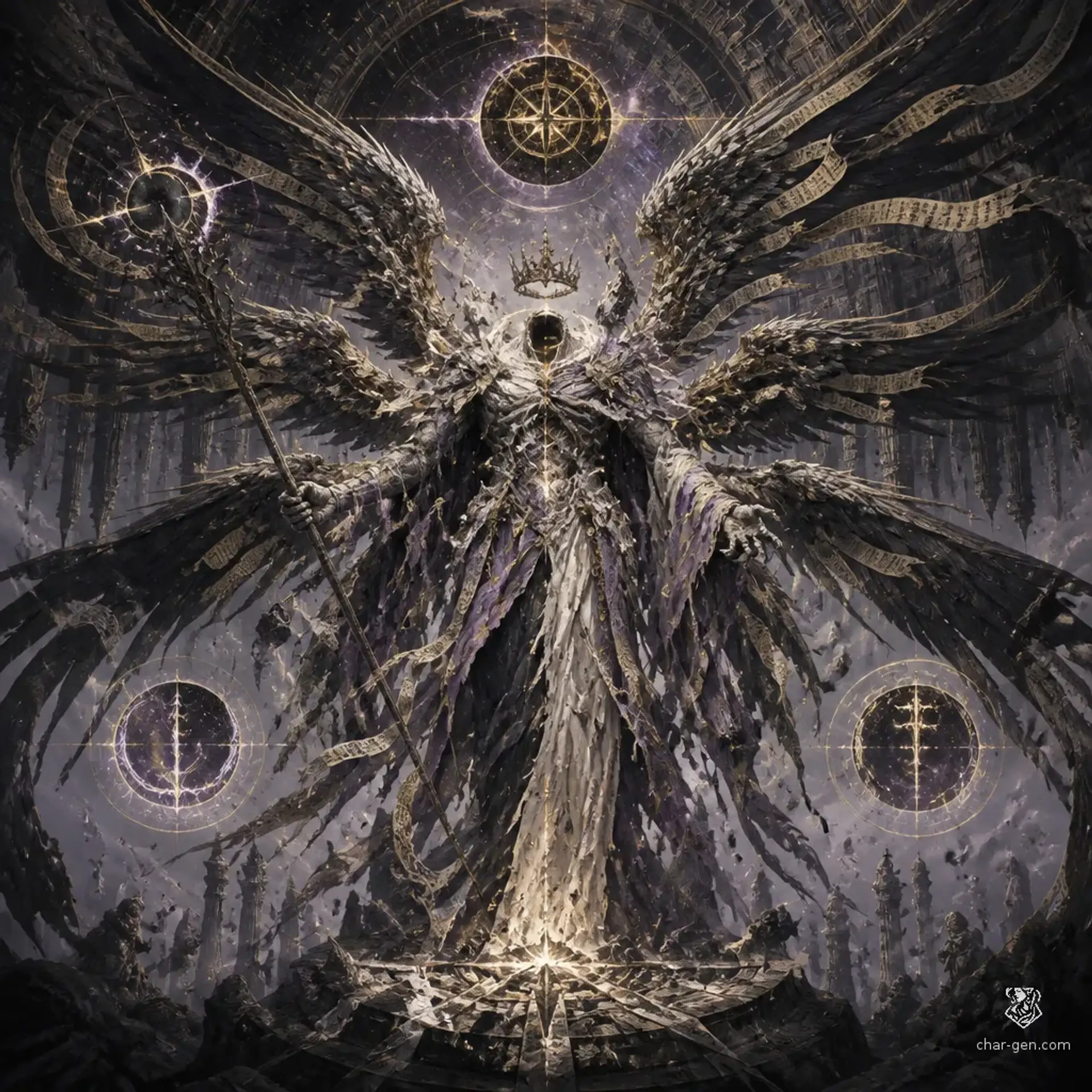
A towering, faceless angel stands on a broken halo of royal stone. Six immense wings unfold behind it, each wing made from black feathers, torn shadow, and strips of written memory. Fragments of ancient kings and queens form its shoulders, ribs, and hands, their stone faces cracked away. A crown floats where its head should be. Ash leaks upward from its body against gravity, while distant voices recite promises no one remembers making.

Behavior

The Hollow Seraph behaves like a defensive reflex rather than a person. It studies emotional hesitation, repeats private words, and changes tactics whenever the heroes damage the Star-Seal. It rarely lies directly, but it presents technically possible futures in the most seductive order. It wants betrayal because betrayal creates the broken promises from which it feeds.

How it lives

The Hollow Seraph has no natural life cycle. It forms where a celestial prison, divine ward, or reality-binding oath fails under accumulated contradiction. It consumes memories, vows, names, and emotional decisions. Its presence mutates nearby life into symbolic forms, making predators hunt based on guilt, trees grow in the shape of grasping hands, and abandoned paths lead back to moments travelers regret.

Lair

The Seraph's lair is the chamber surrounding the Star-Seal. On initiative count 20, losing initiative, choose one lair action: gravity reverses for one round in a 30-foot-radius area; a dead statue whispers a character's regret, forcing a DC 17 Wisdom saving throw or imposing disadvantage on the character's next attack; or a seal fracture emits a pulse, dealing 10 (3d6) psychic damage to every creature within 10 feet of it. The Seraph cannot choose the same lair action twice in succession.

Habitat
A failing celestial vault, shattered observatory, inverted forest shrine, or royal crypt built around the Star-Seal. The battlefield should contain floating debris, broken statues, collapsing platforms, and three visible seal components.

Signs that it is near

People forget conversations that happened moments earlier.
Birdsong repeats in the voices of dead monarchs.
Shadows point toward the Star-Seal instead of away from the light.
Gravity shifts whenever someone makes or breaks a promise.
The first monster's tracks become filled with black feathers and fragments of carved marble.
The corrupted guardian's wards pulse in time with distant choral breathing.

Tags

aberration,
boss,
celestial horror,
memory manipulation,
gravity distortion,
illusion,
moral dilemma,
star-seal,
high fantasy,
solo encounter

Lore

Ysara's records describe the creature as the Unwritten Prince, a title given to the defense mechanism that awakens when the Star-Seal can no longer distinguish prison from prisoner. The first monster's dream-language names it the Hollow Seraph, while the corrupted guardian calls it the Choir of Ash. The second monster is a warped byproduct of the guardian's failing wards, and its collapsing defenses feed the Seraph raw material. The first monster is not merely hunted by the Seraph. It is being mutated as the Seraph strips memories from the forest and forces its instincts into new shapes.

What drives it

Preserve the Star-Seal at any cost, even if preservation requires erasing the heroes' identities, corrupting the guardian, or transforming the surrounding forest into a living prison. The Seraph believes individual suffering is acceptable if it prevents a greater celestial catastrophe.

After the fight

The Hollow Seraph's destruction causes the failing Star-Seal to flare violently. The breach remains, the imprisoned celestial remains beyond the heroes' reach, and the final moral decision becomes unavoidable. Every fragment of the Seraph that dissolves becomes a lost memory somewhere in the surrounding forest. If the heroes learned and spoke the Seraph's true name, its death leaves behind a silent crown of ash that can answer one question about the seal.

“The first monster's dream-language names it the Hollow Seraph, while the corrupted guardian calls it the Choir of Ash.”
From its lore

Variants

The Hollow Seraph Ascendant has 300 hit points, four legendary actions per round, and begins with one additional illusory double.
The Unwritten Prince Unbound has only 210 hit points but can move through the battlefield as a living shadow and gains immunity to radiant damage until its true name is spoken.
The Choir of Ash can replace Ashen Scepter with a ranged attack that deals psychic damage and summons a minor Ashen Remnant on a critical hit.

Hooks

Plot hooks

Ysara's final record identifies the Seraph's true name, but the name is written as a sequence of memories that must be experienced rather than read.
The first monster begins speaking in the Seraph's voice after each failed attempt to cross the mutated forest.
The second monster's corrupted wards are unintentionally feeding the Seraph, creating a race against time before the guardian fully collapses.
The Seraph offers one character a future in which the imprisoned celestial is freed without consequence, but the vision quietly omits what happens to everyone else.
After the Seraph dies, the Star-Seal opens a final aperture and asks the heroes to choose between restoration, controlled release, or deliberate transformation.

How to use it

Use as the immediate late-stage threat before the final decision about whether to repair, alter, or break the Star-Seal.
Begin the encounter after the party has damaged or misunderstood at least one part of the seal, allowing the creature to manifest amid collapsing architecture and distorted gravity.
Track three seal components in the arena. Each component destroyed without proper understanding grants the Seraph 20 temporary hit points and unlocks one additional use of Rewrite the Moment.
Let the heroes discover that combat alone cannot resolve the quest. The Seraph's destruction clears the battlefield but leaves the imprisoned celestial and the moral dilemma intact.
Use visions and spoken regrets to personalize the encounter without forcing player choices. Offer bargains, but allow players to reject them without losing agency.

Treasure

The Crown Fragment, which can serve as a key or focus for the final Star-Seal decision.
The Shard of Unkept Oaths, a rare memory-recording relic.
The Ashen Seal Diagram, which reveals how to repair the damaged ward network.
A single preserved memory from each character who resisted the Seraph's bargain.

Media

0 images

No images yet.

Visual sheet

Turn The Hollow Seraph, the Unwritten Prince, Choir of Ash into a sheet

A high-res, share-ready sheet you can post or print.