Unnamed Miller
Unnamed Miller
At the table
Voice
A dry, work-worn sound, with a faint rasp from years of mill dust and a slightly breathy finish after exertion. His speech has the measured cadence of someone accustomed to listening for machinery over his own words. His laugh is brief and brighter than his guarded manner suggests.
He speaks in practical, work-shaped phrases, often naming quantities and tasks rather than feelings. His answers can be evasive without sounding theatrical. When he talks with his son, his humor is dry and quick; when discussing food shortages, his words become clipped and exact.
Speech patterns
How to play them
Approach him through a concrete need: repairing equipment, moving a sack, or finding food for a household. He is cautious with questions about stores and records, but responds to practical help and demonstrated concern for his son. Avoid treating him as a combatant or assuming he will risk his family on a stranger's word.
Goal
Keep the mill operating, protect his son, and get enough flour to the village to carry people through the next shortage.
Motivation
To preserve his son's safety and the village's access to food without drawing attention to either.
Appearance
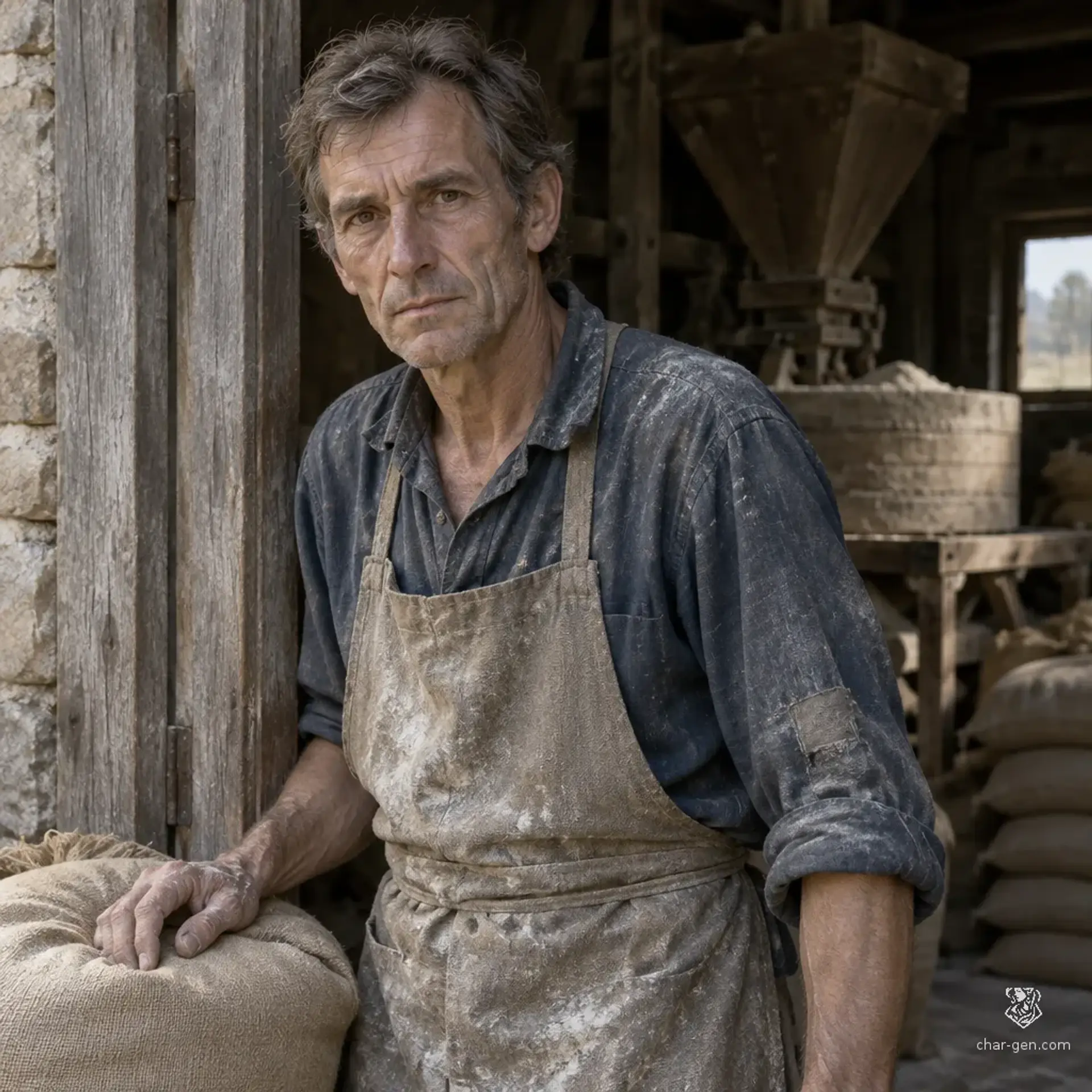
A lean man with a narrow, weathered face and observant brown eyes much like his son's. His graying chestnut hair lies flat where mill dust has settled into it; his clean-shaven jaw is tight at rest, but when he laughs his broad front teeth show in a quick, unexpectedly boyish grin. He stands at the mill doorway with both hands resting on a plain burlap sack. His movements are economical and slightly forward-leaning, as if always listening for the next change in the mill's rhythm. Soft stone-gray morning light catches the flour on his cheek; muted ochre timber and working machinery fill the background. He leaves an impression of watchfulness rather than menace.
Clothing
A plain faded indigo work shirt and a coarse canvas apron dusted with flour. The clothes are serviceable, repeatedly mended, and unmarked by insignia.
Body language
He keeps one hand on a sack, doorframe, or work surface whenever possible. His shoulders incline toward whoever is speaking, but his eyes periodically check the doorway and the mill machinery. When unsettled, his jaw shifts as if testing a troublesome tooth.
- Height
- Average height
- Build
- Lean and sinewy from years of lifting and working machinery; his shoulders are narrow, his posture slightly pitched forward.
- Eyes
- Brown
- Hair
- Graying chestnut
- Skin
- Weathered light skin, dusted with flour around the face and hairline
- Age
- About fifty
- Gender
- Male
- Size
- Average adult human
Distinguishing features
Personality
12 traits and drivesHe is observant and guarded with strangers, yet generous in small, practical ways once he believes someone is in need. At work he is patient with machinery and exacting about measures; under pressure he grows terse and stubborn. Around his son, a dry humor and unexpected warmth surface, though fear can make him overprotective. He wants to be honest, but occupation has taught him that a truthful answer can endanger people.
Quirks
Habits
Traits · 3
Flaws · 3
Fears · 3
Wants and needs · 3
Combat
HP 0He is not a trained combatant. If threatened, he tries to get his son and other civilians out of reach, use the mill's heavy machinery and sacks as cover, and escape through a familiar exit. Any numerical combat ratings would be custom placeholders, not verified rules for Before the Lorry Leaves.
Unnamed Miller
Services they sell
Equipment
- Burlap sack (work item)Plain, flour-dusted sack held at the mill doorway; it is ordinary work equipment, not a concealed weapon.
Possessions
Background
He has spent most of his life measuring grain, tending the mill, and keeping its machinery running through bad harvests and worse winters. His son grew up among the sacks and millstones, learning early that a little flour could mean the difference between a meal and a hungry night. During the occupation, the mill became a place where villagers had to negotiate ration demands, shortages, and the risk of being noticed by the authorities. A formative winter came when he obeyed an order to surrender a portion of the village's grain; afterward he watched a neighbor's children go without bread. Since then, he has tried to make each measure serve people first, while hiding that choice behind careful accounts and a habit of appearing merely tired. He remains protective of his son, wary of strangers, and caught between keeping the mill open and refusing to let it become an instrument of hunger. His current problem is a dwindling stock of grain and growing pressure to account for every sack.
Role in the story
A civilian contact and portrait subject: a guarded village miller whose livelihood and family are entangled with the occupation's demands. He can offer local knowledge and practical help, but is not presented as a combat encounter.
“His son grew up among the sacks and millstones, learning early that a little flour could mean the difference between a meal and a hungry night.”
- Faction
- No formal faction affiliation. A village civilian working under occupation.
Known connections
Media
0 imagesNo images yet.
Turn Unnamed Miller into a sheet
A high-res, share-ready sheet you can post or print.