Charlie Frost
Charlie Frost
At the table
Voice
A sturdy, slightly rough voice with the breath control of someone accustomed to calling across fields and speaking over wind. The sound catches at the end of long sentences, as if his throat has gone dry; when he talks about a dream, his words become clipped and report-like. Laughter comes easily around his siblings but can stop in the middle when he notices a reflection or hears a sound no one else acknowledges.
He speaks in a plain, practical rhythm, shaped by farm work and a lifetime of telling people what the weather or an animal is about to do. His sentences often begin with a concrete observation and end in an uncertain question. When describing a strange experience, he becomes unusually exact about time, direction, and sound, as if a careful report might keep fear from becoming a story. His Shropshire inflection is present but not exaggerated. He does not whisper when angry; he tends to speak faster and more bluntly.
Speech patterns
How to play them
Approach him with patience and concrete questions. Do not ridicule his alien explanation, but do not confirm it as fact. He responds well to shared work, a calm offer of food, and honest acknowledgment when something sounds frightening. If treated as a monster, he withdraws or becomes defensive; if treated as an ordinary man with an extraordinary problem, he may share his notebook.
Goal
Discover what happened to him after the loss of his first family, understand the recurring lights and voices, and remain a dependable brother without letting the boggart nature he fears govern his choices.
Motivation
To belong to a family without being owned by it, and to learn whether his strange experiences are evidence, memory, or a story he needs in order to survive.
Appearance
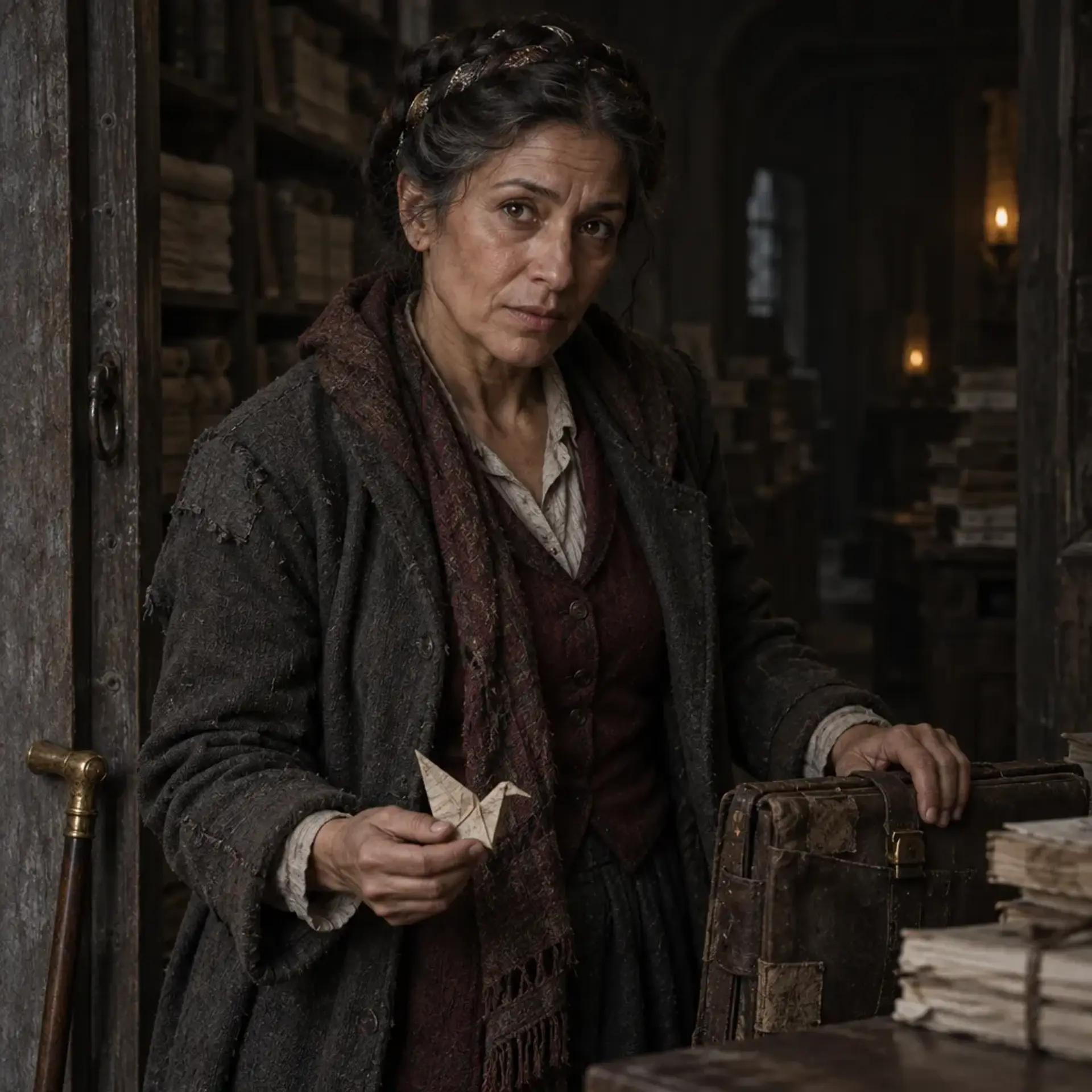
Charlie Frost is a fine, strapping young man, five feet ten inches tall, with blond-brown hair that looks sun-bleached at the tips and green eyes that keep returning to doorways, window glass, and the unoccupied space behind a person's shoulder. His cheeks retain the softness of youth, but his shoulders and forearms have the dense, work-made strength of someone who has hauled sacks, dug stubborn soil, and shouldered a rifle. His skin is weathered pink across the nose and knuckles, with pale lines where a watch and shirt cuffs usually sit. He moves with an odd economy: feet placed carefully, weight held ready to turn, as though every room might have a second exit visible only to him. When nervous, he takes up less space; when he decides a stranger is a threat, he plants himself broadside in the passage and seems surprised that anyone finds this obstructive. An unexpected detail for a veteran farmer is that he can reproduce the dry, ticking call of a hedge sparrow so precisely that birds answer him from nearby hedges. He smells faintly of damp wool, cut grass, and the cold iron of a neglected gate. His smile can make him look like an ordinary local lad until his attention slips past the people in front of him, fixed on something no one else can see.
Clothing
Practical modern farm clothes: a waxed jacket, checked shirts, worn jeans, thick socks, and muddy boots. He keeps an old wool scarf in his coat even in mild weather. A small metal cross hangs beneath his shirt, though he is uncertain whether it comforts him or reminds him of the family he lost.
Body language
He keeps his hands loosely curled as though ready to lift a sack or close a gate. In a group he tends to stand near an exit, but unconsciously places himself between strangers and the person he feels responsible for. His gaze tracks empty corners and window reflections. When he feels safe, his posture softens and he leans toward whoever is speaking; when he senses danger, he goes still rather than puffing himself up.
- Height
- 5 feet 10 inches
- Build
- Strong, broad-shouldered, and work-hardened without looking heavily muscled.
- Eyes
- Green
- Hair
- Blond-brown, sun-lightened at the tips
- Skin
- Fair, weather-reddened across the nose, cheeks, and knuckles
- Age
- Appears 20; claims to be 20 in 2026. His actual age is uncertain and may span centuries.
- Gender
- Male
- Size
- Average human adult
Distinguishing features
Personality
20 traits and drivesShorpy is protective without being consistently gentle. He notices who has been left out, who is cold, and which animal is limping, then may make decisions on their behalf before asking what they want. He dislikes being treated as important, but becomes stubbornly proud when someone dismisses his knowledge of land and weather. He is curious about lights, voices, and missing memories, yet can panic when a clue seems to point toward the fae rather than aliens. Among his siblings he is capable of easy affection and teasing; with strangers he tests the room for ridicule before trusting them. When rested, he is wry, practical, and quietly helpful. When exhausted, he becomes suspicious and speaks as if every coincidence is part of a pattern. At Christmas he can laugh with his family while still watching the mirror. During the first days of May his customary caution gives way to a bright, mischievous delight that he finds both exhilarating and abhorrent. He wants to be understood, but fears that understanding will make him less human in everyone else's eyes.
- Alignment
- Not a Call of Cthulhu 7E statistic. Protective by habit, capricious under pressure, and not reliably governed by human moral categories.
Quirks
Habits
Traits · 5
Flaws · 5
Fears · 5
Wants and needs · 5
Combat
HP 12 · Not represented as a standard numerical combat statistic in this NPC record; use ordinary human movement and the Keeper's Call of Cthulhu 7E movement rules.Call of Cthulhu 7E is not a tactical fantasy combat system. Shorpy avoids violence where possible, uses cover, and tries to get endangered people away. If forced to fight, he uses a farm tool or unarmed attacks. He does not have armor, supernatural combat defenses, or a formal combat level.
Charlie Frost
Actions
Reactions
Services they sell
Rewards they can give
Equipment
- Field notebook (personal item)A weathered notebook containing dates, sketches of lights, fragments of dreams, and several entries crossed out so heavily they tore the paper.
- Folding pruning saw (tool)A small, old farm tool kept for work. It may serve as an improvised weapon if the Keeper allows, using the standard Call of Cthulhu rules for the appropriate weapon.
- Wrapped wooden toy (keepsake)A child's wooden toy wrapped in a wool sock, found after the recurring childhood dream. He cannot remember owning it.
Possessions
Background
Charlie Frost calls himself Shorpy when he is among the personifications of the English counties, and insists that both names are simply names. He is not certain which one came first. In 2026 he rents a modest farmhouse on the Shropshire side of the Welsh border, works occasional jobs on neighboring holdings, and keeps a handful of sheep on land that is not quite enough to support them. He is good at mending fences, reading weather, and telling whether a frightened animal is ill or only frightened. He is less good at explaining why a road he has never driven seems familiar, or why a light over a wet field can make him feel that someone has called him home. His oldest memories begin in a time of border raids, when the kingdom of Merica was in conflict with Welsh kings. The dates and names of rulers slide away whenever he tries to hold them. What remains is a cramped dwelling, a mother fading after childbirth, and a man he knew as his father: a hard raider who was not his mother's husband. Shorpy remembers the man's wet boots, the smell of old leather, and the way the other children learned to watch his hands. He remembers having half-siblings, but cannot reliably place them in age order. Their childhoods moved forward. His seemed to stop. He stayed small and childlike in the ways that mattered, even when the others grew older, learned the silences of adults, and left the house behind. He remembers being loved in scraps rather than in a single secure bond. One sibling once shared a heel of bread with him beneath a table. Another told him not to speak when the raider was angry. There was a woman who hummed while working, though Shorpy cannot decide whether she was his mother or a neighbor. His mother withered after giving birth, and the household's grief had no safe place to go. He developed an early sense that the land itself was listening. At first, that meant ordinary things: knowing which ditch would flood, which path stayed firm, which sheep would lamb badly. Later, he would say that the fields had begun sending him messages. A formative change came after his first family was gone. Shorpy cannot describe the departure as one continuous event. He recalls a night of wind, a hand on his shoulder, and a door that opened onto a place that was not the yard. In one version, he was taken by the fae. In another, lights descended from the sky and brought him into a craft. In a third, he simply wandered out and was found weeks later beside a stream, with no memory of how he got there. The details change, but the consequence does not: when he returned to ordinary human life, the people who had known him were dead, missing, or no longer able to recognize him. He experienced the loss as abandonment and rescue at once. He has never reconciled the two. Shorpy worked the land, then fought in wars whose causes and uniforms blur together. He has the reflexes of a veteran but no tidy military biography. He remembers mud sucking at boots, orders shouted through smoke, and the intimate panic of trying to keep a frightened boy alive. In some memories he is a farmer carrying a musket; in others, a soldier who has somehow been fighting for longer than his face should permit. He has watched families move away from places that would not let them go. A house might be left empty, yet the sounds of its household continued: a chair dragged over a floor, a child laughing in the loft, a kettle set down in a kitchen with no fire. He learned to stay near farms and cottages because he could not bear the sound of a home becoming empty. The war years did not make him brave in a simple way. He can stand under gunfire, but a locked bedroom door makes his palms sweat. He once abandoned a position to carry a wounded stranger to shelter, then returned to find his unit had moved on without him. He was angry at them for leaving and ashamed that he had expected them to wait. He also learned that he could be cruel in the name of protection. In one village, he tormented a man who beat his animals, leaving the man's tools scattered and his doors open night after night. The man left. Shorpy called it justice until the man's children had to leave with him. He still cannot decide whether the disturbance had been a warning, a punishment, or something in him enjoying itself. His life is now threaded into a new family: other personifications of English counties, siblings by a kinship that is older and stranger than ordinary blood. Wiltshire, called Wilt, is a five-foot-ten man with black hair and eyes like a pond under moonlight. Wilt denies being a changeling, verbally and, Shorpy suspects, even psychically. Shorpy is convinced that Wilt was taken by aliens as well. Northumberland, called Thumber, is a blond border man with dark blue eyes and a lingering scar from an old conflict; Shorpy trusts his practical judgment even when he resents his vigilance. Cumberland, called Cyril, is five-foot-eight, light brown-red-haired, freckled, and green-eyed. Westmoreland, called Mary, is five-foot-six, red-haired and freckled. Her brothers joke that she is a witch, but she is practical, traditional, kind, and capable of repairing a torn sleeve before anyone has finished complaining about it. Hampshire, called Philp, is a blond, bright-eyed man who earned money through sailing, ship work, and metalwork, and now protects his new wealth by working exhausting hours. Kent, called Ken, is a blond gardener with hazel eyes flecked blue and brown, middle-class and careful to appear more refined than he feels. The siblings' affection is not simple. They quarrel about who is responsible for whom, and their jokes often hide real arguments over what their shared nature means. Their father is a sorcerer, and tradition keeps him at a distance. Shorpy suspects that this distance is a rule built around a fear rather than a sign of indifference. He has not asked directly. His siblings have not pressed him to. He wants a family that will tell him the truth, but he is terrified that a truthful answer will prove he is not one of them at all. His current trouble began with lights and sounds that he cannot explain. A white point hangs above a field, then vanishes behind a tree without moving across the sky. A low vibration comes through the ground while his phone shows no signal. Voices call him by names he does not remember being given. He calls them aliens because that word is available, modern, and less humiliating than saying he hears the land. He has researched abduction accounts, drawn diagrams of lights, and kept a notebook of dates. He does not claim that every strange noise is a visitor. He is painfully aware that exhaustion, memory, and fear can distort perception. Yet the lights sometimes answer questions he has not spoken aloud. The notebook has become a conflict with Mary, who believes he is not sleeping enough, and Thumber, who thinks he should stop going alone to the fields. Ken has offered to pay for a proper inspection of the old wiring in the farmhouse. Philp keeps insisting that Shorpy can simply move closer to town, a suggestion Shorpy hears as a demand to abandon a place that has attached itself to him. Wilt does not discuss their shared missing time. That silence makes Shorpy more certain than any evidence that Wilt knows something. One dream has returned in fragments for years. In it, he is a child in a stone-walled room while rain taps a shutter. His mother is alive, though her face is hidden by a fold of blanket. A bowl of milk sits on the floor, untouched. His father stands outside, arguing with a woman whose voice seems to come from the chimney. The woman calls Shorpy by a name he cannot remember after waking. He crawls beneath the table and finds a second room there, opening into a night meadow full of small, cold lights. His mother reaches down to him and says, 'If you go, you must know what you are leaving.' He wakes with the certainty that he did go, and with no memory of choosing. The next morning he finds a child's wooden toy in the dirt outside the farmhouse, though he has never seen it before. He keeps it wrapped in a sock. The Christmas party happened in the farmhouse the previous winter. The siblings had come to eat, argue, and pretend that their strained family was ordinary. Mary had sewn a loose button onto Shorpy's coat. Philp brought too much food and bragged that he had bought it all himself. Ken arranged the table as if expecting a wealthy employer to inspect it. Cyril sat by the fire, while Thumber watched the dark windows. Wilt remained near the hallway mirror, avoiding its surface whenever anyone looked his way. Shorpy was happy, but the happiness made him uneasy. He kept checking the mirror over the mantel, where the room's lamplight did not quite match the real room. When the party turned noisy, Shorpy went to fetch a tray from the kitchen. In the mirror he saw himself standing behind his own reflected shoulder. The other figure was tall and narrow, its outline shifting like a shadow cast by a fire that was not there. Its face was roughly his, but the eyes were too bright and too intent, and its mouth stretched with a delight that seemed to have no human reason. Damp, dark hair or fur moved around its head like weeds underwater. Its fingers rested against the glass from the wrong side. Behind the shape, the reflection showed the farmhouse door standing open onto a moonlit field, although the real door was shut. Shorpy turned. No one was there. In the mirror the figure leaned closer. He felt a sudden, joyful recognition, like seeing an old friend after a long separation, and hated himself for being glad. Then the reflected figure tilted its head and grinned. The lamps flickered. The party in the next room seemed to go very far away. Shorpy touched the mirror, and the glass felt cold enough to sting. For one breath he saw the room from the mirror's point of view: his family gathered around the table, their faces turned toward him with expressions he could not read. He heard a voice say, 'You came back.' When he blinked, he was alone in the kitchen. The tray was on the floor, and the mirror showed only his ordinary face. He told the family he had seen a trick of light. Wilt went pale. Thumber asked what exactly he had seen, but Shorpy refused to answer. Mary put a hand on his sleeve and did not let go until he stopped trembling. They finished the evening together, though Shorpy avoided the mirror for the rest of the night. He remembers that Wilt left before midnight. He cannot remember whether Wilt said goodbye. The May Day incident is more difficult to explain away. During the first three days of May, Shorpy felt as though a hammer were driving a nail through the boundary between his ordinary self and something ancient. It began as a bright, restless energy. Sleep seemed unnecessary. Every sound had a comic edge; every locked gate was an invitation. By the second day, he was grinning at nothing and taking delight in small acts of disruption. He moved a neighbor's boots onto the roof, left a trail of eggshells up a church path, and shifted a gate so that a flock of sheep wandered into an empty orchard. No one was hurt, but he laughed with a warmth that frightened him. On the third day, the joy became unnatural. A dog barked at him and Shorpy felt a flash of glee so sharp it seemed to belong to someone else. He heard the animal's fear as a kind of music. He found himself at a cottage window, watching a child sleep, and recoiled from the tenderness and hunger tangled together in his chest. He went to the door and left a bowl of porridge on the step, then ran through the fields as if chased. He remembers leaping a ditch and landing too lightly, and hearing his own laughter answer from the hedgerow behind him. At dawn on the fourth day he woke in the sheep shed, muddy, exhausted, and weeping. The gate was open, but every sheep had returned to its pen. He cannot recall closing it. He told himself it was a breakdown brought on by lack of sleep. Mary believes him, but keeps checking that he eats. Thumber believes the behavior was a warning. Wilt calls it a story Shorpy is telling himself. Shorpy's own interpretation is that something in him had been waiting for the right season to come awake. He is frightened not only of losing control, but of missing the joy when it is gone. His present aim is to understand the lights, recover the missing portions of his past, and keep his family safe without making them prisoners of his fear. He still wants the human things he has always wanted: a steady home, honest work, and someone who will remain in the room after he admits what he saw.
Role in the story
A companion, witness, or unsettling source of clues whose sincere account of alien lights may conceal a folkloric abduction and a fractured personal history. He can become an ally, a source of family connections, or a danger during the May Eve period. His story supports investigation and roleplay rather than presenting a prewritten answer to the mystery.
“He is good at mending fences, reading weather, and telling whether a frightened animal is ill or only frightened.”
- Faction
- The personifications of the English counties, treated as a family rather than a formal organization. He has no known formal allegiance to a Mythos cult or institution.
Known connections
Media
0 imagesNo images yet.
Turn Charlie Frost into a sheet
A high-res, share-ready sheet you can post or print.