Oswin Hirst
Oswin Hirst
At the table
Voice
His voice has the dry, lightly rasped grain of someone who has spent years speaking over wind and bleating sheep. He places consonants carefully, as if each word is a tool he means to use once. In a crowded room he projects without shouting; when speaking to William, he rounds the edges of his words. At moments of strain, his breath catches on a low, rough undertone that does not sound quite human.
He speaks in an old, work-worn Yorkshire cadence, shaped by Anglish and occasional Old Norse turns. His words are plain, precise, and often anchored in weather or farm work. When he is tired, older sounds creep into his phrasing. He avoids certain harsh, unfamiliar syllables because they belong to the forbidden tongues he knows.
Speech patterns
How to play them
Begin with practical kindness and talk about the farm, weather, or livestock. He is warmest around William and can be persuaded by evidence that a plan will protect the household. He dodges direct questions about his age, family, and the wedding night. Pressing him too quickly makes him retreat into omissions; a calm, specific confrontation can make his concern for Mary outweigh his instinct to hide. Do not present his conduct on the wedding night as harmless or consensual.
Goal
Keep Mary and William safe, help his son grow without shame, and build a home that can survive the next season of supernatural danger. To do so honorably, he must stop deciding for Mary what truths she can bear.
Motivation
He wants to be a husband and father in a human household, not a creature feared on winter roads. He loves the ordinary routines he once thought impossible, but fears the truth will end them.
Appearance
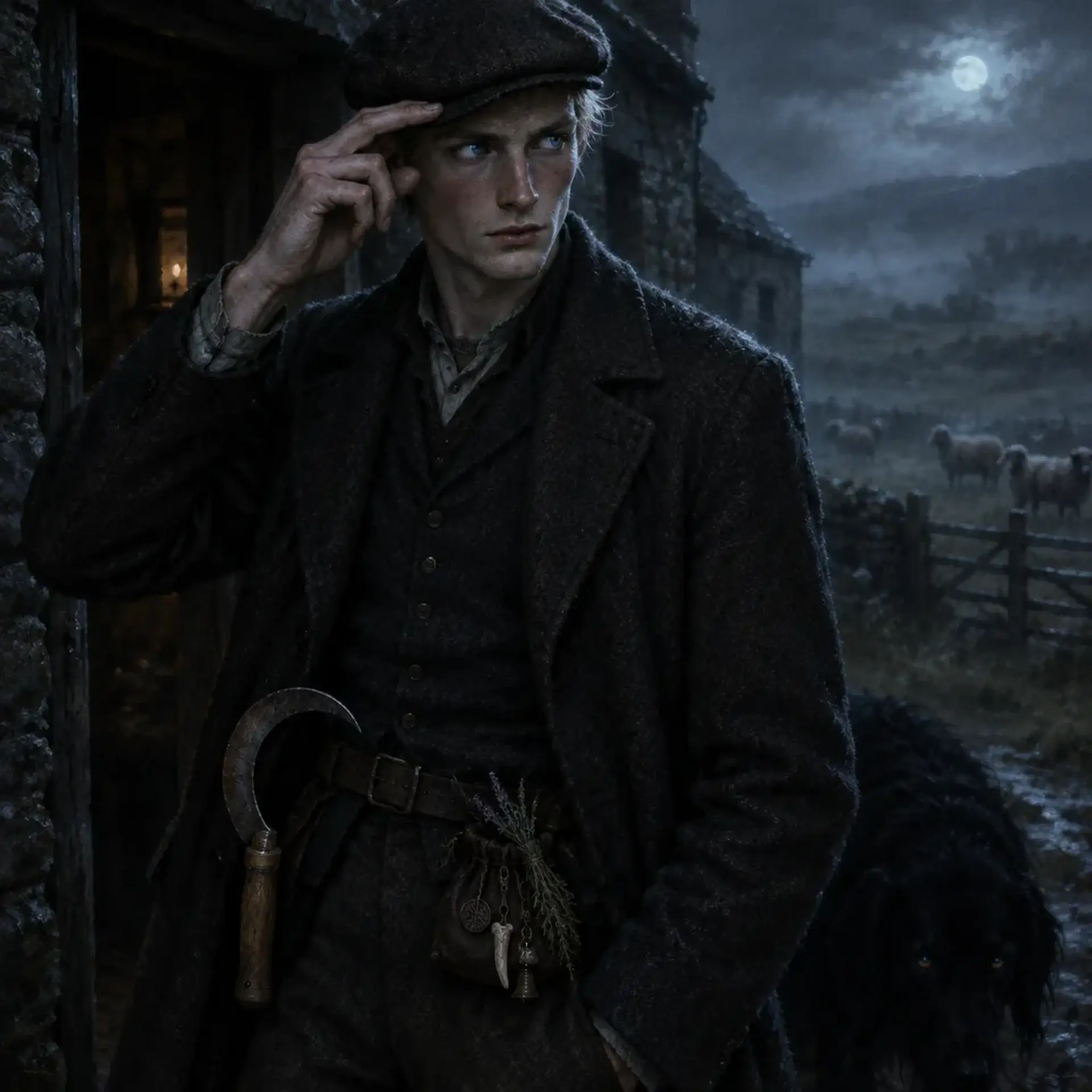
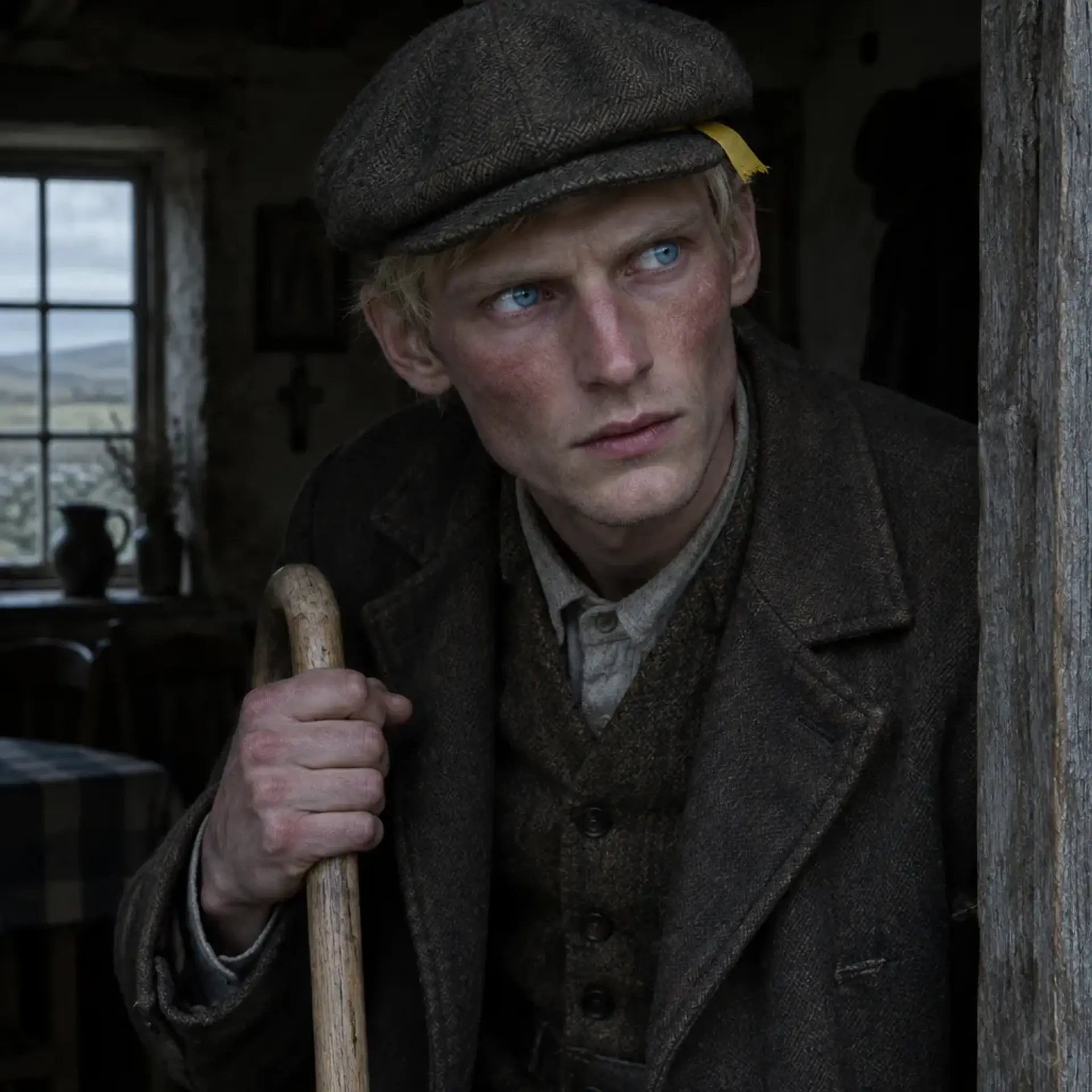
Tall and handsome in the unnerving way of a face that seems to have stopped aging: pale, straight blond hair falls neatly beneath his flat cap, framing clear, burning blue eyes. His skin is winter-pale, with a faint wind-roughened texture at the cheeks. He stands with his weight slightly forward, as if listening through the soles of his boots, and waits without fidgeting. His farm clothes are practical and carefully mended, but the hems never seem to weather as much as they ought; his cap is brushed and reshaped with almost ceremonial care. His movements are economical until a sound startles him, when he turns too swiftly and precisely, like a hound catching a scent. The unexpected detail: he keeps a tiny, neatly folded scrap of bright yellow ribbon tucked in his capband, a keepsake from a child's winter fair.
Clothing
A clean but work-worn coat, stout boots, wool waistcoat, and the common flat cap. His clothes are repeatedly repaired with tidy, almost invisible stitching. He avoids metal fastenings where he can, and the cap is cared for more tenderly than any other possession.
Body language
He waits with his weight pitched slightly forward and his chin angled toward the nearest sound. In company he keeps his hands visible and still; with his family he leans close and makes small, careful gestures of service. Under stress, his head turns before the rest of him, and his stillness becomes so complete that people notice the silence around him.
- Height
- 6 feet 3 inches
- Build
- Tall, rangy, and strong from years of handling sheep, gates, and wet wool sacks; his strength looks practical rather than showy.
- Eyes
- Clear, intensely bright blue
- Hair
- Pale blond, straight
- Skin
- Pale, with wind-roughened cheeks
- Age
- Young adult in appearance, though he has lived far longer than he admits. His face has scarcely changed in the years Mary has known him.
- Gender
- Male
- Size
- Medium
Distinguishing features
Personality
19 traits and drivesOswin is genuinely gentle with children and animals, yet can be calculating when his own safety or secrecy is at stake. He is patient with ordinary work and impatient with questions that threaten his carefully built life. In calm weather he is helpful and dryly funny; during uncanny seasons he becomes vigilant, sleepless, and too alert to every sound. He longs for closeness but responds to the risk of rejection by withholding the very truth that intimacy needs.
- Alignment
- Neutral, with a genuine capacity for care compromised by secrecy, self-preservation, and a grave violation of Mary's trust.
Quirks
Habits
Traits · 4
Flaws · 5
Fears · 5
Wants and needs · 5
Combat
AC 14 · HP 38 · 30 ft. (40 ft. in Barguest hound form)Oswin avoids a fair fight. He uses eldritch blast to keep threats at a distance, thorn whip to drag intruders away from Mary or William, and entangle or fog cloud to break lines of attack. If cornered, he shifts into black hound form to flee, knock a foe down, or protect his family. He avoids iron weapons and tries not to use lethal force unless someone threatens his household.
Oswin Hirst
Spells
Actions
Reactions
Services they sell
Rewards they can give
Equipment
- Herding staff (weapon)A sturdy ash staff used for walking fields and herding, serviceable as a quarterstaff.
- Flat cap (clothing)A worn flat cap with a concealed yellow ribbon tucked into the band.
- Farmer's clothes (gear)Plain work clothes, wool layers, and hard-wearing boots, repeatedly and carefully mended.
- Farm remedies (gear)A small bundle of dried herbs and twine, kept for livestock and household remedies.
Possessions
Background
Oswin Hirst tells people he was born among the Yorkshire dales, in a place where the hills teach a child to watch the clouds and the sheep teach him to notice a change in temper before it becomes a quarrel. He offers the story with a mild smile, as if it is no more remarkable than the weather. Ask after his parents, however, and he gives no names. Ask what village he means, and the answer shifts: a fold of hills farther north, a hamlet that no longer stands, a childhood spent at one farm until he was old enough to earn his keep elsewhere. He is practiced at making each version sound reasonable. He has learned that most people prefer a plain tale to an honest silence. The truth has older paths in it. Oswin is a Barguest changeling, raised neither wholly among humankind nor wholly beyond it. He passed through human settlements under names that did not always last, and he knew the roads used by the hill-folk long before they were fenced or mapped. He learned to take shapes, to listen for danger, and to leave before a neighbor's questions turned into certainty. He came to understand that a life made of departures could keep him safe, but it could not give him a home. In time, he chose sheep farming. The work had a rhythm he could trust: feed, mend, watch, shear, repeat. It required patience, gave him a reason to rise with daylight, and left him a place to return to at night. The farm he eventually made his own is better kept than a man of his means strictly needs. Its rooms are sound, its stores plentiful, and its furnishings chosen to suggest unremarkable comfort. Oswin has spent considerable care making the house seem like the natural reward of steady work, rather than the refuge of someone who has spent years preparing for threats no ordinary farmer would expect. He can mend a gate or tend a lamb without complaint, and in fair weather he is a useful neighbor, with a dry remark ready for anyone who takes themselves too seriously. Children and animals draw a gentleness from him that he rarely offers adults. He remembers small preferences, speaks softly to frightened creatures, and can wait out a child's tears with the patience of a man who knows that fear has its own pace. He met Mary Pickles, daughter of Thomas and Rose, and married her. Mary had been raised in a family that knew hardship and the cost of local superstition. Her mother worked as a herbalist and midwife, while her father and brothers, Hugh and Edmund, kept a wary eye on the people and dangers around them. The Pickles family had already lost an eldest child to fever after the child was chased through winter snow at twelve. They understood that a Barguest was not merely a story told to frighten children, and they had reason to be cautious of anything that carried its shadow. Oswin's wedding night became the secret on which his household was built. In his human shape, he failed to consummate the marriage. He was frightened of what that failure meant, of what Mary might understand, and of the distance it could place between them. Rather than tell her the truth or accept her judgment, he changed into the headless black hound that people feared. Its only visible features were saucer-red eyes. He slept with Mary while she did not know who or what the creature was. She fought it with iron scissors. Oswin has never told her that the beast was him. In the days that followed, he pressed Mary to consummate the marriage again. He wanted to obscure the first encounter, but he also wanted the closeness between them to feel real to him. Those motives do not make what he did less coercive. His longing for a loving marriage does not undo his decision to deceive and violate Mary, or the betrayal that continues because he withholds the truth. He tells himself that confession would destroy the life they have made and expose her to danger. He hopes to keep her safe, yet has mistaken silence for protection and has left her to fear a truth she cannot name. Mary believes that a Barguest violated her. She fears that William, their young son, might be the creature's child. She does not know that Oswin was the hound. Their family has endured other losses. Alice and Rose were lost before birth, and Edward, a sickly boy with reddish eyes, died young. William, whom some villagers call Black William or Blackby, has black hair despite both parents being blond. His eyes are his father's bright blue. He is slow to meet some milestones and can become intensely distressed by harsh sounds or unpleasant sensations. Oswin gives him time and attention, making a steady effort to understand what comforts him. He is tender with the boy, but the child’s appearance and needs also sharpen Oswin's fear that old truths may be visible to the people around them. Mary works beside her mother, Rose, and remains within reach of her wary family. Thomas lives some distance from the Hirst farm and suspects that Oswin is not what he claims to be. He means to use that knowledge to protect and advantage his family, not to expose Mary to the town's cruelty. Hugh and Edmund share the family's watchfulness. Oswin recognizes their scrutiny, though he rarely acknowledges it. He is careful around them, especially when questions touch on his past, his odd habits, or the things that happen when the season turns uncanny. Oswin attends church with conspicuous dedication, though he sits stiffly and can remain unnaturally still through the service. He avoids iron when he can, and if anyone notices, he has an explanation ready. He speaks Old Norse, Anglish, and the shifting local varieties he has gathered in his travels. He also knows forbidden tongues associated with devils and the hill-folk. He makes himself avoid speaking them, as though silence alone can keep an old road closed. In difficult seasons, that effort becomes harder. He sleeps little, studies every sound outside the house, and starts awake at signs that would pass unnoticed in calm weather. He complains about rain, frost, or wind rather than admit that a night has felt too long or that the years seem not to have touched him as they should. Oswin's present struggle is not simply to keep his secret. He wants to preserve his family and to be loved by the people he has placed in danger of learning what he is. He wants Mary to feel secure, William to grow without fear, and the farm to remain a settled home rather than another stopping place. Yet every answer he refuses makes that home more fragile. He can be patient with chores, sheep, and a frightened child, but he grows sharp when someone asks a question that threatens the story he has built. He has learned how to stay. He has not learned how to stay honestly.
Role in the story
A loving but compromised family man whose secret makes him both a source of help and a serious threat to the trust and safety of his household. He can become an uneasy ally, a target of exposure, or the center of a folk-horror mystery about consent, inheritance, and the cost of keeping a family intact.
“He offers the story with a mild smile, as if it is no more remarkable than the weather.”
- Faction
- No known public faction. He is bound to the Hirst household and entangled with the Pickles family; his history also touches the hidden paths of the hill-folk.
Known connections
Media
0 imagesNo images yet.
Turn Oswin Hirst into a sheet
A high-res, share-ready sheet you can post or print.