Henri Vasseur
Henri Vasseur
At the table
Voice
A dry, slightly rough voice shaped by cold dawn air and years of calling across work yards. The first sound is usually a small nose-breath before speech. His words carry clearly without theatrical force, and he can cut through a noisy lane with a sharp, workmanlike instruction.
Plain village French with the clipped economy of someone used to calling directions across rain and cart noise. He names useful landmarks rather than giving long explanations. When a question touches the winter alarm, he begins an answer, takes a small breath through his nose, then chooses a narrower truth.
Speech patterns
How to play them
Approach him with a concrete need and he will help if it does not expose someone else. He distrusts grand claims, uniforms, and requests to identify neighbors. Show that you respect the route and the people using it, and he will offer practical information. Press him publicly and he will become guarded.
Goal
Keep the shelter approach usable for the people who need it without drawing danger to them or his household.
Motivation
He believes that small acts of order can keep frightened people from hurting one another, even when he cannot control the larger danger.
Appearance
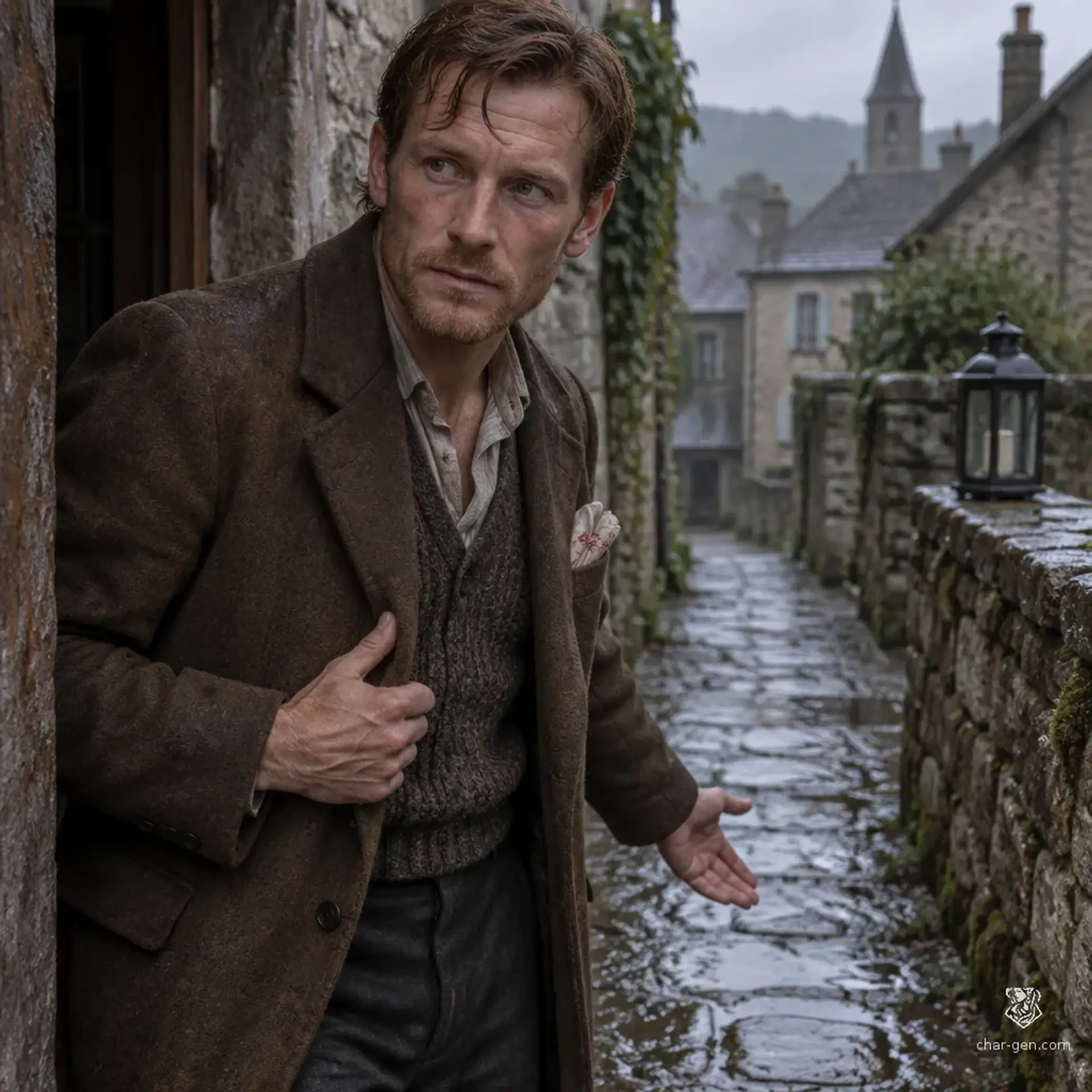
A lean, angular man with a long, weather-cut face, short reddish-brown hair that lies in damp points, and a day’s reddish stubble. His pale gray eyes keep measuring the lane even while he speaks. He stands with his weight set slightly forward, as if prepared to step into someone’s path or out of it in an instant. Rain beads on the nap of his faded umber wool coat. A small, unexpected detail: he has a neatly folded square of embroidered linen tucked into his breast pocket, too fine and carefully kept for a man who works in a wet lane. He leaves the impression of someone who has made himself part of the doorway: easy to overlook until he moves.
Clothing
Faded umber wool coat over a plain knitted vest and work shirt, dark trousers, and worn shoes suited to wet stone. No uniform or military markings.
Body language
Keeps one shoulder near the shelter wall, leaving the passage visibly open. His open hand points low, toward the safe footing, rather than gesturing at people. He watches shoes and the space between bodies; when uneasy, rubs his thumb along the seam of his coat pocket.
- Height
- About average for an adult man
- Build
- Lean and angular, with wiry strength from lifting carts and clearing stone.
- Eyes
- Pale gray
- Hair
- Short reddish-brown
- Skin
- Fair, weather-reddened at the cheeks
- Age
- Late thirties
- Gender
- Male
- Size
- Human
Distinguishing features
Personality
13 traits and drivesHenri is steady in a muddle but uneasy with praise; he can be patient with a frightened stranger and abruptly hard with someone who blocks the passage for convenience. In ordinary conversation he is reserved and almost wry. During an alarm he becomes brisk, decisive, and willing to put himself in the way. When the danger passes, he turns inward and replays what he should have done differently.
- Alignment
- Not applicable; a civilian whose loyalties are practical and personal.
Quirks
Habits
Traits · 4
Flaws · 3
Fears · 3
Wants and needs · 3
Combat
HP 0Avoids fighting. If threatened, prioritizes getting civilians through the doorway and away from the lane, then seeks cover or escape. He has no assumed combat training or weapon.
Henri Vasseur
Actions
Reactions
Services they sell
Equipment
- Hand lantern (civilian equipment)A plain, unlit hand lantern left on the low stone wall; he avoids lighting it unless it is genuinely needed.
- Embroidered handkerchief (personal keepsake)A small folded embroidered linen square, clean and carefully maintained despite the weather.
- Twine (work tool)A short length of twine used to move small obstructions or mark a loose stone temporarily; not a weapon.
Possessions
Background
Henri Vasseur was a farm cartwright’s son who learned early that a lane is a piece of shared machinery: if one person blocks it, everyone waits. When the occupation brought checkpoints and sudden orders to his village, he volunteered to keep the shelter approach clear, telling himself that a narrow, orderly passage might prevent panic. The belief was tested during a winter alarm when a cart overturned at the lane mouth and a neighbor’s child was briefly trapped in the crush. Henri hauled the cart aside, but afterward he could not forget how quickly a frightened crowd turned neighbors into obstacles. Since then, he watches feet and gaps more than faces. His wife, Sabine, works in the washhouse and resents that he risks being seen for a task that rarely earns thanks. Their neighbor, Thérèse, depends on the clear route to reach the shelter with her bad knee; Henri quietly leaves the lantern ready for her, though he never lights it unless necessary. Now a local patrol has begun asking why the lane is kept open at dawn, and Henri must decide whether to keep volunteering or protect the people who rely on him by stepping away.
Role in the story
A grounded civilian point of contact whose routine makes the shelter route legible to the players. He can explain practical lane conditions, provide a brief moment of help, or become a source of tension if patrol scrutiny increases. He is not a combatant or a source of guaranteed intelligence.
“The belief was tested during a winter alarm when a cart overturned at the lane mouth and a neighbor’s child was briefly trapped in the crush.”
- Faction
- Civilian village volunteer; no military or resistance affiliation established.
Known connections
Media
0 imagesNo images yet.
Turn Henri Vasseur into a sheet
A high-res, share-ready sheet you can post or print.