Oruva
Oruva
At the table
Voice
A dry, lightly rasping voice with the breath control of someone accustomed to calling across water. The sound is plain and carrying rather than theatrical; Oruva's old work makes them shape consonants sharply so they are not lost in surf.
Oruva speaks in a dry, breath-measured cadence shaped by years of calling over surf. Their words have a faint rasp from salt air, and they often pause to listen before finishing a thought. They do not sing the warning verses in conversation; instead, they mark their rhythms with a low hum or a tap of the stick.
Speech patterns
How to play them
Begin with practical hospitality, such as offering dried fish or a dry place to sit. Oruva warms to people who listen carefully and take the children's safety seriously. They become stubborn if visitors dismiss local warnings, but can be persuaded by concrete evidence and a plan that includes Sumi.
Goal
Convince the village to close the newly dangerous cave passage and help Sumi update the children's warning songs before the next spring tide.
Motivation
Keep the children alive without making them afraid of the sea, and preserve the warning songs that Oruva's own family taught them.
Appearance
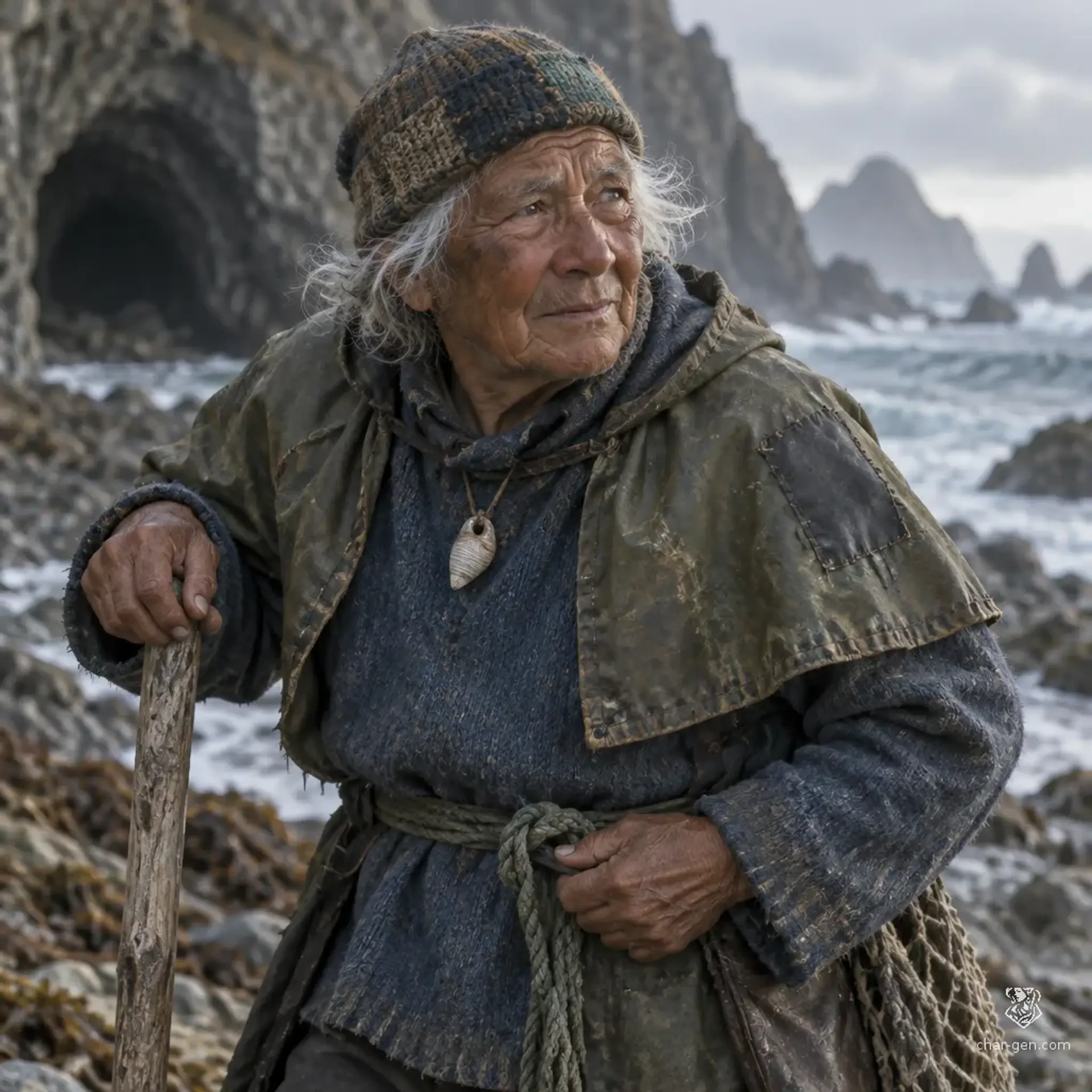
Oruva is a weather-browned elder with a broad, creased face and a pale fringe of hair that sticks out in salt-stiff wisps beneath a patched cap. Their shoulders pitch forward as if leaning into a persistent sea wind, but when waiting they set their weight on the balls of their feet, ready to turn toward a change in surf. A coil of faded green cord always hangs at their belt, polished nearly smooth at one precise spot where their thumb worries it. Their steps are careful on dry ground and unexpectedly quick on wet rock. They leave the impression of someone listening to the shoreline even while speaking to you.
Clothing
A salt-faded blue wool tunic, patched oilskin shoulder cape, loose trousers tucked into cracked rubber-soled boots, and a knitted cap repaired with thread of three different colors. A small shell whistle sits on a thong beneath the collar.
Body language
Oruva keeps their chin angled toward the sea and often braces a palm on the top of their walking stick. When waiting, they stand on the balls of their feet rather than settling back on their heels. Their thumb rubs the same worn place on the cord at their belt when they are worried.
- Height
- 5 feet 2 inches
- Build
- Compact and sturdy through the torso, with narrow, slightly bowed shoulders and strong calves from a lifetime on uneven shore rock.
- Eyes
- Deep hazel, clouded slightly by age but alert to movement
- Hair
- White with a few wiry gray strands
- Skin
- Deeply weathered umber with a wind-reddened nose and salt-dry patches at the temples
- Age
- About 76
- Gender
- Nonbinary
- Size
- Small
Distinguishing features
Personality
12 traits and drivesOruva is generous with food and knowledge but guards their judgment fiercely. Around children, they are playful and patient, turning lessons into games; around officials, they become blunt and suspicious. They enjoy a good joke when the weather is fair, yet grow tightly controlled when anyone treats the caves as harmless scenery.
- Alignment
- Neutral good
Quirks
Habits
Traits · 3
Flaws · 3
Fears · 3
Wants and needs · 3
Combat
AC 10 · HP 4 · 25 ft.Oruva avoids combat, calls a warning to protect bystanders, and retreats toward open ground or a familiar boat. If cornered, they use the walking stick to create distance and try to reach help rather than pursue or finish a fight.
Oruva
Actions
Reactions
Services they sell
Rewards they can give
Equipment
- Net cord (tool)A knotted length of faded green cord used for net repairs and as a personal worry-token.
- Walking stick (weapon)A plain, salt-worn stick used for balance on rocks and, reluctantly, self-defense.
- Shell whistle (signal)A small shell whistle with a sharp, carrying note.
- Tide notes (reference)A waxed bundle of hand-copied warning verses and crude sketches of cave entrances.
Possessions
Background
Oruva has fished the inlet since they were young, first alongside their mother and later with a small crew of neighbors. In their middle years, a spring tide trapped three children in a sea cave after a familiar passage flooded faster than expected. Oruva found them by following the echoes of their frightened calls, but one child did not survive. Afterward, Oruva began teaching Sumi the old cave-warning songs, then relied on Sumi to teach them to the children as Oruva's breath and memory grew less dependable. Oruva and Sumi have been longtime friends ever since, though Oruva can be prickly when Sumi changes a verse without asking. Now a new break in the outer rocks has altered the currents, and Oruva fears the old songs no longer cover every danger. They still mend nets, trade fish, and check the cave markers each morning, while quietly trying to persuade the village to close one popular passage.
Role in the story
A local guide, source of coastal knowledge, and emotional connection to Sumi. Oruva can warn the party about the caves, teach them how the warning songs encode hazards, and draw them into the village's dispute over whether to close a newly dangerous passage.
“In their middle years, a spring tide trapped three children in a sea cave after a familiar passage flooded faster than expected.”
- Faction
- No formal faction; trusted by the inlet's fishing families and respected by the cave-side households.
Known connections
Media
0 imagesNo images yet.
Turn Oruva into a sheet
A high-res, share-ready sheet you can post or print.