Pivikki
Pivikki
At the table
Voice
His voice comes from a young body that has spent years breathing smoke, cold air, and resinous fire fumes. It has a dry, slightly rasped edge, with clipped consonants and a faint breathy scrape on words beginning with h. Finnish names and old spirit-words emerge with precise, hard-edged clarity. He does not sing or boom; his words land like small stones placed carefully on a table.
He speaks Finnish with an old-fashioned cadence and chooses English words carefully, as if testing their weight before setting them down. His phrasing is concrete and spare. He describes emotion through weather, fire, or animal behavior rather than naming it directly. He uses a person's name only after deciding they matter, and avoids contractions when he is trying to sound authoritative.
Speech patterns
How to play them
Pivikki begins at a distance and expects visitors to explain why they are on his ground. He responds best to practical honesty, respect for the flame, and people who ask before touching his cape or limbs. He offers help through actions rather than reassurance. A character who admits fear without posturing may earn a brief, useful answer. A character who threatens the flame or mocks Kokko is likely to be warned once and then driven away.
Goal
Discover why Kokko's hidden flame is faltering, protect it from disturbance, and learn what happened to the people of his childhood settlement without letting that search become another disaster.
Motivation
Service to Kokko gives his long, disjointed life its structure. He wants the flame to endure, but beneath that duty is a guarded wish to know whether he can still choose what he is, rather than merely obeying the shape the Hissi left him.
Appearance
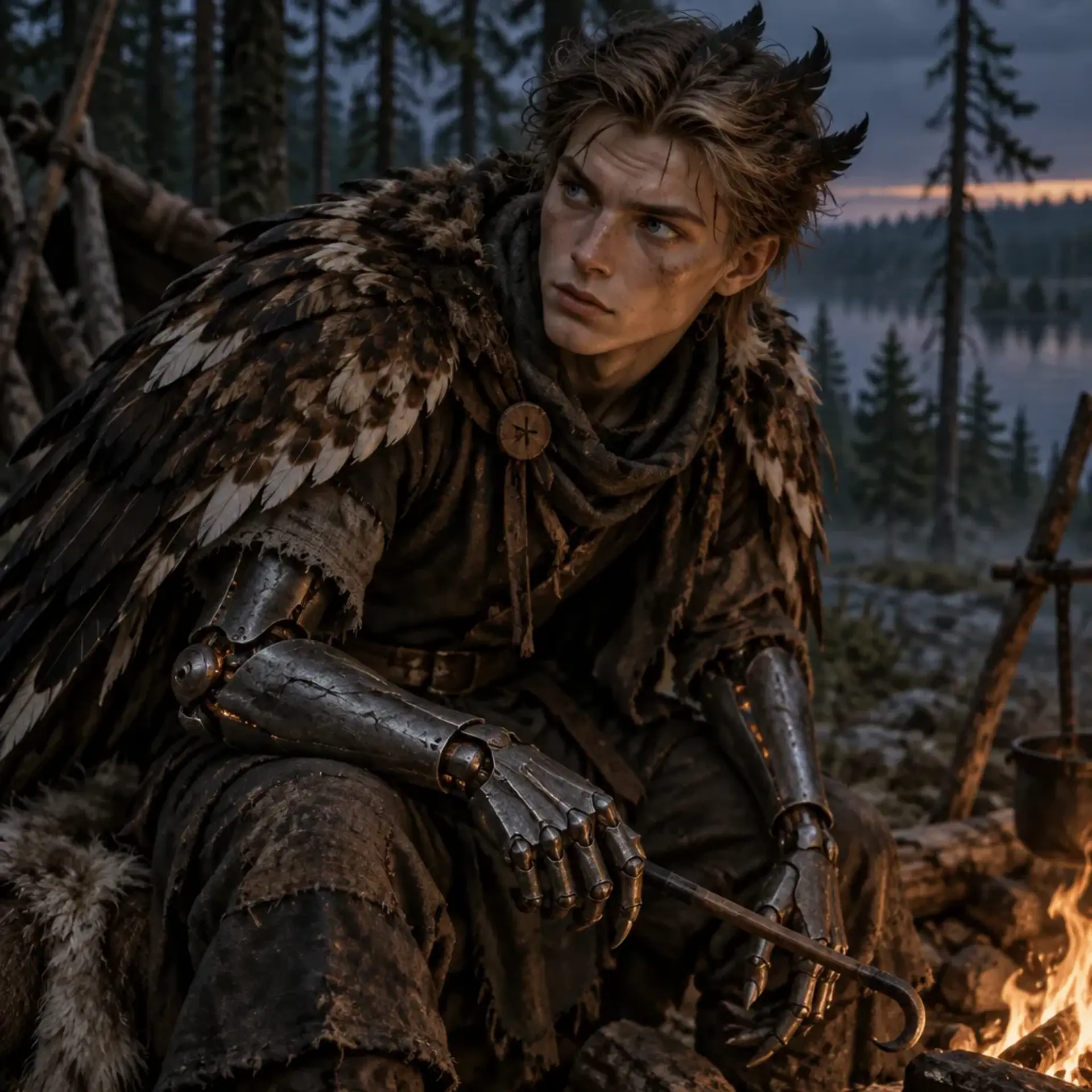
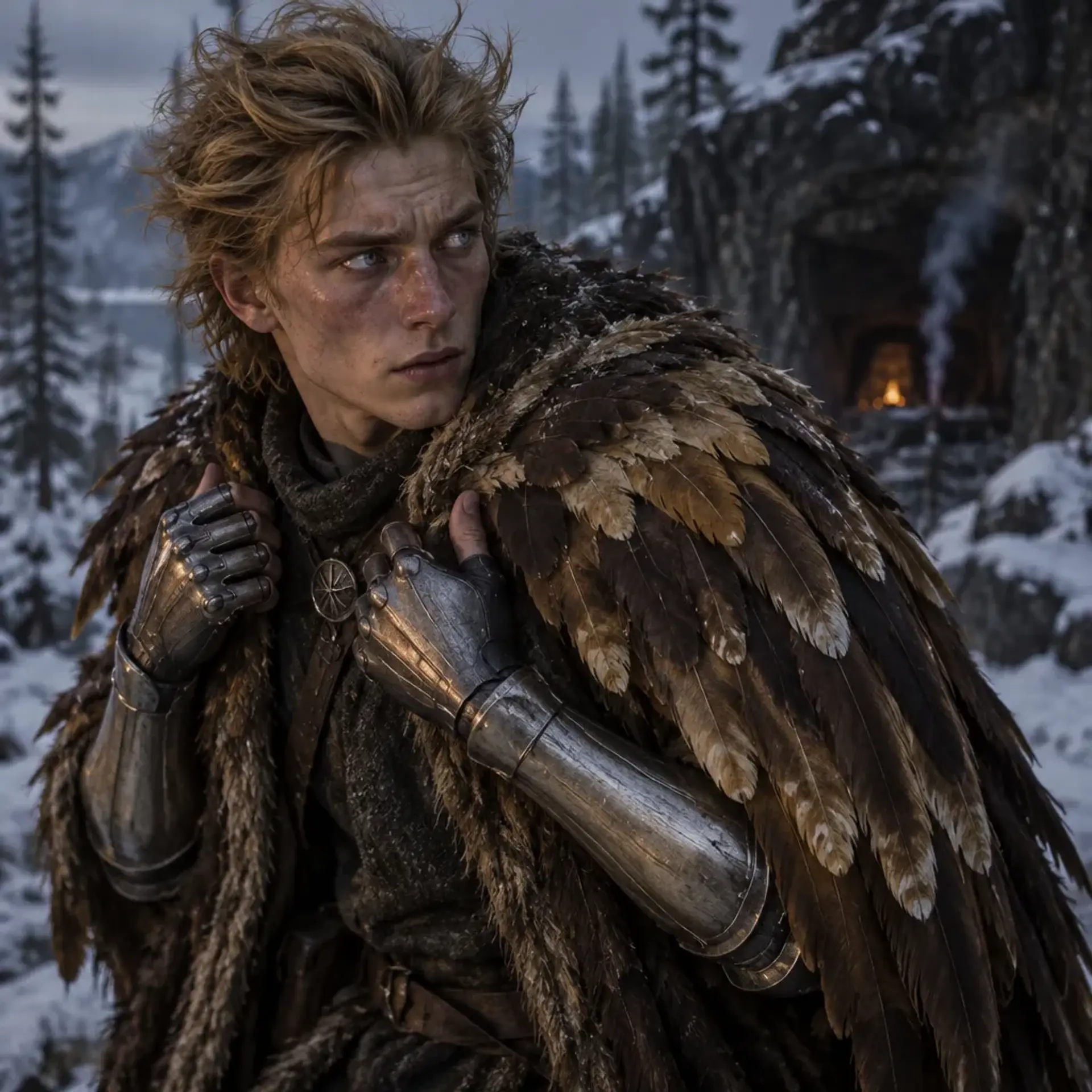
Pivikki looks like a young man assembled by a smith who had only half-remembered the shape of a human. Steel-like metal begins at his shoulders and sheathes both arms without seams, hinges, or visible fasteners, continuing over his hands except for the small, dark flint tips replacing his fingertips; his thumbs remain warm, ordinary flesh. His legs are metal from the calves down, with narrow feet that land heel-first and leave sharp, clean impressions in mud. A faint warmth lives beneath the cold surface of the metal. Around his eyes, the skin has partly turned and drawn toward his temples, as if his face were slowly rotating around its gaze. His porcelain-glass blue eyes catch light too cleanly and seem to reflect a distant fire even in daylight. His hair is tawny gold and layered in stiff, wind-ruffled points like the nape feathers of a golden eagle. He waits with his weight forward on the balls of his metal feet, shoulders slightly hunched, head making small, birdlike corrections toward every sound. The old golden-eagle feather cape on his back is an unexpected softness against the metal: its down is worn smooth where he grips it at the collar, and it sheds a few feathers whenever he turns abruptly. The overall impression is not of a man wearing armor, but of a wild thing that has learned to stand upright.
Clothing
A rough dark wool tunic, weather-dark trousers, and a golden-eagle feather cape that falls to his calves. The cape is old, patched beneath the shoulder blades, and polished smooth at the collar from constant handling. He wears no obvious armor over his fused metal limbs.
Body language
He rests forward over the balls of his metal feet, with his weight ready to spring rather than settle. His head makes quick, precise turns toward sounds, and his eyes often remain fixed on a person after the rest of his body has shifted away. He grips the cape's worn collar when uncertain. When angered, he squares his metal shoulders and spreads his hands so the flint tips are unmistakable.
- Height
- 5 feet 10 inches
- Build
- Lean and rangy, with the taut shoulders and narrow waist of someone accustomed to climbing, crouching, and long stretches without food.
- Eyes
- Porcelain-glass blue, bright and unnervingly reflective
- Hair
- Tawny gold, stiff and wind-ruffled like eagle nape feathers
- Skin
- Pale, weather-reddened human skin, interrupted by fused steel-like surfaces
- Age
- Appears to be nineteen; has lived for centuries in disrupted, spirit-tangled stretches of time.
- Gender
- Male
- Size
- Medium
Distinguishing features
Personality
16 traits and drivesPivikki is not simply cold or feral. He can be patient enough to watch a stranger for hours, then act with startling speed when a boundary is crossed. In solitude he is methodical: he checks the flame, sorts kindling by dryness, and studies the wind as if it were a familiar language. Around people he becomes guarded and literal, especially when they make promises. He dislikes being treated as a curiosity, yet he is intensely curious about the human world he missed; he may silently inspect a radio or ask a blunt question about an ordinary object, then reject the explanation as though he never wanted it. His loyalties pull in opposite directions. He serves Kokko with genuine reverence, but fears that this service is partly the shape imposed on him by the Hissi. He considers his golden-eagle luonto a truer reflection of himself, yet he will not confuse it with Kokko or use it as an excuse to neglect his mistress's flame. He resents trespassers, but remembers that the first people he met after isolation were searching for someone lost. He can leave a stranger bleeding to teach them that his home is not theirs, then risk himself to lead that same stranger away from a real danger. When calm, he listens with his entire body and gives people time to correct themselves. When embarrassed, he turns the discussion toward practical matters. When frightened, he becomes more animal than conversational: he fixes on movement, spreads his hands, and prepares to flee or strike. Anger does not make him softer or more courteous. It makes him direct, physical, and exact about what he believes must stop. Afterward, shame may keep him away for days, though he will quietly leave food, firewood, or a safe trail marker where the injured person can find it. Pivikki has a capacity for tenderness that he mistrusts. He is careful with fallen feathers, fledgling birds, and the small flame in a traveler's stove, but becomes impatient if anyone praises him for it. He does not seek to protect nature as a principle; he serves a particular spirit and defends a particular place. His kindness is local, conditional, and often difficult to recognize. His curiosity about people is real, but it competes with a conviction that closeness gives them leverage over him. He wants to be understood, yet dislikes being asked to explain himself. He wants to belong to something, yet treats belonging as a trap. This contradiction governs nearly every encounter: he watches for a reason to send people away, while remembering every name they give him.
- Alignment
- Neutral
Quirks
Habits
Traits · 4
Flaws · 4
Fears · 4
Wants and needs · 4
Combat
AC 16 · HP 44 · 30 ft.Pivikki avoids a fair fight. He uses trees, rocks, and height to break line of sight, opens with control or a sudden burst of fire, and targets weapons, lights, or escape routes rather than pursuing the strongest opponent. He saves his eagle transformation for escape, reconnaissance, or an opponent he cannot reach on foot. If someone threatens the hidden flame, his restraint collapses and he fights to incapacitate or drive them away. He is not reckless enough to die for an insult, but he may accept serious injury to protect Kokko's hearth.
Pivikki
Spells
Actions
Reactions
Services they sell
Rewards they can give
Equipment
- Kokko's Feather Mantle (wondrous item, custom)A weathered cape of naturally shed golden-eagle feathers. It enables his custom eagle transformation and is treated by Pivikki as a sacred service garment.
- Hearth-tending kit (tool)A small stone-and-resin tending kit for maintaining the hidden flame, including a scraper and a pouch of dry tinder.
- Hunting knife (weapon)A narrow utility knife with a bone grip, carried for cutting cord and preparing kindling.
- Modern phone (personal item)A battered mobile phone, kept in a waxed pouch and used reluctantly to contact Aino.
Possessions
Background
Pivikki was born in the Finnish interior long before roads had names that survived from one generation to the next. His first home was a lakeside settlement of smoke-dark rafters and winter stores, where his mother taught him the practical work of keeping a household alive and his father taught him to watch the sky for weather. As a child, he was attentive but not gentle: he would sit motionless beside a snare until an animal came, then stare at it with such unsparing concentration that adults found excuses to turn away. He learned the old words for wind, flame, and the presences people treated with care. He did not think of himself as a chosen boy. He thought the world was full of things that could hear you. The eagle that became his luonto, his inward nature and spirit-double, first appeared to him in a dream of a white lake. It circled above a black pine and spoke without words. Afterward, he began to notice the golden eagle in waking life: a distant shape over a ridge, a feather caught in an unlikely place, a shadow sliding across snow. The presence did not make him a guardian of woodland or beast. It made him watchful, territorial, and keenly aware of the places where wind and flame met. He would later understand that this eagle was his own luonto, not Kokko. Kokko came to him through fire. In the settlement, an enormous ceremonial flame was kept alight for a winter rite. The fire was not merely a hearth magnified; the people addressed it as a living power, and Pivikki felt something answer. Kokko, an eagle spirit of fire and winds, revealed herself as a mother of eagles and a mistress distinct from his personal luonto. Pivikki's first sight of her was a vast winged outline in the smoke, with sparks pouring from the feathers like a storm of stars. He became her servant, tending the great flame, carrying offerings, and learning to recognize the difference between a fire that warmed and a fire that demanded attention. He never mistook service for ownership. Kokko was not his animal spirit, nor a comforting mother in human shape. She was a power he revered and feared, and at times he could not tell whether her approval was warmth or merely the absence of punishment. His life broke during a winter when strangers came to the settlement seeking shelter and iron. Their arrival coincided with a season of sickness, suspicion, and hunger. Pivikki was young, and his devotion to the flame had already made him an outsider. He believed the visitors had brought a hostile presence into the settlement. When a fire took hold in a storehouse, he tried to contain it, but the panic around him fed it. He remembers a woman calling his name from inside, and the sound of snow hissing on burning beams. He cannot remember whether he reached her or whether someone dragged him away. The uncertainty became a wound that could not be seen. After the fire, he fled into the deep country. There, according to the stories he later pieced together, the Hissi found him. The Hissi are not a single simple monster in his telling, but a malignant presence of wild places and twisted bargains. They took the boy who had failed to save a home and remade him. Pivikki's arms and legs became metal fused directly to his flesh. His fingertips turned to flint, while his thumbs remained human. The skin around his eyes drew and rotated, leaving him with a gaze that seemed set at an impossible angle. His body acquired a steady inner warmth beneath its cold metal exterior. He remembers being held over a fire, or perhaps being the fire itself. He remembers a voice asking what he would give to endure. Whatever answer he made, it left his soul twisted toward the eagle and toward the fae-like logic of the wild. When he woke, seasons had passed. The settlement was gone, its site swallowed by regrowth and altered waterways. He was alive, but the human habits that had once made a village feel like home had become difficult to wear. He could spend days following a thermal current or watching a hawk work a slope. He developed a fierce claim over the remote place he came to call home, a rough basin of stone, pines, and wind where he tended a hidden flame for Kokko. The flame was enormous by ordinary hearth standards, but it did not blaze openly. It burned within a cleft in the rock, fed by resinous wood and offerings, and its smoke emerged in a thin column that seemed to lean against the wind. Pivikki believed that if it went out, Kokko would turn her attention elsewhere. He has never tested that belief. For years, his existence narrowed to service, hunting, and solitude. His luonto remained a golden eagle, at once companion and mirror. Sometimes the eagle perched near him; sometimes it circled where he could not see it. Pivikki began wearing a cape made from golden eagle feathers, gathered over many years from natural molts and, he insists, never taken by killing. In time he learned to pass into the eagle's shape. He considers the transformation neither trick nor escape. It is a return to a truth that his altered body only partly expresses. The modern era reached his wilderness in the form of surveyors, hikers, and machines. The first humans he encountered after his long isolation were a small rescue party, led by Aino, a Finnish search volunteer whose team had lost a radio and one member in the rough country. Pivikki watched them for two days from the trees. He knew that they were human in the abstract, but their clothes, lights, and speech made them seem like creatures from a story told badly. When one of them approached the cleft where his flame burned, Pivikki emerged and struck the person's pack with his flint fingers, showering sparks across the fabric. He meant to warn them away. They saw a young man with metal limbs and a face that seemed to turn toward them from the wrong direction. The encounter nearly became violence. One frightened member raised a flare; the flare's glare triggered Pivikki's old memories of the storehouse fire. He lunged and left a deliberate cut across the volunteer's coat and skin before Aino spoke his childhood name, which she had read in a local archive while searching for information about the vanished settlement. The sound of his name stopped him. He could have driven them out. Instead, he led them to the missing hiker, then watched from above as the party left. It was his first exchange with ordinary humans in generations, and it taught him that people could be both threat and responsibility. It did not make him trust them. Now Pivikki moves between his isolated fire and the edges of modern life. He has learned to use a phone only when necessary and dislikes its cold light. He is increasingly troubled by the fact that Kokko's flame has begun to gutter on windless nights. He suspects that the old rite sustaining it has been disturbed by a new road, a power line, or some human act he has not yet identified. Aino occasionally returns to the region, sometimes alone, sometimes with people who claim to be researchers. Pivikki does not know whether to treat her as a friend, a messenger, or a danger to his home. He is also searching for the truth about the woman in the burning storehouse. In an abandoned local record he found a name and a family line that may still exist. He has not decided whether learning the truth will free him or give his guilt a sharper shape. His life beyond the player characters continues in practical, uneasy rhythms. He checks the flame before dawn, tracks unfamiliar footprints, repairs his feather cape, and watches for signs of Kokko in sudden updrafts. If travelers threaten his domain, he can be ruthless. If they are lost, injured, or honest about their fear, he may guide them to safety without offering comfort. He does not call this kindness. He calls it keeping a disturbance from becoming a larger one. Still, he remembers the rescue party leaving alive, and he remembers that he chose not to follow them. That choice, more than any spell or transformation, is the first human decision he has made in a very long time.
Role in the story
A dangerous, wary wilderness encounter who can become a guide, an uneasy ally, or the keeper of a supernatural fire the party must protect. His history connects an old folkloric bargain to the modern world, while his first renewed contact with humans gives players a chance to influence whether he retreats further into isolation or risks making a human connection.
“He learned the old words for wind, flame, and the presences people treated with care.”
- Faction
- Servant of Kokko, an eagle spirit of fire and winds. He belongs to no modern organization and claims a remote wilderness basin as his home.
Known connections
Media
0 imagesNo images yet.
Turn Pivikki into a sheet
A high-res, share-ready sheet you can post or print.