Pivikki
Pivikki
At the table
Voice
Pivikki's voice is dry and grain-edged, shaped by years of speaking over wind and fire rather than across rooms. It carries a little rasp, like a breath drawn through cold air, and his old-fashioned Finnish inflections show most clearly when he is tired. He does not raise his voice when angry. Instead, his words become blunt and exact, with the clipped certainty of someone naming a hazard before it reaches you.
He speaks in short, declarative phrases, with old Finnish turns of wording and occasional pauses to listen to the wind. He calls fire a presence to tend rather than a thing to own. His language is concrete and image-rich: smoke can lean, a trail can drink rain, and a frightened person can smell like a trapped hare. He avoids promises unless he intends to keep them.
Speech patterns
How to play them
Approach Pivikki as someone responsible for a place, not as a curiosity or a monster. State plainly why you have come, keep a respectful distance from the flame and nests, and do not touch his cape or limbs without permission. He responds well to practical offers and honest admissions. If he believes a visitor is a threat, he will give one clear warning before he acts.
Goal
Protect Kokko's flame and the golden-eagle nesting grounds without letting the Hissi's bargain turn him into a creature incapable of leaving them.
Motivation
A fierce duty to preserve the flame, the eagles, and the old boundary, combined with a buried wish to be more than the keeper the Hissi made.
Appearance
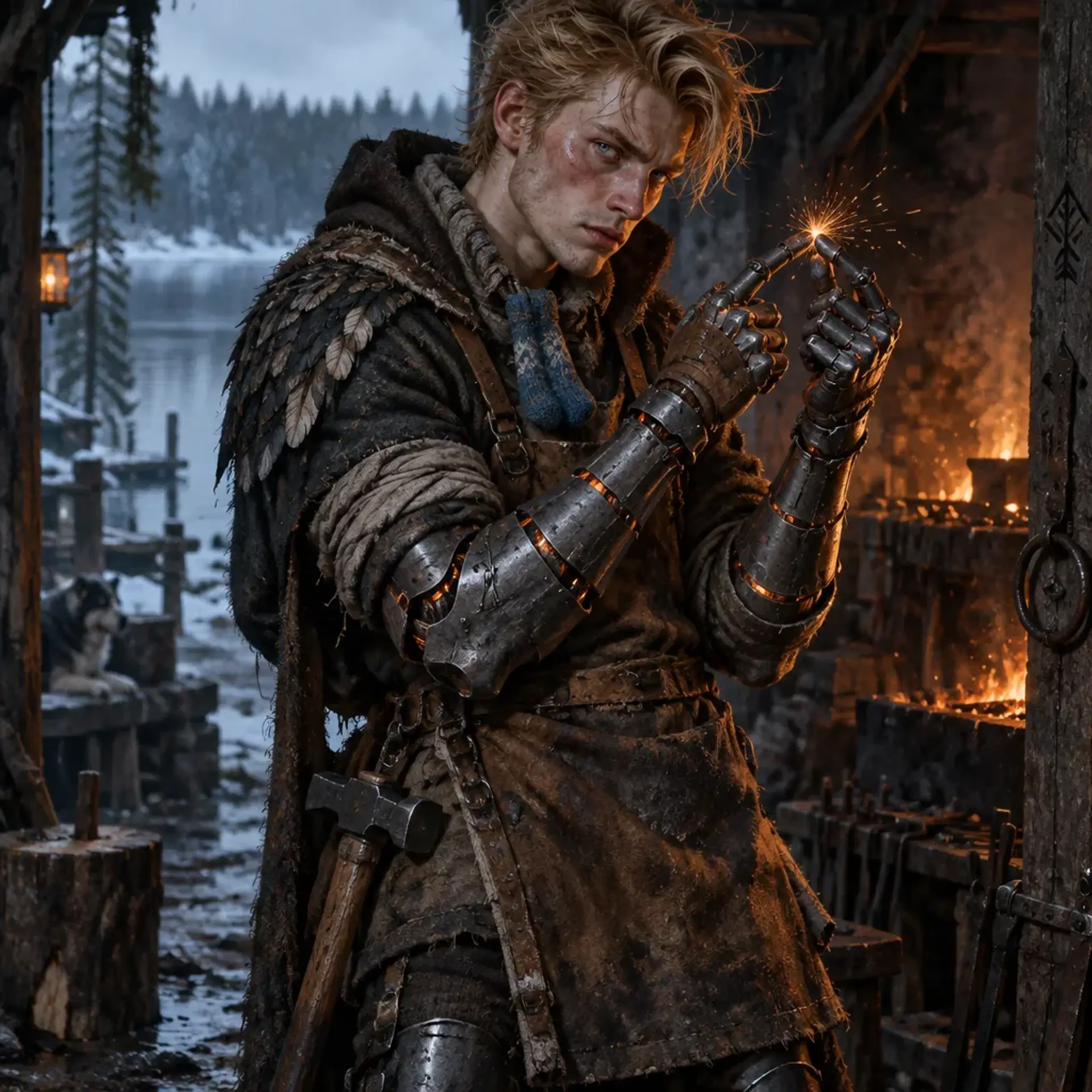
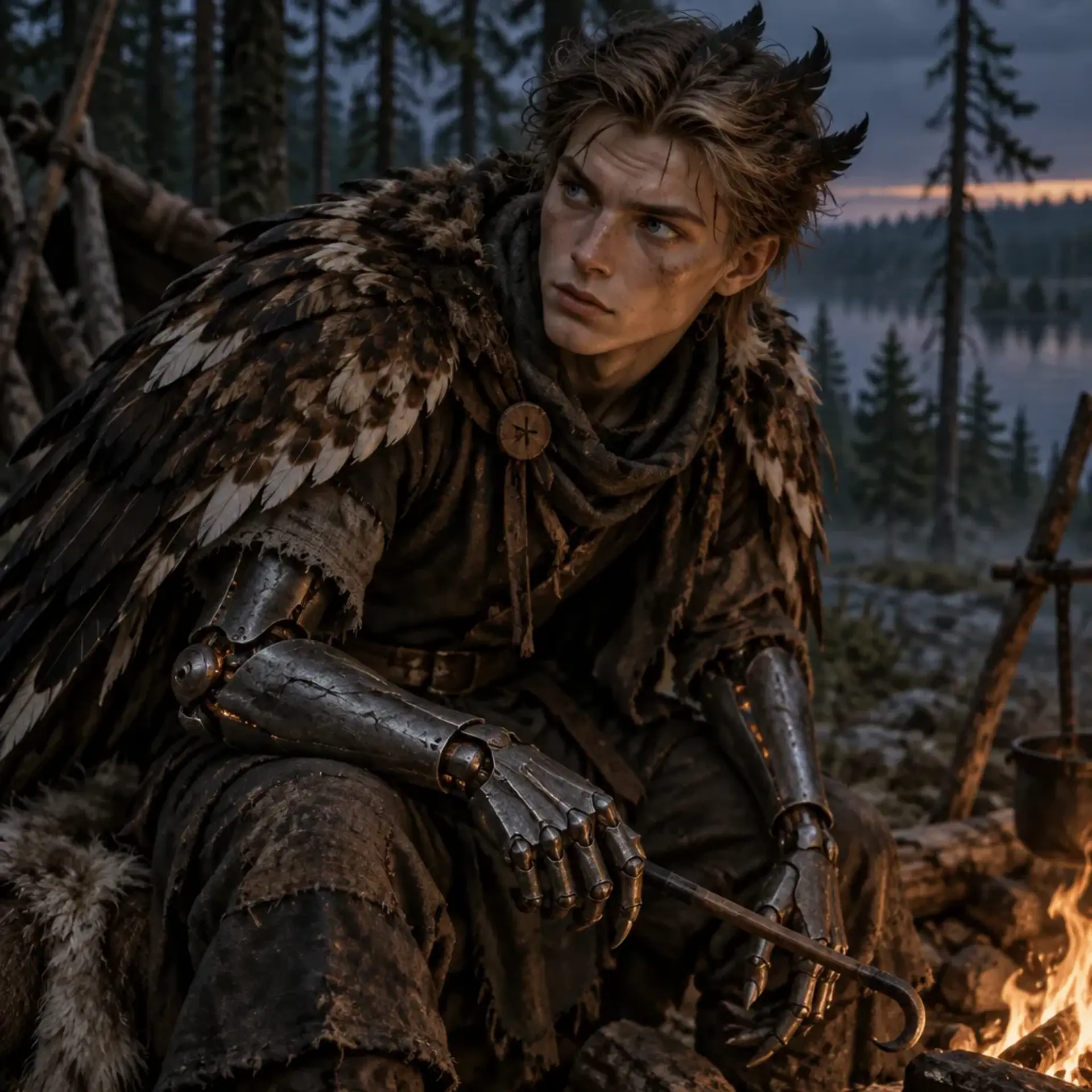
Pivikki looks like a young man who has been assembled from a human body and the remembered shape of a bird of prey. His arms are metal from fingertips to shoulders, a dull steel color that drinks in the light rather than reflecting it. The surface runs seamlessly into his skin with no seams, screws, or visible joints; close up, a faint warmth moves beneath it like banked coals under winter ash. His legs are metal from feet to calves, with narrow, talon-like toes that click softly on stone. Around both eyes the skin and bone have partly turned and shifted, as though his face were trying to rotate toward whatever he is watching. The effect is unsettling without making his gaze unfocused. His porcelain-glass blue eyes are clear and bright, and his hair rises in tawny, dark-tipped points like the crown of a golden eagle. He stands with his weight forward on the balls of his feet, almost never leaning against a wall; when waiting, he makes small adjustments that keep him facing the nearest open ground. The feather cape on his shoulders is a startling mantle of genuine golden-eagle feathers, broad and weathered at the edges. Its soft, dry rustle seems much too gentle for the cold metal beneath it. He moves with a bird's abrupt economy: stillness, a quick turn, then stillness again. An unexpected detail is that he keeps his feather cape immaculately groomed, smoothing and aligning each feather with painstaking care despite the soot on his clothes and the wilderness grime on his boots.
Clothing
A soot-dark wool tunic, patched trousers, and a weather-stiffened leather belt hold his tools. Over them he wears a cape of golden-eagle feathers, carefully arranged and fastened with a plain wooden clasp. His clothes are practical and often dirty, but the cape is kept meticulously groomed. He wears no gloves, leaving the flint tips and warm metal of his arms visible.
Body language
Pivikki keeps his weight forward, heels barely settled, as if he might spring to a branch or sprint into the trees. His metal toes click when he turns. He rarely fidgets with his hands; instead, he aligns the cape's feathers one at a time, or turns his whole head toward a sound with a bird's sudden precision. When protective, he widens his stance and angles his shoulders to block the route to whatever he considers his charge.
- Height
- 5 feet 10 inches
- Build
- Lean, corded, and long-limbed, with the wiry strength of someone accustomed to climbing, hauling wood, and crossing rough ground. His metal lower legs make him look heavier than he moves.
- Eyes
- Clear porcelain-glass blue
- Hair
- Tawny gold with dark brown tips
- Skin
- Weathered fair skin with a faint, soot-warmed cast; the skin around his eyes is subtly distorted by the Hissi's work.
- Age
- Nineteen by the reckoning of the towns he visits; born centuries ago, though the Hissi's reforging left him outside ordinary time for much of that span.
- Gender
- Male
- Size
- Medium
Distinguishing features
Personality
16 traits and drivesPivikki is restrained but not calm. He can wait without moving for an hour, then make a decision in the space of one breath. He is suspicious of strangers and attentive to small needs: a loose bootlace, a coughing child, a fire left too close to dry grass. He rarely offers comfort in words, yet will stand watch through the night without being asked. His sense of responsibility can become possessiveness. He tells himself he is protecting the land, but can react to a misplaced stone or snapped twig as though someone has attacked a living relative. With animals and children, he is unexpectedly patient. He lets a child ask the same question several times, and he will move slowly around a frightened dog, keeping his metal hands in view. With adults who claim authority over the forest, his patience thins. He is capable of negotiation, especially when someone arrives with useful knowledge, but he hears a proposal to compromise as a demand that he abandon his post. In a crowd he becomes watchful and stiff, tracking exits and wind currents. Alone outdoors, he is more at ease, though never entirely relaxed; he sleeps lightly and wakes facing the nearest threat. Pivikki can be generous and unforgiving in the same afternoon. He may guide a lost traveler to shelter, then mark the traveler's pack with soot so the person remembers not to approach the nesting ground again. He dislikes cruelty, but his idea of proportion has been warped by centuries of vigilance and the Hissi's influence. He believes a clean, memorable warning can prevent greater harm. That belief is sincere, and sometimes disastrously wrong. When grief reaches him, he becomes methodical. He cleans the hearth, sorts wood, and checks every feather of his cape. When frightened, he becomes more animal: head tilted, shoulders forward, attention fixed on movement. When ashamed, he avoids faces and busies himself with repairs. His stoicism is partly discipline and partly fear that human feeling, once allowed to surface, will become too large to contain. Yet the old tenderness has not disappeared. It shows in the way he remembers the names of dead neighbors and in the care with which he tends a flame no one else can see as sacred.
- Alignment
- Neutral
Quirks
Habits
Traits · 3
Flaws · 5
Fears · 4
Wants and needs · 4
Combat
AC 15 · HP 38 · 30 ft.Pivikki prefers to warn trespassers away and use terrain before fighting. He opens with control or fire from range, keeps himself between intruders and the flame, and uses his eagle form to reposition or escape. In a close fight he uses his hook to pull enemies away from vulnerable ground. He does not pursue foes beyond the territory he is guarding unless they threaten Kokko or its nesting grounds.
Pivikki
Spells
Actions
Reactions
Services they sell
Rewards they can give
Equipment
- Fire-tending hook (weapon)A long, hooked blade used to pull burning logs into place and to keep dangerous objects or people at a distance.
- Golden-eagle feather cape (wondrous item, custom)A weathered mantle of golden-eagle feathers that enables his custom eagle transformation. Pivikki treats it as sacred and keeps it carefully groomed.
- Fire-keeper's pouch (adventuring gear)A small leather pouch containing dry tinder, flint shards, and fragrant resin for tending Kokko's flame.
- Field notes (tool)A bundle of hand-drawn trail notes and nesting observations, written in several old scripts and modern shorthand.
Possessions
Background
Pivikki was born in a lakeside settlement in Finland, long before roads, clocks, or modern borders. He was the son of a charcoal burner and a woman who knew the old names for wind. As a child he learned the practical discipline of fire: how to feed it without smothering it, how to read smoke, how to keep a hearth alive through a long freeze. He was quick to climb and quicker to climb down, and golden eagles often watched him from the bare crowns of pines. His mother said his luonto, the animal nature bound to a person's spirit, was a golden eagle. Pivikki did not regard this as a metaphor. He spoke to the birds as if they were neighbors, and they sometimes answered by appearing at moments when he was lost. When he was fifteen, a forest fire drove his family and neighbors onto the ice of a narrow lake. The wind changed. Burning branches fell across the escape, and Pivikki saw his younger cousin trapped beneath a collapsed sled. He had a choice between hauling the child free and keeping the path clear for the others. He chose the child. A gust sent the fire over the trail, and the people who had already crossed survived. Several who had not crossed did not. Pivikki carried the child to safety, but the survivors blamed him for the dead, and he learned that doing the right thing did not make a person innocent. The experience turned his childhood curiosity about fire into a hard, unsleeping vigilance. After that winter he withdrew into the forest, where an old fire-keeper taught him to tend the great flame of Kokko. Kokko is an eagle spirit of fire and winds, a mother of eagles who is distinct from Pivikki's own luonto. The flame was kept in a sheltered stone hollow and fed with carefully chosen wood, oils, and offerings. The work was not simply worship. The flame marked a meeting place for migratory birds, guided lost travelers, and, according to the keeper, held a boundary between the living world and the country of the Hissi. Pivikki learned rites, weather lore, and the patient practice of making fire serve rather than consume. In time, he began to shape magic with his hands: a spark, a sudden gust, a lick of flame turned aside from a sleeping nest. The Hissi came during a season when the flame had nearly gone out. Pivikki was alone at the hollow, exhausted and frightened by visions of the old fire crossing the forest again. The Hissi offered to preserve him and the fire, but its promise was a trap made of half-truths. It reforged him. Metal flowed over his arms and lower legs, his fingers changed to flint at their tips, and his face turned strangely around his eyes. The work did not leave a visible seam. It left a body that looked made for a purpose and a mind that no longer fit comfortably inside human habits. His soul felt twisted toward the hunger and vigilance of a bird, and toward the strange, rule-bound attention of the fae. He came to understand the bargain only afterward: the Hissi had made him a keeper who could endure fire, but bound his life to the flame and its territory. The old keeper died before Pivikki could learn how to reverse the transformation. Pivikki stayed. For many years, people in nearby settlements brought him oil, dry wood, and news. He guarded their paths in return, though he never claimed to be kind. He punished trespassers who cut trees from the fire's boundary and once left a trespassing hunter with deliberate claw-like cuts across his shoulder, warning that the forest would remember the shape of his disobedience. Stories grew around him, some accurate, most not. He learned to accept that fear could keep a careless person away from a sacred fire, but he never enjoyed being feared. Modernity reached the region by degrees: surveyors, roads, power lines, hikers with bright packs, and later the glow of distant towns. The world changed more quickly than Pivikki's sense of time. His ancient refuge became an inconvenient pocket of wilderness between settlements. He sometimes lets people believe he is a local hermit, sometimes an old tale, and sometimes a dangerous animal. He has lived long enough to watch the people who once knew his name become stories themselves. He keeps scraps of their lives in memory, including the particular way his cousin used to whistle when frightened. His closest present-day connection is Aila, a young forest ranger who found him after a windstorm toppled a tree across a nesting site. She knows he is not simply a man in a costume, but not the whole truth. She brings him news of development plans and asks him to help protect the eagles. Pivikki distrusts her maps and trusts her care for the birds. Their relationship moves between wary cooperation and sharp disagreement: she wants negotiated protections, while he thinks a boundary is only real if trespassers feel it. He also keeps a distant connection to an old lakeside family, the descendants of people he once protected. They leave supplies near the fire hollow without approaching it. He resents their pity and quietly depends on their offerings. Now a construction company intends to widen a road near Kokko's flame. The work will cut through an old nesting route and may break the boundary the Hissi made. Pivikki wants to stop it without setting the entire region alight. He has begun following workers and marking their camps with feather signs, yet the creeping urban lights and the threat to the flame are wearing down his restraint. He has also begun to suspect that the Hissi's bargain is not merely keeping him alive; it may be slowly turning him into a guardian who can no longer leave his territory at all. He needs allies who can help preserve the nesting ground, but he has little practice asking for help without making it sound like a warning.
Role in the story
A wary wilderness guardian who can be an uneasy ally, a formidable obstacle, or a guide into old Finnish-inspired spirit lore. His conflict over the road project offers players a choice between protecting the land, negotiating with its human neighbors, and confronting the Hissi's ancient bargain.
“He was the son of a charcoal burner and a woman who knew the old names for wind.”
- Faction
- Keeper of Kokko's flame, with no formal organization. He is tolerated by local conservation workers but is not their employee.
Known connections
Media
0 imagesNo images yet.
Turn Pivikki into a sheet
A high-res, share-ready sheet you can post or print.