Charlie Frost
Charlie Frost
At the table
Voice
Charlie speaks from a chest used to calling across fields and over the noise of wind, sheep, or distant work. His voice has a lightly rough, breath-worn texture, with consonants clipped by habit rather than affected refinement. It warms when he talks about animals or food and gains a hard edge when he thinks someone is in danger. He does not sing his words or lower them into a theatrical murmur. When a memory intrudes, his breath catches before the sentence, as if he has smelled smoke.
He speaks in plain, workmanlike sentences, with rural English phrasing and a habit of naming the practical details first. He often calls unexplained phenomena 'visitors' or 'signals' and describes the sky as if reporting weather. Under stress, his sentences become more immediate and emphatic; he repeats a key word, such as 'door,' 'light,' or 'gone,' until someone answers him.
Speech patterns
How to play them
Meet Charlie with patience and practical questions. He responds better to being asked what he saw, heard, and did than to being told what he is. Do not affirm his alien theory as fact; let evidence support or complicate it. He will cooperate readily if the group protects his family or helps investigate a missing memory. Mockery makes him defensive, while calm skepticism and a shared task can earn his trust.
Goal
Discover what happened in the field after the loss of his first family without letting the truth endanger the family he has now.
Motivation
Charlie wants a home that will not disappear when he stops watching it. He wants proof that his memories belong to him and reassurance that the people he calls family will not be taken as his first family was.
Appearance
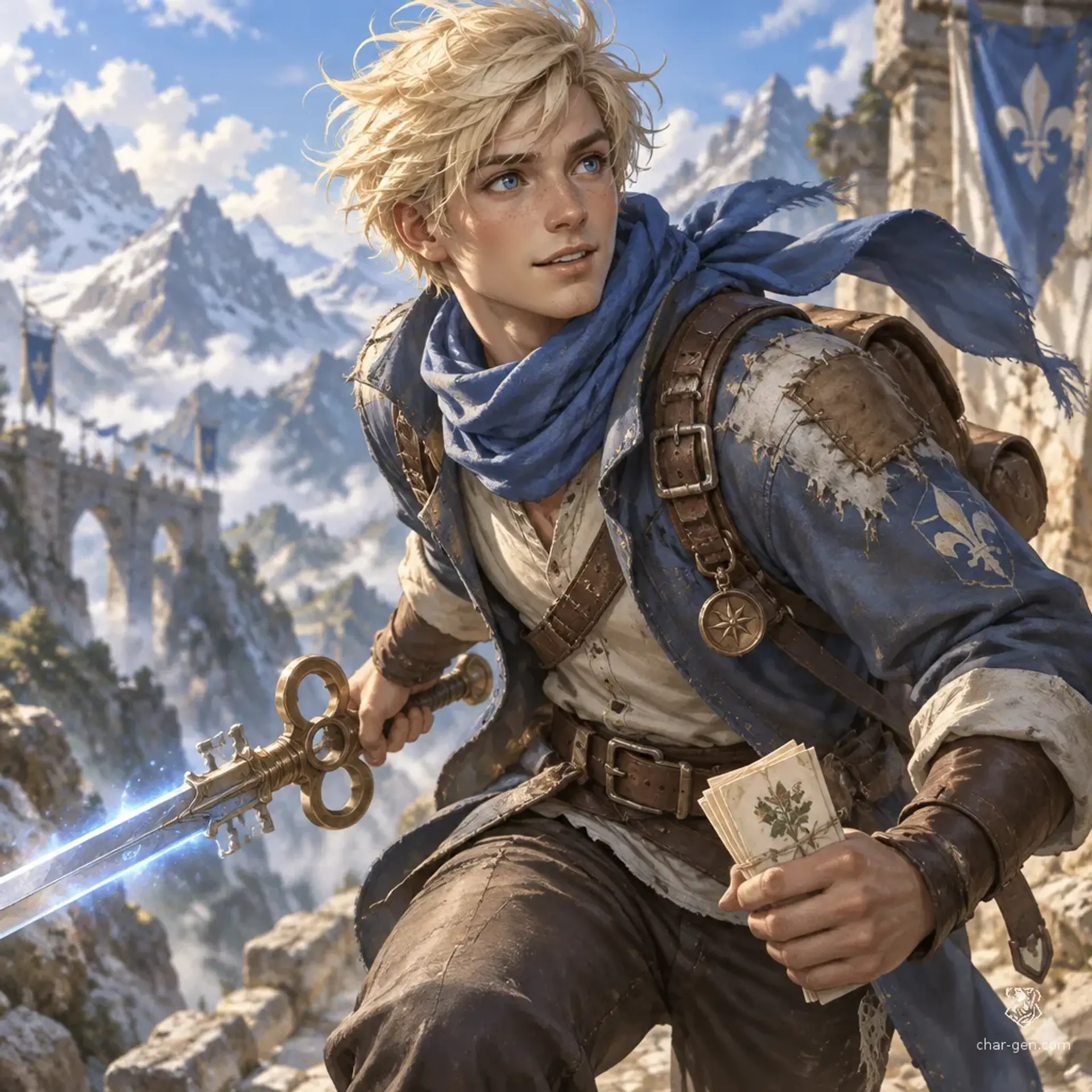
Charlie Frost is a fine, strapping young man, five feet ten inches tall, with the healthy, weather-marked look of someone accustomed to fields and cold mornings. His blond-brown hair refuses to lie flat; it has a coarse, sun-dried texture and a stubborn cowlick at the crown. His green eyes look ordinary until he is startled, when they seem to hold a second, dim reflection of whatever light is in the room. His skin is fair, reddened at the nose and knuckles by wind rather than polished by indoor life. He moves with a farmer's economical balance, weight placed quietly and heels rarely striking hard. When uneasy, however, he makes a sharp sideways jerk, as if dodging a blow no one else saw. One minute into meeting him, people notice the small brass button he keeps in his trouser pocket: its face has been rubbed entirely smooth, and he checks it with his thumb whenever a door is shut behind him. Unexpectedly for a veteran and sheep farmer, he keeps a tiny, carefully mended paper star folded in his wallet, a decoration from a Christmas party he insists he barely remembers. In bad light his shadow occasionally seems to lag a fraction of a second behind him.
Clothing
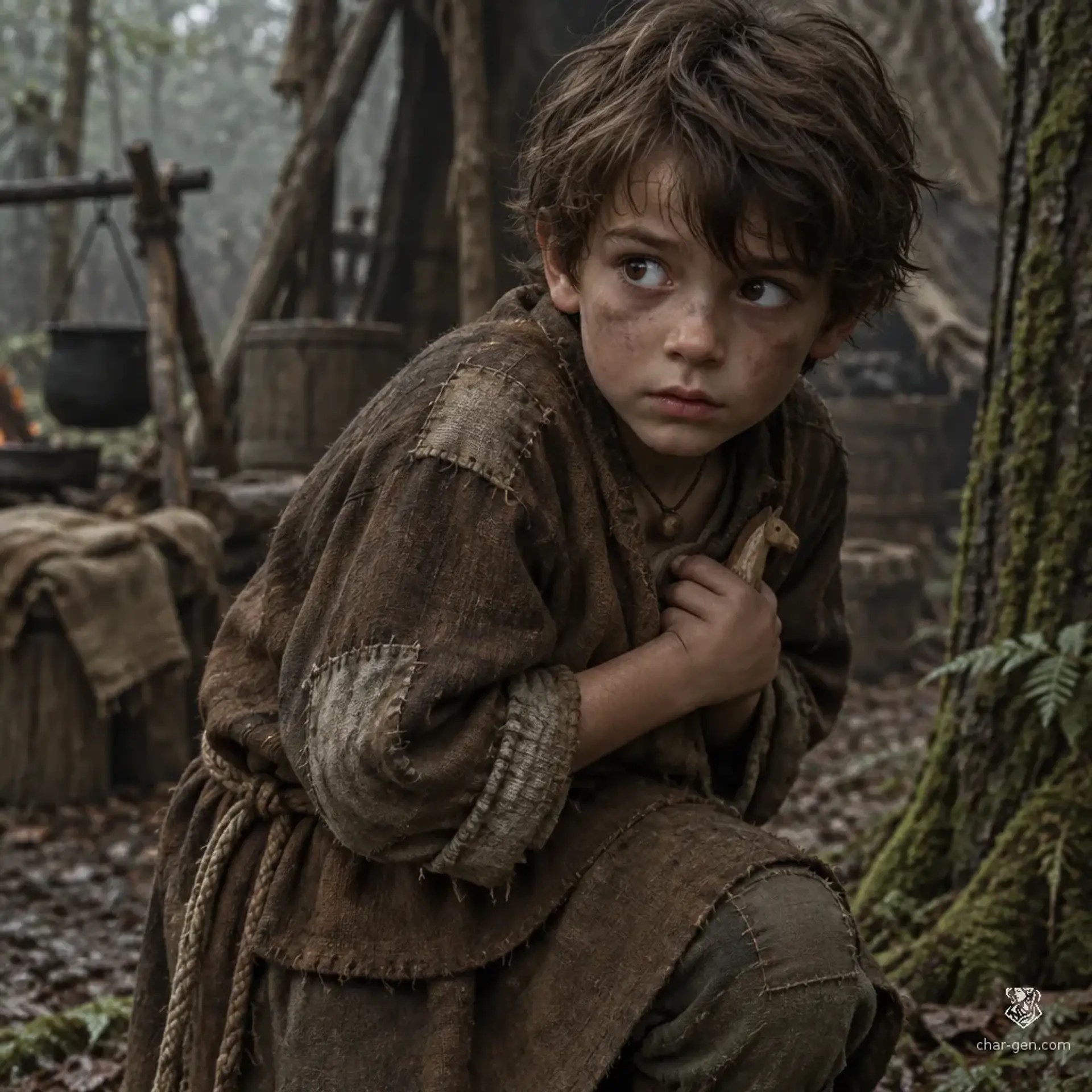
Practical modern clothes layered for wet country weather: worn work jacket, sturdy trousers, boots with dried mud in the seams, and a wool scarf he claims is only for warmth. His clothes are serviceable and repeatedly mended. He carries no obvious costume or antique armor.
Body language
Usually stands squarely and comfortably, with the stillness of someone used to waiting beside livestock. His hands are often busy: checking the button, brushing an invisible crumb from a sleeve, or testing a latch. When a memory breaks through, his shoulders hitch as if bracing against a sudden wind. He avoids standing directly in front of a mirror, but glances at reflections when he thinks nobody notices.
- Height
- 5 ft 10 in
- Build
- Fit, sturdy, and work-hardened, with the compact strength of a farmer rather than a trained athlete.
- Eyes
- Green, with an unusually reflective look in low light.
- Hair
- Blond-brown, coarse and unruly, with a persistent cowlick.
- Skin
- Fair, weather-reddened at the nose and knuckles.
- Age
- Appears 20; his actual age is uncertain, with memories reaching back to medieval clashes between the kingdom of Merica and Welsh kings.
- Gender
- Male
- Size
- Medium human build; SIZ 60
Distinguishing features
Personality
19 traits and drivesCharlie is welcoming in the manner of someone who knows how to make a stranger useful: he offers a chair, checks whether they have eaten, and asks what needs fixing. Yet he distrusts easy familiarity and watches for the moment a guest starts acting as if the place belongs to them. He is proud of being useful but embarrassed by praise, replying with a joke or immediately finding another chore. He can be tender with animals and children, but that tenderness has a possessive edge: he remembers where a creature sleeps, who feeds it, and whether it came home. He wants to believe that every life can be protected by ordinary effort, while some buried instinct in him treats a household as territory that must be guarded. In a calm mood, Charlie is patient, grounded, and good company. He explains the difference between rain coming over a ridge and rain gathering in a valley, or how to tell whether sheep have been disturbed by a dog. He does not make a performance of his old experiences. He is capable of listening, especially when the subject is work or someone else's grief. He will quietly repair a gate rather than announce that he has noticed it is broken. He enjoys being included in family routines, though he may not know what to do when attention is given to him without a practical reason. When he feels cornered, he changes. His explanations become more certain as his evidence becomes less clear. He calls a strange light a craft, a voice a transmission, a vanished hour an examination. He does not appear to be lying; he is trying to make a frightening event fit a story with a beginning and an end. If challenged too harshly, he may accuse the questioner of wanting him to be mad, then regret the accusation without apologizing directly. His anger is physical and sudden: a clenched jaw, a hard step toward the door, hands looking for a tool. He does not become quiet or mannerly when angry. He gets blunt, names what he thinks has been done, and may leave before he says something that cannot be taken back. There is a childlike quality in him, but it is not innocence without experience. He is curious about new machines and asks direct questions about them; he can be delighted by a silly joke, a bright shop window, or the novelty of a family recipe. At the same time, he carries centuries of practical caution. He knows how quickly a small grievance becomes a feud and how a hungry animal can become dangerous. He can be generous with food and labor, but wary about accepting gifts, as if a gift could be a claim. He dislikes being made a spectacle and is more comfortable at the edge of a gathering, close to a door or a window. The contrast in Charlie becomes clearest around family. He longs for siblings and fears being known by them. He asks after everyone's health, then dodges questions about his own. He would take a risk to protect Mary, Wilt, Thumber, Cyril, Philip, or Ken, yet resents their ability to contradict his account of the past. Wilt's denial of being a changeling troubles him because Charlie recognizes something in it, though he calls the recognition evidence of shared alien contact. He teases Philip's bragging, then worries when Philip works too long. He treats Ken's gardening knowledge as humble wisdom and may trust it more than an academic explanation. Thumber's scars and hard-won certainty make Charlie feel both safe and judged. Charlie has a private moral struggle about the difference between a joke and a torment. He likes a harmless surprise and is quick to set up small tricks when he feels safe. He understands that a joke stops being funny when the other person cannot leave, but that understanding can fail under the seasonal pressure of his boggart nature. During the first three days of May, his mood lifts into a giddy, unnatural joy. Mischief seems not merely pleasant but necessary, and the discomfort of others can look like part of the game. He may be horrified afterward by how much he enjoyed it. At Halloween and All Saints' Day, his humor curdles into an interest in fear, lost paths, and the boundary between home and outside. He does not want to harm anyone, but wanting and doing are not always separated by as much distance as he believes. He is most himself when given useful work and honest company without pressure to explain every contradiction. He will talk about the past if another person accepts that his account is incomplete. He does not want pity. He wants someone to help him keep track of what happened, and to remain nearby long enough to see whether the memory changes. His best quality and his greatest danger are linked: Charlie is fiercely loyal to those he has accepted as his own. His loyalty can make him the first to help and the last to let go.
- Alignment
- Not applicable in Call of Cthulhu 7th Edition. He is protective of people he considers family, but his instincts can become cruel and possessive.
Quirks
Habits
Traits · 5
Flaws · 5
Fears · 5
Wants and needs · 4
Combat
HP 12 · MOV 8; human movement. Damage Bonus 0 and Build 0.Charlie is a reluctant, competent survivor, not a professional combatant. He tries to leave, put a barrier between himself and danger, or get someone else to safety. If cornered, he uses a walking stick or whatever farm tool is at hand and aims to make space rather than kill. He is especially dangerous when confused by iron or by a seasonal episode, but those states make him less reliable, not more powerful.
Charlie Frost
Actions
Reactions
Services they sell
Rewards they can give
Equipment
- Worn brass button (personal keepsake)A small, smooth brass button, its face polished blank by constant handling. Its origin is unknown.
- Walking stick (tool)A plain walking stick used for long walks and, in danger, as an improvised weapon.
- Paper star (keepsake)A folded paper star from a family Christmas gathering. Charlie cannot explain why he keeps it.
- Mobile phone (personal item)A phone with weather, map, and calendar apps. He records odd lights and missing stretches of time in notes.
Possessions
Background
Charlie Frost calls himself Shorpy when he is among the county family, and Shropshire when he wants a conversation to stop. He says he was born in Shropshire during the old clashes between Merica and the Welsh kings, in a time when borders were argued over with fire and cattle theft. The story he tells begins with a mother who died soon after giving birth and a brutal raider who was his father in blood, though not the husband of the woman who bore him. Charlie was an unfortunate bastard, unwanted by the household that raised him and never quite able to explain why the other children seemed to grow away from him. His half-siblings became adults, acquired griefs and ambitions, and eventually died or vanished from his day-to-day life. He remained small, young-looking, and oddly unchanged. His account is not a reliable chronology. He has gaps in his memory and treats those gaps as evidence of alien abduction. As a boy, he learned work before he learned belonging. He drove sheep, dug drainage ditches, carried water, and stood in the wake of men who went to fight. Over the long stretch of history he remembers, he served in wars and returned to farming whenever he could. He can name old roads by the feel of their mud and recall how a field looks just before rain, but cannot always say whether a memory belongs to him or to a dream. He remembers the noise of men shouting in a language he no longer understands, the smoke of burning thatch, and a hand pulling him from a ditch. The hand might have belonged to a rescuer. It might have been a captor. He remembers the nails as long and dark, then doubts the detail. The turning point he can most clearly describe happened after the loss of his first family. By then, he believes, he had grown attached to a woman and children whose names have slipped away. He says a light appeared over a field one night, blue-white and steady despite the wind. A low sound came from the hedgerow, like several people talking through a wall. He walked toward it, certain that someone needed help. The next morning he was alone, with a torn sleeve and mud on his knees. The house he remembered was gone, or perhaps it had never stood where he thought it had. He insists visitors from another world took him, examined him, and returned him to the wrong time. The idea is frightening, but it is also a structure he can live inside. The other possibility, that something took him and changed him, is harder to name. His dreams sometimes open onto a memory the waking Charlie cannot reach. One recurring dream begins with rain tapping on a low roof. He is a child again, lying under a rough wool blanket, watching a fire's red pulse through a crack in the door. A woman with a tired face kneels to tie a strip of cloth around his wrist. She calls him by a name he wakes unable to retain. Outside, men argue about the boundary stones and the missing sheep. A second voice, from beyond the wall, says that the child belongs to the hill now. In the dream he knows the voice is not human, but also knows the woman heard it and chose to keep tying the cloth. The scene ends with a little brass button pressed into his palm. When he wakes, he checks his pocket for the smooth button he carries now. The dream may be a memory, an invention, or a mixed thing; it is never enough to settle the matter. In 2026, Charlie uses his current name and keeps a room among a family of personifications of English counties. They are brothers and sisters in the way of old kin: not necessarily born together, but bound by land, history, inherited grudges, and an obligation to recognize one another. He has found a place with them, although he is not sure he deserves it. He lists Wiltshire, called Wilt, among them, a black-haired man with eyes like a pond under full moonlight. Wilt verbally and psychically denies being a changeling, and Charlie thinks this denial proves that Wilt has been taken by aliens too. Northumberland, or Thumber, is a blond border man with dark blue eyes and a lingering old scar, a veteran who has fought with and against his neighbors. Cumberland, called Cyril, is shorter, freckled, and green-eyed. Westmoreland, Mary, is practical and kind, with red hair and freckles; she sews and darns for the family, and is not a witch despite her brothers' teasing. Hampshire, Philip, worked at sea, in shipyards, and in metalwork before finding money; he still works long hours and boasts about his success. Kent, Ken, is a gardener for wealthy people, middle class and forever trying to look as if he belongs among his employers. Charlie's ties to each are real, though he sometimes knows them through borrowed memories rather than shared events. His father among the county personifications is a sorcerer, and family tradition keeps Charlie at a distance from him. Charlie cannot tell whether that distance is a warning, an old resentment, or simply the sort of rule a family preserves because nobody remembers who made it. He resents it and fears being invited closer. He does not know whether the man who fathered him long ago and the sorcerer who stands among his current kin are the same being, a reflection, or two separate fathers made confusing by his own history. At a Christmas party with his current family, Charlie experienced a moment he has been trying to classify as a trick of the light. The room smelled of damp coats, roast food, pine needles, and the hot dust of old radiators. A paper star, folded by Mary, hung near the mirror over the mantel. Charlie was carrying mugs toward the table when the glass showed him standing still, even as his body kept walking. He turned back. In the mirror his apparent young man's shape had fallen away. The thing looking out was short and broad-headed, with coarse black hair over its shoulders, a face too long in the muzzle and too narrow at the eyes, and a dark outline that wavered like a horse's hide seen underwater. Its fingers were knotted like roots. One hand held the smooth brass button. Behind it, the paper star looked like a pale hole cut through the room. The reflection smiled with a mouth Charlie did not feel moving. His family saw him stop. Wilt asked if he had spotted another visitor; Philip began a joke and lost it when Charlie dropped the mugs. Mary put a hand on his sleeve, and the touch felt human enough to bring him back. The mirror showed Charlie again, pale and shaken. He said the glass had caught an alien in disguise. Later he insisted he had seen an alien wearing his face, and then, when alone, asked the mirror what it had called him. He has never told the family the whole description. The paper star is still folded in his wallet, though Mary insists she never gave him that one. May Day is worse. For the first three days of May, Charlie feels something strike through him like a hammer driving a nail. It begins at dawn on the first, a pulse behind his ribs, then spreads into a bright, unnatural joy. He wants to run across wet fields, startle livestock, and make every shut door open to a draft. He laughs at tricks that would frighten him in winter. He describes this as being visited by a brilliant alien signal and is genuinely delighted by it. His sense of ordinary human restraint loosens. On one May Day he moved every pair of boots in the family house to the wrong side of the doors, then hid in the pantry to hear them discover the joke. When a ewe went missing from a neighboring field, he found it quickly, but remembered a moment of wanting to keep it just because it had wandered into his reach. By the third day, exhaustion and shame arrive together. He apologizes by repairing things and will not explain why he cannot bear to hear a hammer strike. Halloween and All Saints' Day draw out a different inheritance. On Halloween his shadow thickens, and he becomes alert to thresholds, locked rooms, and the sound of children calling from a distance. He feels an ugly, possessive delight in making people lose their way around familiar places. At All Saints' Day the delight turns colder. He sees the dead not as ghosts, exactly, but as absences with outlines. He may stand at a gate for hours, convinced someone is coming home. He has once followed a child's voice into a field and stopped only when he felt iron in a fence post bite his palm. He fears what he might do if he ever accepts that the voice is not a visitor from space but something in himself answering to a season. He is currently trying to keep a calendar, avoid wandering alone after dusk, and persuade himself that dates are only dates. His life is not only a mystery. He takes temporary farm work, repairs fences, and is useful around a house. He has a habit of checking that everyone has got home, though he disguises it as asking about roads and weather. His current family are his closest relationships, but each carries friction: Wilt's denial irritates him, Thumber's practical skepticism can feel like an accusation, and Philip's boasting makes Charlie worry that a person can mistake survival for safety. Mary is the one he trusts to mend his clothes and challenge his stories without humiliating him. Ken can talk him through the ordinary details of a day when Charlie is drifting. His immediate problem is that his memories are becoming more vivid while his certainty about them grows less dependable. A recent dream included the same blue-white light he remembers from the field, but this time the light stood behind him in a mirror. He wants to know who took him, what he became, and whether the family he has now can be kept safe from the answer.
Role in the story
A useful rural ally and an unreliable witness whose personal mystery joins English county folklore to an investigation of strange lights, voices, and missing time. He can be a source of local knowledge, a vulnerable person to protect, or the cause of escalating household disturbances if his nature is provoked.
“His half-siblings became adults, acquired griefs and ambitions, and eventually died or vanished from his day-to-day life.”
- Faction
- The informal family of English county personifications; no formal organization. He is distant from the family's sorcerer father by tradition.
Known connections
Media
0 imagesNo images yet.
Turn Charlie Frost into a sheet
A high-res, share-ready sheet you can post or print.