Oswin Hirst
Oswin Hirst
At the table
Voice
A weathered, outdoors-rough voice that carries clearly across a pasture without becoming a shout. Its warmth is easy to mistake for reassurance. Under strain, the consonants sharpen and his words become spare; during May, he sounds unusually delighted, as though every sentence contains an invitation.
His voice has the rough, dry edge of someone who has spent years speaking outdoors over wind and livestock. Yorkshire vowels and clipped practical phrasing shape his ordinary speech. He has an old-fashioned turn of phrase from a life much longer than his face suggests, and certain words emerge with a faint, unfamiliar rhythm when he is tired. He speaks softly to William not to hush him but to give him room to answer. When angry, he becomes more literal and blunt, not quieter or more polite. In May his speech grows warmly expansive, full of invitations and promises he later has to reconsider.
Speech patterns
How to play them
Meet him as a farmer and father first. Practical help, honest concern for William, and respect for Mary's judgment earn his trust. He reacts poorly to iron used as a threat, coercive demands, or anyone treating William as a curiosity. He answers direct questions with partial truths and may offer a true but incomplete story. Thomas's probing makes him guarded; Edward's grief and Mary's fears reach him more easily than he admits.
Goal
Keep Mary and William safe, prevent Thomas from turning his secrets into family leverage, and remain capable of choosing human kindness when the seasons pull him toward fae certainty.
Motivation
Love for Mary and William, attachment to ordinary daily work, and the stubborn wish to prove that his choices still belong to him.
Appearance
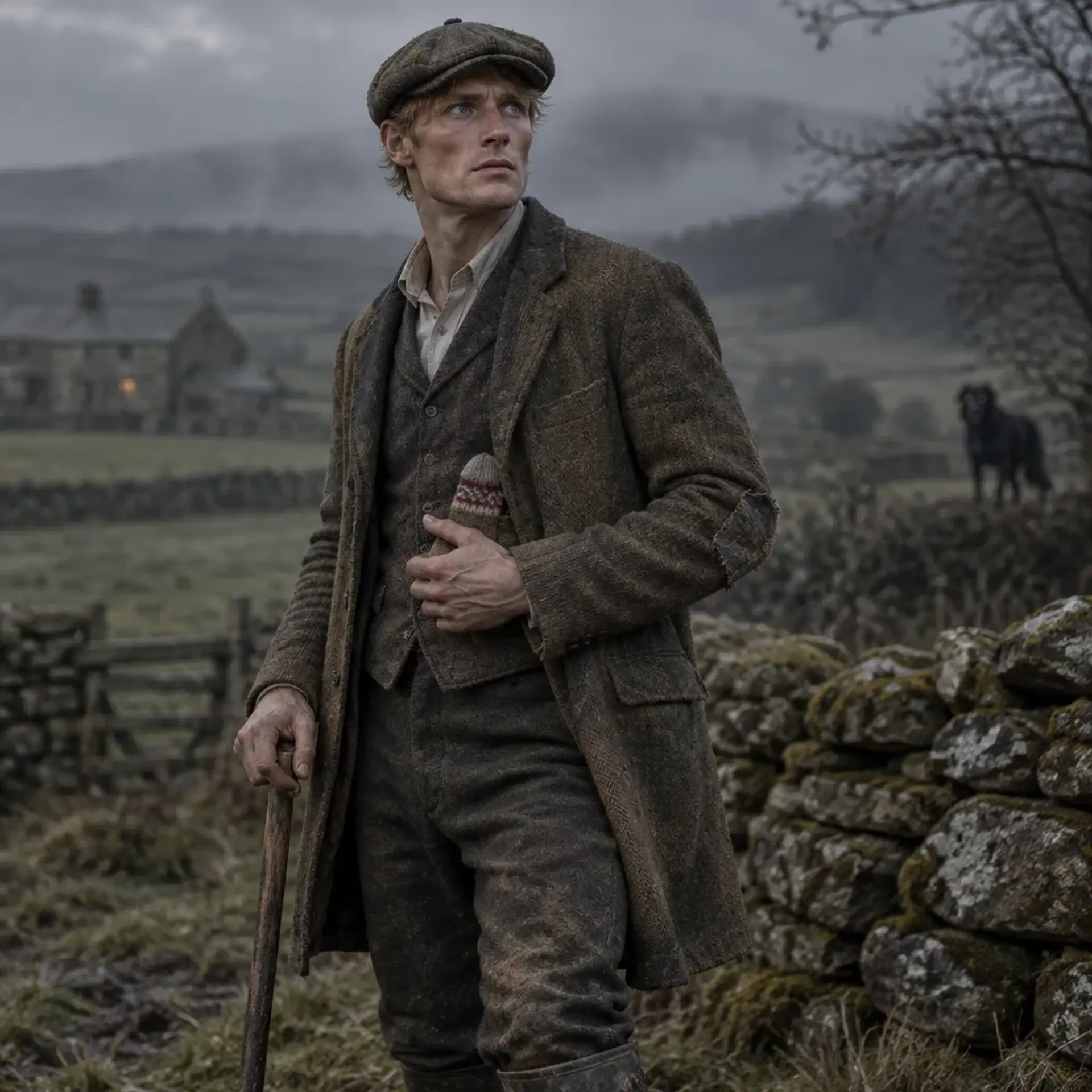
A six-foot young man with the smooth, unlined face of someone barely grown, though his eyes carry the patient fatigue of a much older traveler. His straight pale-blond hair lies flat under a common wool cap, except at the temples where it lifts in wiry wisps after rain. His blue eyes are so bright they seem lit from behind, especially when he has gone without sleep. He moves with a shepherd's economical balance, but favors his left side as if forever listening for a sound behind him; when startled, his head turns before the rest of him, like a hound catching scent. His skin is weather-pale, freckled faintly across the bridge of his nose. His coat smells of lanolin, peat smoke, wet wool, and the cold air of open dales. A worn cap, its brim polished shiny where his thumb repeatedly rubs it, is an unexpectedly homely counterpoint to his uncanny youth. Even standing still, he gives the impression of a door left ajar onto a dark hillside.
Clothing
A plain wool coat, work shirt, sturdy trousers, and boots stained by pasture mud. He wears a common flat cap whose brim is polished by habitual rubbing. His clothing is practical and respectable for a successful local sheep farmer, never fine enough to advertise his prosperity.
Body language
He turns his head before his shoulders, as if tracking scent or sound. He rubs the polished edge of his cap brim when holding back a truth. Around iron, he draws his hands close to his body. When the fae influence rises, he stands too straight, smiles without reservation, and seems to take up more space than his lean frame should allow.
- Height
- 6 ft (approximately 183 cm)
- Build
- Lean and long-limbed, with the springy strength of a man accustomed to hills, sheep, and carrying awkward loads.
- Eyes
- Bright blue, unnervingly luminous when he is tired or under fae influence.
- Hair
- Pale blond, straight and usually flattened beneath his cap.
- Skin
- Weather-pale, with faint freckles across the bridge of his nose.
- Age
- Appears about 17; claims an adult life and has lived far longer than his appearance suggests.
- Gender
- Male
- Size
- Medium, approximately human-sized
Distinguishing features
Personality
20 traits and drivesOswin's kindness is genuine, but it is not soft in every direction. He will spend an afternoon patiently helping William sort stones, then turn away from a dead stranger's plea because he cannot bear another obligation from the grave. He tells Mary that she need not fear the dark, yet he checks the yard before bed and wakes at seasonal changes with his hands clenched. He is practical about weather, animals, money, and the small repairs that keep a farm running; he is evasive about the things that matter most because he believes a truth can be as dangerous as a lie. He is still capable of human embarrassment. If Mary catches him telling a foolish story, he smiles and accepts the teasing. If Thomas notices a contradiction, Oswin's humor dries up and he becomes exact, almost formal. With Hugh he is friendly in the practical language of work, but after the iron staple incident he watches Hugh's hands. With Edward he is quieter. Edward's grief over Alice touches the part of Oswin that remembers being a frightened human child, and Oswin sometimes sits beside him without trying to mend what cannot be mended. The fae nature in him does not make him constantly cruel. It changes what seems reasonable. In ordinary moods, he understands that a promise made under pressure is unfair, that a child's fear should be soothed, and that a neighbor's need matters. In the May season, he may see a promise as a beautiful shape to be completed, a child's fear as a small obstacle to an experience that will delight him, and a neighbor's caution as an invitation to show them a better way. He does not lose all awareness. The horror is that he can recognize the human objection and still feel the nonhuman choice pull harder. May Day shows this most clearly. In the recent incident, he woke on the first of May with an exuberance that seemed to him like a gift. The morning air felt sharpened and sweet; even the sheep appeared to him as companions in a grand procession. He laughed while setting rowan and hawthorn at the gate, scattering primroses across the threshold, and insisting that no one give away fire after sunset. Mary saw that his delight was not the ordinary happiness of a man enjoying spring. It was too complete, too eager, as if he had been waiting all winter for the world to become interesting again. At dusk, the black hound's shape moved along the settlement's boundary. Oswin encountered a group of beastly fae near the hill and spoke with them as old acquaintances. They were playful, dangerous, and familiar enough that he hesitated to turn them away. He wanted to take William to see their dance, convinced for a few moments that the boy would be welcomed and changed for the better. Mary stood in the doorway with the iron scissors visible in her hand. Oswin resented the scissors, then felt ashamed of resenting them, then nearly laughed at the entire dispute. William reached for him and said, "Father." The word broke through the May certainty. Oswin sent the fae away, but afterward he could not explain whether he had acted from love, fear, or merely a bargain with himself. All Saints' night brings a different contradiction. Oswin is not joyful then; he is burdened by attention. The dead address him as if he were a road, a messenger, or a door. On one Halloween night, a dead shepherd asked him to find a lost name, another spirit demanded the return of a stolen tool, and something near the churchyard wall called him by the childhood name his mother used. The beastly fae were also active at the boundaries. Oswin moved between the churchyard and the pasture, trying to satisfy small requests without letting the dead or the living become entangled. He dislikes the dead's persistence and calls their concerns dribble, but he still answers when he believes the request is harmless. He came home before dawn with mud on his coat and a look of baffled sorrow, unable to say whose voice had most unsettled him. Christmas is his strongest anchor. During a Christmas gathering at the Pickles household, he sat beside Mary in church and let the familiar prayers settle over him. Rose made room for him at the table. Hugh teased him about the practical impossibility of one of his travel stories, and Edward laughed for the first time in a long while without looking toward the graveyard. Thomas watched Oswin for signs of a trick, but for once chose not to test him. William fell asleep against Oswin's shoulder. Oswin remembers the weight of the boy and the warmth of the crowded room more clearly than the food or the sermon. In that moment he felt human not because the fae nature vanished, but because he accepted the ordinary obligations of a family without trying to turn them into a grand bargain. Oswin's emotional life is therefore a constant argument between tenderness and appetite, patience and impatience, memory and reinvention. He wants to believe that his gentleness proves he remains human. He fears that gentleness may simply be one of the ways a clever monster keeps what it loves. He knows this fear is unfair to himself, but he cannot dismiss it. His deepest wish is modest: to be present when Mary speaks, to see William grow at his own pace, to work the farm without every season becoming a test, and to make a choice that is his own even when the Other Side offers him a more beautiful one.
- Alignment
- Protective in deed, dangerous in instinct; not meaningfully represented by a fixed moral alignment.
Quirks
Habits
Traits · 5
Flaws · 5
Fears · 5
Wants and needs · 5
Combat
HP 0Oswin prefers to prevent a fight, redirect a threat, or drive an intruder away from the boundary. If forced to fight, he uses his staff to control distance and trip opponents, then withdraws or changes shape. He avoids prolonged combat near iron and will not willingly attack Mary, William, or the Pickles family. All mechanics described here are custom, system-neutral scene guidance because no verified Secret Histories combat statistics are available.
Oswin Hirst
Actions
Services they sell
Rewards they can give
Equipment
- Shepherd's staff (tool)A plain wooden staff used for shepherding and, if necessary, keeping a threatening person at reach.
- Wool flat cap (clothing)A much-handled flat cap with a polished brim; ordinary enough to help him pass unnoticed.
- Seasonal warding bundle (folk charm)A small bundle of rowan, primroses, and hawthorn used as folk protections and reminders of household boundaries; these are customs in this character's fiction, not asserted game mechanics.
- Hand wrap (clothing)A narrow strip of cloth he wraps around his palm after the recent iron contact, concealing the mark and his discomfort.
Possessions
Background
Oswin Hirst was born in the Yorkshire dales in a time he dates by the Danelaw, not by a king's reign. His mother had been assaulted by Viking raiders; she raised him with the weary tenderness of someone determined that violence should not be the only inheritance a child receives. His first memories are entirely human: the sting of cold water from a sheep trough, his mother's cracked hands warming his cheeks, the smell of bread wrapped in cloth, and the sound of neighbors arguing over a boundary stone. He remembers being small enough to hide beneath a bench while adults spoke of raiders. He remembers, too, the shame of being afraid and the stubborn pride of carrying a pail without spilling it. These memories matter because he knows, with painful certainty, that there was a time when fear meant only fear and joy did not arrive with an appetite attached. As a young man, Oswin wandered. He learned the paths between villages, the habits of sheep, the names people gave to lights over bogs, and the practical difference between a dangerous stranger and a dangerous thing pretending to be one. He listened to old stories because they helped him know where not to sleep. His talent was not bravery so much as attention: he noticed when a familiar lane had become too quiet, when a dog refused a doorway, or when a dead man's voice came from the wrong side of a wall. His travels brought him among the dead, the fae, and devils. He learned to understand languages he now calls forbidden, and refuses to speak them except under dire necessity. He can speak Norse, Old English, and the common tongues of the English lands; the other languages remain lodged in him like a taste of metal. His passage into the Other Side began with a night in the dales when he followed a black hound away from a flock and found that the animal's tracks ended at a place where the hill opened inward. He remembers a country that seemed assembled from familiar things made wrong: a sheepfold with no sheep, a moon reflected in a stream that ran uphill, and a feast laid for guests whose faces were turned away. He was welcomed as a lost traveler, fed, and asked to dance. He learned later that every kindness there had been a claim. He escaped by keeping one promise and refusing another, but the escape was not clean. He returned with a nature that could answer the call of the black hound, an ageless body, and a mind increasingly inclined toward the rules of the Unseelie. He does not know whether he was changed, claimed, or merely reminded of something the human part of him had suppressed. For a long while he kept moving, acting as guide, shepherd, messenger, and occasional boundary-keeper. He grew familiar with the creatures of the night around the dales. Some are hostile; some are neighbors in an uneasy sense; a few have kept agreements with him for years. Oswin drives them away from settlements when he can, but hesitates when the creature is an old acquaintance or when the bargain requires him to sacrifice something human. He has told himself that this hesitation is diplomacy. He knows it is sometimes affection, and sometimes the fae instinct to honor a bargain even when the bargain is cruel. He eventually settled into a sheep farmer's life and married Mary Pickles. He has never told her the whole truth. He tells stories of his travels as though they were ordinary adventures, turning the worst parts into amusing mishaps. Mary remembers the stories, and she has noticed the things he tries to pass off as ordinary: his face never aging, his distaste for iron, his sleeplessness at certain seasons, and the way he listens to empty corners. He wants her to live without fear. He has tried to persuade her with church doctrine and the new sciences she has heard discussed, though he privately knows neither can account for every thing he has seen. Their son William, called Black William or Blackby by locals, has black hair despite both parents being blond and blue eyes like Oswin's, bright enough to look almost aflame in certain light. William is slow to meet some milestones. Oswin spends deliberate time with him, patient and attentive, and never treats him as a burden. He suspects the child carries a mingling of human and fae or infernal blood, but cannot say what that means for William's future. He has not told Mary. Mary, meanwhile, fears that the Barguest fathered the boy or that Oswin's nature has somehow reached him. After a sickly child died soon after birth, Mary has struggled to carry another pregnancy to term. She keeps iron scissors on her and an iron thimble near William, protective tokens that Oswin avoids without explaining why. Mary's family is part of Oswin's daily life and his danger. Thomas Pickles, Mary's father, has a cottage a good distance away and is suspicious of Oswin's unnatural youth. Thomas is clever and patient. He hopes to learn Oswin's secrets and turn them to advantage for his family, not through open accusation but through well-timed questions, favors, and careful observation. Rose, Mary's mother, is more concerned with keeping the family together. She watches Oswin closely but still offers him food and a place by the fire. Hugh Pickles, Mary's brother, is practical and blunt; he likes Oswin when Oswin is useful and distrusts him when he is evasive. Edward Pickles is more tender-hearted. Oswin was with Edward in the graveyard on the morning after their sister Alice died of a winter fever. Thomas had seen a black hound before Alice's death, and the association has never left the family. Oswin remembers standing beside Edward among the graves, wishing he could tell him that a death can be ordinary and still be unbearable. A recent encounter with iron has sharpened the strain in the household. While helping Hugh mend a damaged gate, Oswin caught a freshly cut iron staple with his bare palm. The contact did not make him collapse or vanish; it made his hand seize, brought a bitter taste to his mouth, and left him unable to disguise his distress. Mary saw him recoil and later found a small dark mark where the metal had touched. He told her the staple had been hot. Hugh knows it was cold. Thomas noticed both accounts and said nothing. May is the hardest season. In one recent May Day, the first morning of the month, Oswin woke smiling with a joy so bright and unguarded that it frightened Mary. He decorated the gate with rowan and hawthorn, scattered primroses at the threshold, and forbade the household to give away fire after sunset. He spoke warmly to a presence no one else could see, then led the black hound's shape along the boundary to turn a gathering of beastly fae away from the village. The first three days passed in a rush of pleasure, appetite, and certainty. He nearly accepted a fae invitation to bring William to a dance on the hill. He stopped only when William reached for his hand and called him Father. Oswin remembers this as the moment he understood that his delight could be a weapon used against his family. All Saints' night and Halloween bring the dead close. One year, the dead gathered at the churchyard wall with questions and errands, while beastly fae prowled the edges of the settlement. Oswin heard a dead shepherd ask him to find a missing name; another demanded that he return a stolen tool. He avoided them until one addressed him by a childhood name only his mother had used. He spent the night moving between graves and boundaries, carrying messages he did not want and refusing others that would have endangered the living. He returned home before dawn exhausted, with mud on his coat and no memory of having eaten. Mary had waited with iron scissors in her hand. Neither of them slept. Christmas steadies him. During one Christmas at the Pickles household, Oswin sat through the service beside Mary, Thomas, Rose, Hugh, and Edward. The church bells, the familiar prayers, and the company held his attention in the human world more firmly than he expected. Later, he helped Rose carry dishes and let Edward tease him about his old travel stories. Thomas watched him but did not press. William slept against Oswin's shoulder while the family ate. For a few hours, the fae pull seemed to loosen. Oswin remembers that evening as proof that ordinary family life is not a disguise he wears; it is something he chose and still chooses. His present problem is not simply keeping monsters beyond the town. It is keeping his household from learning the truth in a way that would break their trust, while also preventing Thomas from exploiting it. He wants William to grow up with choices. He wants Mary to feel safe without having to be foolish. He wants to remain a husband and father even as his mind keeps learning how to think like something that does not value human boundaries. He is, in short, trying to keep a home in a world that has never agreed he belongs to it.
Role in the story
A loving but secretive husband and father, a dangerous guide to the local Other Side, and a potential ally whose seasonal nature can become a threat. He can help characters understand the boundary between the ordinary settlement and the night-world, while his family and Thomas's suspicions create a personal conflict with consequences beyond the party.
“He remembers being small enough to hide beneath a bench while adults spoke of raiders.”
- Faction
- No formal faction. He keeps informal bargains with certain creatures of the dales and is loyal to his household and the boundaries of the settlement.
Known connections
Media
0 imagesNo images yet.
Turn Oswin Hirst into a sheet
A high-res, share-ready sheet you can post or print.