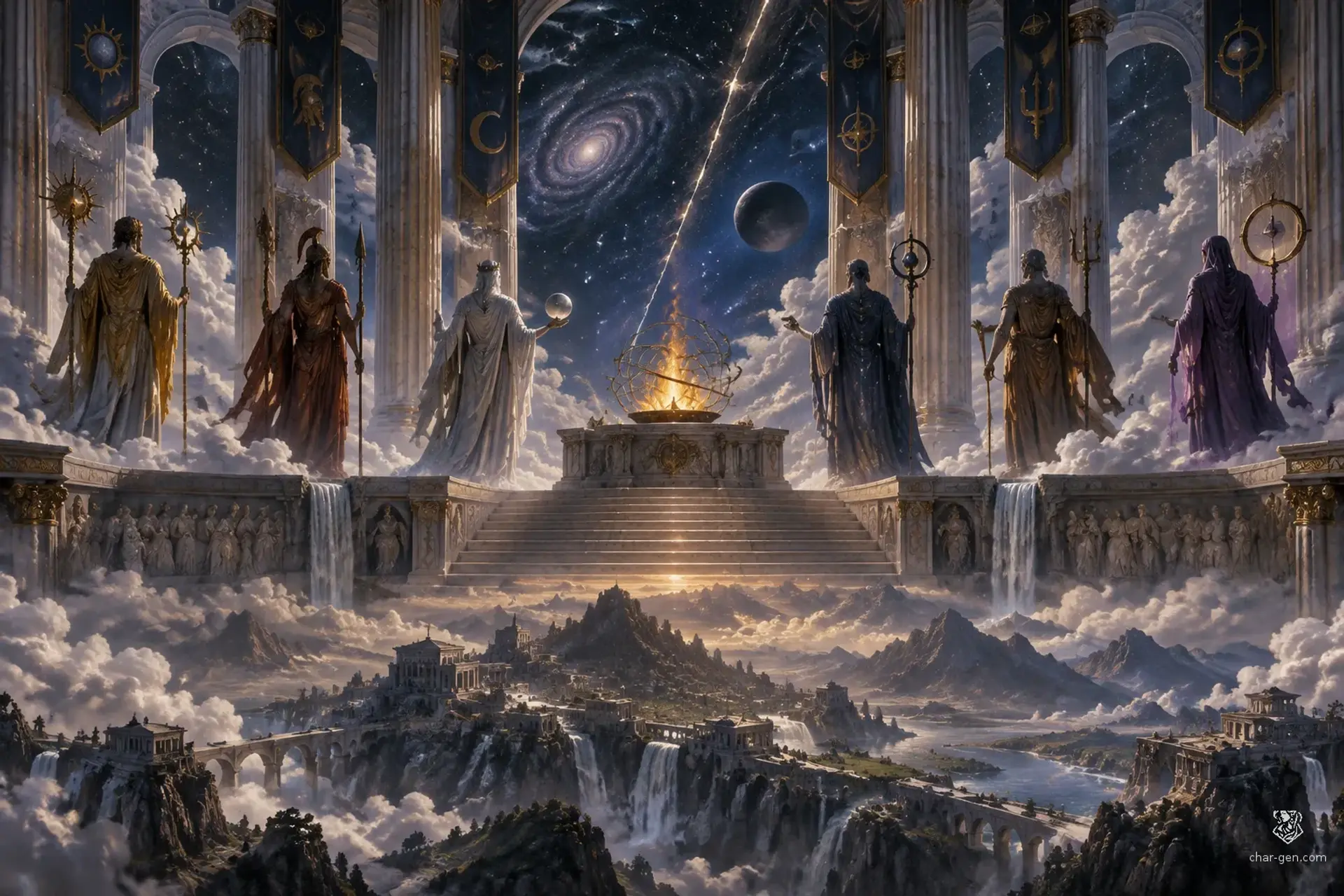
Unnamed pantheon
Unnamed pantheon
Invoke a god
Varo
The Far-Sighted Sun
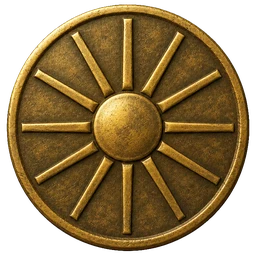
Symbol A golden disk above three ascending steps
Holy day The First Measure
- Build what can outlast you.
- Let law serve the living, not merely preserve itself.
- Do not mistake a sign from heaven for permission to neglect your neighbor.
The gods
6Varo
The Far-Sighted Sun
Greater · Lawful Good
Sun and civilization, whose ordered light follows the measures Kett laid down.
Patient, grave, and sincerely benevolent, Varo expects mortals to uphold the common good without waiting for divine rescue. Varo admires Kett's constancy but distrusts Gant's appetite for change.
Faith
- Build what can outlast you.
- Let law serve the living, not merely preserve itself.
- Do not mistake a sign from heaven for permission to neglect your neighbor.
Holy dayThe First Measure, celebrated at the spring equinox with public oaths and the lighting of new hearths.
Holy textThe Book of the Open Sky
RitesOpen shutters at dawn and speak one promise for the day. · At the founding of a settlement, set a sun-marked stone where its roads meet. · Offer bread to strangers on the First Measure.
ValuesStewardship · Courage · Public duty
Look
SymbolA golden disk above three ascending steps
- Gold
- Ivory
AnimalsEagle · White bull
AppearanceA towering figure in a sun-bright mantle, with a face like a classical statue warmed by dawn. Varo's crown resembles a simple golden disk, and the clouds around him form the same measured arches found in Kett's temples.
Followers
WhoJudges, civic builders, guardians, and rulers who accept that authority carries obligations.
BeliefsFollowers believe that Varo sees all mortal lives but intervenes only when the foundations of civilization are at stake. A just society is a form of worship, even when no temple stands nearby.
The faith
How it began
Before there was a sky, there was only a silent amphitheater.
Varo lit its center; Kett measured the light's reach; and Doru established the limit beyond which it could not pass. Omi found paths through the empty tiers, Seki remembered the first light, and Gant made the first alteration to its course. The gods' creation was not a single act but a continuing arrangement, and the world remains imperfect because Gant's alteration was never undone.
The heavens
The cosmos is a vast, ordered amphitheater: the mortal world occupies its central stage, while the gods watch from distant tiers beyond the sky.
Varo kindled the first light at its center; Kett gave that light a course, and Doru set a final curtain at the edge of life. Omi made the spaces between worlds navigable, Seki gave them memory, and Gant introduced the possibility that the script might change. The gods influence events through signs, dreams, and chosen agents, rarely by appearing openly.
Gods and mortals
The gods are distant patrons, not household presences.
Their influence comes through temples, dreams, omens, and the choices of clerics, paladins, rulers, and ordinary people. Most communities honor several deities according to circumstance: Varo at civic ceremonies, Kett for contracts, Omi before travel, Seki in schools and archives, and Doru at funerals. Gant is invoked in private at moments of desperate change. No priest can claim that a god will answer simply because a rite was performed correctly.
After death
The dead cross the quiet River of Glass under Omi's distant gaze.
At its far bank, Kett weighs the deeds they remember and those they refuse to remember; the worthy pass into the Hall of Echoes, while others return as nameless shades until their unfinished bonds are released. Varo's priests teach that no god can alter this passage, though Doru is said to shelter lost souls from the river's cold.
What people say, what is true
Players may hear
For the GM
Plot hooks
Conflicts
The wars
Kett insists that Varo's laws bind gods and mortals alike, while Varo believes law is a tool rather than an end.
Gant repeatedly tests the boundaries guarded by Kett and Doru, sometimes with Omi's tacit blessing. Seki's visions frustrate Doru, who guards the secrets that Seki would expose. The assembly has not met in person since Gant stole a bronze key from Doru's threshold.
| Varo | Kett | Omi | Gant | Seki | Doru | |
|---|---|---|---|---|---|---|
| A | A | E | ||||
| A | E | E | A | |||
| A | A | E | ||||
| E | E | A | A | |||
| E | A | A | ||||
| A | E | E |
Order of heaven
Structure
The faith has no supreme earthly authority.
Each deity is served by independent temples and local priesthoods, while traveling synods convene when matters cross divine portfolios. Varo's civic shrines and Kett's courts often cooperate; Omi's hospices provide refuge regardless of creed; Seki's archives preserve disputes between sects; Gant's worship is decentralized and often clandestine; Doru's sanctuaries tend graves and oversee funerary customs. The synods cannot command the gods, and their decisions bind only those communities that accept them.
Theme
Divine distance, contested order, and mortal agency within a world shaped by powers that rarely explain themselves.
Tone
Distant and mythic: the gods are real, consequential, and difficult to reach.
Their signs are open to interpretation, miracles are rare, and mortals must live with the consequences of divine rivalries as well as their own decisions.
Alignments
The six range from lawful good to chaotic evil, with every moral and ethical tendency represented.
Their rivalries are not a simple war of virtue against vice: even the kindest gods can be remote, and the cruelest may keep a necessary oath.
Media
0 imagesNo images yet.
Turn Unnamed pantheon into a sheet
A high-res, share-ready sheet you can post or print.
