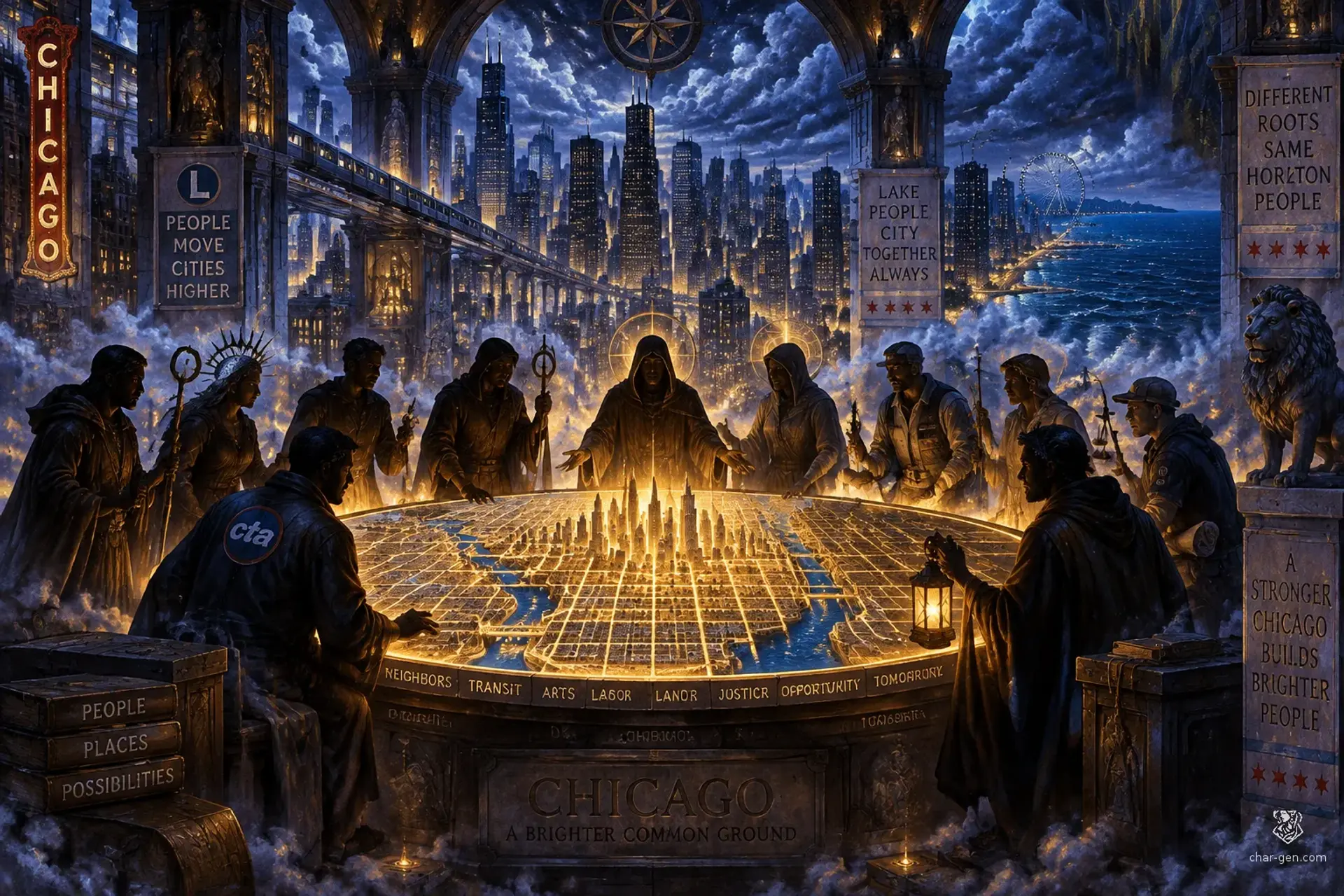
The Chicago Twelve
The Chicago Twelve
Invoke a god
Alpha
Keeper of the Common Ground
Symbol A key laid across a simple outline of Chicago.
Holy day Founders’ Vigil
- Protect the living before protecting property.
- A city is only as strong as its least sheltered resident.
- Make room for change without abandoning what sustains people.
The gods
12Alpha
Keeper of the Common Ground
Greater · True Neutral
Life · City protection · Civic balance; Alpha’s warding signs are traditionally witnessed by Mother of All.
Patient, pragmatic, and attentive to ordinary needs, Alpha favors repairs and compromise over grand gestures. Alpha consults Knowledge Master before changing the city’s ancient protections.
Faith
- Protect the living before protecting property.
- A city is only as strong as its least sheltered resident.
- Make room for change without abandoning what sustains people.
Holy dayFounders’ Vigil, observed on the first warm evening of spring with block cleanups and shared meals.
Holy textThe Common Ledger, a changing collection of neighborhood promises and accounts of lives saved.
RitesLeave a spare key with a trusted neighbor. · At dusk, name one person or place you will help protect. · Repair a public space without claiming credit.
Valuescontinuity · mutual aid · shelter
Look
SymbolA key laid across a simple outline of Chicago.
- brick red
- lake blue
Animalspigeon · coyote
AppearanceA calm figure in a plain dark coat, carrying a brass key ring whose keys open the doors of every Chicago home and public refuge.
Followers
WhoNeighborhood organizers, public defenders, emergency workers, building stewards, and people who quietly look after their blocks.
BeliefsFollowers believe that the city survives through countless small acts of care and that Alpha’s protection is a covenant, not a wall against change.
The faith
How it began
The Twelve formed through successive covenants between the land and the people who made a home beside the lake and river.
Alpha gathered the first assembly to guard life in the growing city. Mother of All demanded a place for care, Knowledge Master insisted that memory be kept, and Rivet Saint spoke for the hands that built and maintained the streets. The others came from the city’s shifting needs and contradictions. The Dark One’s place in the assembly remains disputed, but removing the god has never stopped death, decay, or disruption from answering.
The heavens
Chicago is a living covenant built where lake, river, prairie, and human ambition meet.
The city’s streets are its veins, the elevated trains its nerves, and Lake Michigan its immense, listening heart. The Chicago Twelve arose from the bargains between people and place: no god rules alone, and each domain is strongest where mortals keep faith with one another. Their divine assembly meets in a hidden room beneath the Loop, accessible by a door that appears only during a citywide crisis.
Gods and mortals
The gods are present in ordinary life but do not rule it.
They answer through dreams, sudden green lights, a neighbor’s timely knock, a song heard at the right moment, or an unmistakable warning in the weather. Their clergy tend to be community workers rather than secluded hierarchies, and followers of different gods often cooperate. Divine power is strongest when mortals act together; no god can compel a neighborhood to love, trust, or worship them.
After death
The dead arrive at the Midway, a vast station beneath the city where every departed soul receives a ticket stamped by Alpha.
Some ride the Green Line toward a quiet rest; others return as ancestors, neighborhood spirits, or unfinished business. The Dark One claims those whose lives have curdled into ruin, but Mother of All and Alpha may appeal a judgment when a death was unjust. Knowledge Master keeps the names of the dead in an archive no flood or fire can erase.
What people say, what is true
Players may hear
For the GM
Plot hooks
Conflicts
The wars
Alpha and the Dark One contend over whether a neighborhood’s destruction is a necessary ending or a preventable crime.
Sly Fox steals secrets from Knowledge Master’s archives, while Knowledge Master insists that memory must serve the living. Mother of All and the Dark One struggle over the boundary between healing and death. The Blue-Lantern and Rivet Saint argue over whether the city is best protected by vigilance or by collective labor; Tavik profits when their disagreements leave openings.
| Alpha | Dark One | Sly Fox | Mother of All | Knowledge Master | Blue-Lantern | Rivet Saint | Shesh | Nahla | Tessik | Morrow Judge | Tavik | |
|---|---|---|---|---|---|---|---|---|---|---|---|---|
| E | A | A | A | E | ||||||||
| E | A | E | E | A | ||||||||
| E | A | E | A | A | ||||||||
| A | E | A | A | E | ||||||||
| A | E | A | A | E | ||||||||
| A | E | A | A | E | ||||||||
| A | E | A | A | E | ||||||||
| E | A | E | A | A | ||||||||
| A | E | A | A | E | ||||||||
| A | E | A | A | E | ||||||||
| A | E | A | A | E | ||||||||
| E | A | A | E | A |
Order of heaven
Structure
The assembly has no permanent monarch.
Alpha chairs its meetings and keeps the civic covenant, while the others speak from their domains and from the mortal communities they serve. The gods form shifting working circles: guardians, healers, keepers of memory, and challengers of established power. A divine decision requires the agreement of at least seven members, though any god may act alone within their domain. Mortals can petition the assembly through public rites, community gatherings, and the deeds of dedicated champions.
Theme
A city is not a machine or a monument; it is a living bargain among neighbors.
Protection, memory, work, risk, grief, and joy all have divine voices, and no voice can replace the choices of mortals.
Tone
Mortal-engaged urban fantasy: the gods are close enough to notice a block in trouble, but they rely on people to decide what help should look like.
Everyday acts of solidarity can carry divine weight, while neglect and exploitation create openings for darker powers.
Alignments
The Chicago Twelve range from principled good to predatory evil, with neutral powers holding the city’s competing needs in balance.
Their alignments describe divine instincts, not the moral character of every worshipper.
Media
0 imagesNo images yet.
Turn The Chicago Twelve into a sheet
A high-res, share-ready sheet you can post or print.
