The Heptagram
The Heptagram
Invoke a god
Zephyron
The High Witness
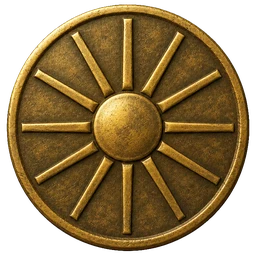
Symbol A seven-pointed star pierced by a descending bolt.
Holy day The First Thunder
- Keep oaths, especially when keeping them is difficult.
- Use authority to shelter those who cannot command it themselves.
- Let no ruler claim the sky as proof of unquestionable right.
The gods
7Zephyron
The High Witness
Greater Deity · Lawful Neutral
Sky, kingship, and storms; Zephyron's authority is challenged by Thalassar's command of the sea and tempered by Athenza's counsel.
Commanding, attentive, and severe about broken promises. Zephyron believes order protects the weak, though he can mistake obedience for virtue.
Faith
- Keep oaths, especially when keeping them is difficult.
- Use authority to shelter those who cannot command it themselves.
- Let no ruler claim the sky as proof of unquestionable right.
Holy dayThe First Thunder, celebrated at the season's first storm with oaths renewed beneath open skies.
Holy textThe Seven Witnesses, a collection of judgments, royal vows, and accounts of mortals whose deeds drew the gods' gaze.
RitesSpeak important vows beneath an open sky. · Leave a bowl of rainwater on a temple roof after the first storm. · Record public judgments on star-shaped tablets.
Valuesduty · justice · steadfastness
Look
SymbolA seven-pointed star pierced by a descending bolt.
- storm blue
- gold
Animalseagle · ram
AppearanceA crowned figure in a mantle of storm-cloud blue, with lightning threading the constellation behind his brow.
Followers
WhoRulers, judges, sailors seeking fair weather, and guardians who swear public vows.
BeliefsFollowers believe every oath is spoken beneath Zephyron's stars and that honest leadership lets him see clearly through a ruler's eyes.
The faith
How it began
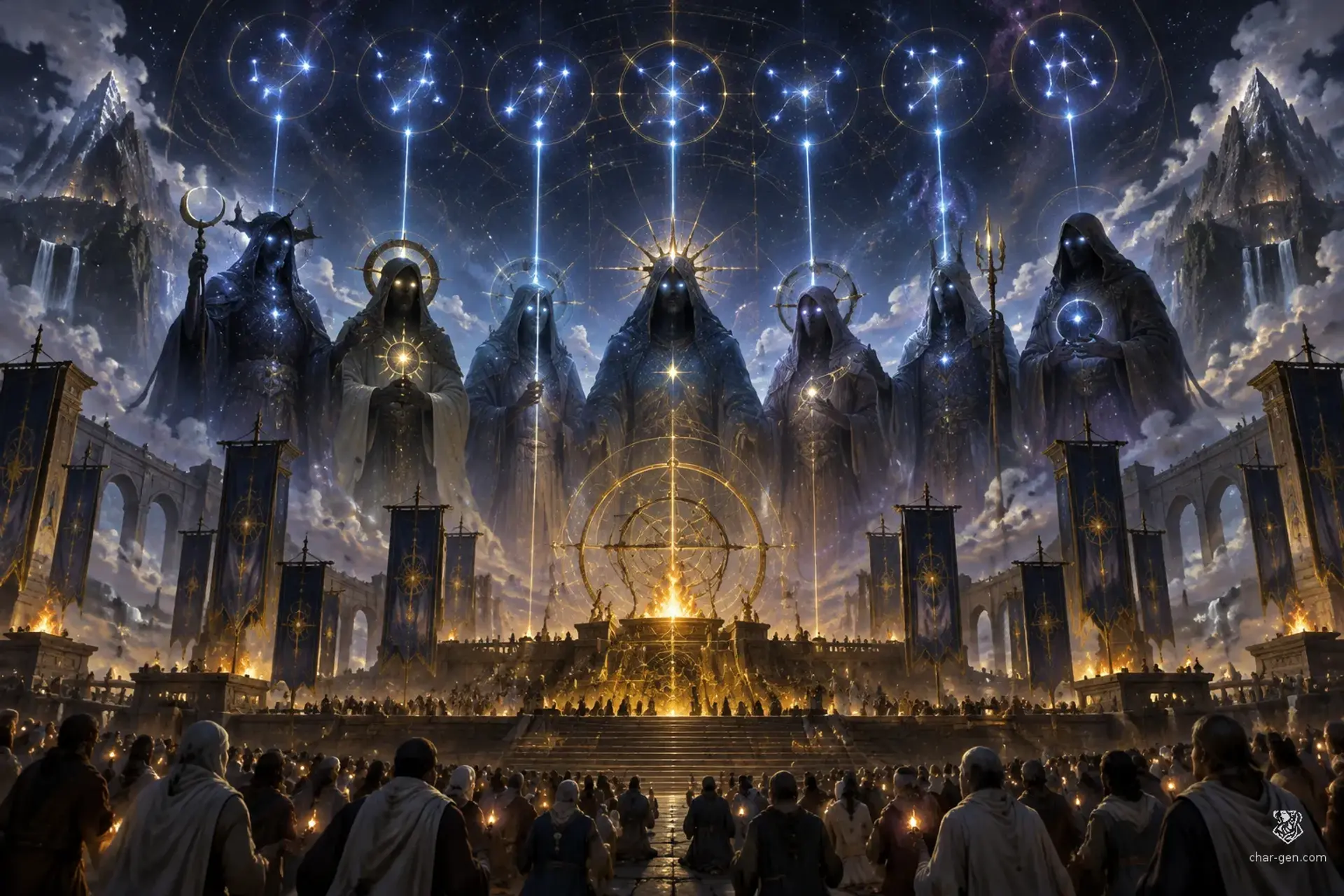
Before the first dawn, seven powers looked upon a silent world but could not see it clearly.
They made the first mortals and found that each mortal gaze revealed a different truth: the storm's danger, the sea's freedom, death's boundary, the value of wisdom, the cost of conflict, the force of love, and the needs of the living wild. The gods set seven constellations in the heavens so they would remember that the world's meaning could only be seen through mortal eyes.
The heavens
The world lies beneath a dark celestial vault patterned by seven great constellations.
The Heptagram formed these stars as seven stations of divine attention: each god sees through the eyes of followers who honor them. Stars shift when a god's attention turns, and a new star may appear when a mortal act changes the balance of fate. The gods are powerful but not omniscient; their mortal witnesses are their sight, their testimony, and sometimes their only warning.
Gods and mortals
The Heptagram is worshipped through a web of local shrines, observatories, household altars, and roadside offerings rather than a single hierarchy.
Priests commonly serve one deity while learning the rites of the others, because every mortal life touches several divine concerns. The gods answer through dreams, omens in the stars, and rare direct manifestations, but most often they see and act through mortal followers. Clerics, rulers, and ordinary believers therefore disagree about whether a sign is truly divine, and must take responsibility for how they interpret it.
After death
The dead travel by starlit roads to the House Beneath, where Hades weighs their lives without haste.
Those who lived with courage, restraint, or generosity may dwell in a fitting afterrealm; the cruel and oath-breaking are confined to bleak regions of their own making. The constellations are windows through which the living can glimpse the dead, and the dead can watch their descendants.
What people say, what is true
Players may hear
For the GM
Plot hooks
Conflicts
The wars
Zephyron wants mortal rulers to obey divine law, while Kharzun insists that hardship and struggle forge worthy souls.
Thalassar resents Zephyron's claim to command the sky above his seas. Athenza tries to restrain Kharzun's appetite for war, but Velyra often turns their rivalries into matters of passion and honor. Orsika's hunt crosses the borders of Hadeskar's realm, where lost souls sometimes flee into the wilderness.
| Zephyron | Thalassar | Exnos | Athenza | Kharzun | Velyra | Orsika | |
|---|---|---|---|---|---|---|---|
| E | A | E | A | ||||
| E | A | A | |||||
| E | A | A | E | ||||
| A | E | A | A | ||||
| E | A | E | E | ||||
| A | A | E | A | ||||
| A | A | E | A |
Order of heaven
Structure
The religion has seven recognized divine seats and no supreme earthly authority.
Each deity's priesthood maintains its own rites, but regional councils gather under open skies to coordinate festivals, settle disputes, and interpret celestial changes. Temples often honor all seven in a star-shaped arrangement, with shrines facing their corresponding constellations. A single community may favor one deity without excluding the rest; funerals invoke Hadeskar, marriages Velyra, public oaths Zephyron, and seasonal hunts Orsika. The priesthoods teach that divine sight is shared: to neglect the people is to blind the gods.
Theme
Divine attention is intimate but incomplete: gods watch through their followers, and mortals shape what the heavens can see.
Tone
Mortal-engaged: divine powers take an active interest in ordinary lives, but depend on mortal witnesses, choices, and interpretations.
Their presence is tangible without making mortal agency irrelevant.
Alignments
The Heptagram spans lawful, neutral, and chaotic convictions, and both benevolent and malign impulses.
Its gods disagree about how mortals should live, but all accept that mortal choices matter.
Media
0 imagesNo images yet.
Turn The Heptagram into a sheet
A high-res, share-ready sheet you can post or print.
