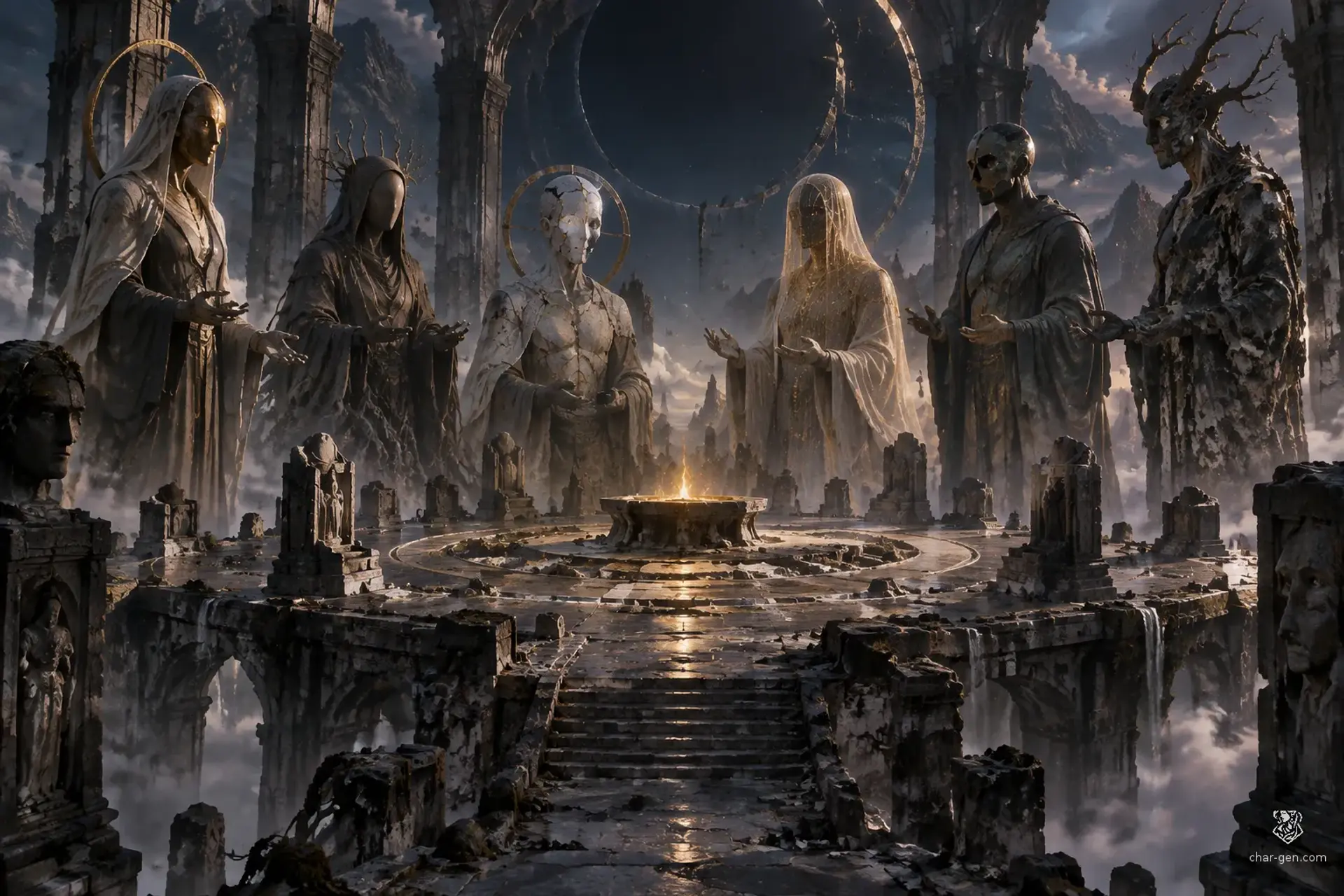
The Six Who Fell Silent
The Six Who Fell Silent
Invoke a god
Orm
The Measure at the World's Edge
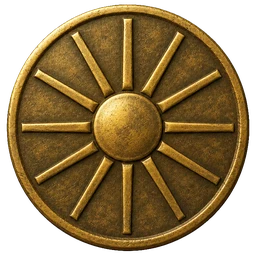
Symbol A vertical line crossed by three short horizontal marks.
Holy day The Measure
- Keep promises even when no witness remains.
- Mark boundaries clearly, and do not mistake them for justice.
- Preserve what protects the vulnerable.
The gods
6Orm
The Measure at the World's Edge
Greater · LN
Law and boundaries, once set beside Ilyora's measured passage of time · Protection of oaths and civic order, which Syth guarded at the borders
Patient, exacting, and remote; Orm valued a stable world more than the comfort of those living within it.
Faith
- Keep promises even when no witness remains.
- Mark boundaries clearly, and do not mistake them for justice.
- Preserve what protects the vulnerable.
Holy dayThe Measure, once observed at the year's turning by surveying fields and renewing agreements.
Holy textThe Unbroken Measure, known only through partial inscriptions that attribute its first laws to Orm and their keeping to Syth.
RitesDraw a boundary line before beginning a solemn agreement. · Set a stone upright for each promise fulfilled. · Read a public rule aloud before changing it.
ValuesOrder · Continuity · Accountability
Look
SymbolA vertical line crossed by three short horizontal marks.
- Bronze
- Chalk
AnimalsOx · Tortoise
AppearanceA towering figure in a featureless bronze mask, with a staff that resembles a boundary marker. Old reliefs show Orm standing beside Ilyora at the edge of a measured sky.
Followers
WhoIn the lost age, judges, masons, record-keepers, and guardians of civic peace.
BeliefsOrm's former adherents believed that honest limits made freedom possible, and that the laws of Orm and the compassion of Ilyora belonged together.
The faith
How it began
Old, mutually inconsistent fragments describe the six as powers that emerged when the first world took shape: Orm gave it measure, Ilyora gave it duration, and Velune gave it longing; Syth opened its ways, Brannoc rooted its living things, and Qesh made change possible.
The Great Forgetting came later, gradually erasing personal memory until no worshippers remained. The gods are now gone, but the exact relationship between memory, worship, and their disappearance is unknown.
The heavens
The pantheon once taught that the world was a woven vessel suspended between the First Silence and the starless Deep.
Orm set its boundaries, Ilyora spun time through them, and Velune gave the pattern its living breath. Syth guarded its thresholds, Brannoc anchored its wild places, and Qesh loosened whatever grew too rigid. The Great Forgetting gradually erased personal memory; as remembrance and worship disappeared, the gods themselves vanished. The surviving cosmology is fragmentary, and no authority can confirm its details.
Gods and mortals
The gods once shaped mortal law, seasons, passage, memory, and ambition, yet were never intimate companions.
Their worship vanished over generations as the Great Forgetting erased personal memory. Today, people live among their abandoned shrines without knowing whom they once honored. Some treat the ruins as historical curiosities; others follow inherited gestures whose meanings are lost.
After death
The dead once crossed the Quiet Meridian, where Ilyora weighed their remembered deeds and Orm kept the gates.
Since the Great Forgetting, no living person remembers the route or the gods who maintained it. Souls are now said to drift into an impersonal dusk, though this is a mortal hypothesis rather than a known truth.
What people say, what is true
Players may hear
For the GM
Plot hooks
Conflicts
The wars
The old accounts say Orm and Qesh disputed whether the world should be bound by law or allowed to change, while Syth and Brannoc contended over the price of protection.
Ilyora kept the balance between them, and Velune mourned the losses their quarrels caused. These conflicts survive only as anonymous carvings and contradictory inscriptions.
| Orm | Syth | Ilyora | Brannoc | Qesh | Velune | |
|---|---|---|---|---|---|---|
| A | A | E | ||||
| A | E | A | ||||
| A | A | |||||
| A | A | |||||
| E | E | A | A | |||
| A | A |
Order of heaven
Structure
The Six Who Fell Silent were once understood as an assembly without a permanent monarch.
Orm maintained boundaries, Ilyora mediated disputes, and the remaining deities each held powers that crossed the others' concerns. Their old faith had local shrines, traveling rites, and civic observances rather than a single hierarchy. No priesthood, active congregation, or authoritative doctrine survives; scattered customs and ruins are all that remain.
Theme
The Great Forgetting erased personal memory over time, leaving no worshippers and ultimately no gods.
The pantheon survives only as broken monuments, inherited gestures, and uncertain scholarship. Its central question is not how to restore divine favor, but what remains of a world when even its former rulers have vanished from memory.
Tone
Distant, quiet, and archaeological.
Divinity is not an active presence but an absence measured in empty temples, worn symbols, and customs whose meanings have been lost.
Alignments
Varied: the vanished assembly included lawful, neutral, and chaotic powers, both benevolent and cruel.
Their alignments describe their remembered natures, not any active influence in the present.
Media
0 imagesNo images yet.
Turn The Six Who Fell Silent into a sheet
A high-res, share-ready sheet you can post or print.
