Old Elven Gods
Old Elven Gods
Invoke a god
Ilyuun
The First Rememberer
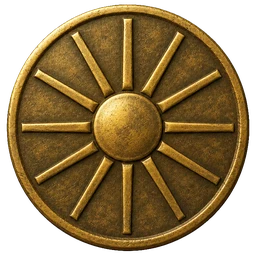
Symbol A silver disk crossed by one unbroken line.
Holy day The First Quiet
- Remember what was entrusted to you.
- Do not mistake silence for consent.
- Keep promises even when their witnesses are gone.
The gods
10Ilyuun
The First Rememberer
Greater · Lawful Good
Memory and the keeping of promises; Ilyuun preserves the first songs that Veyrath set among the stars.
Patient, exacting, and remote. Ilyuun remembers every vow but offers no comfort to those who break one.
Faith
- Remember what was entrusted to you.
- Do not mistake silence for consent.
- Keep promises even when their witnesses are gone.
Holy dayThe First Quiet, observed at the winter solstice by keeping a night without speech.
Holy textThe Measures of the First Light
RitesRecite an ancestor's name before making a solemn vow. · Copy a fragment of a family record by hand and leave it in a public archive.
Valuescontinuity · truth · restraint
Look
SymbolA silver disk crossed by one unbroken line.
- silver
- deep blue
Animalswhite moth · elder deer
AppearanceA distant figure in a mantle of pale branches, face hidden behind a disk of unmarked silver. The figure's shadow falls like a road toward the horizon.
Followers
WhoRecord-keepers, oath witnesses, elders, and elves entrusted with ancestral histories.
BeliefsFollowers believe a promise is a path laid across time. Even forgotten words leave a trace that Ilyuun can see.
The faith
How it began
In elven tradition, the gods emerged when the first night found the world already full of sleeping things.
Ilyuun remembered the darkness, Veyrath measured its stars, and the others took shape around the needs and dangers of a young world. The elves say their ancestors learned the gods' names in the first forests, long before human tribes began to wander the lands. No surviving account claims the gods made the world outright.
The heavens
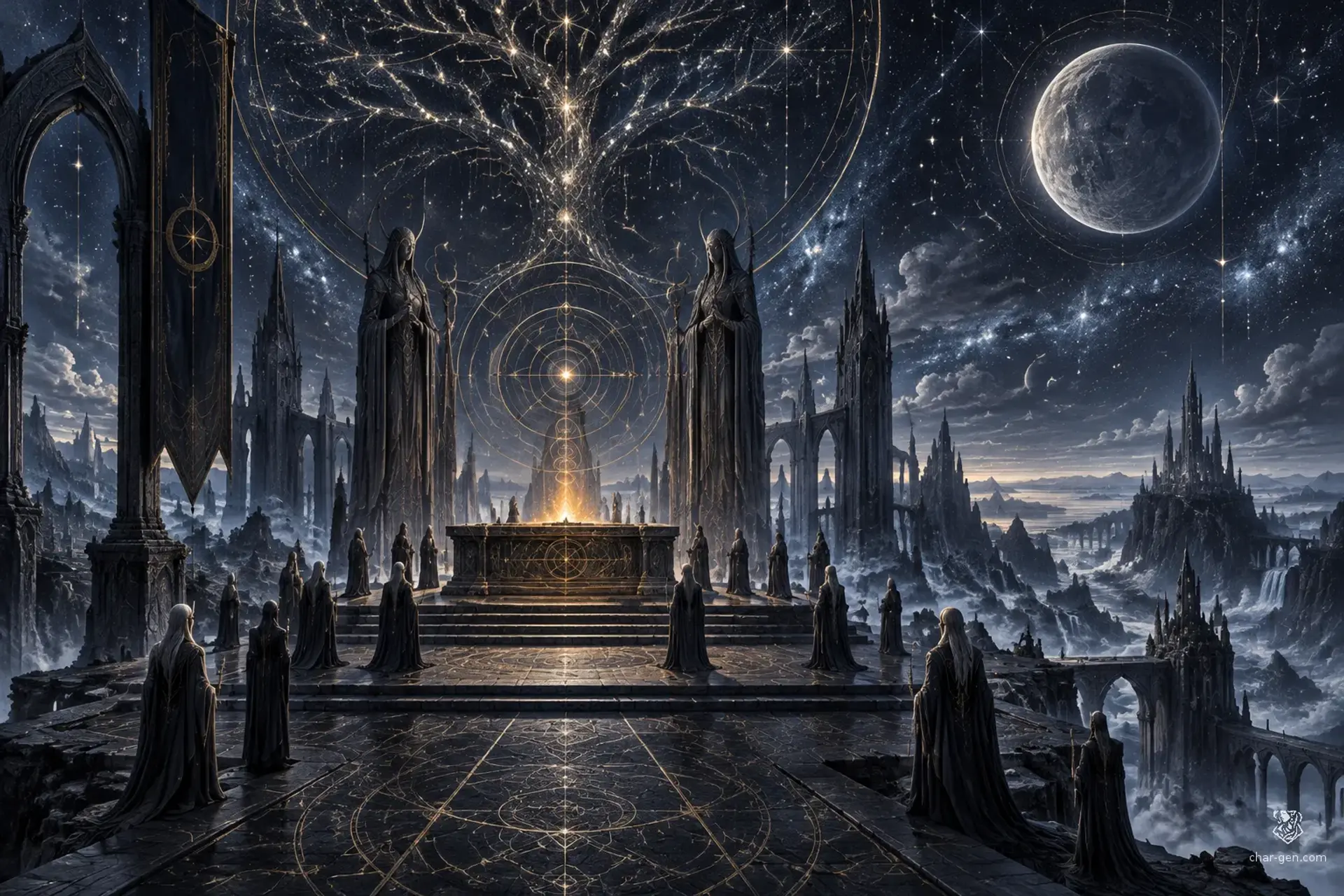
The world rests beneath the Rootless Bough, whose branches are the constellations and whose unseen roots thread the dark between worlds.
Ilyuun first kindled the stars; Veyrath set them in their courses, and Namaris left unlit spaces among them so creation would have room to change. The moon is a bowl carried across the sky by Oruvai. At the world's edge, Saryun keeps a gate that opens toward the Long Dimming. The gods are not creators in the human sense: they are ancient powers who shaped a world already beginning to awaken.
Gods and mortals
The gods are distant patrons rather than constant visitors.
Elven communities honor them through seasonal observances, household offerings, burial customs, and quiet vows; no single temple hierarchy speaks for the whole faith. Priests serve as keepers of local rites, while wandering singers and astronomers carry teachings between settlements. The gods' influence is usually felt through dreams, unusual weather, remembered songs, or a sudden sense that a familiar place has become strange. Humans in this age are scattered tribes on the edge of elven maps; most have heard only fragments of the old gods' names.
After death
The dead travel the Long Dimming, a road beyond the visible stars.
There they pass through the keeping places of the gods: Saryun weighs their promises, Oruvai shelters their memories, and Ithesh loosens the names that have become burdens. Most souls eventually become pale lights among the constellations, not servants or reincarnations but distant presences. Elves say the gods do not greet the dead; they keep the road open.
What people say, what is true
Players may hear
For the GM
Plot hooks
Conflicts
The wars
Ilyuun and Veyrath dispute whether history should be preserved or allowed to fade.
Kharuun breaks the boundaries that Saryun insists must hold, while Tazhei's care for living growth repeatedly frustrates Ithesh's necessary endings. Namaris and Oruvai both claim the silence between stars, but Namaris treats it as an invitation and Oruvai as a refuge. The gods' quarrels are slow, immense, and rarely resolved in a mortal lifetime.
| Ilyuun | Namaris | Kharuun | Saryun | Oruvai | Tazhei | Veyrath | Eshkavar | Ithesh | Shoruvan | |
|---|---|---|---|---|---|---|---|---|---|---|
| E | E | A | A | |||||||
| AE | A | E | ||||||||
| A | E | A | E | |||||||
| A | E | E | A | |||||||
| A | E | A | E | |||||||
| E | A | E | A | |||||||
| A | A | E | E | |||||||
| E | A | E | A | |||||||
| A | E | E | A | |||||||
| A | E | A | E |
Order of heaven
Structure
The faith has no universal church.
Local circles maintain shrines, calendars, burial grounds, and oral traditions, often giving different gods greater attention according to regional needs. Councils of elders consult Ilyuun's records and Veyrath's sky charts, but neither can command every community. Priests may honor several deities, and disagreements between traditions are tolerated so long as rites and boundaries are clearly stated. The oldest sanctuaries are open-air places: a stone for Saryun, a quiet pool for Oruvai, a marked clearing for Tazhei, or a hilltop from which Veyrath's stars can be observed.
Theme
An ancient elven faith shaped by memory, distance, slow change, and the burden of living beneath powers older than recorded history.
Tone
Distant, contemplative, and ancient.
The gods rarely intervene directly, and their attention is difficult to distinguish from coincidence, memory, or the turning of the natural world.
Alignments
Varied: two lawful, three neutral, two good, two chaotic, and one evil deity, with no single moral or ethical outlook governing the assembly.
Media
0 imagesNo images yet.
Turn Old Elven Gods into a sheet
A high-res, share-ready sheet you can post or print.
