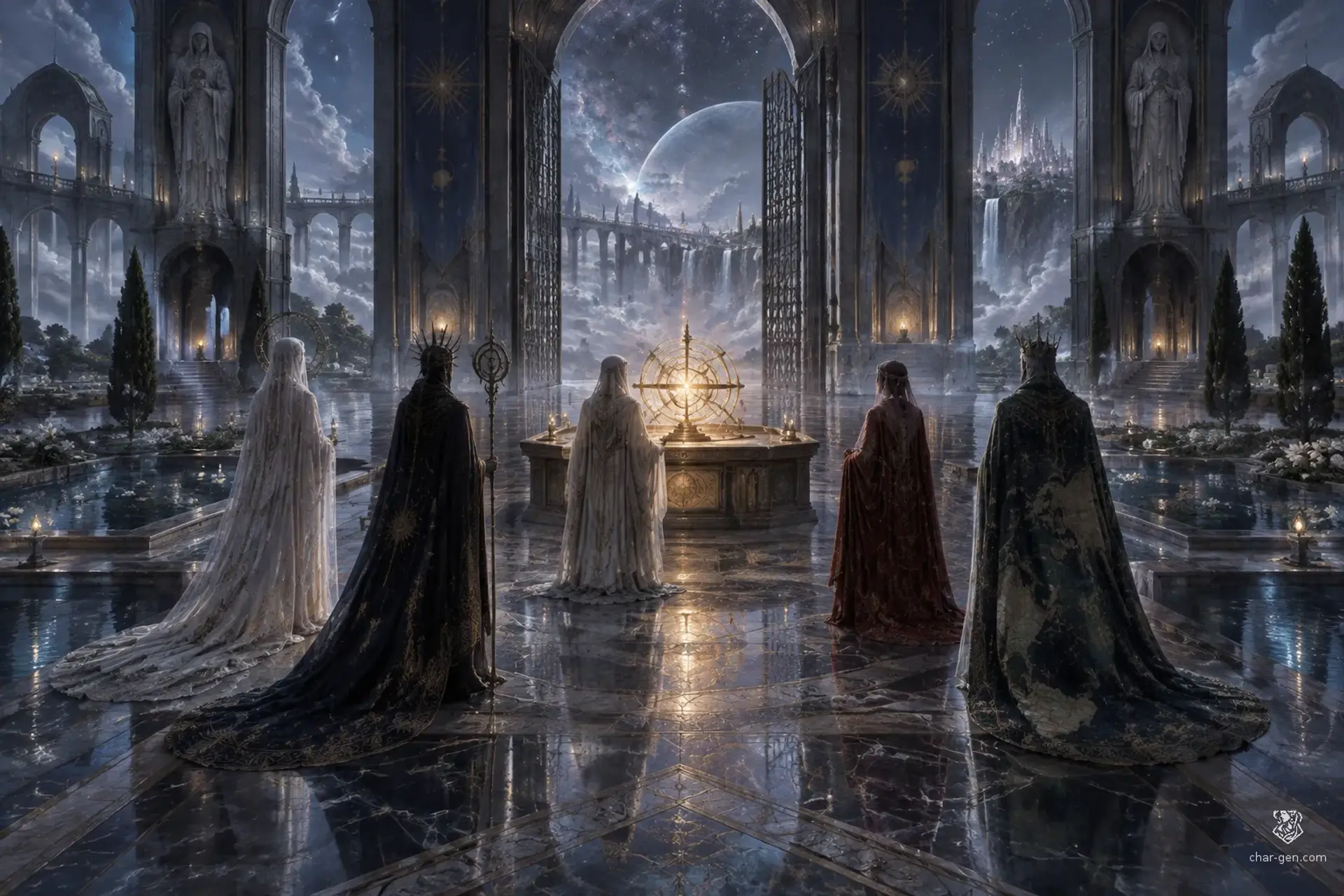
Unnamed pantheon
Unnamed pantheon
Invoke a god

Seshara
Keeper of the Unopened Door
Symbol A silver key laid across a closed eye.
Holy day The Closing of the Doors
- Keep promises in their exact meaning.
- Do not cross a threshold uninvited.
- A rule that binds the powerless must also bind the powerful.
The gods
5Seshara
Keeper of the Unopened Door
Greater · Lawful Neutral
Thresholds and sacred law, which define the boundaries Gwyndor guards and the refuge Avelune offers
Patient, exacting, and almost impossible to surprise. Seshara regards law as a shelter from caprice, but rarely explains why the shelter must be so difficult to enter.
Faith
- Keep promises in their exact meaning.
- Do not cross a threshold uninvited.
- A rule that binds the powerless must also bind the powerful.
Holy dayThe Closing of the Doors, observed at the year's longest night.
Holy textThe Book of Measured Doors, a collection of precedents whose last pages are deliberately blank.
RitesPause before entering any important room and ask leave. · Record a promise in writing, then leave one line for its future revision. · At funerals, place a key beside the closed eyes of the dead.
ValuesMeasure · Continuity · Consent
Look
SymbolA silver key laid across a closed eye.
- pearl
- silver
- smoke
Animalswhite heron · moth
AppearanceA slender figure in layered pearl-gray robes, face concealed by a translucent veil embroidered with tiny silver clauses. Seshara is usually shown holding a key and a folded decree.
Followers
WhoJudges, archivists, household stewards, and nobles who believe continuity is a form of mercy.
BeliefsFollowers believe that every boundary—between guest and host, ruler and subject, living and dead—must be acknowledged. They consider Seshara distant but attentive to the wording of vows.
The faith
How it began
In the oldest account, the first elves awoke in a dark hall with no doors.
Seshara gave them a threshold, Avelune planted a seed in its courtyard, and Torkel made the first reflection smile. Gwyndor claimed the high seat when the hall filled with voices. Zuberi found a way out—and returned with stories of a world beyond. The gods' disagreements began with that first open gate.
The heavens
The world is a great, unfinished palace suspended in a silver dusk.
Its halls are the heavens, its gardens the mortal lands, and its mirrors the possible futures. Seshara established the first thresholds; Torkel scattered change through the corridors; Avelune gave the rooms their seasons and growing things. Gwyndor maintains the high galleries, while Zuberi opens windows onto roads no architect intended. The palace has no known outer wall.
Gods and mortals
The gods rarely answer prayers directly.
Their influence is inferred through dreams, courtly coincidences, changing reflections, sudden blooms, and doors found ajar. Elven nobles favor Seshara and Gwyndor as patrons of precedent and sovereignty; artists, healers, and quiet benefactors turn to Avelune; performers court Torkel's favor; and those fleeing rigid stations carry small tokens of Zuberi. The same person may honor several gods, though doing so openly can invite political suspicion.
After death
The dead pass into the Still Gallery, a palace of quiet rooms beyond the visible heavens.
There they are received by Avelune, who weighs the memories they offer, while Seshara keeps the doors between the Gallery and the living world. The honored may linger as distant lights; most eventually dissolve into the silver hush from which elven souls first came. No priest can promise reunion or explain what lies beyond that final silence.
What people say, what is true
Players may hear
For the GM
Plot hooks
Conflicts
The wars
Gwyndor claims that the world requires a firm hand and seeks to make Seshara's laws absolute; Seshara counters that even divine authority must observe its own precedents.
Avelune shelters petitioners whom Gwyndor would silence, while Torkel delights in turning their disputes into theater. Zuberi disrupts all settled arrangements, sometimes to liberate the oppressed and sometimes simply to prove that no court can contain the living.
| Seshara | Avelune | Torkel | Gwyndor | Zuberi | |
|---|---|---|---|---|---|
| A | E | A | E | ||
| A | E | A | |||
| E | E | A | |||
| A | E | E | E | ||
| E | A | A | E |
Order of heaven
Structure
The religion has no single central church.
Each royal court maintains a Gallery of Observance, where separate shrines occupy formal rooms connected by corridors and gardens. Seshara's keepers oversee vows and funerals; Avelune's gardeners and healers serve local communities; Torkel's performers carry rites between courts; Gwyndor's official clergy advise rulers; and Zuberi's wandering road-keepers preserve hospices and unmarked paths. Ceremonies are ornate, carefully ranked, and often conducted at a deliberate remove from ordinary worshippers.
Theme
An elven divine court shaped by ceremonial hierarchy, cultivated beauty, polished manners, and the quiet tension between inherited station and the desire to depart.
Tone
Distant, elegant, and politically charged.
Divinity is encountered as a remote presence behind ceremony and architecture rather than an intimate companion; even blessings feel like messages sent from another room.
Alignments
The assembly ranges from principled compassion to ruthless self-interest: Seshara is lawful neutral, Avelune is neutral good, Torkel is chaotic neutral, Gwyndor is lawful evil, and Zuberi is chaotic good.
Media
0 imagesNo images yet.
Turn Unnamed pantheon into a sheet
A high-res, share-ready sheet you can post or print.
