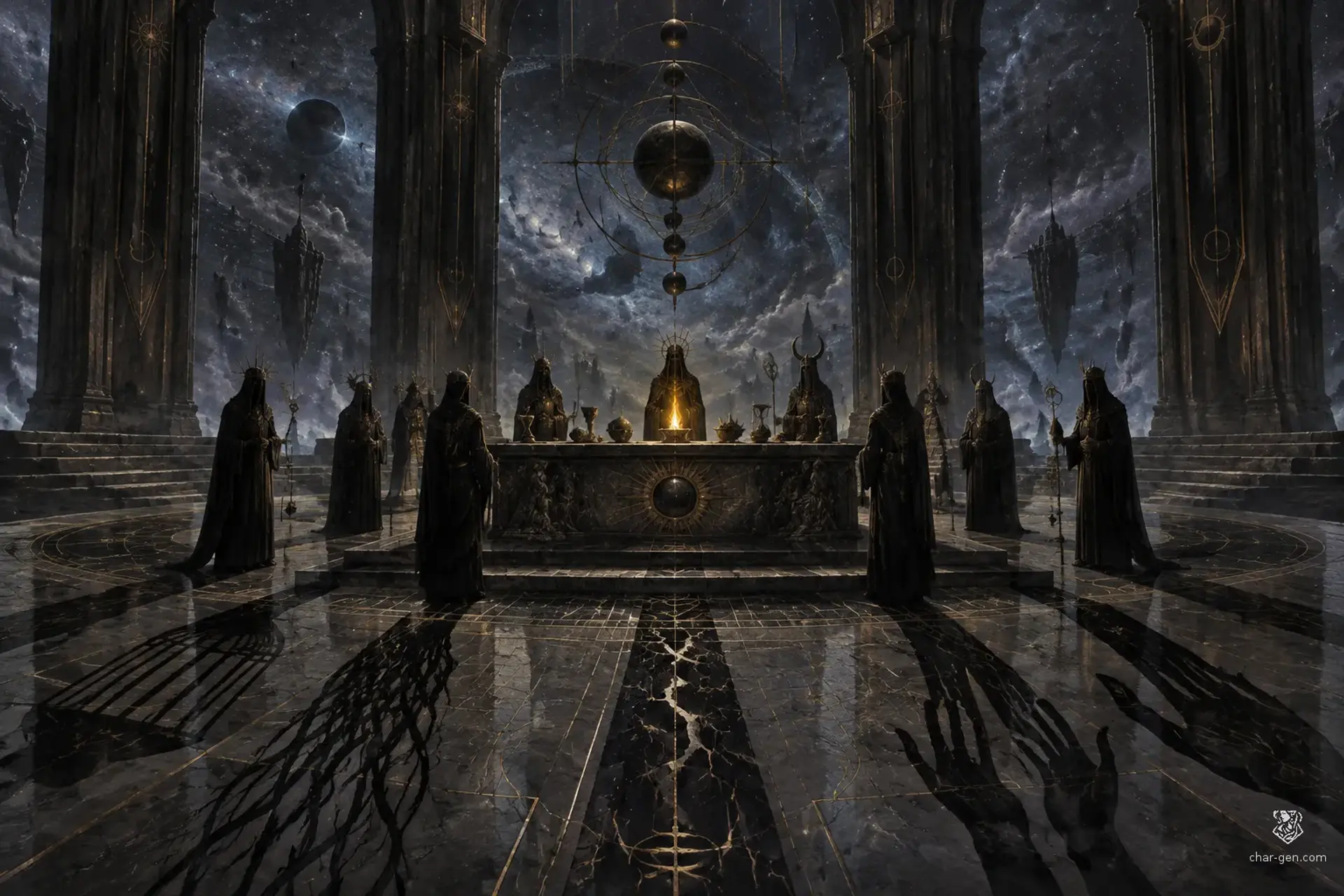
The Baneful
The Baneful
Invoke a god

Varkesh
The Unbending Seat
Symbol A closed hand above three descending bars.
Holy day The Tallied Day
- Order is worth more than comfort.
- A promise binds the weaker party first.
- Make punishment visible, so obedience needs no explanation.
The gods
9Varkesh
The Unbending Seat
Greater · Lawful Evil
Tyranny, hierarchy, and obedience; Varkesh teaches that Ketta's lies are useful only when they serve a superior.
Patient, exacting, and convinced that cruelty becomes virtue when properly administered.
Faith
- Order is worth more than comfort.
- A promise binds the weaker party first.
- Make punishment visible, so obedience needs no explanation.
Holy dayThe Tallied Day, when worshippers publicly count their obligations and renew them before a superior.
Holy textThe Measure of Knees, a collection of decrees attributed to Varkesh's first mortal judge.
RitesKneel before an empty chair and recite the names of those one commands. · Bind a written vow with a strip of bronze-colored cloth.
ValuesDiscipline · Dominion · Endurance
Look
SymbolA closed hand above three descending bars.
- Dull bronze
- Slate
AnimalsMule · Mantis
AppearanceA tall, still figure in layered court robes, with a face concealed by a smooth bronze mask. His shadow resembles a cage of bars.
Followers
WhoAutocrats, jailers, ambitious officials, and those who mistake submission for safety.
BeliefsFollowers believe that a world without masters would collapse into indiscriminate violence, and that Varkesh alone can make cruelty predictable.
The faith
How it began
According to the oldest and least trusted account, the Nine gathered after mortals first chose cruelty, greed, deceit, and neglect over one another.
No god claims to have begun the assembly. Sahrun says it was convened by debt; Zhur says it formed when the first law was broken.
The heavens
The world was not made by the gods; they arrived as habits that found bodies.
Their assembly, the Nine Seats, stands beyond the visible heavens in a hall with no doors. Mortal choices cast shadows there, and the gods feed on those shadows. Each deity can influence the world through dreams, coincidence, and willing agents, but none can simply command it.
Gods and mortals
Most people encounter the Nine indirectly: a magistrate invoking Varkesh, a creditor citing Sahrun, or a desperate trader bargaining in Shesh's name.
Open worship is tolerated in some places and outlawed in others. Even devoted cultists rarely meet a god; they interpret coincidence as a sign and use doctrine to justify choices they already wished to make.
After death
The dead descend into the Still Court, a dim and silent country where each soul is offered a place among the vice it cultivated.
Those who refuse every temptation are not rewarded; they simply fade into the Court's unlit margins. The gods rarely intervene directly. Sahrun weighs the dead there, while Ketta's whispers can still turn a judgment.
What people say, what is true
Players may hear
For the GM
Plot hooks
Conflicts
The wars
Varkesh seeks to make every mortal life obey a single chain of command, a vision that makes him the enemy of Zhur's delighted disorder.
Sahrun claims the final accounting of every soul, but Ketta keeps teaching the dead how to falsify their debts. Nizet and Dovra compete for the loyalties of those who crave more than they need. Ilyat's spite repeatedly spoils Odran's bargains, while Shesh tries to turn every rivalry—including the feud between Varkesh and Zhur—into a profitable exchange.
| Varkesh | Zhur | Sahrun | Ketta | Dovra | Shesh | Ilyat | Nizet | Odran | |
|---|---|---|---|---|---|---|---|---|---|
| E | A | A | E | ||||||
| E | E | A | A | ||||||
| A | E | A | E | ||||||
| A | E | A | E | ||||||
| A | A | E | |||||||
| E | A | E | |||||||
| E | A | A | E | ||||||
| E | A | E | A | ||||||
| A | E | A | E |
Order of heaven
Structure
The Nine Seats have no permanent ruler.
Varkesh chairs formal councils, but Zhur refuses their order, Sahrun records every claim, and the others attend only when they expect advantage. Mortal religions devoted to the assembly usually keep separate shrines and rival clergy; shared temples are uncommon and politically unstable.
Theme
The Baneful: evil deities embodying mortal vices and destructive qualities.
Their power comes less from devotion than from people recognizing themselves in the gods' excuses.
Tone
Distant and cold.
The gods are not constant companions or visible rulers; they are remote powers glimpsed through ritual, institutional cruelty, private obsession, and rare, ambiguous signs.
Alignments
The nine are united by their appetite for mortal weakness, not by temperament or method.
Six are evil, three are neutral, and none are benevolent: lawful tyrants, chaotic predators, and patient opportunists all find a place in the assembly.
Media
0 imagesNo images yet.
Turn The Baneful into a sheet
A high-res, share-ready sheet you can post or print.
