The Assembly of the Deep Works
The Assembly of the Deep Works
Invoke a god
Korr
The Keeper of the Seal
Symbol A closed ring crossed by a straight nail
Holy day The Day of the Unbroken Seal
- Keep what you have sworn.
- Make no law you would refuse to obey.
- Repair a breach before hiding it.
The gods
12Korr
The Keeper of the Seal
Greater · Lawful Neutral
Oaths and law; Korr’s decrees are copied into the ledgers Edda keeps
Patient, severe, and distant; he regards mercy without accountability as a leak in the foundations.
Faith
- Keep what you have sworn.
- Make no law you would refuse to obey.
- Repair a breach before hiding it.
Holy dayThe Day of the Unbroken Seal, observed at the first frost.
Holy textThe Ledger of Measures
RitesPress a thumb into sealing wax before an oath. · Read the names of broken promises at winter’s end.
ValuesDuty · Continuity · Accountability
Look
SymbolA closed ring crossed by a straight nail
- Iron black
- Amber
AnimalsBadger · Raven
AppearanceA broad-shouldered figure of dark iron, seated beside Edda’s veiled lectern; his face is a sealed furnace door with one narrow eye of amber glass.
Followers
WhoJudges, contract-makers, clan arbiters, and engineers entrusted with dangerous works.
BeliefsFollowers believe that promises hold the world together as rivets hold a boiler. Korr’s silence is taken as a test, not a blessing.
The faith
How it began
Dwarven tradition says the twelve gods emerged from the first great engine’s turning shadows.
Other traditions claim they were already present in the world’s machinery and merely took names when dwarves learned to listen. The oldest temple records disagree, and the gods have not clarified the matter.
The heavens
The world is a vast, cold machine whose maker is unknown.
The gods did not build it; they discovered its workings and claimed stations within it. The sky is the great flywheel, the deep earth its furnace, and the passage of time a chain of unseen pistons. The gods’ temples imitate these stations, though no mortal engine has ever reproduced the true mechanism. Whether the cosmos is running down, waiting to start, or simply indifferent is a matter of sectarian dispute.
Gods and mortals
The gods rarely appear in person.
Their temples are often embedded in workshops, clan halls, memorial vaults, and civic infrastructure; clergy are practical custodians as much as preachers. Dwarves debate the gods’ intentions fiercely, but no single priesthood commands the whole faith. Most worshippers ask for steadiness, safe machinery, fair judgment, or a place to grieve—not dramatic divine intervention.
After death
The dead descend by lift-cage into the Quiet Foundry, a cavernous station where no engine turns and no bell rings.
There, Korr weighs each soul’s work against its promises, while Edda records the names of the unremembered. The worthy may join the ancestors in stillness; others are sent back in dreams to repair the harm they left unfinished. No priest can say whether this is judgment, maintenance, or merely a comforting story.
What people say, what is true
Players may hear
For the GM
Plot hooks
Conflicts
The wars
Korr insists that every oath must be kept, while Sitha argues that a vow can become a chain; their dispute is sharpened by Garen, who sells either side the means to prevail.
Edda and Drom disagree over whether the dead should be remembered or allowed to rest. Breg’s demand for invention without restraint alarms Unna, and Wuln quietly benefits from the accidents that follow. The assembly has not met in person for generations; its quarrels reach mortals as rival doctrines, strange failures, and unanswered prayers.
| Korr | Edda | Sitha | Tovik | Garen | Unna | Drom | Breg | Heth | Ygda | Wuln | Shesk | |
|---|---|---|---|---|---|---|---|---|---|---|---|---|
| A | E | A | E | |||||||||
| A | A | E | ||||||||||
| E | A | A | E | |||||||||
| A | E | A | ||||||||||
| A | E | E | A | |||||||||
| A | E | E | A | |||||||||
| E | A | E | A | |||||||||
| A | E | E | A | |||||||||
| A | E | A | E | |||||||||
| A | A | E | ||||||||||
| E | E | A | A | E | ||||||||
| A | A |
Order of heaven
Structure
The religion has no central pontiff.
Each major settlement maintains a Council of Stations: twelve seats in principle, though the seat devoted to Shesk is often left empty and the one for Wuln is forbidden in many cities. Local councils interpret the gods’ teachings through craft guilds, clan traditions, and civic law. Priests are called keepers, readers, tenders, or witnesses according to their station. Disagreement is expected; the assembly is honored through balance among its shrines rather than uniform doctrine.
Theme
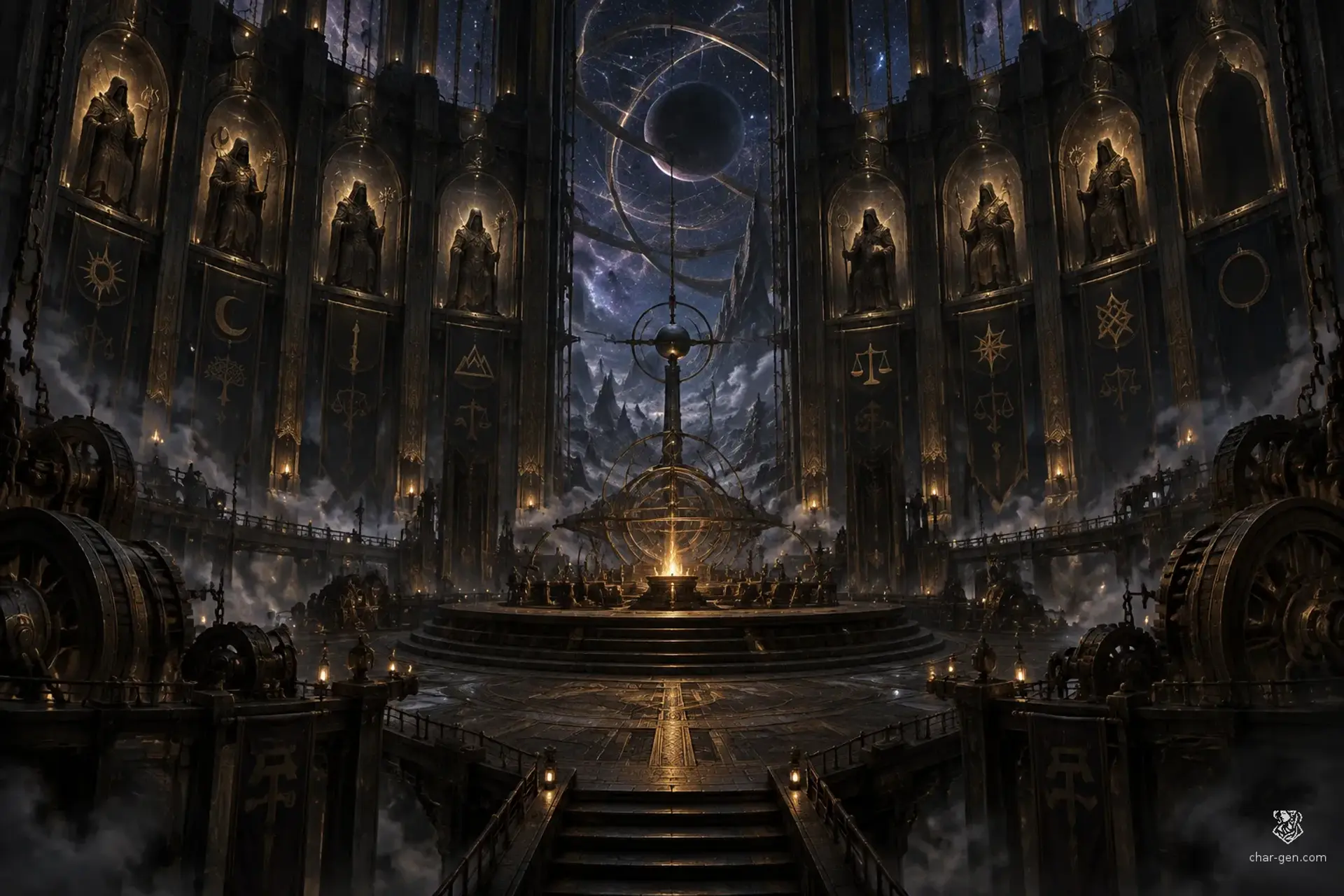
Dwarven faith amid steampunk industry: craft, labor, law, invention, and mortality under the gaze of gods who are powerful yet remote.
Tone
Distant, industrial, and contemplative.
Divine signs are rare and ambiguous; faith offers practices for enduring uncertainty rather than guarantees of rescue.
Alignments
Varied: the assembly includes lawful, chaotic, and neutral powers, as well as good, neutral, and evil ones.
Their disagreements are fundamental, not a tidy division into opposing teams.
Media
0 imagesNo images yet.
Turn The Assembly of the Deep Works into a sheet
A high-res, share-ready sheet you can post or print.
