Unnamed pantheon
Unnamed pantheon
Invoke a god

Suth
The Keeper of the Unfinished Stair
Symbol A narrow stair beneath a closed eye.
Holy day The Long Ascent
- Measure your desire before you pursue it.
- Accept hardship as instruction, never as proof of virtue.
- Do not mistake a high station for a finished journey.
The gods
6Suth
The Keeper of the Unfinished Stair
Greater · Lawful Neutral
Discipline and measured advancement; Suth teaches the patience that Orun calls necessary for lasting strength. · Judgment of ambition, weighed against Theska's insistence that some limits must be broken.
Remote, exacting, and difficult to impress. Suth believes desire is only the beginning of greatness; without restraint, it becomes a chain around the aspirant's own neck.
Faith
- Measure your desire before you pursue it.
- Accept hardship as instruction, never as proof of virtue.
- Do not mistake a high station for a finished journey.
Holy dayThe Long Ascent, observed once each year through a day of silence followed by a single chosen act of effort.
Holy textThe Unfinished Measure, a collection of austere maxims attributed to Suth's first mortal disciple.
RitesClimb a set of stairs before dawn without speaking. · Record one ambition and one cost it may demand. · At a shrine, leave an unfinished tool or lesson as a sign that growth continues.
ValuesPatience · Self-command · Endurance
Look
SymbolA narrow stair beneath a closed eye.
- Ivory
- Dull gold
AnimalsIbex · Crane
AppearanceA tall, veiled figure in layered ivory robes, seated on a narrow stair that vanishes upward into mist. A crown of six unlit lamps hangs above the veil.
Followers
WhoAscetics, strategists, ambitious scholars, and rulers who want their power to endure beyond their own lives.
BeliefsFollowers believe that Suth watches from beyond the visible heavens, not to reward obedience but to assess whether an aspirant can bear the consequences of becoming stronger.
The faith
How it began
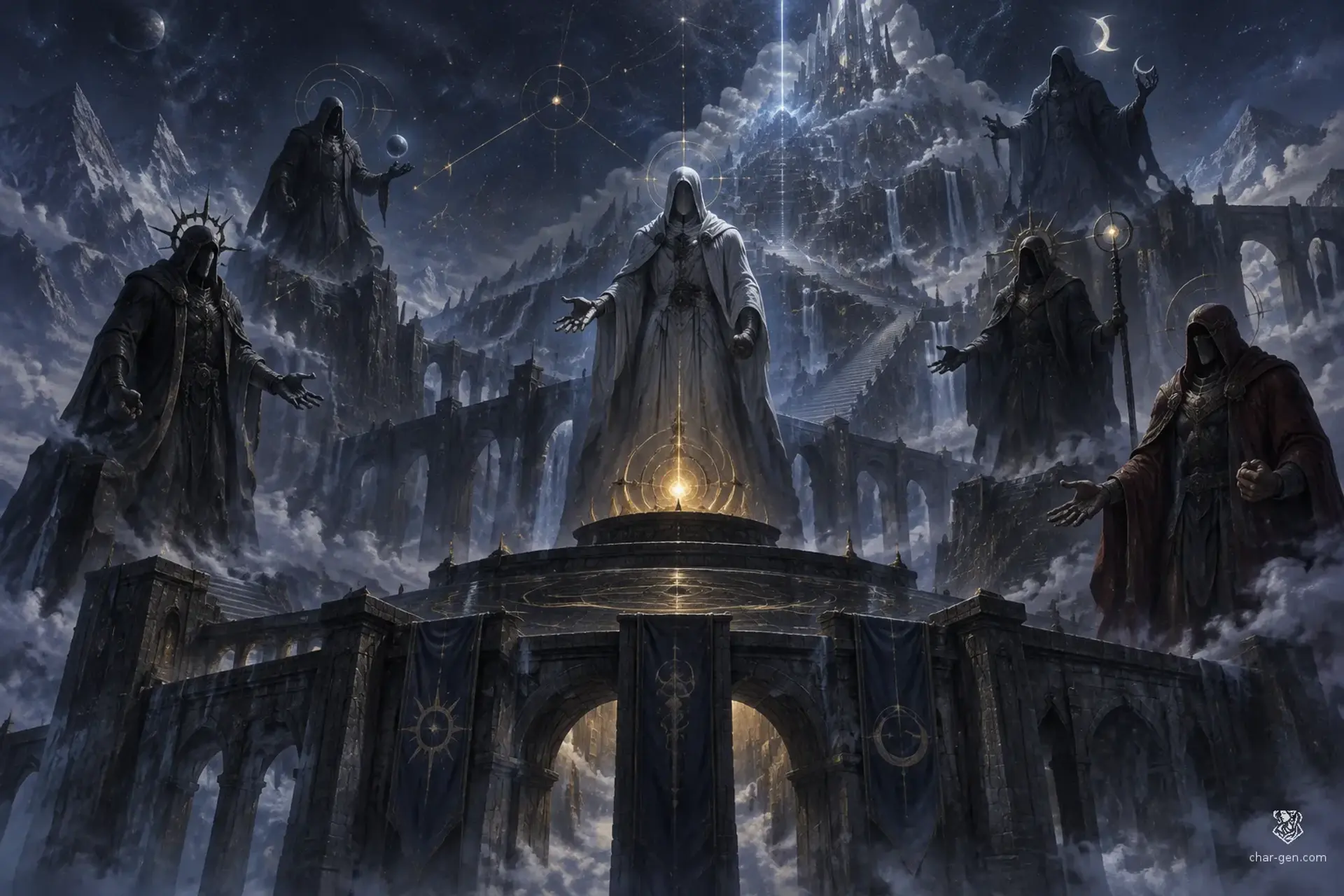
In the oldest surviving account, the first mortals saw six lights above the world and longed to rise beyond their given station.
Their longing took form as Suth, Orun, Theska, Boran, Mbeku, and Yel. The gods are therefore not worshipped as makers of the world, but as exalted beings who embody the struggle to become more than one is.
The heavens
Creation is a ladder without a known summit.
The world rests on the lowest rung, beneath a succession of veiled heavens inhabited by powers that may themselves be climbing. The six gods emerged when the first mortals looked upward and desired not merely safety, but transcendence. Suth calls the ladder a test, Orun calls it a path, and Yel insists it is a throne waiting to be taken. Beyond the highest visible heaven lies the Unmeasured, which none of them claims to understand.
Gods and mortals
The gods are distant patrons rather than constant guardians.
Their signs are rare and ambiguous, and they favor mortals who pursue strength with purpose. Temples are usually schools, training halls, archives, or roadside shrines rather than grand centers of daily worship. Devotees of different gods often cooperate until a test, succession, or political crisis forces them to answer the question at the heart of the faith: who deserves to rise?
After death
The dead do not ascend to a single heaven.
Their souls arrive at the Quiet Stair, where Suth weighs what they became against what they might yet have become. Those judged worthy are granted a distant, silent realm in which to contemplate their unrealized potential; the unready linger as sparks in the world, sometimes claimed by Boran or Mbeku. No soul is promised another life, and even the gods refuse to say whether the Stair has an end.
What people say, what is true
Players may hear
For the GM
Plot hooks
Conflicts
The wars
Suth and Theska dispute whether power should be measured by discipline or by daring.
Boran resents Mbeku's claim that transformation matters more than conquest, while Mbeku regards Boran's victories as crude and temporary. Orun quietly counters Yel's hunger for individual supremacy by teaching that strength can be shared, though Yel considers this a trap. Their rivalries rarely become open war; instead, they compete through mortal champions, impossible trials, and boons that arrive years apart.
| Suth | Orun | Theska | Boran | Mbeku | Yel | |
|---|---|---|---|---|---|---|
| A | A | E | ||||
| A | A | E | ||||
| E | E | A | A | |||
| A | E | A | ||||
| A | A | E | ||||
| E | E | A | A |
Order of heaven
Structure
The faith has no supreme earthly priesthood.
Each god's temples and orders operate independently, while the Sixfold Conclave convenes only when a threat concerns the whole pantheon. Its seats are deliberately arranged at different heights, a custom that fuels endless arguments over precedence. Most adherents honor one god primarily and acknowledge the others as rival truths; the most respected teachers study all six and warn that devotion to only one path can become its own limitation.
Theme
Exalted beings driven by the hunger for power and the chance to become stronger still.
Tone
Distant, solemn, and aspirational.
Divine presence is rare, conveyed through trials, dreams, and changes in fortune rather than direct intervention; even the gods seem to be reaching toward something beyond mortal sight.
Alignments
The assembly ranges from disciplined benevolence to ruthless ambition: two lawful gods, two neutral gods, and two chaotic gods, with good, neutral, and evil impulses represented.
Its members agree that strength matters, but fiercely disagree about what strength is for.
Media
0 imagesNo images yet.
Turn Unnamed pantheon into a sheet
A high-res, share-ready sheet you can post or print.
