Unnamed pantheon
Unnamed pantheon
Invoke a god
Asterion
The Keeper of Measures
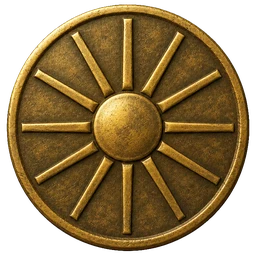
Symbol Seven points joined by a single unbroken line.
Holy day The Night of Fixed Points
- Keep an honest record, even when it offers no comfort.
- Do not alter a witness's account to make the pattern pleasing.
- A measure is a guide, not a command.
The gods
6Asterion
The Keeper of Measures
Greater · Lawful Neutral
Constellations and celestial order, whose patterns Varda challenges and Nerea records · Timekeeping and navigation · The duty of sustained attention
Patient, exacting, and remote. Asterion believes that a world can endure only if someone keeps its measures, though Koru's doubts trouble him more than he admits.
Faith
- Keep an honest record, even when it offers no comfort.
- Do not alter a witness's account to make the pattern pleasing.
- A measure is a guide, not a command.
Holy dayThe Night of Fixed Points, held at the year's longest darkness, when worshippers silently mark the stars and refuse to name any new one.
Holy textThe Measured Sky, a collection of star charts annotated with brief accounts of mortal witnesses.
RitesMark a star's position beside a written account of something witnessed that day. · Keep one lamp burning overnight for someone traveling beyond familiar roads. · At a funeral, leave an unfinished line in the family record for the dead to complete in the sky.
ValuesAccuracy · Patience · Continuity
Look
SymbolSeven points joined by a single unbroken line.
- bronze
- deep blue
Animalscrane · moth
AppearanceA tall figure of dark bronze whose face is a rotating chart of stars. Asterion's hands are always measuring the distance between points, while Varda's gaze appears in the polished surface of his chest.
Followers
WhoWayfinders, astronomers, archivists, and people entrusted with keeping watch through long nights.
BeliefsFollowers believe Asterion sees the world through their careful observation, but never intervenes simply because a pattern is clear. They look to Varda for the moral weight of what they record.
The faith
How it began
In the first age, the world had no sky and every living thing saw only what stood close enough to touch.
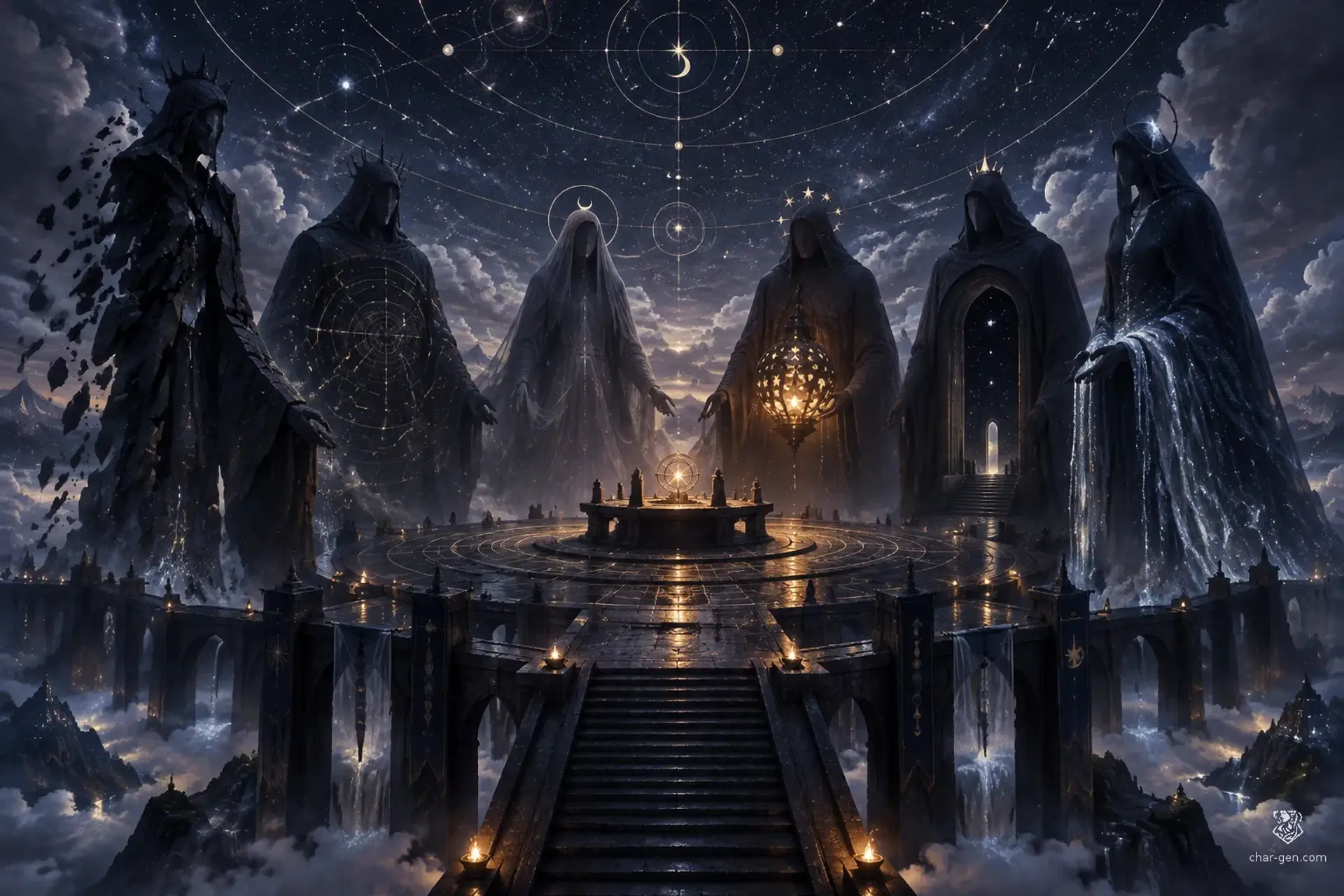
Six powers gathered above it and made openings in the darkness, so the world could be witnessed from far away. The powers became Asterion, Varda, Iruñ, Sumaq, Koru, and Nerea. Their first followers gave those openings familiar patterns, and the patterns became the constellations. The gods still see through mortal eyes, but the heavens preserve the first shapes they made together.
The heavens
The world rests beneath a dark, shallow heaven called the Witnessing Vault.
The constellations are not distant objects but apertures through which the gods perceive what their followers perceive. A god without worshippers is not blind, but sees only the old, fading traces of the world. Each act of attention—keeping watch, telling a true story, tending a shrine—briefly sharpens a star. The six deities gathered the sky from the scattered lights of the first night, but disagree about whether that act was creation, theft, or mere arrangement.
Gods and mortals
The gods rarely answer prayers with voices or miracles.
Their influence is subtle: a traveler notices a safe passage, a witness finds the courage to speak, or a constellation appears unusually clear. Worshippers are the gods' eyes, but not their puppets; mortals can disagree with divine interpretations, and the gods cannot force a person to keep watching.
After death
The dead become dim points along the Long Meridian, a celestial road watched by the living.
They do not speak to their descendants; their patterns may be read as warnings, memories, or comforting lies. The gods judge no soul in private. Each departing spirit is witnessed by the last mortal who remembers it and by the constellations that have watched that mortal in turn.
What people say, what is true
Players may hear
For the GM
Plot hooks
Conflicts
The wars
Asterion keeps the measures of the sky, but Varda insists that mortal testimony must outweigh celestial order.
Koru wants the dead to pass beyond the gods' sight, while Sumaq argues that remembrance is a sacred form of continued witness. Iruñ has begun loosening the constellations' fixed courses, drawing the ire of Asterion and the quiet approval of Nerea, who believes no watcher should mistake a familiar pattern for truth.
| Asterion | Varda | Iruñ | Sumaq | Koru | Nerea | |
|---|---|---|---|---|---|---|
| A | E | A | ||||
| A | E | A | ||||
| E | E | A | A | |||
| A | A | E | ||||
| A | E | A | ||||
| E | A | A |
Order of heaven
Structure
The religion has no central church.
Local observatories, roadside witness-houses, family memory halls, and quiet threshold shrines form a loose network. A council of six keepers—one for each deity—may convene to settle disputes, but it has no authority over local worship. Asterion's chart-keepers preserve dates and routes; Varda's witnesses safeguard testimony; Iruñ's wander-priests resist permanent hierarchies; Sumaq's reciters maintain shared histories; Koru's door-tenders oversee funerals and leave-taking; Nerea's pool-keepers protect privacy and sanctuary. Most communities honor all six while emphasizing whichever god best answers their local needs.
Theme
Attention as a sacred bond: to witness is to connect the mortal and divine, but every watcher must choose what deserves to be seen, remembered, changed, or released.
Tone
Distant, contemplative, and quietly uncanny.
The heavens are attentive but not reassuring; divine signs are rare, ambiguous, and dependent on mortal perception. Faith offers practices for living beneath an immense gaze, not a promise that the gods will intervene.
Alignments
Varied: two lawful deities, two neutral deities, and two chaotic deities; the assembly has no single moral consensus.
Media
0 imagesNo images yet.
Turn Unnamed pantheon into a sheet
A high-res, share-ready sheet you can post or print.
