Tlasosololikestli Covenant
Tlasosololikestli Covenant
Invoke a god
Nemilistliika
Keeper of the Last Shadow
Symbol A white vertebra encircled by a dark crescent.
Holy day The Long Night of Names
- Give the dead a name and a proper passage.
- Keep necessary secrets, but do not use them to deny justice.
- Return what the cycle has lent you.
The gods
9Nemilistliika
Keeper of the Last Shadow
Greater · Neutral
- bones
- death
- souls
- darkness
- subterfuge
Patient, secretive, and scrupulously fair, Nemilistliika keeps the final boundary without mistaking death for evil. It asks Kouatlmixtli to guide lost spirits and trusts Tepamitlchivo to protect tombs from the living.
Faith
- Give the dead a name and a proper passage.
- Keep necessary secrets, but do not use them to deny justice.
- Return what the cycle has lent you.
Holy dayThe Long Night of Names, when families speak aloud the dead they fear will be forgotten.
Holy textThe Quiet Ledger, a collection of funerary chants and accounts of souls returned to the cycle.
RitesWash bones in still water and return them to a marked family ossuary. · Whisper the dead person's name into a clay lamp before extinguishing it. · Leave one unlit doorway in a funeral vigil for spirits to depart.
Valuesremembrance · restraint · secrecy · fair passage
Look
SymbolA white vertebra encircled by a dark crescent.
- bone-white
- midnight blue
Animalscave lizard · owl · blind cavefish
AppearanceA tall lizardfolk figure draped in black reed-cloth, with a skull mask split by a narrow crescent of pale light. Small ancestral spirits follow in its shadow.
Followers
WhoLizardfolk undertakers, spirit-guides, discreet mediators, and those who safeguard ancestral places.
BeliefsFollowers believe every soul is a temporary ember in the wheel and that respectful burial feeds the world as surely as planting does. They hold that Kouatlmixtli’s bells can reveal a spirit that has lost its way.
The faith
How it began
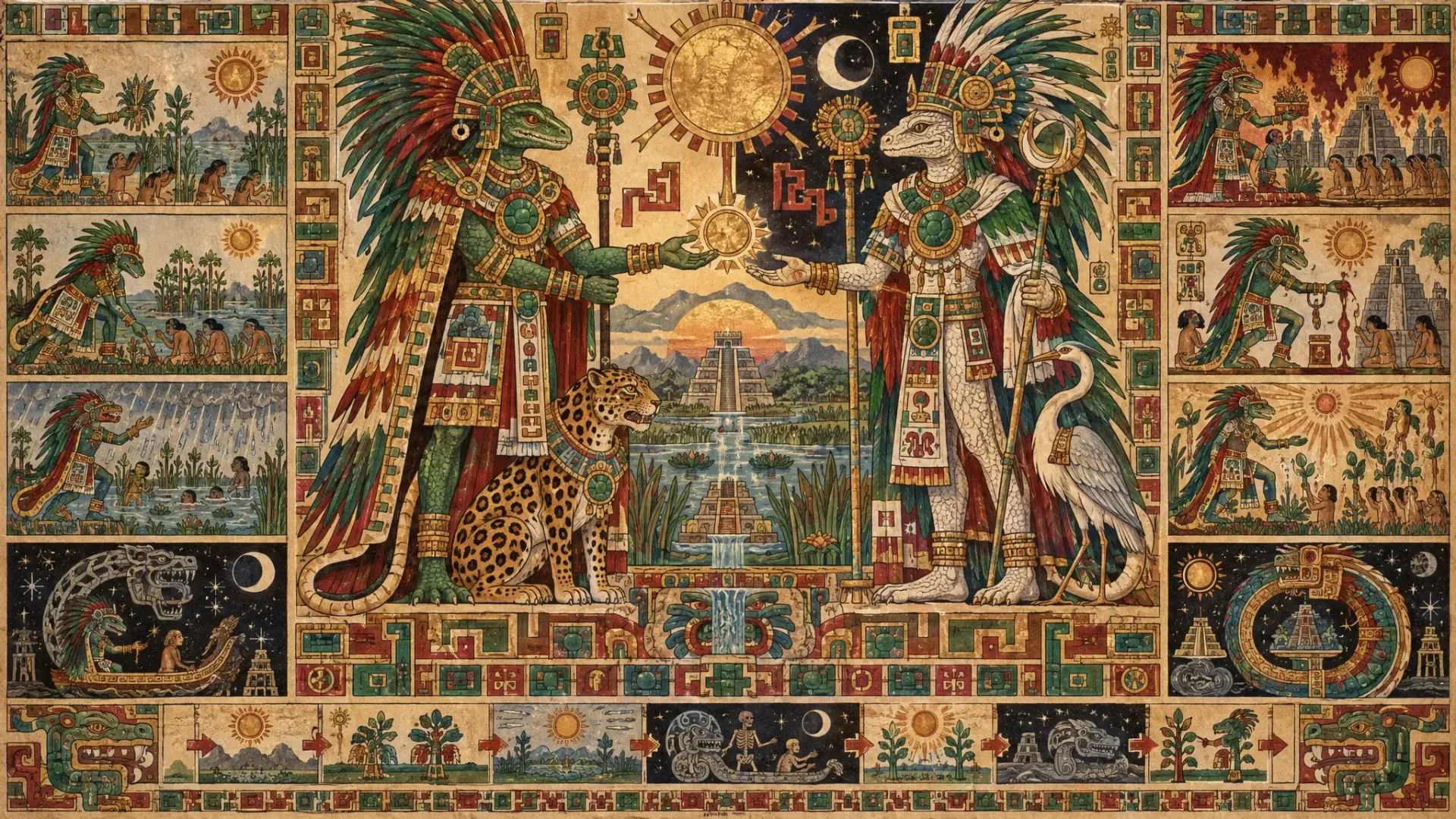
Lizardfolk tradition says the first marsh rose when the nine powers argued over what should happen to the first fallen ancestor.
Nemilistliika claimed the bones, Ātōyānehnecuiloāni claimed the rain, and the others each demanded a place in the turning. Their disagreement became the world’s first cycle; the Covenant began as the promise that mortals would keep its rhythms through offerings, care, and remembrance.
The heavens
The world is a living wheel turning through dawn, growth, ripeness, decline, and dark renewal.
The gods are active forces within it, not distant makers: their rivalries and cooperation shape weather, birth, death, and chance. Ritual offerings feed the wheel’s motion, but no single deity can command the whole cycle.
Gods and mortals
The gods are visibly engaged with mortal life through dreams, storms, ancestral signs, unusual harvests, and local manifestations.
Temples are civic institutions as well as shrines: they maintain canals, host festivals, guard burial grounds, shelter travelers, and negotiate the offerings owed by a community. A devotee may question a deity’s priesthood without rejecting the Covenant.
After death
The dead travel beneath the marsh-roots to Nemilistliika’s dim court, where each soul’s deeds are weighed against the offerings its community made to sustain the cycle.
Those who accept their place pass through Kouatlmixtli’s bell-fog and return as rain, seed, or ancestral memory. The unremembered may wander until the living speak their names; Nemilistliika does not call this punishment, but an unfinished passage.
What people say, what is true
Players may hear
For the GM
Plot hooks
Conflicts
The wars
Tlecuezalhuītequini’s consuming sunset fires threaten Ātōyānehnecuiloāni’s fields, though both insist destruction and renewal belong to one cycle.
Chichiltikescama demands blood-price for cosmic stability, while Tepamitlchivo argues that living communities must be defended before they are spent. Amokualitlajtoli delights in upsetting every settlement the other eight try to preserve. Nemilistliika and Kouatlmixtli dispute whether the dead should be guided swiftly onward or allowed to linger among the living.
| Nemilistliika | Āhuīlxonēhuatl | Tlecuezalhuītequini | Ātōyānehnecuiloāni | Cenquizcaxonēhuatl | Chichiltikescama | Tepamitlchivo | Kouatlmixtli | Amokualitlajtoli | |
|---|---|---|---|---|---|---|---|---|---|
| E | A | A | E | ||||||
| A | A | E | E | ||||||
| E | A | E | A | ||||||
| A | E | A | E | ||||||
| E | A | A | E | ||||||
| E | A | E | A | ||||||
| A | E | A | E | ||||||
| A | E | A | E | ||||||
| A | E | A | E |
Order of heaven
Structure
The Covenant has no single supreme temple.
Each settlement maintains a cycle-house with nine alcoves, tending the powers according to local need and season. Regional councils of priests, craftspeople, farmers, and elders settle disputes; the offices rotate so no deity’s clergy can permanently dominate. Offerings are chiefly food, craft, labor, song, remembrance, and communal service, with blood offerings strictly voluntary and tightly regulated.
Theme
A living cosmos sustained by ritual, reciprocal care, and tensions that cannot be resolved once and for all.
Nature, celestial change, mortality, pleasure, and disorder are powers that demand attention, not distant abstractions.
Tone
Mortal-engaged: divine signs and interventions are part of ordinary life, yet mortals retain agency.
The gods need communities to sustain cosmic rhythms, and communities can challenge, bargain with, or reinterpret their demands.
Alignments
The Covenant spans lawful, neutral, and chaotic traditions, with good, impartial, and cruel powers represented.
Its priests argue that cosmic balance requires honest difference, not moral sameness.
Media
0 imagesNo images yet.
Turn Tlasosololikestli Covenant into a sheet
A high-res, share-ready sheet you can post or print.
