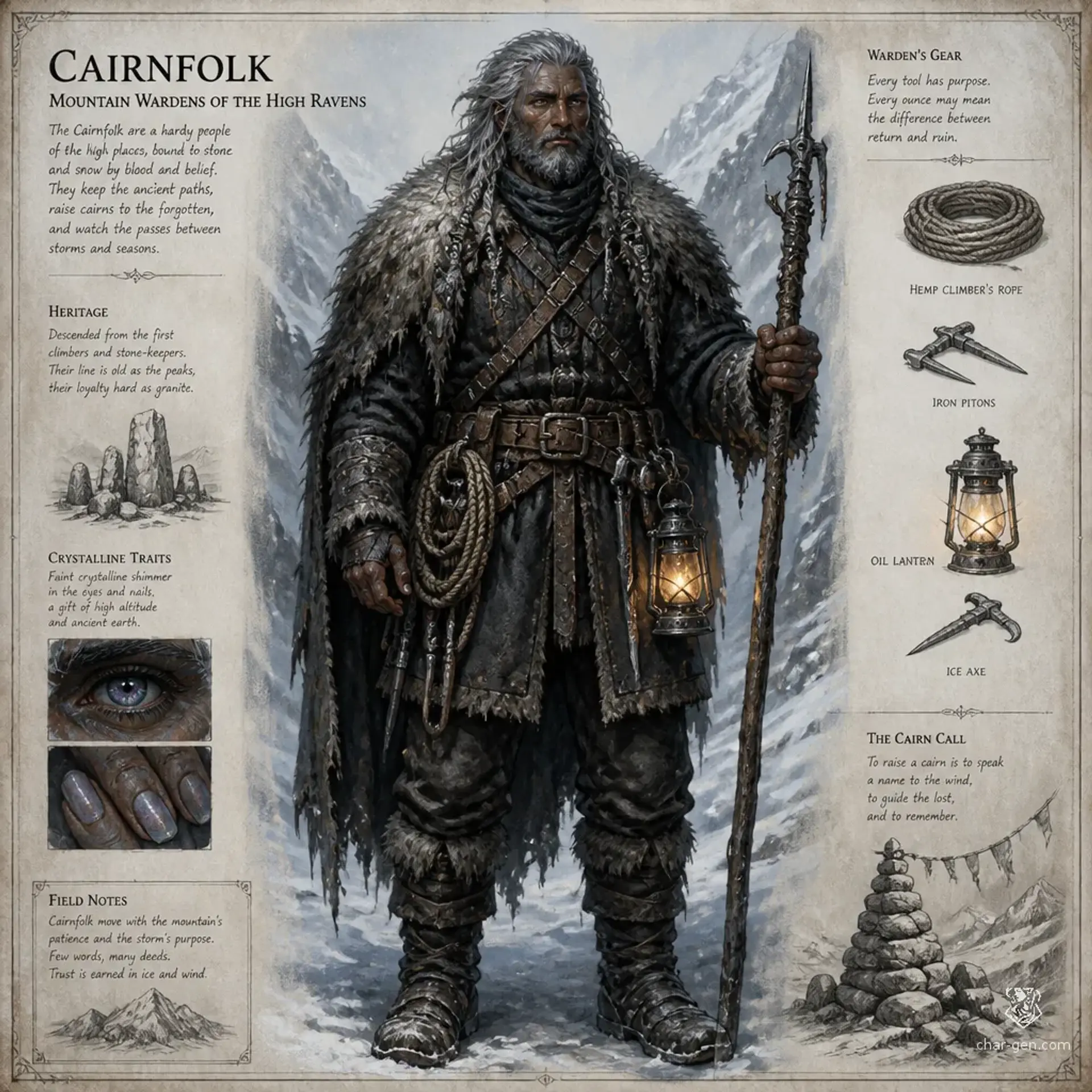
Cairnensis frigivagus
Cairnfolk are the mountaineers and storm-keepers of The Shivering Crown, a people who treat survival as both craft and ceremony.
At a glance
Darkvision 60 ft.
Languages Common, Cairn Tongue
Height 5 to 6 feet
Weight 130 to 220 pounds
Lifespan 70 to 90 years
At the table
Your body is built for cold, climb, and endurance. You have advantage on checks made to resist exhaustion caused by harsh weather, starvation, or long overland travel in cold environments, and you are naturally comfortable moving through snow, sleet, and high-altitude conditions that would slow others. Your form also tends to hold up well under strain, making you resilient without needing to be naturally imposing.
You can see in dim conditions and through snow-blurred twilight as if it were brighter than it is, though true darkness still hides its secrets from you unless you have another source of sight. Your eyes are tuned to the pale reflections of ice, moonlight, and lantern glow.
You know how to prepare for weather before it turns deadly. You can always tell which direction the wind is shifting, whether ice is newly formed, and if a slope is likely to break loose soon. In play, this lets you act as a natural scout in winter terrain and recognize signs of avalanche, frostbite, or stormfronts before they become fatal.
When you finish a Long Rest in a secure shelter with enough warmth and food, you recover more completely than most. You are especially good at returning to duty after hardship, and your recovery is often framed by ritual tea, song, or a quiet counting of the living and the dead.
Common, Cairn Tongue
Cairnfolk tend toward Constitution and Wisdom, shaped by thin air, hard winters, and a habit of noticing what the storm hides. Many are sturdy enough for labor and patient enough for long watch shifts, though any individual can be quick, brilliant, graceful, or strong in whatever way their life demands. In 5E 2024 terms, players should assign their +2 and +1 as they wish.
Their hands and cheekbones have a faint mineral gloss, and they instinctively know how to find shelter under stone rather than only atop it.
Born near volcanic shelves, black cliffs, and old quarry settlements, Basalt Cairnfolk are the strongest builders and most stubborn keepers of old roads. They favor tunnels, retaining walls, and underground granaries, and they are known for a deep, resonant voice that carries through stone corridors.
Cairnfolk are the mountaineers and storm-keepers of The Shivering Crown, a people who treat survival as both craft and ceremony. They read weather like scripture, remember every safe path through the snow, and build their lives around heat, kin, and the names of the dead. Play one if you want a hardy traveler, a solemn guardian, or a practical soul who can turn a blizzard into a hallway and a ruin into home.
Cairnfolk are humanoids adapted to severe cold and elevation.
Their skin tones range from frost-pale to weather-darkened brown, often flushed red at the cheeks and knuckles by the cold. Many have thick hair, dense lashes, and a fine layer of insulating body hair that is more visible in winter. Their ears are rounded and close to the head, their noses broad or narrow depending on lineage, and their hands are usually scarred, strong, and well cared for. Their most recognizable trait is a faint crystalline sheen in the eyes or along the nails when they have spent long seasons in deep cold, a harmless adaptation that catches lantern light like river ice.
High mountains, glacier shelves, pine ravines, icebound river valleys, and storm-walled frontier settlements in The Shivering Crown.
Infants and small children are carried close to the body in layered wrappings and are treated as the household's living hearth. They learn names, routes, and warning signs long before they learn craft.
Young adults are expected to spend a season in the open country, proving they can read snow, conserve heat, and make themselves useful when supplies run short.
Adults become keepers of a skill, a route, or a duty. Most carry the marks of labor on face and hands, and many can identify a person's mood from the sound of their boots in snow.
Elders are treasured rather than set aside. Their memory of winter routes, avalanches, and old feuds is considered a communal resource.
Cairnfolk culture prizes usefulness, memory, and mutual dependence.
A person's worth is measured by what they preserve, protect, or carry forward. Children are taught to mend clothing, mark trails, stack firewood, and speak the names of those who came before them. Public feasts are often modest but deeply ceremonial, with broth, preserved fish, root bread, and fermented teas shared alongside stories of storms survived. Their music favors low drums, reed flutes, and humming choruses that can be sung while walking into the wind. Wit is prized, but always in service of morale. Boastfulness is considered poor form unless the boast can be backed by a rope, a ledger, or a rescued life.
Their faith centers on thresholds, seasons, ancestors, and the spirits of safe passage.
Many honor no single god, instead leaving offerings to the mountain, the hearth, and the dead before any journey. Their moral outlook is usually practical and communal, leaning toward honor, duty, and protection, though some become fiercely individualistic after surviving too many winters alone. Most see cruelty as wasteful and oathbreaking as a grave sin.
Cairnfolk usually judge others by reliability rather than origin.
They respect artisans, caravaners, scouts, and anyone who can keep a promise in bad weather. They often find lowland cultures reckless, while lowlanders may mistake them for stern or superstitious. They have a long memory for allies and a very long memory for trespassers, but once trust is earned, it tends to become fierce loyalty. They make particularly strong bonds with foxlike scouts, river traders, dwarf-like masons, and any people who understand that preparedness is not pessimism.
Their homes are built into slopes, old cairns, and sheltered stone cuts where heat can be trapped and wind can be broken.
Rooflines are steep, windows are narrow, and many dwellings are linked by rope bridges, covered walkways, or tunnel mouths to reduce exposure. A cairnfolk settlement is usually arranged around shared heat sources, granaries, watch posts, and memorial stones, because survival and remembrance are equally practical needs.
No images yet.
A high-res, share-ready sheet you can post or print.
