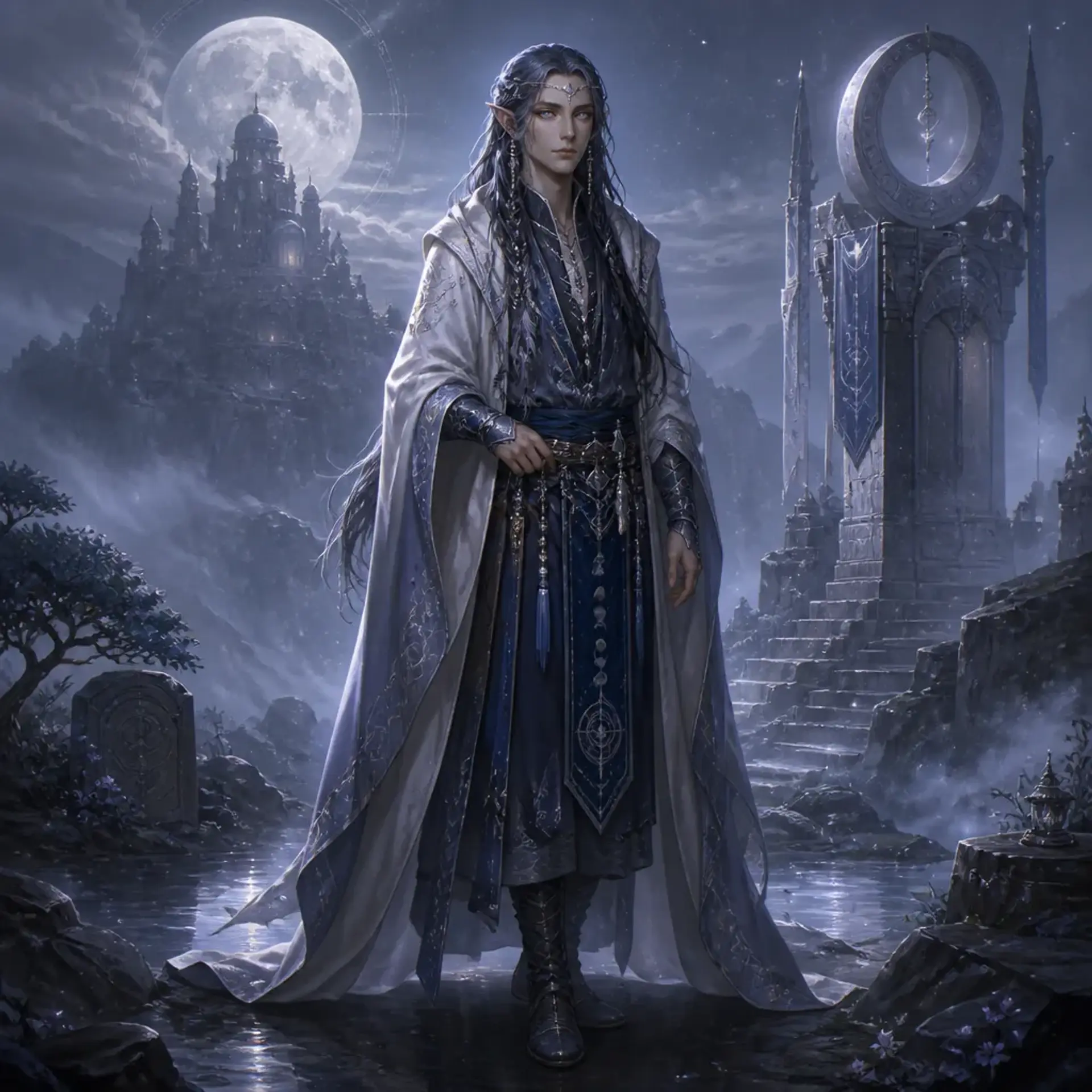
Lunaris noxstellata
The Lunari are a people of moonlit memory, patient scholarship, and hidden roads.
At a glance
Darkvision 60 ft.
Languages Common, Elvish, one additional language of your choice
Height 5 ft. 5 in. to 6 ft. 2 in.
Weight 110 to 165 lb.
Lifespan 750 to 900 years
At the table
Your magical lineage sharpens your senses in darkness. You can see in dim light and darkness within 60 feet as if the darkness were dim light, and you discern colors in dim light only as shades of gray.
You have advantage on saving throws against being charmed, and magic cannot put you to sleep. Lunari folklore says the moon guards the mind against intrusion and preserves dreams from theft.
You do not need sleep in the ordinary way. Instead, you enter a deep meditative trance for 4 hours to gain the benefits of a Long Rest. During this trance, you remain aware enough to keep watch and dream lightly.
You know the hand signals, coded phrases, and hushed etiquette used by Lunari messengers and wardens. You can convey simple ideas silently to another Lunari or trained ally who can see you, and you often read subtle gestures better than most folk.
Lunari tend toward Dexterity and Wisdom, though some are lithe scholars, sentinels, or dream-walkers whose minds are as quick as their feet. In D&D 5E (2024), players assign +2 and +1 wherever they best fit the character.
Their skin and hair often carry brighter silvers and pale blues, and their senses are especially attuned to open skies. They favor watchtowers, exposed ridges, and diplomatic service.
Highmoon Lunari are the most ceremonial of the kind, often serving as astronomers, heralds, or keepers of sacred calendars.
The Lunari are a people of moonlit memory, patient scholarship, and hidden roads. They are not merely children of the night, but custodians of what the dark reveals: lost paths, buried oaths, and truths that daylight can blind us to. A Lunari like Vaneria Lethari may seem serene at first glance, yet beneath that calm is a mind trained to read shadows, a heart bound to ancient duty, and a gift for turning silence into strategy.
Lunari are slender, graceful folk with luminous eyes, fine-boned features, and hair that often ranges from silver to deep black with a blue or violet sheen.
Their skin tones run from pale pearl to warm dusk-bronze, sometimes dusted with freckled constellations or a faint metallic shimmer in moonlight. Many wear their hair long or intricately braided, threading in beads, feathers, or polished stones that catch the light. They move with quiet precision, and even their stillness tends to feel alert rather than relaxed.
Temperate forests, cliffside observatories, ruined moon shrines, misty highlands, and cities that keep gardens and quiet roofs for nocturnal reflection.
Children of the moonlit groves, they mature quickly in body and slowly in judgment, often learning to listen before they speak.
They are physically adult, though many still move through life with the patience of a student or apprentice.
Most Lunari at this stage have fully claimed a calling, whether as artists, wardens, diplomats, or wanderers.
Elders are treasured as keepers of memory, especially those who can still read the night sky without notes.
Lunari society values patience, continuity, and the careful passing of knowledge.
Children are raised with a strong sense that every person is both a student and a keeper of testimony. Music, astronomy, embroidery, and oral history hold equal prestige, because all are ways of preserving pattern. They prize tact, but not dishonesty. A Lunari who lies for vanity is pitied; one who lies to protect the innocent may be quietly praised. Their celebrations often begin at dusk and end at dawn, with games, masked recitations, and songs that change slightly each generation so no memory grows brittle.
Lunari spirituality centers on lunar cycles, dreams, thresholds, and the belief that the night reveals what the day conceals.
They are not uniformly religious, but many honor moon deities, ancestral spirits, or abstract principles of reflection and renewal. Their traditions favor alignment with conscience, balance, and restraint, though individual Lunari can be devotedly benevolent, fiercely pragmatic, or even dangerously obsessive in the pursuit of truth.
Lunari often approach other peoples with courteous reserve at first, then with sincere loyalty once trust is earned.
They admire resolve, craftsmanship, and those who can keep a secret without making a performance of it. Some outsiders mistake them for aloof judges, but most Lunari are simply careful listeners. They tend to form strong bonds with scholars, scouts, healers, and anyone who values long memory over quick triumph.
Lunari homelands favor high windows, reflective pools, pale stone, and walkways aligned to moonrise rather than sunrise.
Their homes are often airy and layered, with archives, meditation alcoves, and roof terraces arranged for listening to wind, rain, and distant bells. Even in dense cities, they build sanctuaries of hush: lantern courts, silvered courtyards, and chambers where shadows are considered a form of ornament rather than absence.
No images yet.
A high-res, share-ready sheet you can post or print.
