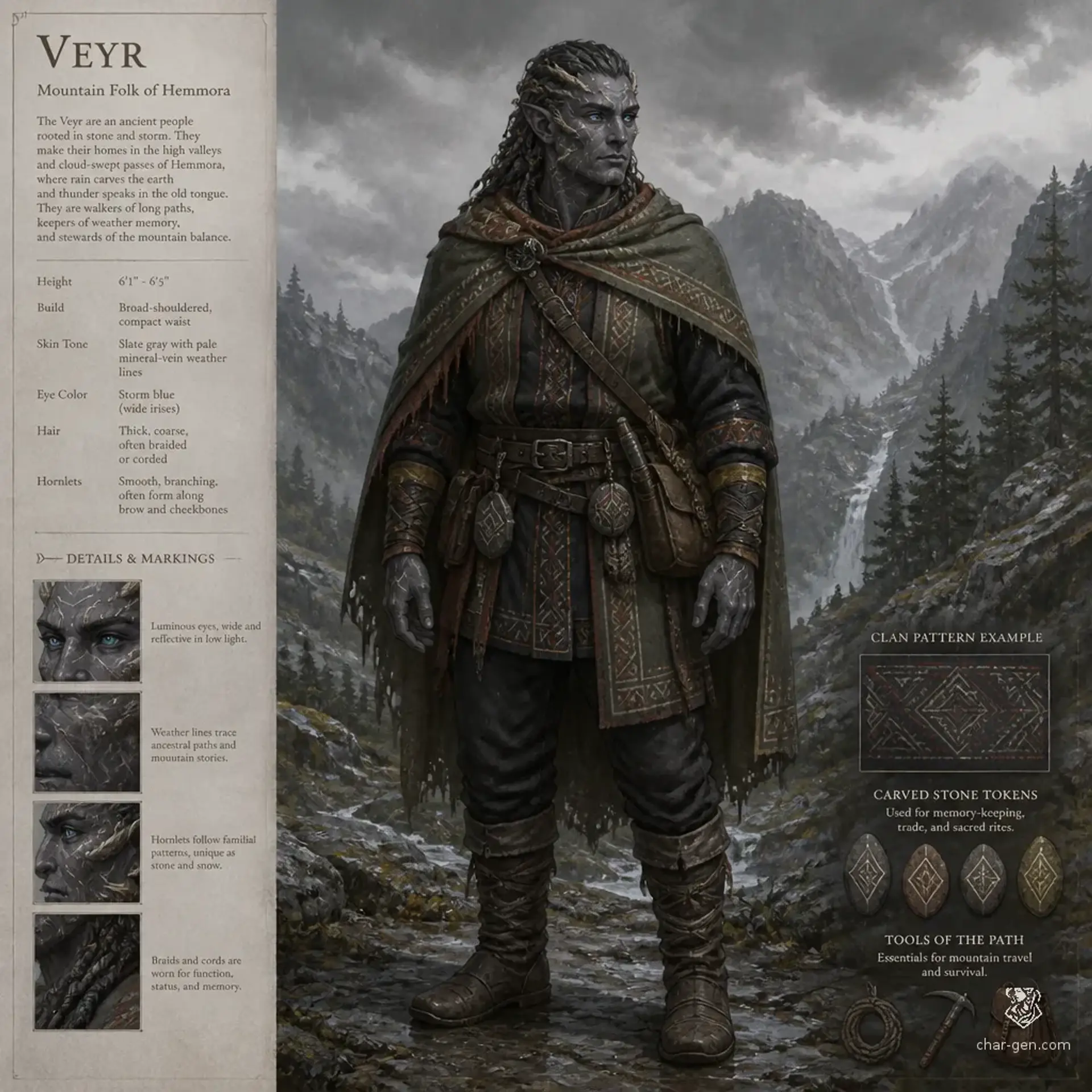
Veyr hominidum
Veyr are weather-wise wanderers whose bodies remember the pressure of storms and whose communities are bound by shelter, debt, and ancestral promises.
At a glance
Darkvision 60 ft.
Languages Common, Veyric
Height 5 feet 6 inches to 6 feet 4 inches
Weight 130 to 230 pounds
Lifespan 110 to 140 years, adult at 18
At the table
You have proficiency in one skill chosen from Insight, Nature, Perception, Survival, or Medicine. Veyr education is practical, observant, and grounded in the ability to notice what others overlook.
You can see in dim light within 60 feet of yourself as if it were bright light, and in darkness as if it were dim light. In darkness, you perceive only shades of gray.
When you finish a Long Rest, you can choose yourself and a number of willing creatures up to your Proficiency Bonus. Until you finish your next Long Rest, each chosen creature has Advantage on the first saving throw it makes against one environmental hazard, such as extreme weather, unstable terrain, or a natural disaster. Once you use this trait, you cannot use it again until you finish a Long Rest.
You have Advantage on ability checks made to determine whether weather, terrain, or a structure poses an immediate danger. In addition, you can usually identify the direction of the nearest significant source of moving air while outdoors.
When you or a creature within 5 feet of you would be pushed or knocked Prone, you can use your Reaction to brace the creature. Reduce the forced movement by 5 feet, and the creature can add your Proficiency Bonus to any ability check or saving throw it makes to resist being knocked Prone as part of the same effect. You can use this Reaction a number of times equal to your Proficiency Bonus, and you regain all expended uses when you finish a Long Rest.
Common, Veyric
Veyr tend toward Constitution and Wisdom, reflecting their endurance, alertness, and instinct for hidden weather. Players assign any ability score increases according to their character concept, such as +2/+1 or three +1 increases, as allowed by the 2024 rules.
Their hornlets grow in branching crowns, and their skin commonly bears pale gray or white weather-lines.
Crownridge Veyr descend from high mountain settlements where thin air, sudden avalanches, and long winters shaped a culture of watchfulness. They are often patient, reserved, and exceptionally skilled at navigating exposed terrain.
Veyr are weather-wise wanderers whose bodies remember the pressure of storms and whose communities are bound by shelter, debt, and ancestral promises. They may be patient guides, stubborn ruin-delvers, practical healers, or haunted fugitives from a mountain clan, but every Veyr carries the same quiet question into the wider world: what warning did everyone else fail to hear?
Veyr are sturdy humanoids with broad shoulders, compact waists, and long, capable hands.
Their skin ranges from clay red and slate gray to moss green, amber, and deep umber, often patterned with pale lines resembling mineral veins or dried riverbeds. Their eyes have wide irises that catch dim light in silver, copper, or storm-blue flashes. Along the brow, cheekbones, shoulders, or spine grow smooth hornlets made of a dense, keratin-like material. These ridges vary dramatically between families and may resemble antlers, swept-back fins, short crowns, or layered plates. Veyr hair is typically thick and coarse, worn in cords, braids, or close-cropped styles that do not catch easily on rock or brush. Their bodies are warm to the touch, and many Veyr carry a faint scent of rain on stone.
Mountain valleys, storm coasts, highland forests, deep ravines, and old trade roads where sudden weather makes every journey a test of preparation.
Veyr children are born with pale, flexible hornlets beneath the skin and learn to read changes in air pressure before they can speak clearly. They are considered dependents of the whole settlement.
Young Veyr undergo a season of travel, service, and practical instruction before choosing a craft, clan, or wandering life. Their hornlets harden into their adult shape during this period.
Most Veyr reach physical maturity in their late teens. Adults are expected to maintain strong ties to their household while pursuing a reputation built through useful deeds.
Veyr age slowly after adulthood, retaining their strength well into later life. Elders develop elaborate horn ridges and are valued as negotiators, historians, and keepers of dangerous knowledge.
The oldest Veyr become contemplative and intensely sensitive to atmospheric changes. Some withdraw into quiet sanctuaries, while others set out on one final journey to return a treasured object to its origin.
Veyr society is organized around hearth-clans, each made up of several related households and trusted adoptees.
A person's birth family matters, but chosen obligation matters more. Children are raised communally, crafts are taught through apprenticeship, and every adult is expected to know at least one form of emergency work, such as first aid, shelter construction, food preservation, or route-finding. Veyr gatherings are marked by the exchange of useful gifts, detailed storytelling, and competitive feats of endurance. Reputation is earned through reliability rather than glamour. A Veyr who arrives late may be forgiven, but one who promises to arrive and does not send warning can lose the confidence of an entire clan.
Veyr spirituality centers on the belief that the world is a living exchange of pressures, currents, and remembered consequences.
Some revere ancestral spirits, while others honor personified forces such as the First Rain, the Patient Stone, or the Wind Beneath Doors. Their religious practice is usually domestic and practical, involving shared meals, repaired tools, weather observations, and vows spoken at thresholds. Veyr culture values responsibility and mutual aid, so many lean toward lawful or neutral alignments, but wanderers often embrace chaotic ideals when clan traditions become oppressive.
Veyr are generally cautious with strangers but generous once trust has been demonstrated.
They respect communities that maintain public shelters, honor agreements, and prepare for hardship without abandoning the vulnerable. They often find highly individualistic societies confusing, especially cultures that treat family obligations as optional. Veyr relations with mountain-dwelling folk are usually cordial, though disputes over mining, water rights, and burial sites can become bitter. They have a particular affinity for travelers, rangers, sailors, and anyone who knows how to make a safe camp in bad conditions.
Veyr settlements are built where stone, water, and wind meet.
Their homes are low, thick-walled structures with inward-facing courtyards, rain channels, concealed storage rooms, and tall listening towers. Doorways are often marked with carved pressure-lines that indicate prevailing winds, notable storms, and the names of those who died defending the settlement. Veyr architecture favors linked household compounds rather than isolated dwellings, allowing neighbors to share tools, food, and shelter during dangerous weather.
No images yet.
A high-res, share-ready sheet you can post or print.
