Cadaverus votivus
The Stillmarked are the dead who woke with a promise still unfinished.
At a glance
Darkvision 60 ft.
Languages Common, One other language chosen with the DM, often a language the character knew before death or learned after awakening
Height 5 ft. 4 in. to 6 ft. 6 in.
Weight 130 to 260 lb., including unusually dense muscle and mineral deposits
Lifespan They do not age normally after awakening
At the table
You are a Humanoid. You are Medium, and your walking Speed is 30 feet.
You have Darkvision with a range of 60 feet.
You have Advantage on saving throws you make to avoid or end the Frightened condition. Your awareness of mortality does not make you fearless, but terror rarely takes hold of you as easily as it does others.
As a Bonus Action, you can draw on the stillness that carried you through death. For 1 minute, you gain Temporary Hit Points equal to your character level at the start of each of your turns, and you have Advantage on Strength checks and Strength saving throws. Once you use this trait, you cannot use it again until you finish a Long Rest.
You do not need to breathe, and you have Advantage on saving throws against disease. You still require food and water as normal, and this trait does not grant resistance to poison or immunity to other conditions.
These people tend toward Constitution and Wisdom, reflecting endurance and a patient awareness of danger; players assign any ability score increases according to the 2024 rules.
Their bodies preserve warmth and scent more readily than those of other Stillmarked, though they remain cool to the touch.
Awakened in family crypts or near communities that kept their memory alive, Hearth-Returned often find it easier to build new ties. Their traditions emphasize hospitality and the care of the living.
The Stillmarked are the dead who woke with a promise still unfinished. They are not a nation of obedient revenants or a curse wearing a face: each must decide whether the vow that called them back still deserves their life. Patient, physically formidable, and difficult to frighten, they bring the perspective of history into the present while wrestling with the danger of becoming nothing but its instrument.
Stillmarked are people whose bodies have returned from death without returning to ordinary life.
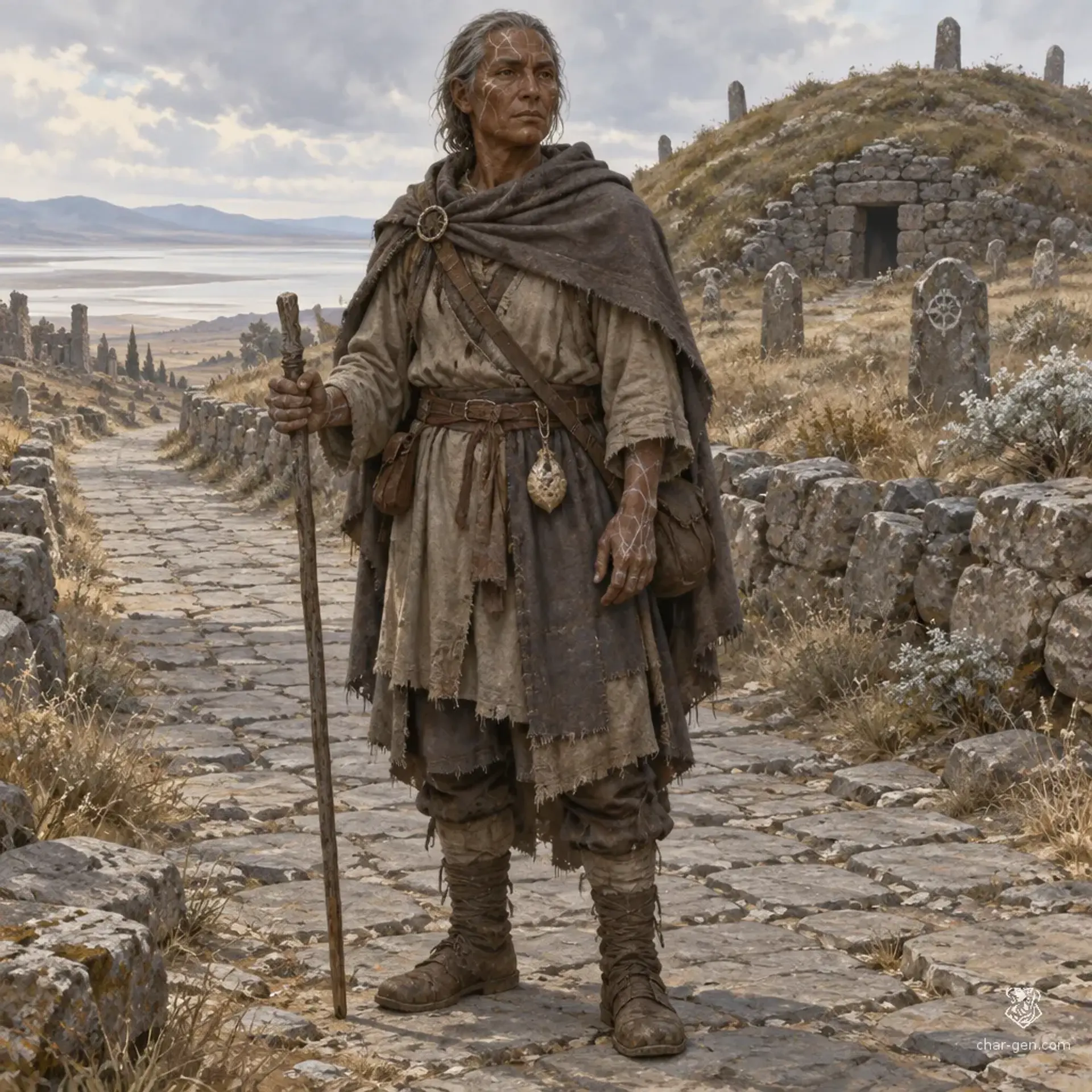
Their skin is cool and dry, ranging from waxen brown and gray to tones like weathered clay; fine mineral lines may trace the hands, throat, or old wounds. Hair grows slowly, if at all, and their eyes often show a faint reflective sheen in low light. Breath is shallow and unnecessary, though many imitate it to ease conversation. Their bodies are solid and capable, but scars may retain the shape of the injury that killed them. Clothing and grooming vary as widely as among other peoples.
Old roads, abandoned fortifications, burial hills, salt flats, and settled communities that have made room for the returned
The first stirring usually comes after a mortal lifetime, when a potent vow or an unusual burial awakens the body. Newly risen folk learn speech and custom by listening to the living.
Most enter settled adulthood after several years of recovery and study. They may look weathered from their first breath, but their judgment is not inherited with their memories.
After roughly three centuries, joints stiffen and the self grows increasingly entangled with the original vow. Some choose a final sleep before that change becomes irreversible.
Stillmarked communities are built around the needs of both the returned and the living.
A newly awakened person may need help recovering speech, identifying familiar customs, and learning what has changed; patient relatives and civic record-keepers often serve as guides. Communities keep careful archives but distinguish recorded fact from the memories of individuals, which can be incomplete or distorted. A vow is treated as serious testimony, never as automatic law. Many Stillmarked adopt new names, trades, and relationships, while others retain an old name as a link to those who remember them.
Beliefs range from ancestor reverence to worship of gods of death, duty, healing, or renewal.
Some refuse temples, seeing their return as a matter of mortal history rather than divine judgment. Their strong sense of obligation can draw them toward lawful conduct, but no alignment is inherent: a vow may be honorable, misguided, or cruel, and the returned person remains responsible for choosing how to fulfill it.
Many living people greet the Stillmarked with gratitude, suspicion, or both.
Their presence can comfort communities that have lost someone, but it can also reopen grief or unsettle inherited accounts of history. Stillmarked generally avoid claiming authority over descendants or strangers merely because they remember an earlier age. They value companions who ask what they want now, rather than assuming an old identity answers the question.
Their ancestral resting places were built for preservation rather than display: dry chambers, fitted stone lids, and narrow vents that could be sealed against flood or fire.
Living communities favor practical homes with cool cellars, wide doorways, and a quiet room where a returned person can keep private objects. Many also maintain roadside shelters for travelers and for kin newly awakened far from home.
No images yet.
A high-res, share-ready sheet you can post or print.
