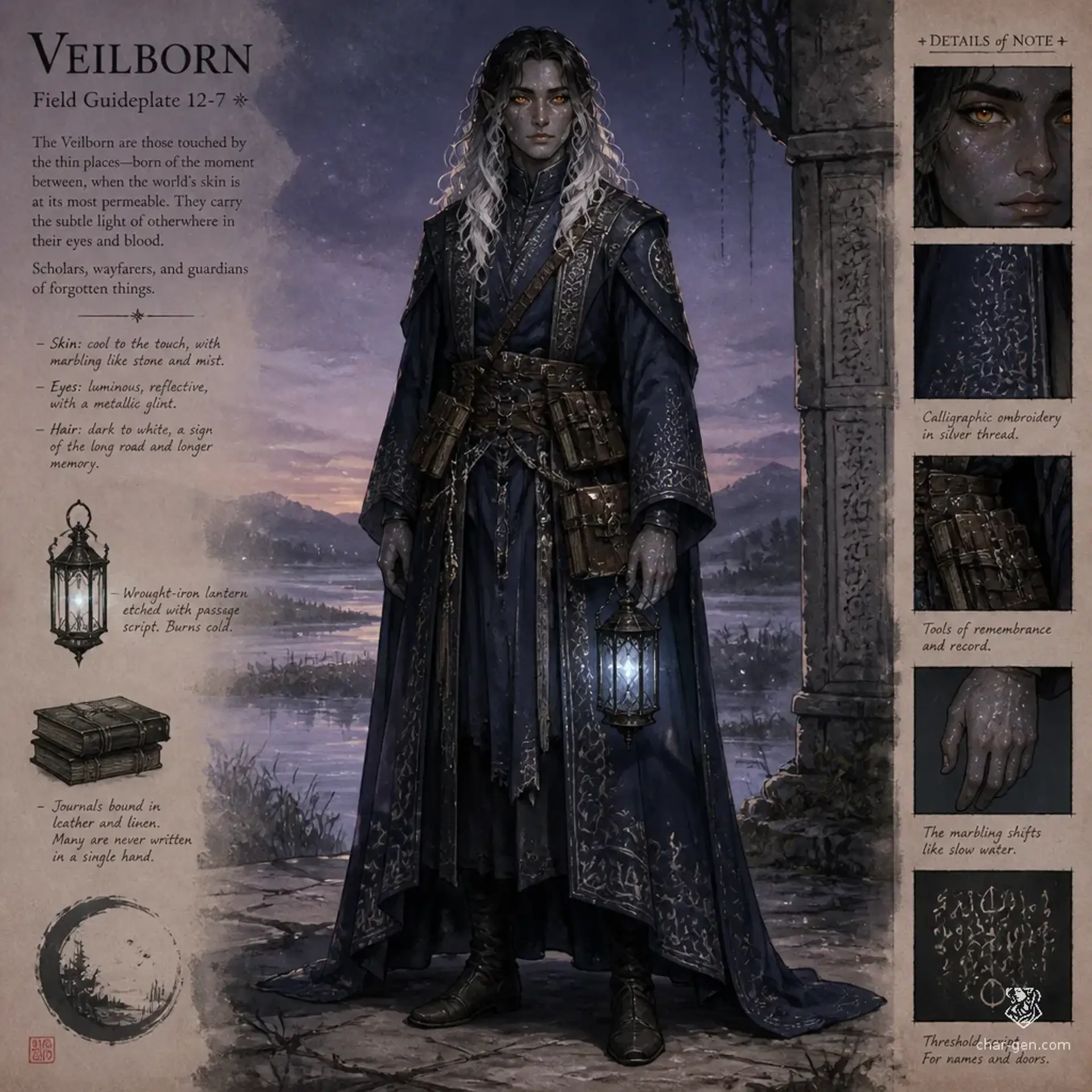
Homo liminalis
Veilborn are the people of thresholds, memory, and the faint pressure of unseen things.
At a glance
Darkvision 60 ft.
Languages Common, one additional language of your choice
Height 5 to 6 feet
Weight 120 to 180 pounds
Lifespan 90 to 120 years
At the table
Your body is tuned to edges and half-light. You can see in dim light within 60 feet of you as if it were bright light, and in darkness as if it were dim light. You cannot discern color in darkness, only shades of gray.
You carry a practiced sense for hidden intent. You have proficiency in one skill tied to reading others or uncovering the past, chosen from Insight, Investigation, History, Medicine, or Religion.
You can remain unnervingly steady when the world grows strange. When you make a saving throw against being frightened or charmed, you can add a bonus equal to your proficiency bonus once per Long Rest after seeing the roll but before the outcome is determined.
You know how to close ranks with a word or a glance. When you finish a Short Rest, choose yourself or one willing creature you can see. That creature gains temporary hit points equal to your proficiency bonus plus your Wisdom modifier, minimum 1.
Veilborn tend toward Wisdom and Charisma, with some lineages showing unusual poise under pressure or a knack for quiet endurance. In play, assign +2/+1 to any ability scores you prefer, reflecting the individual rather than the bloodline.
Those of the Dawn-Scribed line are more open in spirit and often bear brighter eyes, warmer tones in the skin, and a gift for encouragement and public ceremony.
Dawn-Scribed Veilborn are associated with thresholds of hope, new contracts, and public witness. They often serve as heralds, negotiators, healers, or celebrants, and they are known for turning private grief into communal strength.
Veilborn are the people of thresholds, memory, and the faint pressure of unseen things. Some are born with a listener's patience, some with a mourner's grace, and some with a wanderer's need to keep moving before the world can name them. In a party, a Veilborn might be the scholar who reads the ruin correctly, the pilgrim who knows the old road by moonlight, or the envoy who can speak to both the living and the dead without losing their footing.
Veilborn are humanlike folk marked by subtle traits that suggest long acquaintance with dusk, reflection, and solemn places.
Their eyes often catch light in unusual ways, showing silver, smoke, or deep amber glints. Hair ranges widely in color but often appears darker at the roots and lighter at the ends, as if touched by ash or moonlight. Their skin may hold faint marbling, star-flecked undertones, or a cool sheen when seen at an angle. Their voices are typically calm and resonant, and many carry a stillness that makes a crowded room quiet down around them.
Veilborn are found anywhere the world feels thin: old roads, floodplains, chapel ruins, border towns, and cities built atop older cities.
They adapt well to settled regions but rarely feel at ease in places with no history.
Veilborn children are alert, observant, and often unnervingly quiet. They mature by listening before speaking.
By early adulthood, their features and mannerisms settle into a distinctive presence, and many begin to feel the pull of their inherited omens.
Adults are steady and deliberate, often serving as interpreters, wardens, diplomats, or wanderers between communities.
Elders become living archives. Their memories are prized, and many are consulted as judges, keepers of custom, or ritual witnesses.
Veilborn culture prizes remembrance, ritual courtesy, and the careful marking of transitions.
Births, coming-of-age rites, marriages, and funerals all involve spoken names, shared food, and a witness who records what must not be forgotten. Storykeeping is a respected calling, and many Veilborn communities maintain memory ledgers, ancestor lamps, or wall-inked genealogies. Their songs are often slow and layered, designed to be remembered after a single hearing. They value restraint not as emptiness, but as the discipline that lets meaning endure.
Veilborn are not bound to one faith, but many honor ancestor veneration, psychopomp traditions, or deities of dusk, travel, judgment, and remembrance.
Their morality is shaped more by duty and consequence than by dogma. Many lean toward lawful or neutral worldviews, though their sense of order often serves memory and responsibility rather than authority.
Veilborn usually build courteous, cautious ties with others.
They are often valued as intermediaries because they listen longer than most and remember more than they reveal. Some communities distrust them as omens of change, while others seek them out for funerals, treaties, and inheritance disputes. They tend to respect peoples who honor ancestors, oaths, and place-based customs, and they often clash with those who treat memory as disposable.
Their homelands are usually scattered rather than singular, built around shrines, archives, crossroads, and burial paths.
Veilborn architecture favors narrow windows, echoed halls, high thresholds, and inner courtyards where wind can move through stone. Even humble homes often include a memory niche or a carved lintel for names.
No images yet.
A high-res, share-ready sheet you can post or print.
