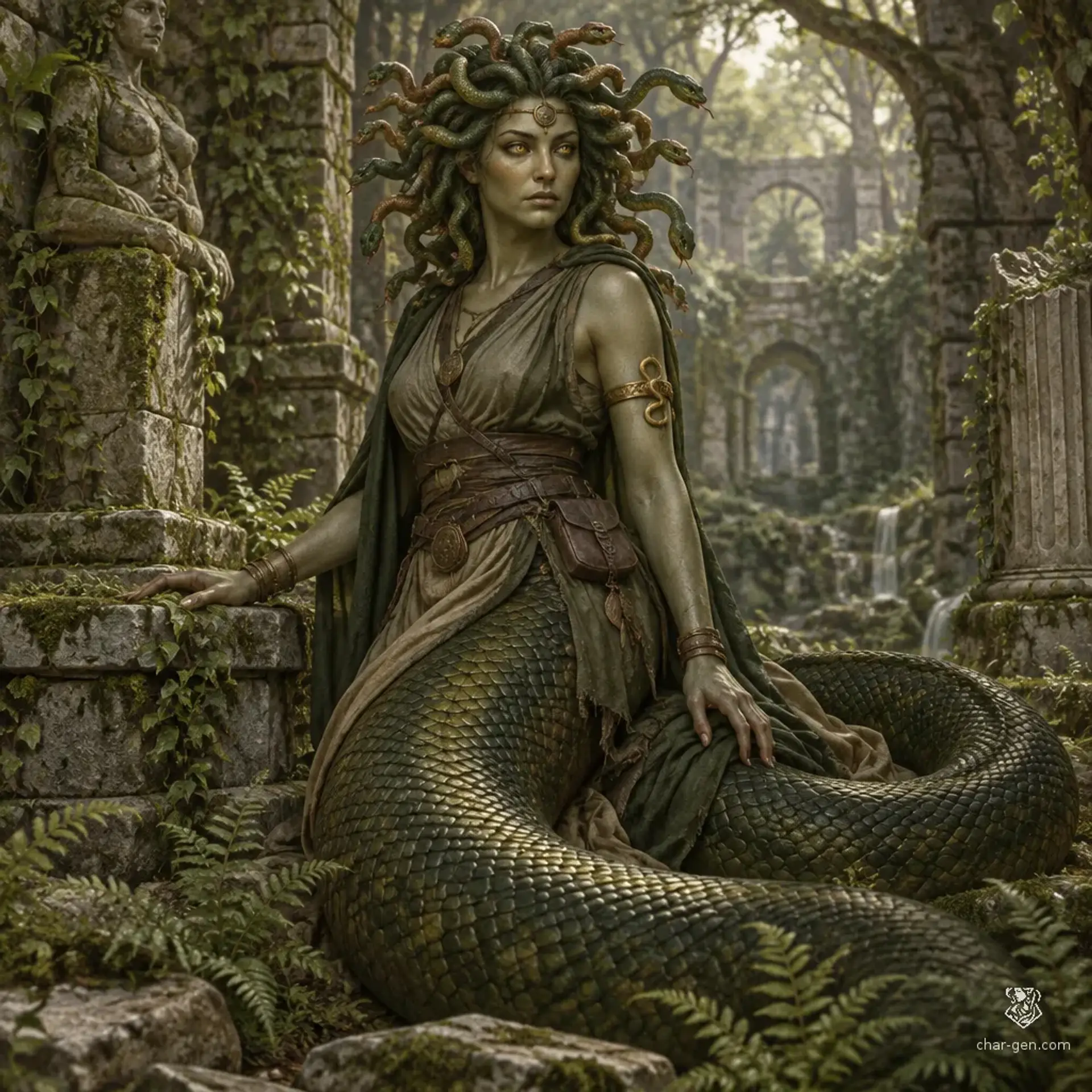
Gorgonea unica
You are a woman cursed with a crown of living snakes and a gaze that can turn the living to stone.
At a glance
Languages Common, One other language of your choice
Height 5 ft. 6 in. to 6 ft. 4 in. when raised upright
Weight 180 to 300 lb.
Lifespan A curse-bearer may live for roughly 120 years, though the curse’s effects can begin at any age and appear to slow little with time
At the table
You can see in dim light within 60 feet of yourself as if it were bright light, and in darkness as if it were dim light. You discern colors in darkness only as shades of gray.
Your living hair-snakes are alert to nearby motion and sound. You have proficiency in the Perception skill.
Your scaled lower body is adapted to winding through broken ground. You have a Climb Speed of 20 feet. You cannot climb smooth, sheer surfaces without handholds.
When a creature you can see within 30 feet of you hits you with an attack, you can use your Reaction to force it to make a Constitution saving throw. The DC equals 8 plus your Proficiency Bonus plus your Constitution modifier. On a failed save, the creature’s body briefly stiffens and its Speed becomes 0 until the start of its next turn. Once you use this trait, you cannot use it again until you finish a Long Rest. This brief effect is not petrification and cannot turn a creature to stone.
Perception
This ancestry’s patience and resilient, watchful nature tend toward Constitution and Wisdom; players assign any ability score increases as they wish.
The crown’s snakes are often pale, leaf-green, or coppery, and tend to grow more restless in bright sunlight.
The bearer has spent years in abandoned temples and fallen halls, learning to read old inscriptions and recognize the signs of trespass. This is a personal history, not a separate bloodline.
You are a woman cursed with a crown of living snakes and a gaze that can turn the living to stone. You have learned to live among the ruins and tangled forests where few people come unannounced, but isolation has never quite silenced your curiosity. The curse is real, dangerous, and yours to master. It is not your whole nature, unless you let it be.
The sole known bearer of this curse has pale green-bronze skin, a woman’s face, and a long, muscular lower body covered in overlapping snake scales.
A crown of living snakes grows where ordinary hair would be; each serpent senses its surroundings and may show a distinct temper. Her golden eyes have narrow, vertical pupils. The gaze is not constantly lethal, but the curse can seize control in moments of danger, and even a willing look carries risk. Her tail is strong enough to coil around branches or move her through broken ground, while her upper body is otherwise human in form.
Forests and overgrown ruins
The curse takes hold during adolescence, when the first hair-snakes emerge and the eyes begin to change.
An adult learns to control the snakes, manage the gaze, and decide what kind of life can be built around the curse.
Age brings slower movement and more deliberate habits, but the curse itself shows little sign of weakening.
This is a one-of-a-kind curse, not a people with a shared society.
Its bearer has had to create personal customs for survival: warning visitors before emerging, asking permission before approaching, and keeping the snakes calm during tense conversations. These habits can look ritualistic to outsiders, but they are practical ways to make trust possible. If the curse is ever passed on or repeated, future bearers may develop their own culture rather than inherit one.
The curse-bearer may honor any faith, reject the gods, or seek a divine explanation for her affliction.
Some pray for a cure; others ask for the strength to live well without one. Her nature does not dictate alignment. A history of fear and exile may make her guarded, but compassion, cruelty, humor, and ambition remain her own.
Most people know the tale before they meet its subject, and many mistake caution for hostility or a living person for a monster from a story.
Some communities leave offerings at the edge of a forest, hoping to avert the curse; others seek the bearer as a guardian, oracle, or weapon. Trust is possible, but requires clear agreements about eye contact, distance, and the snakes’ safety. The bearer may find kinship with other cursed or misunderstood people, while remaining aware that no shared lineage can explain why she is the only one.
There is no homeland shared by this singular, cursed lineage.
A curse-bearer who survives often makes a refuge in a forest ruin, choosing sheltered halls with broad paths, low windows, and mirrored or shuttered surfaces. Such places are arranged for safe conversation: visitors announce themselves, and screens allow the host to choose when to meet someone’s eyes. Stone gardens may be kept as memorials, warnings, or both.
No images yet.
A high-res, share-ready sheet you can post or print.
