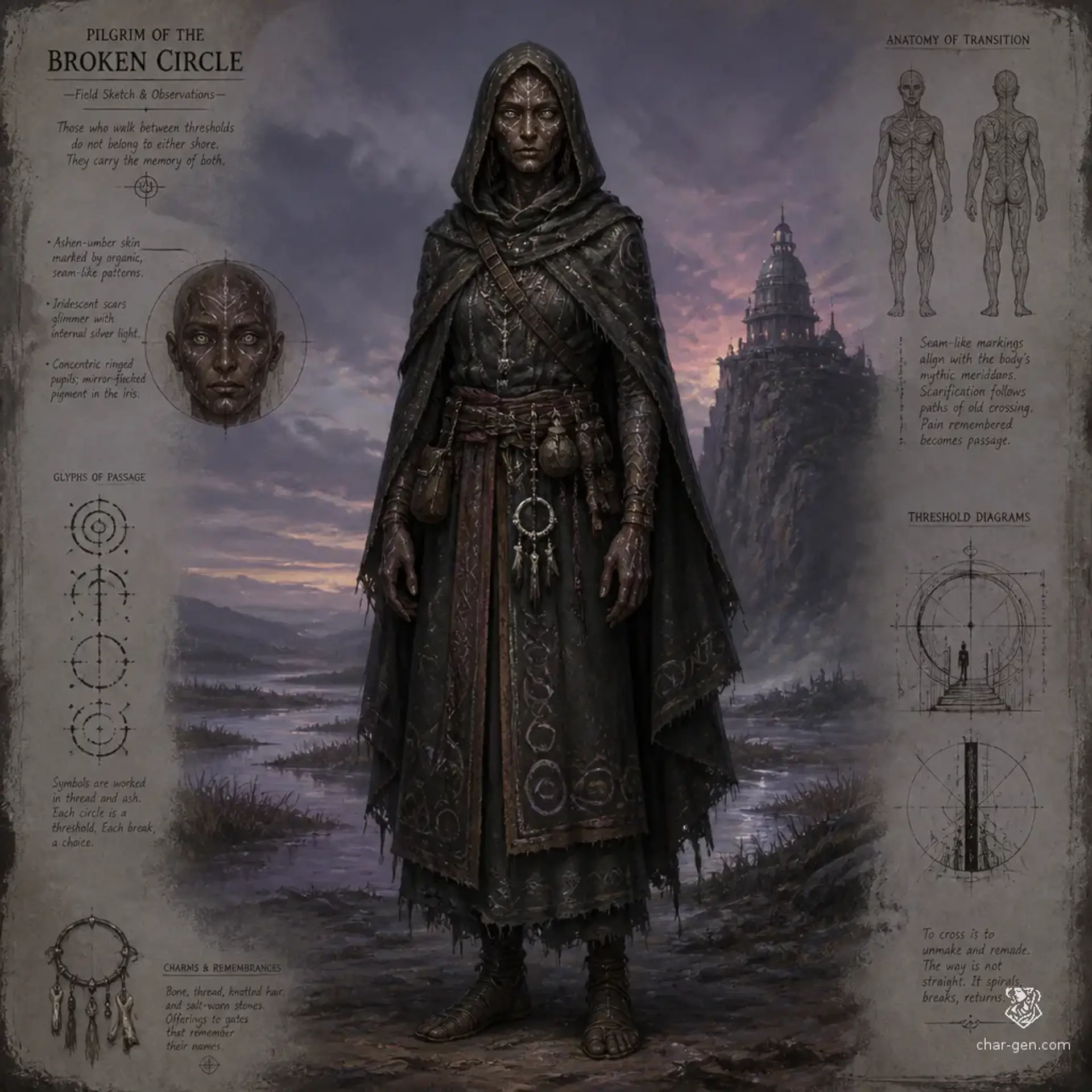
Vagus cicatrix
Scarred Wanderers are the people who came back from the wrong place changed, but not broken.
At a glance
Darkvision 60 ft.
Languages Common, One additional language of your choice, often Deep Speech, Undercommon, or the tongue of the region where you were raised
Resistances Psychic
Height 5 to 6 feet
Weight 130 to 220 pounds
Lifespan 80 to 110 years
At the table
Your mind brushes against hidden patterns. You gain proficiency in one of the following skills of your choice: Insight, Investigation, Perception, or Survival.
You can focus through fear, pain, or confusion with uncanny steadiness. When you make a saving throw to avoid or end the frightened or charmed condition, you can add a bonus equal to your proficiency bonus to the roll once per Long Rest.
Your body remembers impossible pressures. You have resistance to psychic damage.
You can sense the living presence of minds nearby, though not their thoughts. As a Bonus Action, you can briefly attune to the room around you and know whether any thinking creature is within 30 feet of you, provided it is not behind total cover and is not protected by effects that block divination. You can use this trait a number of times equal to your proficiency bonus, and you regain all uses when you finish a Long Rest.
Psychic
Scarred Wanderers tend toward Constitution and Wisdom, shaped by the discipline needed to survive intrusive thoughts, hostile environments, and the lingering pressure of something vast and alien behind their eyes. If you use ability scores, players assign +2/+1 as they wish.
They are more physically grounded than most of their kin, with thickened bones and a habit of standing their ground even against overwhelming force.
Stonebound Wanderers are known for endurance, patient labor, and an almost monastic attachment to shelter, walls, and old oaths.
Scarred Wanderers are the people who came back from the wrong place changed, but not broken. They carry strange resilience, sharpened intuition, and a memory for nightmares that makes them excellent guides through haunted roads, secret histories, and places where the world has gone slightly out of joint. Play one as a survivor with a mind that brushes against the alien, a pilgrim searching for meaning in the fracture, or a watcher who can feel when reality is about to peel.
Scarred Wanderers are a humanoid ancestry touched by an aberrant lineage that never fully settled into one shape.
Their skin ranges from pale ash to deep umber, often threaded with natural seam-like markings, faint iridescence, or scar patterns that appear without any remembered injury. Their eyes sometimes show ringed pupils, mirrored flecks, or a second glimmer of color when they are startled or focused. Their movements are controlled and deliberate, as if part of them is always measuring the room for hidden geometry. Many have narrow shoulders, flexible hands, and a nervous grace that reads as elegance until stress reveals how quickly they can pivot into uncanny stillness.
They favor liminal places where reality feels thin, such as cliff monasteries, observatories, old battlefields, salt marshes, and cities built around ancient scars in the land.
Their features sharpen, their markings settle into place, and they begin to hear the faint pressure of their kind's distant memory.
They are physically resilient and mentally volatile, often leaving home to test their sense of self against the wider world.
They carry the weight of memory with unusual clarity and are treated as witnesses, interpreters, or omens.
Their senses turn inward, and many become quiet custodians of family lore, wardens of thresholds, or wandering pilgrims.
Scarred Wanderer culture is built around witnessing, endurance, and mutual consent.
Families often maintain memory chains, where elders teach children not only names and histories but also how to recognize manipulation, obsession, and the difference between intuition and intrusion. Many communities mark personal milestones with ink, ash, or thread rather than celebration alone, using visible signs to acknowledge hardship survived. Storytelling is considered a civic duty. To forget an important event is a social failing, while to remember only the pain is a spiritual danger. Their music tends to be low, rhythmic, and repetitive, designed to steady the mind. Their art often includes repeating circles, broken spirals, and asymmetrical frames that suggest beauty remains even where the pattern has been interrupted.
Scarred Wanderers hold a wide range of faiths, but many are drawn to deities or philosophies that value thresholds, memory, prophecy, stars, and hidden knowledge.
They are not naturally aligned toward any one moral pattern, though their eerie perspective can make them appear detached or severe. In practice, their communities prize responsibility over dogma and often teach that power without restraint is just another kind of haunting.
Other peoples often find Scarred Wanderers unsettling at first, then comforting once they learn that the ancestry tends to be observant, patient, and difficult to deceive.
They are frequently welcomed as scouts, mediators, and keepers of lost routes, though superstitious communities may blame them for bad omens or unstable magic. Wanderers usually respect disciplined cultures, scholarly orders, and anyone who treats strangeness as a fact instead of a crime. They clash most often with zealots, opportunists, and rulers who fear what cannot be neatly classified.
Scarred Wanderer homelands are usually compact and practical, built around refuge rather than conquest.
Their architecture favors inward courtyards, angled hallways, windbreak walls, and mirrored or polished surfaces used to monitor changes in light and mood. Doorways are often marked with carved rings, knot patterns, or subtle asymmetries meant to remind residents that every threshold can be crossed carefully. Many communities maintain dream lodges, listening chambers, and communal archives where the oldest memories are entrusted to oral keepers.
No images yet.
A high-res, share-ready sheet you can post or print.
