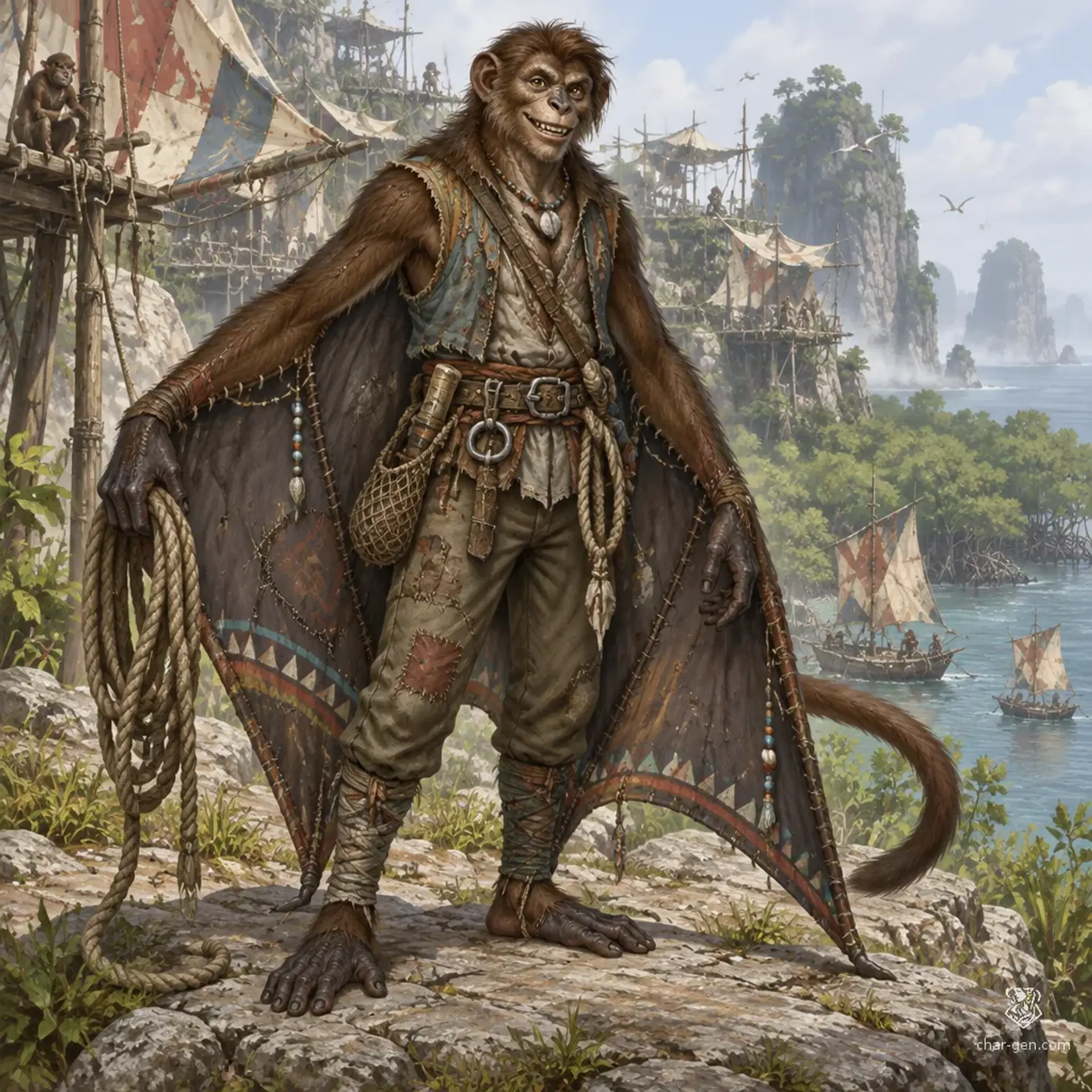
Pithecopterus libertus
At a glance
Languages Common, One other language of your choice, reflecting the ports and crews where you learned to speak
Height 4 ft. 8 in. to 5 ft. 8 in.
Weight 90 to 150 lb.
Lifespan 70 to 85 years, adult at 16
At the table
Your walking speed is 30 feet, and you have a climbing speed of 30 feet.
When you fall and are not incapacitated, you can use your reaction to spread your membranes. You descend up to 60 feet per round and can move up to 2 feet horizontally for every 1 foot you descend. If you are still falling at the end of your turn, you continue falling. When you land, you can reduce the falling damage you take by an amount equal to five times your character level. This trait does not let you gain altitude or hover.
You have proficiency in the Acrobatics skill.
Their quick reactions and sure footing often suggest Dexterity, while long watches and hard voyages favor Constitution or Wisdom. Players assign ability score increases as they wish.
Broad, dark membranes and a talent for judging wind over open water.
Reef Runners grow up among sea cliffs, salt marshes, and shallow-water fleets. They are known as daring boarders and expert salvagers, and often decorate their membranes with bright stitched patterns.
Kiteclans are free-roaming ape-folk of the coasts, ships, and jungle margins, famous for dropping from cliffs or rigging on cloak-like gliding membranes to board vessels from unexpected angles. They call themselves a nation, though its borders shift with the fleet, and their crude, clever engineering keeps their patched ships and airborne raiders in motion. A kiteclan adventurer may be a scout, privateer, runaway, or simply someone who heard a dare and could not let it stand.
Kiteclans are wiry, agile ape-folk covered in thick brown fur, with long arms, gripping hands, and bright, quick eyes.
A furred gliding membrane stretches from each wrist to the ankle or flank, folding around the body like a loose cloak when at rest. Their faces are expressive, usually set in a restless grin, and their tails and limbs help them balance on wet rigging and narrow branches. Membrane markings, scars, beads, and stitched patches often record voyages or daring contests.
Coasts, coastal plains, ships, mangrove jungles, and cliffside rookeries
Young gliders learn to climb, swim, and fold their membranes safely before joining a crew.
Most take their first long voyage in their late teens and are considered full members of a crew after proving dependable under pressure.
Older folk often leave dangerous rigging to younger hands, becoming navigators, craft-minders, or keepers of hard-won stories.
Kiteclan crews form the heart of their society.
Captains earn influence through skill, generosity, and the ability to keep a crew alive, not through inherited rank. Their outlaw nation raids ships and airships, scavenges what it cannot build, and relies on crude but ingenious engineering. One powerful taboo binds nearly all clans: never refuse a dare. The challenge must be answered, though a clever person may choose the terms, set fair limits, or answer with a challenge of their own.
Kiteclans honor sea winds, ancestral navigators, and the luck of a well-timed leap, but have no single faith or supernatural affinity.
Many leave small offerings at launch points before a dangerous glide. Their culture prizes freedom and loyalty, and individuals range across every alignment, from generous rescuers to ruthless raiders.
Many coastal communities admire kiteclan courage and value their skill as pilots, scouts, and salvage workers, while merchants and naval authorities see them as dangerous raiders.
Kiteclans distinguish between a fair raid and a betrayal: they may steal cargo, but breaking a sworn bargain or abandoning a crewmate is a lasting disgrace. Individual clans make their own treaties, so a character's reputation may open doors in one harbor and summon hunters in the next.
Their outlaw nation is not a single kingdom but a shifting network of ship-clans, floating markets, hidden coves, and canopy camps.
Settlements favor flexible structures lashed together from salvaged spars, woven cord, bamboo, and patched sailcloth. Rope bridges and launch platforms connect trees or cliff ledges, while crude winches, pulley lifts, and collapsible glider frames show a practical ingenuity born of constant repair.
No images yet.
A high-res, share-ready sheet you can post or print.
