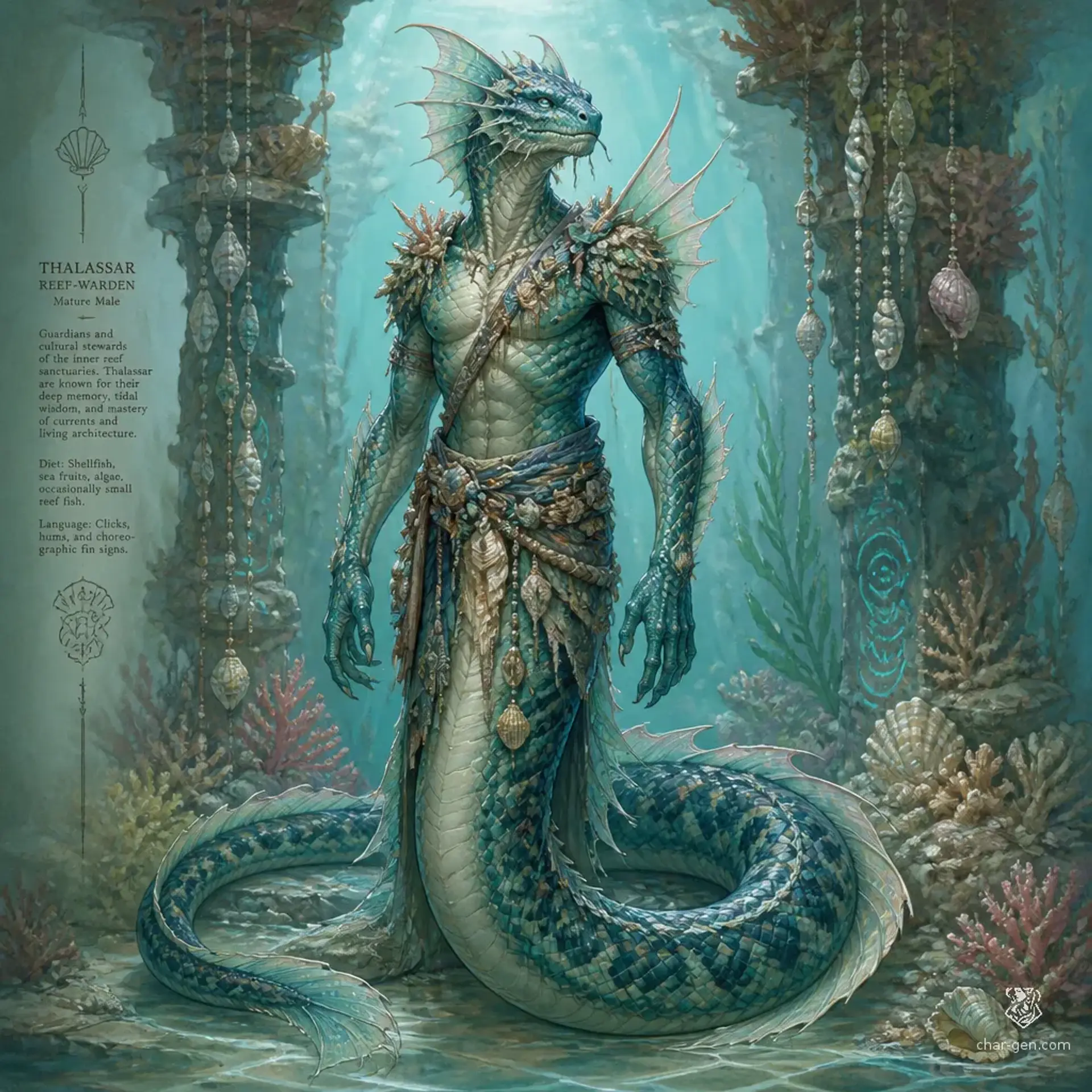
Nerathis pelagoserpens
Nerathi are sea-born serpentfolk who carry the patience of deep water and the memory of every current that shaped their people.
At a glance
Darkvision 60 ft.
Languages Common, Thalassic
Height 5 ft. to 7 ft. when measured from crown to the end of the raised torso
Weight 150 to 260 lb., including the muscular tail
Lifespan 100 to 130 years, adult at 18
At the table
You have a walking speed of 30 feet and a swimming speed of 30 feet. Your body is adapted to both water and land, though you must still breathe air normally when not underwater.
You can see in dim light within 60 feet of yourself as though it were bright light, and in darkness as though it were dim light. You cannot discern color in darkness, only shades of gray.
You have proficiency in the Perception and Survival skills. You can read changes in water, wind, pressure, and scent as naturally as a surface-dweller reads tracks.
You can communicate simple ideas through ripples, taps, and low vibrations in water to any willing creature within 30 feet that can feel or hear them. This communication cannot convey precise speech, complex instructions, or unfamiliar proper names.
Once per long rest, when you fail a Constitution or Wisdom saving throw, you can steady yourself through a remembered tide-song and roll the saving throw again. You must use the new result.
You have advantage on ability checks made to resist being forcibly moved or knocked prone while you are swimming or standing in water at least ankle-deep.
Common, Thalassic
Perception, Survival
Nerathi tend toward Constitution and Wisdom, reflecting their endurance, keen instincts, and attunement to currents and living waters. For D&D 5E (2014), assign ability score increases according to your table's preferred character-building rules rather than treating these tendencies as fixed bonuses.
Broad translucent fins along the arms, shoulders, and tail, with scales that commonly show turquoise, jade, or luminous blue hues.
Reefborn Nerathi dwell in warm coastal waters and coral labyrinths. They are renowned as gardeners, healers, traders, and patient diplomats. Their settlements are bright, communal, and filled with cultivated sea life.
Nerathi are sea-born serpentfolk who carry the patience of deep water and the memory of every current that shaped their people. They live among coral halls and drowned ruins, speak through voice and vibration, and regard promises as bonds strong enough to outlast blood. A Nerathi adventurer may be an envoy sent to understand the surface, a reef-warden pursuing a stolen relic, a scholar following an ancestral song, or an exile determined to prove that even a broken tide can find its way home.
Nerathi are serpentine aquatic humanoids with broad shoulders, flexible arms, and long, powerful tails in place of legs.
Their scales range from sea-glass green and blue-black to pearl, rust, ivory, and storm gray, often forming bands or marbled patterns unique to a family line. A pair of swept-back fins usually rises along the neck and shoulders, while smaller finlets run down the spine and tail. Their hands have four long fingers and a thumb, with thin webbing between the digits. Their eyes possess vertical pupils and a reflective inner membrane that protects them underwater. Most Nerathi have small sensory pits along the jaw and ribs, allowing them to feel changes in pressure and movement. On land, they move by coiling and uncoiling their tails with surprising grace, though long journeys across dry, uneven ground are tiring.
Aquatic
Newly hatched Nerathi remain close to their clutch and learn balance, breathing discipline, and the first tones of their ancestral songs.
Young Nerathi begin formal instruction in currents, kinship, craft, and the obligations of their lineage. They are considered capable of travel but not yet fully entrusted with clan secrets.
Most Nerathi reach physical maturity in their late teens and are expected to take a tide-name, swear a personal oath, and choose a craft or calling.
Elders are valued as keepers of memory and interpreters of the sea's long changes. Their scales often fade toward silver, pearl, or deep slate.
Nerathi society is organized around clutches, lineages, and tide-holds.
A clutch may include several families that share protection, food stores, ritual duties, and oral history. Lineages are not strictly hereditary in the surface-world sense. Foundlings, adopted hatchlings, and honored outsiders may be welcomed into a lineage through a naming ceremony. Nerathi value skilled navigators, healers, singers, reef-tenders, and negotiators as highly as warriors. Their oldest laws concern the protection of spawning grounds, the respectful treatment of the dead, and the keeping of sworn promises. Disputes are often settled through witnessed testimony, ritual debate, or contests of endurance rather than immediate violence.
Nerathi spirituality centers on the Great Current, a sacred metaphor for the living continuity connecting ancestors, seas, rivers, rain, and blood.
Some worship personified tide spirits, moon deities, storm powers, or ancient sea beasts. Others follow philosophical schools that teach discipline, change, or the preservation of memory. Their communities often favor lawful and neutral traditions, yet individual Nerathi can be any alignment. Even rebellious Nerathi usually understand the power of vows, boundaries, and consequences.
Nerathi are cautious with strangers but rarely indifferent.
They respect coastal peoples who honor the sea and distrust those who treat water as an endless resource. They often form strong friendships with sailors, river guides, pearl divers, and other travelers who understand the value of shared navigation. Their dealings with merfolk-like cultures vary from warm alliance to old rivalry, while their relationship with land-dwelling serpentfolk is complicated by competing myths about ancestry. Nerathi may seem formal or distant at first, but once trust is established they are fiercely loyal and difficult to separate from a chosen companion.
Nerathi settlements are built in sheltered lagoons, flooded caverns, drowned forests, and the upper reaches of deep ocean trenches.
Their architecture favors arches, spirals, and broad passageways that accommodate their tails. Coral is cultivated rather than quarried, while stone, shell, glass, and driftwood are woven into living structures. Important halls are marked with current-chimes, hanging shells that sing when tides or intruders disturb the water. Nerathi who live near the surface often maintain half-submerged villages connected by ramps, pools, and tidal channels.
No images yet.
A high-res, share-ready sheet you can post or print.
