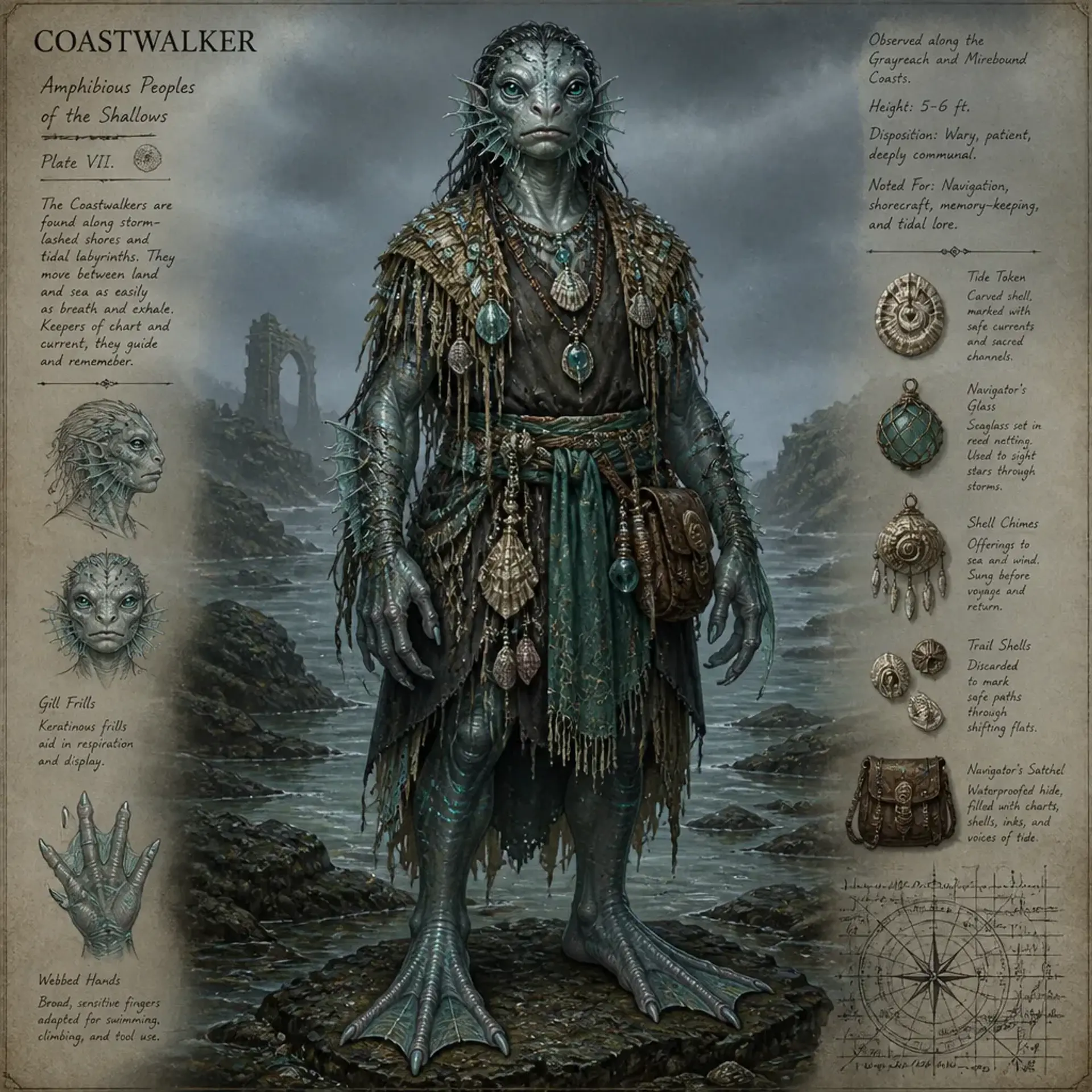
Litoranthus memoriae
Tidekin are patient amphibious wanderers who treat memory as a sacred current.
At a glance
Darkvision 60 ft.
Languages Common, Tidecant
Resistances Cold damage
Height 5 to 6 feet
Weight 110 to 190 pounds
Lifespan 90 to 120 years, adult at 18
At the table
You can breathe both air and water, and you have a swimming speed equal to your walking speed. You can remain underwater indefinitely, provided you are not incapacitated or otherwise unable to breathe.
You have resistance to cold damage, reflecting a body adapted to deep water, winter surf, and prolonged immersion.
You can see in dim light within 60 feet of yourself as if it were bright light, and in darkness as if it were dim light. In darkness, you perceive colors only as shades of gray.
You have proficiency in Insight, Perception, or Survival, chosen when you select this species. Tidekin notice changes in posture, weather, water, and atmosphere that others often miss.
You can communicate simple concepts to aquatic beasts and creatures with a swimming speed through gestures, clicks, skin-color changes, and rhythmic tapping. This communication does not grant the ability to understand their replies.
When you finish a Long Rest while touching or immersed in natural water, you can choose one skill or tool proficiency you lack. You gain that proficiency until you finish your next Long Rest, representing a temporary lesson carried through dreams and remembered sensations.
Common, Tidecant
Cold damage
Tidekin tend toward Constitution and Wisdom, reflecting their endurance, patience, and instinctive reading of currents, weather, and emotion. For D&D 5E (2024), players assign the background-based ability score increases of +2 and +1 as they wish.
Pearlescales possess pale reflective markings along the cheeks, shoulders, and hands. Their markings glow faintly in darkness when they are calm.
Pearlescales dwell in bright shallows, coral gardens, and river mouths. They are skilled diplomats, healers, navigators, and keepers of communal ceremonies. Their culture emphasizes reconciliation and the belief that every conflict contains a hidden point of agreement.
Tidekin are patient amphibious wanderers who treat memory as a sacred current. They can cross a storm-lashed coast, a drowned ruin, or a silent courtroom with equal composure, carrying stories that no one else survived to tell. Their calm is not passivity. It is the stillness of deep water, where every motion is noticed and every secret eventually rises.
Tidekin are amphibious humanoids with sleek builds, broad hands, and flexible feet suited to slick stone and shifting sand.
Their skin ranges from pearl gray and river-green to deep blue-black, often patterned with faint bands that brighten when they are excited, frightened, or near seawater. Fine frills line the jaw, throat, forearms, and ribs, helping them sense movement in water. Their eyes are large and reflective, with irises like polished glass. Most tidekin have dark, filamentous hair that clings together when wet. Their voices carry a soft undertone resembling water moving through caverns, while some communicate privately through subtle changes in skin color and throat clicks.
Coasts, tidal marshes, sea caves, river deltas, flooded ruins, and inland settlements built around deep wells or ancient canals.
Newly surfaced tidekin are born with translucent skin and spend their first years close to communal pools, learning the rhythms of speech, tide, and touch.
Young tidekin undertake a first journey beyond their home waters, usually as a courier, apprentice salvager, or witness to a seasonal rite.
Mature tidekin are expected to maintain a household, preserve ancestral memories, and serve as reliable witnesses during disputes.
Elder tidekin develop pale markings and a stillness that others find uncanny. Their memories are consulted like living archives.
The oldest tidekin gradually withdraw from ordinary life, choosing a final place where they can listen to the sea and recount what they have learned.
Tidekin culture is organized around memory, reciprocity, and the reading of change.
Every community maintains Witness Pools, where elders preserve important events through spoken testimony, engraved shells, and patterned ripples made with the hands. A promise made beside still water is considered binding even when no written contract exists. Tidekin children learn to swim, read weather, recognize dangerous currents, and distinguish honest silence from fearful silence. Disputes are often settled through a formal exchange called the Two Accounts, in which each party tells the story as they understand it while appointed listeners note what both versions share. The goal is not always to identify a winner, but to prevent a false version from becoming the only remembered one.
Tidekin religion centers on the Returning Current, a cycle in which all lives flow outward, mingle, and eventually return to the deep.
Some revere ancestral spirits, others honor elemental powers of rain and sea, and many treat the ocean itself as a vast listener rather than a god. Their communities prize compassion, responsibility, and truthful testimony, leading many tidekin toward good or neutral alignments. Tidekin who embrace strict law often become archivists or oath-keepers, while those who follow personal currents become explorers, smugglers, or revolutionary guides.
Tidekin often serve as interpreters, navigators, witnesses, rescuers, and keepers of difficult histories.
Coastal peoples may regard them as fortunate guests or unsettling reminders of shipwrecks and drowned wars. Riverfolk usually value their practical knowledge, while landlocked communities may mistake their reserve for aloofness. Tidekin are wary of empires that dam rivers, despoil reefs, or erase local memory, yet they frequently form deep friendships with individuals who show respect for living waters and inherited stories.
Tidekin settlements are built to breathe with the water.
Homes stand on adjustable pilings, within hollowed sea stacks, or behind gates that open and close with the tide. Their public halls contain shallow channels rather than corridors, allowing news, offerings, and messages to travel in flowing water. Important buildings are marked with layered shells, colored glass, and carved tide lines that record major events. A tidekin city rarely has a single entrance. It has mouths, drains, sluices, and hidden passages, all maintained as carefully as doors.
No images yet.
A high-res, share-ready sheet you can post or print.
