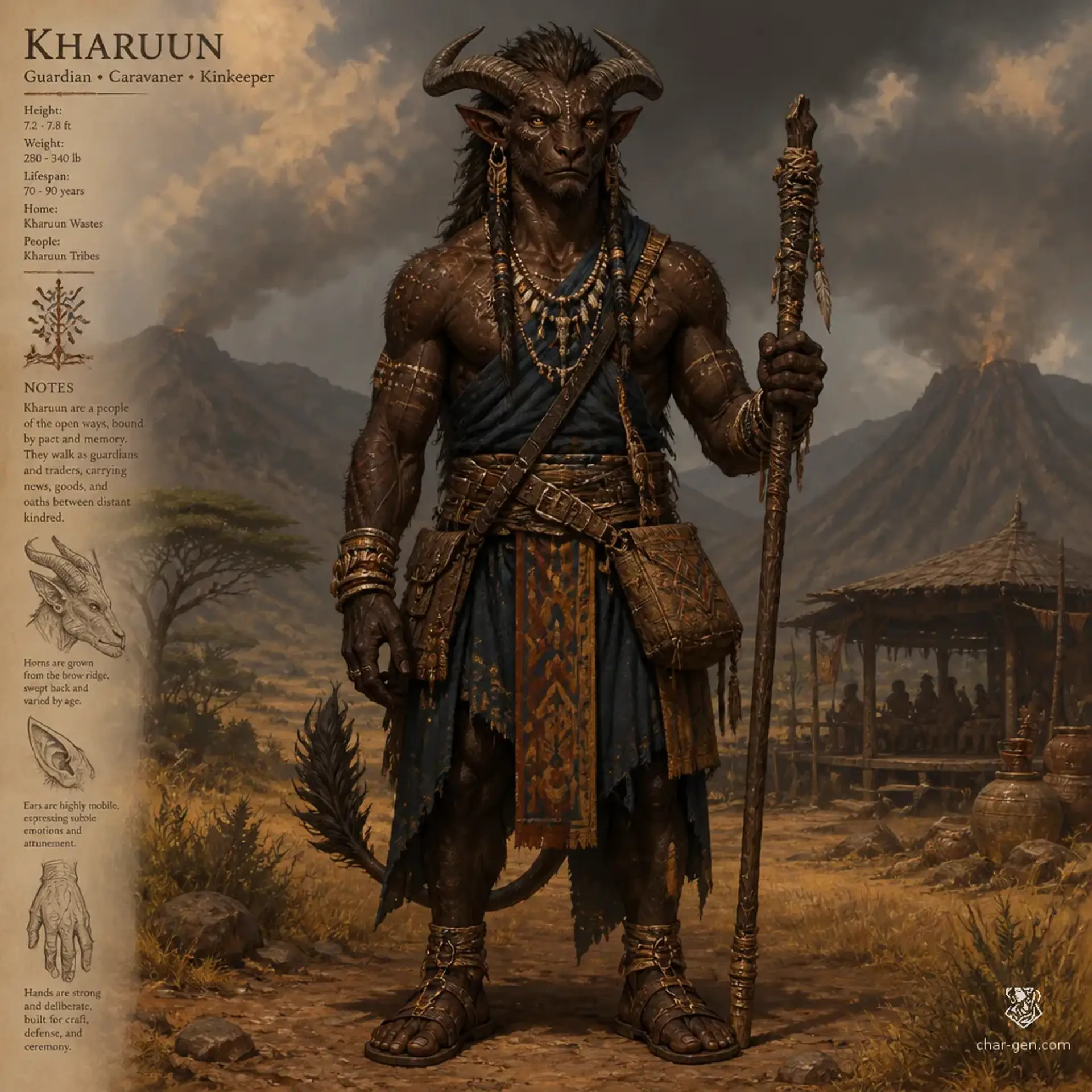
Kharuun sapiens
Kharuun are formidable wanderers and guardians of the living world, horned humanoids whose courage is expressed not only in battle but in stewardship, hospitality, and self-control.
At a glance
Darkvision 60 ft.
Languages Common, Kharu, One additional language of the player's choice
Resistances None by default
Height 6 to 7 feet
Weight 180 to 280 pounds
Lifespan 70 to 90 years, adult at 16
At the table
You can see in dim light within 60 feet of you as if it were bright light, and in darkness as if it were dim light. You cannot discern color in darkness, only shades of gray.
You have proficiency in one of the following skills of your choice: Athletics, Insight, Intimidation, Medicine, Perception, or Survival.
When you or a creature within 5 feet of you makes a saving throw against being frightened, you can use your reaction to grant that creature advantage on the saving throw. You can use this trait a number of times equal to your proficiency bonus, and you regain all expended uses when you finish a long rest.
When you spend at least 1 minute tending to a creature during a short rest, that creature can add your proficiency bonus to one Hit Die it spends to regain hit points. Once a creature benefits from this trait, it cannot do so again until it finishes a long rest.
You count as one size larger when determining your carrying capacity and the weight you can push, drag, or lift. You also have advantage on ability checks made to avoid being knocked prone.
None by default
The Kharuun tend toward Constitution and Wisdom, reflecting endurance, vigilance, and a disciplined relationship with the land. For D&D 5E (2014), players assign their ability score increases as they wish rather than receiving fixed increases.
Their horns curve upward or outward, and their skin often bears warm red, copper, or gold undertones.
Suncrest Kharuun are open-country runners, caravan wardens, and renowned negotiators. They are comfortable beneath vast skies and are taught to read weather, distant movement, and social tension with equal care.
Kharuun are formidable wanderers and guardians of the living world, horned humanoids whose courage is expressed not only in battle but in stewardship, hospitality, and self-control. They carry the memory of their ancestors in songs, masks, and carefully maintained roads, yet many leave home to test their discipline against distant dangers. A Kharuun adventurer may be a champion seeking worthy trials, a healer protecting a caravan, an exile rebuilding a damaged name, or an archivist determined to learn whether the old monsters of legend were ever truly monsters at all.
Kharuun are tall, powerfully built humanoids with broad shoulders, long limbs, and dense musculature.
Their skin ranges from charcoal, umber, and russet to deep violet-brown, often with subtle mottling across the shoulders and arms. Short, swept-back horns or heavy cranial ridges rise from the brow, varying widely between family lines. Their ears are pointed and mobile, their noses broad, and their eyes luminous in low light, commonly amber, pale green, or silver. Many grow coarse manes along the neck, shoulders, or spine, while others have only a narrow crest. Kharuun adorn themselves with beads, copper rings, dyed cloth, scarification, paint, and polished bone, with each mark carrying personal, ceremonial, or clan meaning.
Savannas, dry forests, high grasslands, volcanic valleys, and the edges of great desert trade routes.
Kharuun children are born with soft facial ridges and dark, velvety skin. They learn clan history through rhythm, mimicry, and supervised games of pursuit.
At roughly seven years, a Kharuun begins formal instruction in a craft, calling, or martial discipline. Adolescents undertake a solitary night watch before being recognized as adults.
Adults are expected to contribute labor, counsel, or protection to the community. Even renowned warriors are considered incomplete until they have taught someone else.
Elder Kharuun often serve as judges, genealogists, healers, and keepers of oral law. Their horns and facial ridges commonly become decorated with bands marking vows fulfilled.
Kharuun society is organized through extended households, craft circles, and traveling oath-bands rather than a single empire.
Every adult is expected to master at least one practical contribution, such as hunting, farming, metalwork, healing, diplomacy, animal care, or defense. Warriors are admired, but a fighter who cannot share food, settle a quarrel, or protect a child is considered poorly trained. Public debate is commonly conducted through call-and-response speech, rhythmic clapping, or displays of remembered precedent. Festivals feature wrestling, spear dances, masked theater, communal feasts, drumming, and contests of endurance. Hospitality is sacred for three nights, provided the guest does not threaten the household.
Kharuun spirituality centers on the Three Responsibilities: remember the dead, tend the living, and prepare the way for those yet unborn.
Their shrines often honor river spirits, storm ancestors, legendary founders, and personified virtues rather than a single universal pantheon. Many Kharuun are neutral or good, valuing balance and communal welfare, though some become rigid traditionalists or fiercely independent champions. Clerics and druids are respected, but so are cooks, midwives, smiths, storytellers, and scouts whose work keeps the people alive.
Kharuun communities are outward-looking but not naive.
They respect people who honor agreements, protect dependents, and show competence under pressure. They are often welcomed as caravan guards, scouts, healers, and negotiators, though their martial traditions can make less disciplined neighbors uneasy. Kharuun generally distrust inherited claims of superiority, whether based on blood, wealth, or divine favor. They are especially protective of children, elders, travelers, and anyone who has been formally placed under their hospitality.
Kharuun settlements are built around shade, water, and shared defense.
Their homes combine packed earth, woven screens, carved posts, and high ventilated roofs. Larger towns use circular courtyards linked by covered walkways, with public kitchens, training grounds, story halls, and ancestor gardens at the center. Fortifications are often subtle, relying on thorn hedges, elevated watch platforms, concealed cisterns, and maze-like approaches rather than massive walls.
No images yet.
A high-res, share-ready sheet you can post or print.
