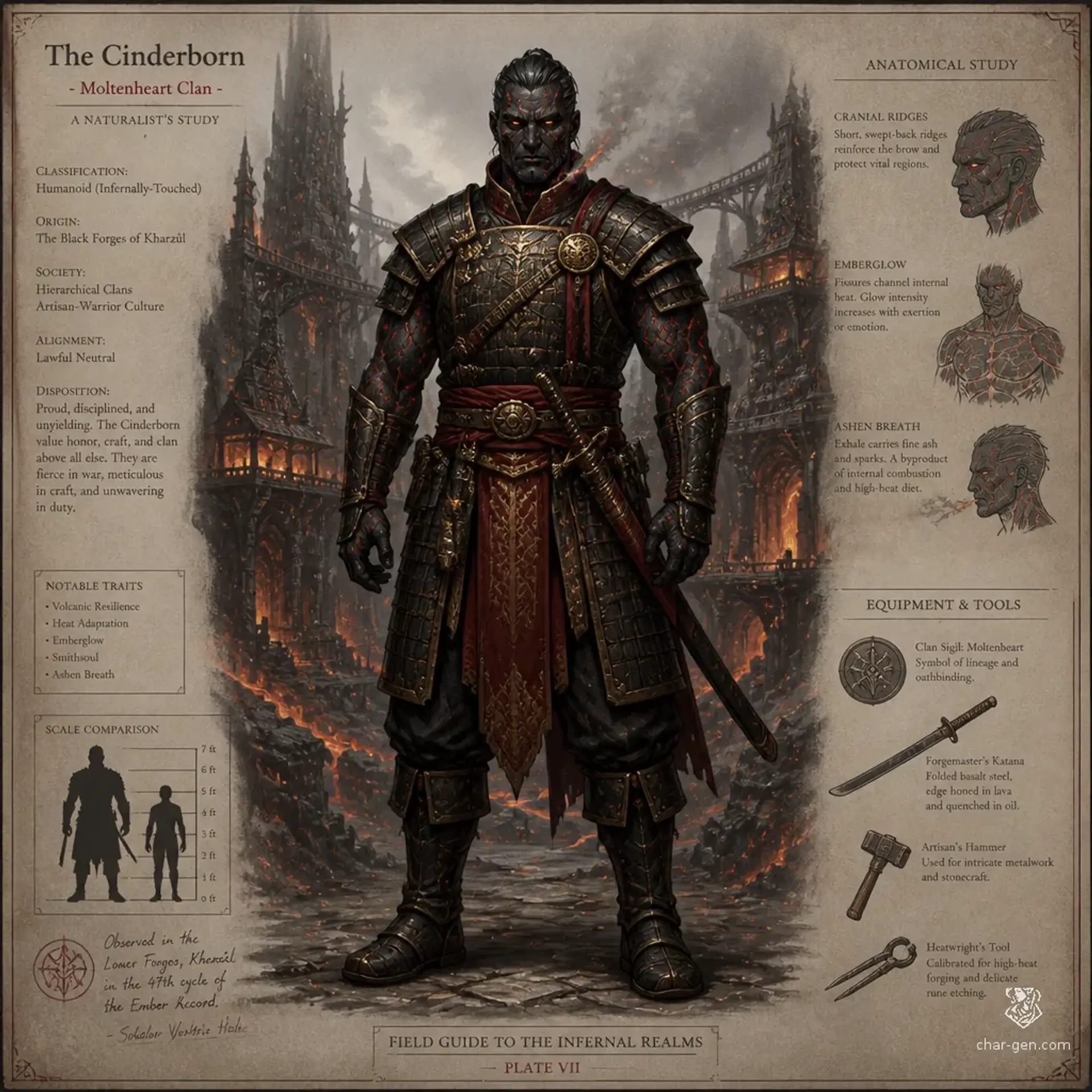
Pyrocaris infernalis
Born beneath the iron skies of Inferna, the cinderborn are tall, battle-minded cityfolk whose charcoal skin glows with the fire beneath it.
At a glance
Darkvision 60 ft.
Languages Common, Infernal
Resistances Fire
Height 6 ft. 2 in. to 7 ft. 2 in.
Weight 180 to 300 lb.
Lifespan 90 to 120 years, adult at 18
At the table
You can ignite or extinguish a small flame within reach as a minor act of will. This produces no meaningful heat beyond that of a candle, cannot damage creatures or objects, and is primarily useful for lighting, signaling, or ceremonial displays.
Your body is adapted to infernal heat. You have resistance to fire damage, and ordinary environmental heat does not trouble you unless it is extreme enough to harm other creatures.
You have proficiency with one martial weapon of your choice and one artisan's tool of your choice. Cinderborn training is as likely to produce a skilled armorer or mason as it is a soldier.
When you make a Charisma check to uphold a promise, command a disciplined group, or negotiate from a position of clearly demonstrated strength, you may add your proficiency bonus if you are not already proficient. Once you use this benefit, you cannot use it again until you finish a long rest.
You can cast the thaumaturgy cantrip. Constitution is your spellcasting ability for it. When you reach 3rd level, you can cast hellish rebuke once without expending a spell slot, using Constitution as your spellcasting ability. You regain the ability to do so when you finish a long rest.
Common, Infernal
Fire
Cinderborn tend toward Constitution and Strength, reflecting bodies hardened by infernal heat and a culture built around martial discipline. For a 2014 D&D character, assign ability score increases according to the character's history and concept rather than ancestry alone.
Their fissures glow bright orange or white, and their bodies radiate a steady furnace heat.
Forgeguard cinderborn descend from labor clans and siege engineers. They are famed for endurance, practical craft, and the ability to remain calm amid fire, noise, and collapsing structures. Their communities often control foundries, construction guilds, and military supply lines.
Born beneath the iron skies of Inferna, the cinderborn are tall, battle-minded cityfolk whose charcoal skin glows with the fire beneath it. They inherit no simple curse and seek no easy absolution. To a cinderborn, every life is a campaign, every promise a fortress wall, and every city worth defending. They may arrive in the mortal world as mercenaries, exiles, diplomats, deserters, or pilgrims, carrying the heat of the Hells in their blood and a dangerous question in their heart: what is strength for, if not to choose one's own cause?
Cinderborn are tall, broad-shouldered humanoids with dark skin ranging from smoked brown to charcoal black.
Fine red fissures cross their faces, necks, arms, and torso like cracks in cooling volcanic glass, glowing brighter with emotion, exertion, or anger. Their eyes resemble banked coals, most often burning red, orange, or gold. Hair is usually black, deep crimson, or ash-gray, and some cinderborn grow short horn-like ridges along the brow, cheekbones, or jaw. Their bodies are warm to the touch, and faint sparks sometimes escape from their breath in cold air. Though intimidating in appearance, they are not inherently monstrous, and many take great pride in elaborate uniforms, polished armor, and carefully maintained insignia.
Urban
Cinderborn children are raised communally in household-clans and are taught basic weapon safety, civic duty, and the history of old campaigns.
Young cinderborn enter apprenticeships, military companies, guild houses, or temple service. Their first public oath marks their passage into adult society.
Mature cinderborn are expected to serve as soldiers, officers, artisans, magistrates, or guardians of clan honor. Their cracks glow more steadily with age.
Elders become living archives. Many withdraw from active warfare, though their counsel remains politically potent and their names are carved into public monuments.
The cinderborn are a warrior race, but warfare is only one expression of their civic identity.
Every cinderborn belongs to a household-clan, a web of relatives, sworn companions, apprentices, and political allies. Children learn that personal glory matters less than the reputation carried by the clan name. Military companies, forge guilds, courier houses, and civic watch orders all compete for influence in the dense cities of Inferna. Duels are legal in many districts, though they are usually formalized as contests of skill rather than fights to the death. Cinderborn society prizes public service, visible achievement, and the careful recording of promises. Those who fail an oath may be marked with cold iron rings or exiled from the city until they earn restoration.
Cinderborn religion centers on the First Flame, an impersonal sacred fire said to represent will, memory, and consequence.
Temples function as shrines, barracks, courts, and archives, with priests preserving oaths in heated metal tablets. Some cinderborn venerate ancient generals, forge saints, or personified virtues such as Defiance and Mercy. Their culture favors lawful behavior and disciplined institutions, but individual cinderborn range from compassionate guardians to ruthless tyrants. Good-aligned cinderborn often define honor as protection of the vulnerable, while evil-aligned members treat hierarchy as proof that the strong deserve command.
Cinderborn respect competence, courage, and reliable service, but their reputation for harshness often precedes them.
They maintain intricate relationships with infernal powers, city guilds, mercenary companies, and mortal communities that fear their appearance while depending on their labor. Among themselves, cinderborn distinguish sharply between honorable rivals and oathless enemies. They may admire dwarven craftsmanship, distrust aristocratic elf-like courts, and feel an uneasy kinship with other peoples shaped by supernatural forces. Cinderborn who reject infernal society are not necessarily gentle. Many remain intensely protective, ambitious, and suspicious, simply directing those qualities toward chosen companions rather than inherited masters.
Cinderborn cities rise from black basalt, iron, and heat-scarred brick.
Streets are arranged around parade courts, public forges, oath-halls, and monumental stairways broad enough for marching companies. Buildings commonly include sealed inner courtyards, reinforced doors, elevated walkways, and channels that carry controlled magma beneath the pavement. In mortal settlements, cinderborn neighborhoods often become fortified trade districts, with workshops on the ground floor and clan halls above.
No images yet.
A high-res, share-ready sheet you can post or print.
